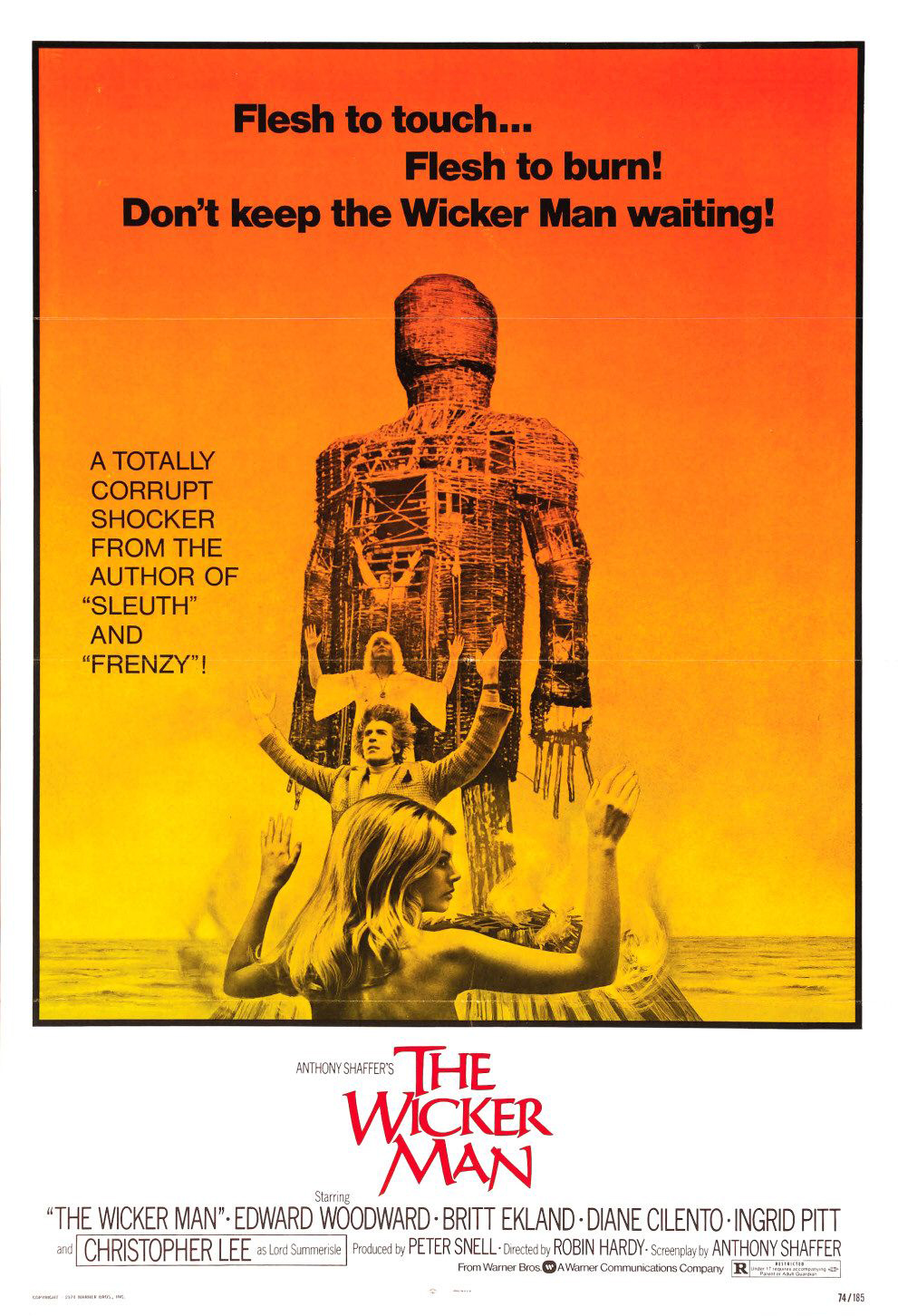
 There are few films that have amassed quite as intense a following as The Wicker Man, the darkly comical horror by debut director Robin Hardy, who instantly forged a path for himself as someone of great significance in the canon of horror history, even if this film was his only notable work. A gloriously dark and delightfully twisted piece about the intersections between faith and society, and executed with such precise detail and dedicated conviction to a broader set of themes, The Wicker Man is a marvel of horror filmmaking, something that established the roots of the sub-genre known as folk horror (which sadly doesn’t have nearly enough films contained within it, which is unfortunate considering how wonderful these stories tend to be), and influenced independent horror for decades to come, showing that a film could be disturbing without being violent, and find frights through suspense, implication and mystery, rather than anything overtly shown on screen. It is a rare accomplishment for a horror film to actually appear fresh and entirely original even by today’s standards, and it is astonishing that Hardy made a film that not only successful integrates a panoply of different ideas into a small but impactful format that feels refreshingly unique and entirely singular in its particular vision towards a set of ideas that converge into a profoundly brilliant but terrifying glimpse at the world and the secrets underlying it.
The Wicker Man starts like any rural horror film, whereby a seaplane flies over the beautiful islands off the coast of Scotland, piloted by a middle-aged virgin police officer who is defined by his intuition, his tenacity and inability to take no for an answer. In this case, it is Sergeant Howie (Edward Woodward), a dedicated police officer sent to Summersisle, a small island that rarely gets any visitors – so few, in fact, that the only way to access the island is by a small dinghy (and only after a heated argument with a particularly hesitant shoreman, who needs a full thesis justifying precisely what business one has on the island). Howie is there to investigate the disappearance of a young girl named Rowan Morrison based on an anonymous letter that claims she hasn’t been seen in months. There is something very strange about the community of Summersisle – considering they are so hesitant to accept visitors, they are remarkably welcoming to Howie, who does not face the hostility that would be suggested by their secrecy. However, it soon becomes clear that there is something amiss on the island, with our protagonist finding himself privy to a host of strange rituals and unconventional traditions, all of which point to the enigmatic Lord Summersisle (Christopher Lee), the cheerful magistrate who presides over the island with a blend of congeniality and iron-fisted wisdom. Slowly but surely, Sergeant Howie starts to realize what a mistake this work outing actually was.
No one can ever know what to expect with The Wicker Man, despite the fact that it is heavily ingrained in horror culture, and film history by extent. Yet, there’s something about it that remains entirely mysterious until you actually experience it. Hardy made that film that is sinister, grotesque and altogether just brilliant in every conceivable way. It is inherently a defiant film, not only in terms of the story it tells but also in the way it explores different themes with a certain controlled recklessness that would’ve been far impressive had Hardy opted for something a lot more straightforward. The film isn’t ever afraid to deflect into complete narrative anarchy, even going so far as to imbue the story with a sense of heightened surrealism that feels almost jarring, but works alongside the very sinister story. Don’t mistake this for criticism – I absolutely adored The Wicker Man, and the majority of that had to do with the execution: when confronted by something with the potential to be very serious and dour, Hardy chose to go a different avenue, creating something entirely different from what we’d expect from a story like this (and something that many of the films supposedly inspired by it conveniently forget about), and making great use of a subversive sense of humour and a relentless sense of cinematic lawlessness.
In having a conversation on The Wicker Man, we obviously need to talk about two performances that form the core of the film, not necessarily individually but rather how they stand alongside each other. Other than the imagery (which effectively creates an indelible impression into the mind of every viewer), what is most remembered about this film are the performances, particularly those by Edward Woodward and Christopher Lee. The former anchors the film, playing the devout and moral police officer who takes it upon himself to go and investigate a potential disappearance (the fact that he went by himself is never explained) and falling into a sinister conspiracy that thrusts him into the centre of a complicated world that borders on the unholy. This is contrasted significantly by Lee, who is giving the very definition of high camp in his role as the ominous Lord Summersisle and is clearly relishing in the chance to play a character very different to what he had been known for. There is one point in this film where his character even dresses as a woman and frolics through the countryside, and despite being extremely amusing, it doesn’t detract from the broader themes or narrative flow, rather supplementing it beautifully. Lee was vocal that this was his favourite film to work on, and it does show, as his performance is one of his very best – offbeat, eccentric and menacing to a fault, it is rare for a director to have been able to put a saddle on Lee for long enough to the point where, despite the fact that he only appears in a handful of scenes, he is the best part of the film.
Thus, the most unexpected part of The Wicker Man, and the quality I would never have guessed would be found in it, is that this is a very dark comedy, containing a very specific sense of humour that doesn’t invalidate the terror, but rather supplements it in a very unique way. There are moments where this film descends into complete absurdism, becoming so oddly endearing, it is almost bewildering to experience. All credit must go to Hardy and Shaffer, who had the gall to make a horror film that wasn’t only just intense and terrifying, but also outright hilarious in many different instances – and the humour is not a byproduct, nor is it there to break the tension. It is an effective method of demonstrating the heightened insanity governing the film, and highlights the horror by adding to the suspense, as the audience never knows where precisely the Hardy is leading us – and even in its moments of ludicrous humour, there is an underlying malice that is almost overbearing, simply because there doesn’t seem to be any traditional rhyme or reason to whatever is happening on screen. This is an inherently playful film, opting for a very strange but effective approach to portraying the central themes, and it provokes the question as to why more horror films at the time didn’t take this kind of subversive approach – some of the Vincent Price films from the era certainly did, but considering The Wicker Man came about at the tail-end of the era when Hammer House of Horror dominated mainstream terror, it almost feels as if The Wicker Man is a response to the more lurid, excessive style that would often become unintentionally hilarious through the blend of gauche camp and melodramatic storytelling – it is unsurprising that Lee jumped on the opportunity to make this film, that challenges horror without being a derisive parody. It is subtle, but there is certainly some meta-commentary hiding somewhere in this film, and it is all the more enriching because of it.
Beneath everything, The Wicker Man may be a very surreal and oddly hilarious film, but that doesn’t detract from the fact that it is still a very dark horror film, and one that goes a completely different direction, deviating from the well-worn path set out be previous horror films. At the core is a complex story about faith and the conflict different religions. Unlike other films on the subject that shows tradition and modernity clashing, The Wicker Man looks at archaic beliefs and how they are seemingly incompatible – Paganism, depending on the historical account you align yourself with, came about concurrently with Christianity, if not even predating it, which makes this film’s central storyline, whereby a devoutly Christian man finds his faith tested, not by anything other than religion itself, albeit a very different one. This is where Hardy finds the most poignant horror, in the moments where Howie has to rely on his faith, which had previously been his salvation and comfort, only to find himself the victim of another religion. At the end of the film, Howie is burned alive as part of the ritual sacrifice by the Summersisle residents, and prayers to be saved, before realizing that he is only a pawn in the religious beliefs of another group, and surrenders himself to his faith, holding onto it until the very last moment. The religious themes here are omnipotent but not heavy-handed, with Hardy and Shaffer making tremendous use of the nature of belief to comment on religion as a whole, where different faiths come into conflict. Of course, I can’t provide an eloquent breakdown of each and every religious allegory and the subtle implications that are neatly scattered throughout the film, but a deeper reading of The Wicker Man shows how it is a lot more profound than just an ordinary horror film.
The Wicker Man is certainly an unsettling film but in the best way possible. It is very unique and original in every sense (which is strange, considering how this film is built from archaic religious mythology), and is fully committed to its strange premise. It is a brilliant piece of folk art, a hilarious but terrifying exploration of belief and traditions that never wavers from its deep and meaningful quests to uncover the core of religion in a way that is never heavyhanded. Whether it be in the wonderful Edward Woodward and his exceptional ability to command the screen despite playing a relatively vapid character (by design – Howie was supposed to represent good, earnest faith), or the gloriously fun work by Christopher Lee, who has never been better than he is here, or in the numerous moments of unhinged genius to be found frequently throughout the film, The Wicker Man is unforgettable – well-written, directed with a certain simplicity, whereby the thematic underpinnings are emphasized without resorting to exposition and ultimately an effective horror film that has a simple premise and a brilliant execution where quality is never sacrificed – pun obviously intended.
 The Postmodern Pelican