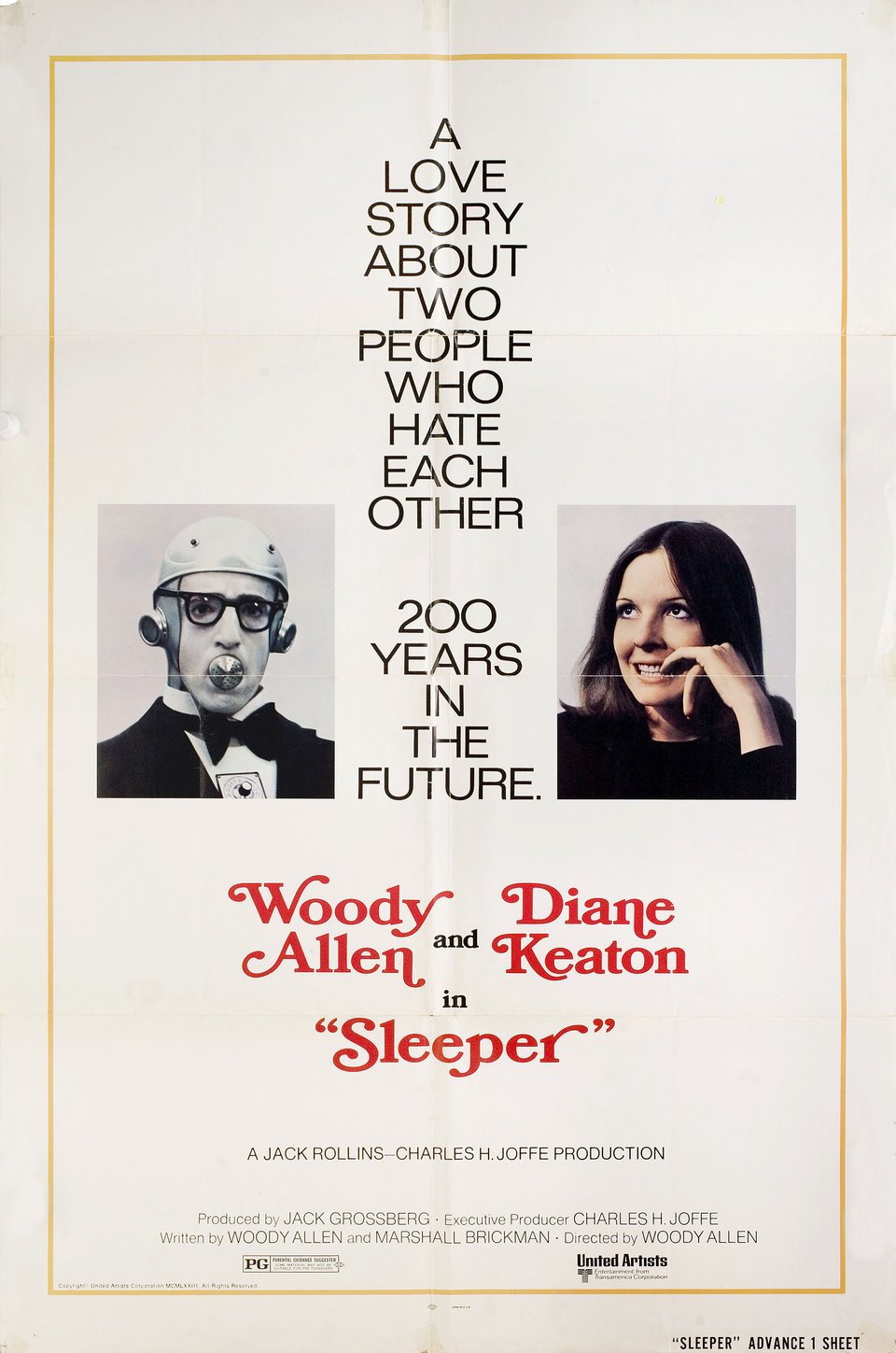
 Miles Monroe (Woody Allen) goes into the hospital for a routine operation, which turns out to not be a success. However, instead of dying, he is cryogenically frozen and is woken up in the year 2173, two centuries later. Not only does he have to overcome the shock of being thrust into the future so unexpectedly, he also soon learns that he is a fugitive by the totalitarian authorities, who consider him to be some extraterrestrial being created by a group of resistance fighters who are against the rule of the mysterious Our Leader, the dictator who rules over Earth and demands complete order. Along the way, he meets bourgeoisie poet Luna (Diane Keaton), who is initially hesitant to befriend the ancient stranger, but soon learns that he is actually on the correct side of the social divide, with the pair of them joining with the underground militants looking to overthrow the state and start their own political system that is more suited to the needs of the people, rather than the interests of one enigmatic leader, who turns out may nor may not have been reduced to nothing but a nose through some fatal accident.
Woody Allen hasn’t made a great film in nearly a decade – he certainly has made some good ones, but none of them can come close to what he was doing in the earlier days of his career, where he managed to define comedy in a way that most subsequent directors have often unknowingly sampled from. Allen, when he hit the right notes, could not be beaten, and Sleeper is a work of unmitigated genius, a hilarious and irreverent science-fiction comedy that confirms that comedy in the 1970s belonged to Allen and his unconventional ability to take absolutely any subject and turn it into a work of absolute brilliance. It may seem to be high praise – but anyone who has experienced one of the director’s many masterpieces from earlier in his career, before melancholy and nostalgia took over in later years, will know how unforgettable and fresh his work was. Sleeper is one of Allen’s funniest films (I’d hesitate to call it his best comedy – Love and Death will always hold onto that title when it comes to broad humour), and certainly one of his most audacious works.
Like with all of Allen’s films, especially his broad early comedies, Sleeper can be broken down into several components, each one of them demonstrating the director playfully approaching several subjects, both artistically and socially, and infusing them with his trademark charming insubordination. The broadest theme employed as the framing device for this film is that of science fiction – Sleeper occurred during the apex of science fiction cinema, where its arrival was between the groundbreaking 2001: A Space Odyssey and Solaris and just before Star Wars and Close Encounters of the Third Kind. Allen was clearly heavily inspired by the concerted effort by various filmmakers to push the boundaries, not only of technical filmmaking but also narratives, by crafting his own tale of speculative fiction, all through his own unique style. Futuristic films, especially those from this era, are always particularly entertaining, because they propose ideas of what the future will look like, and as we have seen from various works that situate themselves in periods we’ve already gone through, they’re rarely ever all that accurate, which makes for enjoyable viewing, if only because of the joy of pointing out where this forward-thinking went wrong. Allen is mocking this tendency through implying certain qualities of the future that are outwardly ludicrous compared to reality – cigarettes being healthy, junk food having restorative properties, and human sexuality now nothing more than a clinical procedure. The future is unpredictable, and Allen seems to be intent on showing that trying to predict it isn’t fruitful but is still a lot of fun anyway.
Sleeper sees Allen at his most ambitious (at the time), being his biggest film, and the one that saw him executing some bigger ideas, which would have certainly been a risk, especially because cinema was only starting to enter into the period of special effects and more future-inspired storylines that had the technology to go alongside it. What is most interesting about Sleeper is that despite being an excellent science fiction film, it isn’t ever trying to be like other works of speculative fiction. It may be set in the future, and constantly features complex ideas and advanced gadgets, but this doesn’t feel like a film that is necessarily forward-thinking and often appears to be nothing more than an attempt to assimilate old conventions into a new format. Allen commented that Sleeper was borne out of his desire to make a film that paid homage to some of his comedic heroes, such as Bob Hope and the Marx Brothers, and the film often feels very much like something they would have made years before, only from a futuristic standpoint. This is one of the qualities I admire the most about Allen as a filmmaker – no matter the subject matter, he was always incapable of sticking to conventions, always choosing to go his own way with whatever material he chose to take on. Seamlessly blending broad physical comedy with more subversive, subtle humour, Sleeper is a masterful juggling-act of comedic diversity and proves Allen as one of the genre’s true maestros. It’s the precise element that makes his earlier comedies so worthwhile, as they are all unabashedly works of Allen’s boundless creativity.
Moreover, Sleeper has all the qualities that we love when it comes to classic Woody Allen. It has a terrific leading performance by the director himself, playing one of his many neurotic, semi-autobiographical schmucks (has there ever been an actor with such limited range who was consistently so good at the same time?), this time transporting the archetype to the twenty-third century. Diane Keaton reunites with the director for their second cinematic collaboration, and considering Keaton had just come from shooting The Godfather, he ability to effortlessly slide into a far less serious role, where she could not be further from Kay Adams, is remarkable, and proof that she is one of the best actresses of her generation. It would be a few years until Allen finally gave her the role that would see her making great use of everything in her arsenal, but even in these earlier collaborations, Keaton shows a keen sense of comedic timing that is only supported by her dedication as an actress – she understands the absurdity of the story, but never lets her performance falter just because this isn’t a very serious film. Ditzy but not without substance, her portrayal of Luna, the scatterbrained socialite, is a lot of fun, and works extremely well with what Allen was trying to do. The chemistry between the two leads was also palpable, and their comic energy resonates off the other with wonderful ferocity and genuine sincerity.
Sleeper is an iconic film for a reason – it represents Allen at his most sardonic, giving a hilariously irreverent take on the future in the way only he could. It is an outrageously funny comedy that never deviates from its central premise of organized chaos, and whether in the audacious sight-gags, or the underlying socio-political commentary (which is explored well enough, but isn’t omnipotent to the point where it becomes overbearing), it is a well-constructed, ambitious film that serves as a worthy addition to the canons of both comedy and science fiction cinema. Easygoing and entirely captivating, Sleeper is a potent reminder that Allen has not always been defined by more innocuous subject matter as we have seen in recent years, but has been capable of subversive brilliance that challenges genre and conventions perfectly. A sense of humour and a brilliant execution are more than enough to make for a comedic classic, and Sleeper, while not necessarily his best film, is still indicative of Allen on top form, and one of the many reasons why he is a director more than deserving of all the acclaim he’s amassed over the decades. Witty, filled to the brim with memorable one-liners and put together with deft precision, it isn’t difficult to see precisely why Sleeper is the comic masterwork it is seen as today.
 The Postmodern Pelican