 A few years ago, I went through a period of intense interest in the work of Diane Arbus, captivated by her ability to capture reality in a way that was most beautiful but grotesque, simple but layered with meaning, all portrayed through the most gorgeous photographs I’d ever seen, which spoke to me unlike anything I had ever experienced. She once famously stated that “a photograph is a secret about a secret. The more it tells you, the less you know” – and this contradiction forms the basis for today’s discussion, that of Ray & Liz, the debut directorial effort from Richard Billingham, a photographer whose work bears striking similarity to Arbus’ iconic images, and whose intentions in capturing his subjects were eerily comparable, if not incredibly moving in the grim portrayal of reality. Contradictions form the core of this film in many different ways – in terms of the story, the visuals and the underlying emotions, Billingham is taking us on a journey into the past, where we become present in his often macabre explorations of the secrets he has harboured for years, told through the perspective of the titular characters that are amongst the most unlikeable characters in modern cinema, yet ones we cannot help being morbidly fascinated by. It goes without saying that Ray & Liz is one of the year’s most daring films, a strange and often dark tale of human desperation and debauchery, and one innundated by a certain unsettling humour that works more to provoke discomfort than incite laughter, and reveal the dark underpinnings of the human condition. Ray & Liz is a film that is understandably quite obscure, mainly because this is not the kind of film that necessarily lends itself to a wide audience seeking out seem entertainment – it is a challenging, twisted visual memoir that is just about as controversial as the work of those who inspired it, and as meaningful as many of the great coming-of-age autobiographies, and just as effective.
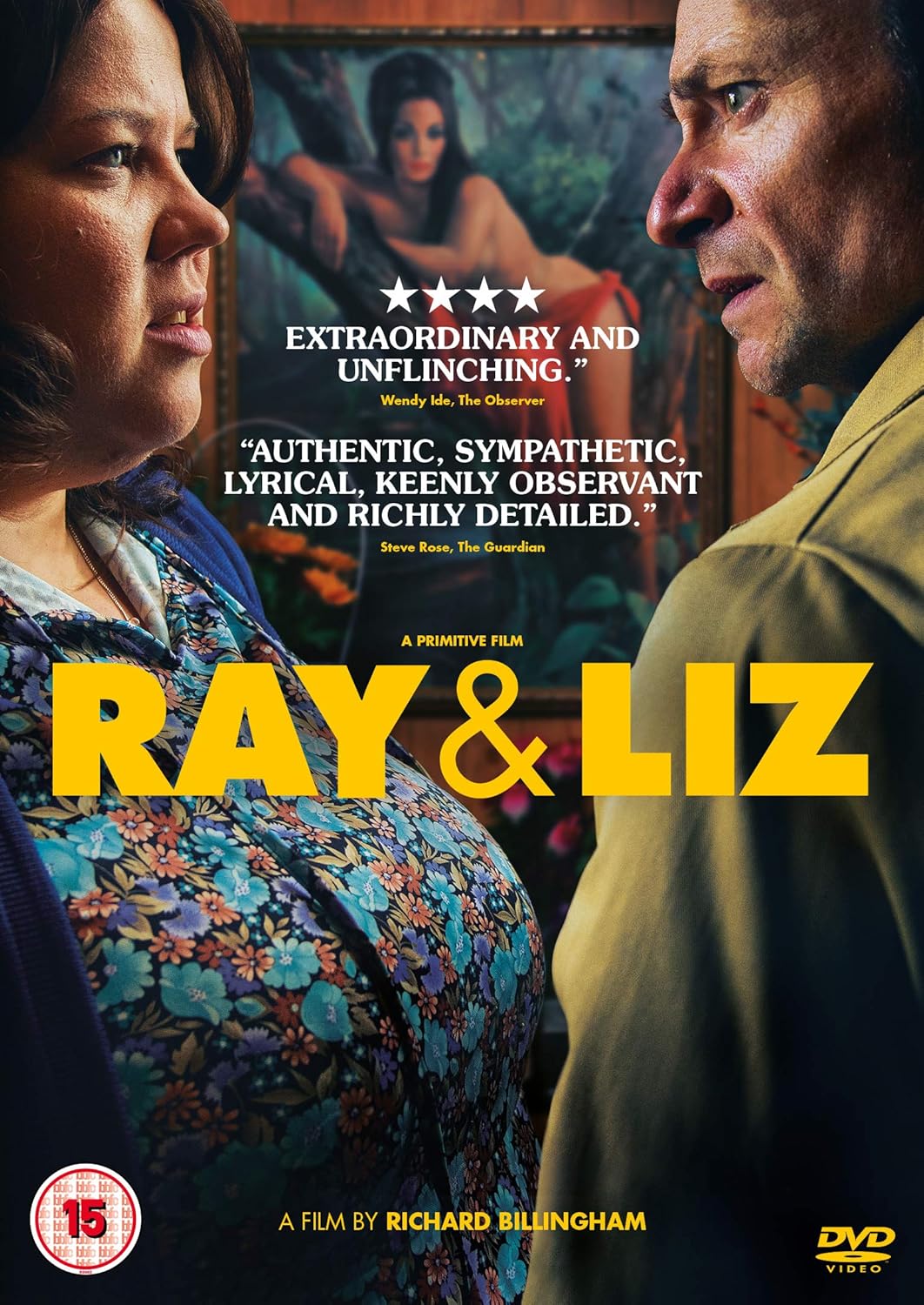
Ray & Liz is set during the peak of the Thatcher era and focuses on the titular characters and their daily lives. Ray (Justin Salinger in the past, Patrick Romer in the present) and his wife, Liz (Ella Smith in the past, Deidre Kelly in the present) are both unemployed and living with their three children on a council estate in Birmingham, raising their family in a squalid flat that is falling apart due to neglect. Neither of the two parents intends to seek out work, especially because the benefits they receive from the government is enough to provide them with the essentials – namely junk food, cigarettes and copious amounts of booze, which seems to be their only motivation to get up in the morning. In between fiery arguments and drunken stupors that characterize their marriage, Ray and Liz find the time to try and raise their children to the best of their abilities (but without much effort), with their older son, Richard (Sam Plant) being a very quiet and almost sinister boy and their younger son, Jason (Joshua Millard-Lloyd) suffering the most due to being the most neglected. The centrepiece of the film sees Jason trying to escape from the poor quality of life he is starting to realize he has been forced to endure, and slowly but surely makes an effort to rid himself of the despair wrought by his neglectful parents and an extended family that seems entirely apathetic to the plight of a boy growing up without any direction, a product of parents who disregard the wellbeing of their children, with their only motivation for keeping them being that they receive benefits based on the number of dependents that they have. Escape, as Jason soon learns, is not particularly easy, but also not impossible, and he does his best to try and break the cycle of despair and poverty, even if that means actively seeking out a better way of life. A heartwrenching social drama, Ray & Liz is composed of fragments of a set of fractured lives, with each person being on their own personal journey, often distracting from their unfortunate economic situation in their own way, sometimes compensating through vices or addictions of some form, which only temporarily shield them from the harsh realities that face people in their position.
A searing portrait of the working class, Ray & Liz is a film made as a product of a range of emotions, which the director explores through a very unconventional representation of a world he grew up in. Billingham is an artist who incites quite a bit of interest in terms of contemporary photography, and as anyone who has ever seen some of his work will know, he manages to provoke certain emotions and sensations that are otherwise rarely found in even the most troubling of pieces, which serves to be one of his most significant merits as an artist, as he understands the impact a powerful piece can have on one’s perspective. His art is uncomfortable and causes the most visceral of reactions, which he does through representing reality without any embellishment or exaggeration. His first foray into filmmaking obviously carries the same qualities with it, and quite brilliantly captures the same working-class malaise that his photographs tended to, without losing any of the disturbing imagery or haunting discomfort, or the intimate agony that his work has always carried. Ray & Liz is a nihilistic blend of anger and sorrow, put together to create a disconcerting portrait of a family suffering under a system built against people like them – it is about as pessimistic and difficult as a film like this can get without resorting to tangible horror, and most certainly an intrepid work of modernist filmmaking from an artist intent on representing his own reality, regardless of how distressing it may be for the audience to be placed in this almost voyeuristic position, watching as a dysfunctional family only continues to disintegrate, making poor choices and ignoring the consequences, which is very different from the more conventional and more moralistic portrayals of troubled childhoods. Unlike many coming-of-age stories, Ray & Liz seems to entirely lack any semblance of hope, replacing it with a sense of uneasy despair and palpable anguish that is upsetting but hauntingly effective.
Richard Billingham is certainly not a conventional artist – in fact, his work is more aligned with the school of outsider art than anything else, and he has built his entire career on his supposed interest in representing the gradual decline of civilization through capturing the most banal and commonplace of situations through stark but beautiful imagery, in which he can derive meaning from the most unexpected of sources, often making significant use of grueling disconnection from reality, and social alienation that many of us deeply fear. Ray & Liz sees him asserting the same style, and assimilating his warped perspective into a quasi-fictional form, as he constructs something very much against what we’d normally consider to be a traditional structure. Despite being constructed and marketed as a coming-of-age film, Ray & Liz doesn’t appear to have any discernible beginning, nor an end and one can even make a point that the most impressive parts of the film occur as the implications between major scenes, rather than being noticeable moments themselves, where the smallest minutiae form the basis of the film and inform its morals. It is built out of two extended vignettes (designed as short films), one taking place in the late 1970s, another in the mid-1980s, and centred around two members of the family – Ray’s brother in the first, Jason in the second, and how they feel like outsiders in the family. They are loosely connected by a series of scenes set in the present, where an ageing and lonely Ray spends his days in the same squalid bedroom, his only companion being alcohol and the occasional visit from a sympathetic friend, which serves as a framing device to the film, and demonstrates the stagnancy of this family. Ray & Liz is not a film that makes much sense in its structure, and it openly defies the conventions of narrative storytelling – but would we expect anything less from someone like Billingham, whose entire career is built out of artistic rebellion? The brilliance in this film is derived from the methods through which Billingham challenges conventions, using the medium not as a means of entertainment, but as a canvas upon which he can paint a portrait of his past by returning to the roots of the psychological pain deeply embedded within his formative years, and where he confronts the bleak isolation he experienced early on, and how being cut off from the rest of the world, and reality by extent, impacted him, as both an adult and an artist.
In lieu of a coherent structure, Ray & Liz is quite simply a series of moments in the life of a family, as Billingham ventures into his childhood in an effort to represent his uncomfortable upbringing. Memory is the primary resource for this film – the director has spoken at length about how he was informed to create this film solely from what he remembers from his past, where he tries to replicate his formative moments. More observational than narrative, Billingham’s film is showing us that nothing can or will change and that he is far more focused on recording it and revisiting his memories, hoping to find some meaning in the hazy madness of his bleak childhood. It isn’t clear why he intended to make such a film – the most likely answer is that, much like his photographs, Billingham was working through the aftershocks of a traumatic childhood – and interestingly enough, while he is a character in the film, he is never the focus, serving to be a minor character that is always present, but only as an observer, hardly ever as the catalyst for the events depicted, and speaking less than a dozen times. It almost appears as if Billingham is not making Ray & Liz only to represent his childhood to audiences who may be interested in this kind of work, but as a way of visiting his own past and working through those difficult emotions, trying to come to terms with the tragic imperfections that formed him into the artist he is today. Memory is not an underutilized narrative technique, and Billingham seems to understand the resonance pure and explicit honesty can have in the reception of a film – Ray & Liz is harrowing, but still a rich and evocative experience, solely due to the director’s willingness to portray his childhood as he remembers it.
Ray & Liz is a film about a very different kind of autobiographical nostalgia, one that is uncomfortable and without an iota of sentimentality, with the director refusing to resort to the same saccharine manipulation that normally serves as the basis for autobiographical works. Billingham’s camera has always been focused on capturing the awkward, the uncomfortable and the unconventionally gorgeous, which he does so with such conviction, it is difficult to not be moved by this incredible piece. He has given us a candid snapshot of a family slowly deteriorating through the forces of poverty and addiction. The film never tries to force us to feel unnecessary sympathy for what we are seeing – Billingham presents his family, including himself, exactly how he remembers them, and resists the temptation to give the titular characters any redemption, rather portraying them exactly how his memory recalls them to be. Bellingham and his family suffered during the Thatcher era, and the director is careful to avoid blaming them for their situation, but also not representing them as victims. His upbringing and the plight of his family was tragic and certainly is difficult to watch, but Bellingham is not looking for pity, making it clear throughout the film that he is not seeking out the sympathy of the audience. Rather, he endeavours to make a daring and controversial film that comments on the monotony of working-class life, and the trials and tribulations of poverty, giving the audience harrowing insights into his experiences. It is a deeply powerful film, one that goes against the grain and presents us with something audacious, horrifying and utterly brilliant.
 The Postmodern Pelican