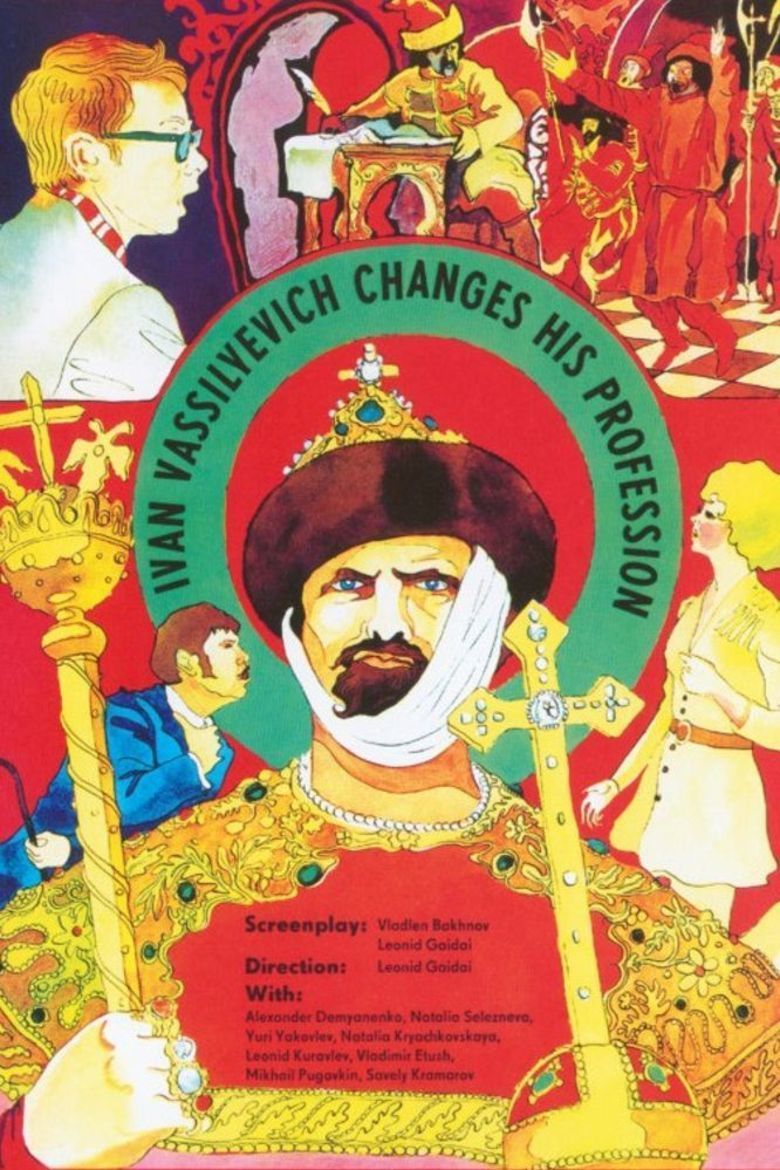
 Somewhere in a modern Russian metropolis stands a large apartment building, just like any other. Inside there are two occupants that we are very interested in, and who form the core of the story. The first is Aleksandr ‘Shurik’ Timofeev (Aleksandr Demyanenko), a meek but brilliant inventor who works on a variety of scientific projects, much to the chagrin of his wife (Natalya Seleznyova) and the other residents of the building. The other character at the centre of the story is Ivan Vasilievich Bunsha (Yury Yakovlev), the intimidating superintendent who does his best to maintain law and order in the building, even going so far as to confront those who don’t abide by the clear rules he sets out. Shurik has secretly been working on perhaps the most coveted scientific discovery of all time: time travel. Somehow, he succeeds in being able to traverse space and time – but by doing so, he accidentally finds himself in quite a difficult situation, as he unintentionally sends his vicious superintendent (and a burglar caught in the building) back to the Medieval era, as well as bringing to the present none other than Ivan the Terrible (also played by Yury Yakovlev), who is robbed of his power and reputation through finding himself in a time when this kind of vicious dictator was not much use to Russian society. With the two sets of time-travellers stuck in the wrong periods, they prove to be hopelessly incompetent at navigating the specific era’s perilous situations and social traditions, and they need to just hold the threats at bay long enough to allow Shurik to bring them back to the future, or send them forward to the past, where they belong and won’t cause too much unintentional havoc.
Russian comedy: two words that rarely ever find themselves appearing together. Yet, like any rarity, it often indicates some sort of hidden treasure, an exception to commonly known conventions, and a subversion of expectations. Ivan Vasilievich Changes Profession (Russian: Иван Васильевич меняет профессию), also known as Ivan Vasilievich: Back to the Future is a film that can legitimately make a case for one of the most hilarious pieces of fiction ever produced. An outrageously funny dark comedy that blends so many different ideas in a way that is not only seamless, but entirely effective and cohesive, and its general sense of humour towards a subject that does not inspire a great man laughs, it is something that lingers with the viewer, who will undoubtedly be quite thrilled with the riotous execution of this very strange film that has numerous layers, and approaches a story that is hardly ever given this amount of attention, especially in regards to the small details and idiosyncrasies that are often absent from more notable comedies. An absurdist masterpiece if there ever was one, this film (which proposes itself at the outset as being not necessarily science fiction, far from realistic and certainly not anything close to historically-accurate) makes a mockery out of society in the best way possible, and whether operating as a masterful piece of Soviet-era catharsis, or as a wonderful time-capsule of the artistic period in which it was made, or just an entertaining comedy, Ivan Vasilievich Changes Profession is astoundingly brilliant, and a film that never fails to leave the audience in stitches.
Ivan Vasilievich Changes Profession succeeds in many ways, but it is most known for being the greatest Russian comedy film ever made (which is apparently held to be an incorruptible fact in the film’s native country, where it remains one of the most beloved pieces of Russian cinema ever produced). Yet, it never feels entirely impenetrable or foreign to the wider audience, as it contains a great deal of recognizable humour that is almost universally-resonant. There are so many different levels of comedy that go towards constructing Ivan Vasilievich Changes Profession as a relatively traditional comedy – amongst the many situations the characters find themselves in include awkward encounters with one another, misunderstanding and cases of mistaken identity, and an abundance of the most refreshingly unique slapstick comedy, which never causes the audience to grow weary of what we’re seeing, always being dynamic and enthralling. It is a relatively simple comedy, but one that doesn’t miss the opportunity to comment on socio-cultural issues as well, as while some of the references and jokes may not be understood by contemporary and non-native viewers (especially in terms of the language use, which apparently harbours a great deal of effectiveness for those who understand the language), Ivan Vasilievich Changes Profession still manages to be highly effective in its own unique way.
Ivan Vasilievich Changes Profession is a very funny film, but its clearly not one made just for the sake of the laughter, nor for the acclaim or fortune that comes with a successful film – in fact, the extreme success this film enjoyed at the time of the release, despite being relatively small and adherent to a story that is otherwise quite niche speaks to a deeper cultural issue. Is it surprising that some of the most outrageous and daring comedies were produced in the Soviet Union between the 1950s and 1970s? It was an era of turmoil, hardship and suffering, and not one that is normally associated with upbeat humour. There’s a certain quality to Ivan Vasilievich Changes Profession that implies that this is a film made not only to entertain but also to distract and provide some sort of hope to the audiences who went to see it at the time. It gave viewers a chance to actually laugh without hesitation and to find the humour in a story that didn’t intend to offend or divide, which was obviously not necessarily easy in a period of intense social, political and economic upheaval. This is perhaps the reason why this film is so highly revered today, because it breaks down the general qualities of life in the Soviet Union to a set of core principles, mocking them in a way that was never offensive, but rather lighthearted and endearing, and doesn’t take itself all that seriously.
It is the immense heart that makes Ivan Vasilievich Changes Profession such a charming film, and keeps it fresh and entertaining throughout. The way in which Leonid Gaidai (who is widely considered to be the most influential Soviety comedy director of all time) constructed this film to be a comedy operating on many different levels was nothing short of genius. The brilliance lies in the fact that it was made to be a satire that not only mocked sacred social tenets but also commented on the modern world, which is perhaps why this film resonates even outside of Russia. Despite being made nearly half a century ago, this is a film that still feels very much current and urgent, and the way the present and the past intersect in this film is astoundingly good. The misunderstanding that comes with putting two different sets of characters in radically different periods creates a sensational atmosphere, and it manages to derive humour from the very human tendency to be unable to adapt to unfamiliar surroundings, showing us not only the excess of the past, but the unhinged absurdity of the present, deftly presenting both ideas in tandem, making this one of the most generously human films of its time, because it aims not at a specific group, but at society as a whole, where absolutely no one is safe from lighthearted ridicule.
In finding the past and the present intermingling, Ivan Vasilievich Changes Profession demonstrates a really outrageous but nonetheless fascinating idea – what happens when someone like Ivan the Terrible, who is permanently etched into the history books as the most violent and intimidating of leaders, finds himself plucked out of his medieval reign of terror and placed squarely in the middle of contemporary society, where his warfare skills, knowledge of weaponry and domineering style of governance (if you could dare call it that) are ill-suited for an era dominated by technology that may appear normal to us, but could be nothing short of terrifying for someone who had never encountered it. In this film, the character is repurposed to be almost farcical – he is an unlikable, but rather pathetic leader whose reputation for violence and cruelty just masks someone hopelessly incompetent at being ordinary. This is only worsened by his sudden arrival in the presence, and his modern counterpart (who is equally as despicably pedantic) travelling to the past. To his credit, Yury Yakovlev is fantastic in the dual roles and finds a lot of brilliance in a character that is not necessarily particularly likeable but is shown to be a great creation through the actor’s marvellous performance, crafting a really memorable comic character. Yakovlev is terrific and holds the film together with his very strange but fascinating portrayal of these characters, and whether it calls for him to make use of his intimidating stature and piercing expressions, or to recede into a more submissive persona for the sake of juxtaposing the maniacal Ivan with modern technology, he handles the challenges of this film (which is quite literally a gag a minute) exceptionally well. Leonid Kuravlyov (as the most charming of criminals), Aleksandr Demyanenko (as the stock character of Shurik) and Natalya Seleznyova all have their own standout moments, with the film being composed of a truly wonderful ensemble.
There is a certain limitless imagination that pervades Ivan Vasilievich Changes Profession and makes it so powerful. It is visually and narratively profound and flourishes on its innovative and daring structure. There is something about these Soviet-era comedies that just make them so extraordinary, especially those that tended towards being more speculative and took on subjects that were more suited for the realm of science fiction. It makes them so wonderful, and some of the most audacious comedies I have ever seen have hailed from USSR countries, whereby the compensated for the social situation with outrageous humour and heartful storytelling, which make them so enthralling. Ivan Vasilievich Changes Profession is a great film and the perfect representation of the brilliance embedded within a society that responded to tough times through bold artistry. For a movie featuring a character in the central role named Ivan the Terrible, Ivan Vasilievich Changes Profession is remarkably geat, and could not be further from being along the same lines as its anti-hero’s reputation. A hilarious, fast-paced romp through time and space, this film possesses an energetic core the likes of which are rarely glimpsed with such potency. It is absurdism at its best, and a wonderfully strange piece of speculative fiction that doesn’t take itself too seriously, and even manages to find the time to be wonderfully tender in the middle of the madcap hilarity that bookends this original, audacious piece of brilliant cinematic anarchy.
 The Postmodern Pelican