 I do wish I knew what Sidney Lumet was trying to do with Serpico, but from the looks of it, not even he was entirely sure. Most definitely not a bad film by any means (in fact, it has moments of excellence consistently throughout), but rather one caught between genres and tonal shifts, whereby it struggles to keep itself afloat at some pivotal points, and unfortunately falters under the weight of a story that those involved seem unable to handle. Serpico is a film I like very much, but there is something about it that keeps me from loving it, which is particularly odd, considering how much I adore Lumet, and find him to be one of the most solid directors of his generation, someone who may have had some trouble finding his narrative voice throughout his long career, but made some true masterpieces that may have been dependent on the script and the acting more than his direction, but still features consistently good guidance from a remarkably nuanced filmmaker. Unfortunately, as much as Serpico has many great elements, they don’t quite come together in a very memorable way, and it sometimes diverts into questionable narrative territory, which (taken alongside the fact that the film is about a half-hour too long, and falls apart towards the end) doesn’t let its several great ideas converge and become something that one would come to define Lumet’s subsequent works like Network or Dog Day Afternoon. It doesn’t necessarily amount to a disaster, but it could definitely have been much better, especially considering the prestige of the people involved, and the reputation this film has amassed.
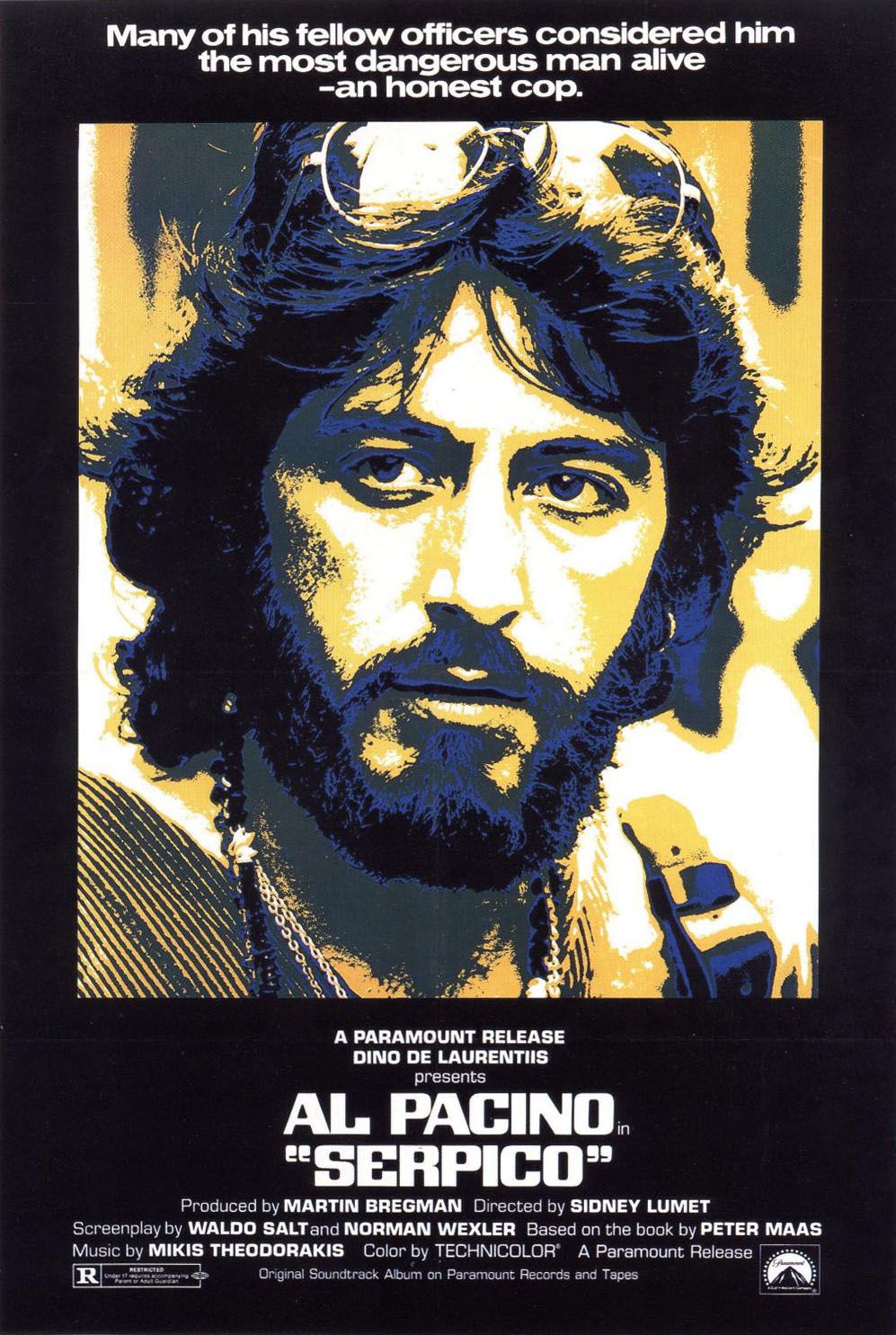
Serpico, on the surface, seems to be fixing to be the exact kind of gritty New York crime thriller produced on a cinematic conveyor belt in the 1970s, where we have a conflicted and morally-ambigious hero who goes to any lengths for the greater good. In this case, we are presented with the true story of Frank Serpico (Al Pacino), the infamous whistleblower that helped expose corruption in the New York Police Department in the 1970s. A man of contradictions, he is vicious and ruthless when it comes to the law, often engaging in violence and borderline illegality, which is excusable through his endeavours to be a good, honest police officer. His desire to bring honour and dignity back to the most respected of professions is the centrepiece of the character, whose entire existence is defined by his moral compass, which obviously puts him on the wrong side of some of his more corrupt colleagues, who begin to grow disgruntled at the presence of a man who refuses to sink to their level of debauchery, and threatens to expose them. Over the course of a few years, Serpico tries and fails to bring to light the corruption within the police force, but with every attempt, he gets closer and close to revealing the truth. In the eyes of Serpico, the police force is not an excuse to look the other way and take advantage or win the trust of ordinary folk, but rather to protect them in what is the most thankless but also most honourable of professions – “protect and serve” is the motto that our hero lives by, and what he wants his colleagues to abide by as well.
Al Pacino is such a great actor, and his streak of films in the 1970s was almost unprecedented – his work during this era was of an impeccable standard, and some of the chances he was given in the early days amounted to a career that any actor would be envious of. Serpico is one of his most famous roles and considered to be the film that made Pacino a leading star (this depends on how you view him in respect to Marlon Brando in The Godfather, as some may argue that Pacino overshadows everyone else in the film). It is also perhaps his strangest role, and the first glimpse audiences had to Pacino’s ability to give an explosively unhinged performance, especially considering nearly every one of his roles leading up to this one had been more subtle and internal. Serpico is a film that I’m not actually sure Pacino was right for, but that is a result of looking at it in retrospect – occurring in between his turns in the two Godfather films, and a reunion with Lumet in Dog Day Afternoon (which can be argued to be his greatest performance), Pacino was certainly used to playing more morally-corrupt individuals, and audiences have definitely grown accustomed to seeing him in these kinds of roles. In Serpico, he’s on the other side of the law, which is not necessarily jarring but doesn’t appear quite right, especially in regards to the fact that he was acting as if he wasn’t playing the paragon of moral virtuosity and dignity.
Pacino is undeniably very good in the film (even if there are far too many moments where it appears as if he is just reciting lines while wearing increasingly ludicrous outfits – the hats in this film are otherworldly), but the problem comes in the fact that no one actually knows quite what to do with him, and despite being a great actor’s director, Lumet struggles to extract a very distinctive performance from Pacino, who seems to be giving a few wildly different versions of the same character, often even in the exact same scene. It wouldn’t be fair to say Pacino was wrong for the role, but rather that he seemed to be giving the right performance in the wrong film. The character never quite develops a particular set of defining characteristics, and he is far more ambigious than he is supposed to be – for those who are not aware of the story of the titular character, Serpico may be a very confusing experience, solely because Pacino is playing the role as if he is on the verge of descending into the debauchery he himself is fighting against. Perhaps this was a deliberate choice – if so, kudos to Lumet and the rest of the creative time in flirting with the idea of constructing a more complex character. The problem is that the performance feels too isolated and different from the rest of the film – its almost as if they were trying to make a darkly comical cop drama, with everyone except Pacino being aware of the fact, and giving the exact kind of dramatic performance he was known for at the time. It is refreshing to see the actor take on a very different character – you couldn’t necessarily call this a more complex role, because he is far from being nearly interesting enough to qualify for such a citation, but it does offer Pacino the opportunity to have some fun with a role – the question is, did he know he was allowed to? While he is still very good, Pacino has shown himself to be far better in numerous other films, and the recognition behind this being one of his definitive performances is bewildering outside of the fact that it was one of his first major leading roles, and a formative moment that would serve to be a gateway to a long career of much better performances.
The main concern with Serpico is that they are given a lot of good material but don’t quite know what to do with it. This was the era of The French Connection and Dirty Harry, gritty crime dramas that position complex leads in tough situations, showing that being a police officer was sometimes about sacrificing morality and putting one’s ethical considerations on hold for just a moment in the pursuit of some broader justice. The problem is, Serpico doesn’t really tend towards being nearly as interesting, and the fact that it was constantly subjected to tonal and narrative shifts in an attempt to get it to fit into the preconceived mould of the previous films with only marginally similar subject matter meant that it sometimes become somewhat mangled and difficult to interpret. This is a story more suited for an elegant and sedate drama, not an exhilarating action film, which this film is often touted as being – perhaps the biggest difference between the story and the film that tried to bring that story to life is that the subject is more about the inner machinations of the police force, where the binary between good and evil is far more ambigious, whereas the films that seemed to inspire this one had relatively simplistic views of heroes and villains. Serpico looks at characters all technically on the right side of the law, which makes for a fascinating experiment in character drama, but not a particularly enthralling crime film, especially not when it is fashioned after the more traditional films in this genre. To his credit, Lumet doesn’t try to make Serpico into anything it isn’t – he doesn’t push the story far enough into the realms of pulpy thriller for it to lose its meaning, which is admirable, but also a fundamental flaw of this film, as it causes it to become absurdly strange at some points, where the exact tone that Lumet was going for remaining ambigious and never quite landing. There are about four different films packaged in Serpico, and none of them actually seem to do the character much justice. Perhaps the immediacy of this film (with the events depicted only occurring as recently as a year before the release) made this more worthwhile back in 1973, where it was relevant and current, which could be a potential explanation why the film is still interesting, but far less riveting, from a modern perspective, as this likely serves as the sole introduction to the life of Frank Serpico for many contemporary, who would have been part of the cultural ether at the time of this film’s release.
To be clear, Serpico is not a bad film. I enjoyed it tremendously. Rather, it is a slightly inconsistent film, one that struggles to find a clear and coherent voice. It might know what it wants to say but doesn’t seem to be able to ascertain precisely how to realize it beyond putting everything out there and hoping something resonates. Pacino is very good, but he really isn’t operating at his full capacity here, delivering a performance with sporadic moments of brilliance, but mostly being a conventional, by-the-numbers performance that we’d expect from this generation of actors, who were rarely ever awful at their peak, but could be severely underwhelming if they aren’t used quite right. I’m not sure where the fault really lies in Serpico – it isn’t a film with clear and consistent flaws, other than some tonal shifts that aren’t as effective as they should be. In fact, one could even argue that this is a film the is often on the precipice of brilliance, but something keeps it at bay, causing the film to narrowly miss the mark regularly. The film does work in its own way, and it effectively conveys the essential message of morality and decency well enough to the point where it is a triumphant and rousing look at the titular character and his efforts to expose corruption. Yet, one can only imagine what a more cohesive approach to the subject, or perhaps a director with a bit more style, could have brought to the life story of a true American hero and his admirable quest to bring honour back to civil service, and which deserved something with much more vigour and passion behind it. Serpico is not awful, nor is it particularly mediocre. It just needed to be a lot better than it actually was.
 The Postmodern Pelican