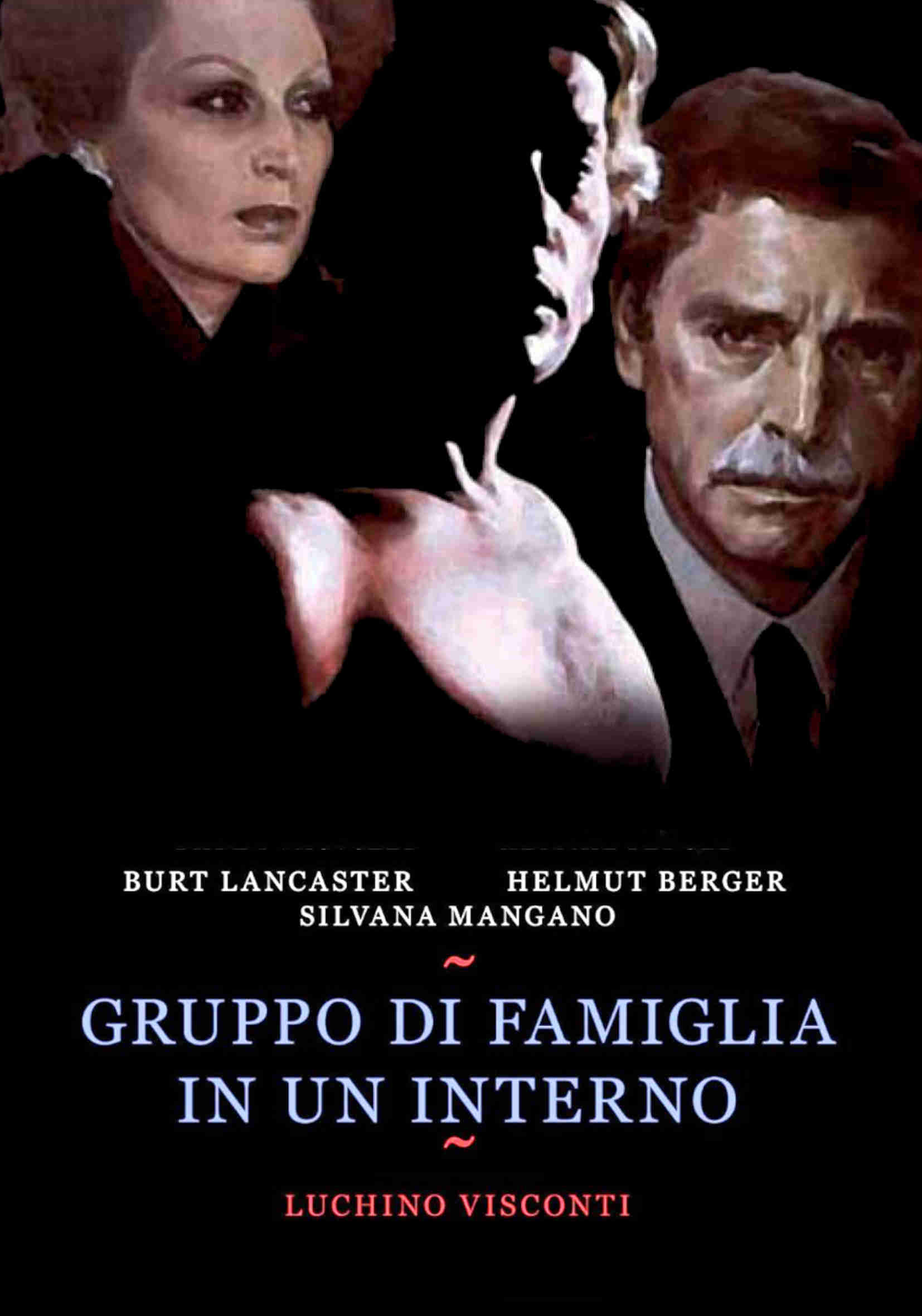
 Conversation Piece is the kind of film that reminds someone precisely why they love cinema. I know it definitely evoked deep and visceral emotions deep within me when watching it. Luchino Visconti had the ability to create the most hypnotic, beautiful expressions of existential issues, and in crafting this film, which is unquestionably one of the most compelling pieces of fiction produced in its times, he creates something so mesmerizing, a deeply haunting drama that takes a unique approach to its characters and the situations they find themselves, setting the stage for one of the most daring, sumptuous and fascinating films of the 1970s. Featuring a cast plucked from all corners of the world, and led by Burt Lancaster, an actor whose effortless ability to command the screen with a certain undeniable conviction has made him amongst the most impressive performers of his era (and if we are being completely honest, it took until this film to finally convert me to the multitudes who heap adulation on the actor). If this all sound a tad hyperbolic, don’t be mislead: it is all extremely true, because what Visconti does in Conversation Piece is nothing short of a miracle of filmmaking, an intricate and measured character study that never falters in its intentions, and never once rings out a single false note throughout its spellbinding venture into the human condition.
Set entirely within a single location, we are introduced to The Professor (Burt Lancaster), who spends his days in solitude, with his only companions being his housekeeper and concierge, and his many books, upon which he pores as a distraction from his intentional loneliness. Quite fatefully, he comes into contact with a mysterious woman who introduces herself as Marquise Bianca Brumonti (Silvana Mangano), a noblewoman who is seeking out a place to rent for her younger lover, the radical and intelligent Konrad (Helmut Berger). After consistent manipulation from the Marquise and her daughter (Claudia Marsani) and her boyfriend (Stefano Patrizi), the Profesor finally relents and allows them to rent the apartment. It soon becomes clear that his initial instincts were indeed correct – the family begin to terrorize him through their rowdy behaviour, constant destruction of his beautiful apartment and their insistence on assimilating themselves into his very quiet life. The most troubling of all of them is Konrad, who begins to assert his control over the Professor, whose meek and mild nature does not work well alongside the younger man’s manipulative attitude. The protagonist has no choice but to quietly wait until their non-renewable lease has ended – but it becomes clear that they are there to stay, and nothing he can do will change the fact that these people, whether he likes it or not, have formed into an unconventional family around him.
Conversation Piece is a fascinating film, mainly because even if we just focus on the broader execution of the story, we can see how Visconti utilized very little to say an immense amount. Set entirely within one location, the luxurious Roman household that the Professor was hoping to spend his remaining days in, split between his downstairs apartment and the one above him, which is soon occupied by a family of troublesome youths who relish in their control over the more reserved man. It is a very theatrical film, in a number of ways. Certainly the limited locations played a role in crafting this very intense character drama (some reports have suggested Visconti’s decision to film only in these two locations was because of the recent health issues that left him confined to a wheelchair), and some of the most audacious commentary on the part of this film comes when we look at the manner in which the director conveys this story, which is quite extensive and spans a considerable amount of time (several months), demonstrating the changing of the seasons and the passage of time not through anything other than meer implication. Visconti certainly gets a great deal of credit for his lush and beautiful production design (and Conversation Piece certainly does not deviate from the standard in this regard), but his imagination, which manifests in the quietly intense moments of allusion peppered throughout the film, is even more fascinating. Another aspect of the theatricality of the film (and perhaps the most important), is the character-driven nature of the story. Throughout Conversation Piece, the directors use the limited space as a way to elevate the focus on the performers, allowing them to take the central role in bringing this story to life.
Of the ensemble, Conversation Piece is anchored by a trio of exceptional performances. Helmut Berger, an actor who absolutely no one has ever been able to harness in a way that would pinpoint him to a particular style, takes on the role of Konrad, a fiercely intelligent but extremely rebellious young man whose entire existence is built out of a need to not only show dominance, but to retain a control over everyone who he encounters. He meets his match in The Professor, who is unflinching in his steadfast beliefs and refuses to be taken advantage of, which is Konrad’s only real skill. Berger gives a memorable performance in Conversation Piece – it is never clear if it is a particularly good performance (he does tend to introduce a sense of unnecessary excess to the character at several points), but it is one with its numerous layers. Silvana Mangano is the portrait of elegance as the deceptive Marquise, who finds herself inserting herself into the life of a man unwilling to be a part of hers, but doing so anyway, because from her perspective, her nobility entitles her to take advantage of anyone she sees fit – once again, while the Professor does compromise after some conflict, he still stands strong, which is far more difficult for the Marquise, who is not nearly as volatile as her younger cohorts. She is also the closest thing the Professor has to an empathetic voice – she is certainly unreasonable for the most part, but her entire arc is built solely around necessity rather than desire, which is inconsequential to her character. Mangano is great in Conversation Piece, playing the character with a blend of high camp and grounded gravitas, finding an ambigious place between the different facets of the character that would go amiss had she not flawlessly oscillated between them. Berger and Mangano give the only good supporting performances (Claudia Marsani and Stefano Patrizi are not particularly noteworthy, and several of the smaller roles don’t do nearly enough to register), and Visconti is quite generous with these characters, giving them enough to work with without them distracting from true heart of the film, Burt Lancaster.
Lancaster is the soul of this film, and he single-handedly makes it the astounding piece of social commentary that it is. This is Lancaster at his most sensitive and vulnerable – playing a character who is far more muted and reserved than we normally see from Lancaster (who is one of the few actors of his generation who has never truly pigeonholed into a particular archetype, with his career being relatively malleable in terms of the diversity of the roles he managed to play), he once again proves that Visconti could bring out another side of him that would be otherwise lost in films that don’t emphasize the actor’s natural expressivity and ability to harness a sense of elegant subtlety. The Professor (who goes entirely nameless throughout the film) is a challenging one, but it seems to be intentional that Lancaster is playing this role. Beyond being a gifted actor in his own right, Lancaster was an icon of the Golden Age of Hollywood, and here is playing a character who is a remnant from an era past, looking to quietly recede into oblivion on his own terms, being bombarded with the rise of modernity. There was certainly some meta-commentary in getting a true idol like Lancaster to play the role of a man confronting the threat of a society in flux that would not have been present had an actor more associated with this kind of role being selected. Lancaster is simply exceptional in Conversation Piece – his restraint, combined with his remarkable expressivity, go towards the construction of one of the most nuanced and fascinating male performances of the 1970s, a performance that is calm on the exterior, but internally ferocious and brimming with complexity. This should be the standard to which actors should aspire, because while other performances from history have entered into the canon of great acting, what Lancaster does in Conversation Piece is an exquisite exercise in restraint and elegance, and more indelible than any more traditionally memorable performances given during this period.
The Professor is a man who is extremely intelligent and has a vast amount of knowledge into matters that interest him. Yet, throughout Conversation Piece, we see that he is not failing to grasp the world around him, not being able to understand the machinations of a society he has deliberately excluded himself from – and this is initially not a problem, as he is someone who enjoys being immersed in the past, with the activities occurring outside his window being of no importance to him. However, this all changes with the arrival of the Marquise and her family, with the omnipotence of the younger generation clashing with his previously idyllic life. The Professor is a man who perceives himself to be at the end of his life, and who unfortunately finds his final days woefully shaken by the presence of his unwelcome visitors, who invade his life and bring a sense of youth and exuberance to his quiet existence. Naturally, this would make for a heartwarming and thrilling comedy – that is certainly far from the case with Conversation Piece, and Visconti is clearly intent on focusing on the more negative aspects of this domestic invasion. The film is built on the dynamic of the traditional intermingling with revolution. Consider the two locations that serve as the stage for the film – the Professor’s apartment remains stagnant, filled with remnants of the past and many secrets, taking on the appearance of a tomb for a man receding into his own peaceful demise. The rented apartment above him is subjected to the folly of youth – it is deconstructed and mangled, rebuilt and fashioned in a way that dismisses the historical beauty of it, and rather reflects the more trendy, gauche modern aesthetic of the time.
Visconti seems to be intentionally riffing off this duality throughout the entirety of the film, with the Professor’s visits upstairs (which a deeper reading of the film possibly indicating a metaphorical ascension towards a more modern way of thinking and living) not being nearly as regular as the younger occupants’ journeys downstairs, and even when invited up to socialize with them, the Professor stands his ground, not wanting to enter into a lifestyle of which he not only has no understanding but also no intention of ever experiencing. It is a certain stubbornness that we can observe in those that don’t necessarily want to engross themselves in the future, nor to embrace modernity. Yet, his stagnancy is not a flaw, but a trait representing his intentional refusal to move forward, which is evident by the sporadic visions of his mother and wife, who we assume met some tragic end at some point, leading to some internalized trauma that pushes the Professor into this ardent isolation. Beyond everything else, Conversation Piece is a film about the perceived decay of the modern world in comparison to the inertia of the older generations, who hold onto their motionless ideals with a certain arrogance, and despite knowing the worldview they are so desperately trying to perceive won’t belong to them for very much longer.
The apparent collapse of the Professor’s peaceful life in Conversation Piece is in a way signalling the beginning of a new era, one where the old guard has to step away to make way for a newer set of ideas. This film doesn’t necessarily contain anyone who is purely admirable or despicable, even if we tend to associate more with the quiet resistance of the Professor over the pretentions of the rowdy family above him. This all makes for an extremely tense, emotionally-complex film about the conflict between generations, manifesting as a twisted drama focused on a group of characters with radically different ideals. Misunderstanding is one of the key concepts underlying Conversation Piece, as the focal point is an older man who finds his quiet and reserved lifestyle disrupted by a group of young people who don’t quite understand him, yet he himself doesn’t put him any effort to understand them either. This is a film constructed out of the psychological diversity of the main characters, which each individual operating in entirely different mental and emotional states, and some deeper analysis could surely draw some fascinating conclusions towards the underlying traits embedded within these characters, explaining precisely why their behaviour takes the form that it does. This is precisely why Conversation Piece is such a compelling film, as the ensemble is not a homogenous mass of identical characters, but a multidimensional, diverse set of individuals with their own existential and psychological quandaries, interpreting their situation in different ways and dealing with the trials and tribulations of life in their own separate manner, which more often than not comes into direct conflict with that of another.
Conversation Piece is truly a fascinating film – a solemn elegy to the past, it laments on the intersections between the beauty of tradition and the vulgarity of modernity. It is not a film that is particularly kind to the younger generations (we need to consider that despite being a genius, Visconti was an old-fashioned artist who most likely could relate far more to the more cynical Professor than he could the disruptive but well-meaning youths he comes into contact with), but it is still one with a very clear message in focusing on the reciprocal conflict between the past and the future, which can only take place in the present, where both separate ideals are in constant battle. Visconti made an intimate, sophisticated and unimpeachably human film with Conversation Piece, which flourishes not only because of its remarkable elegance, but its compassionate approach to a story that could have been mangled by someone who didn’t understand that the emotional intricacies of a film like this are not found in broad strokes, but in the smallest, most inconsequential cracks. Much like the paintings the Professor collects, Conversation Piece is a beautiful work, but one that requires constant admiration, and the closer peer into it, the more we are able to glimpse the beautifully human idiosyncracies embedded within it.
 The Postmodern Pelican