 Don Hertzfeldt is someone who has shifted the perception of animation throughout his career, and even though he is still relatively young by the standards of the industry, he has become extremely influential, and someone whose achievements are more indelible than most artists his age. Some of the most gorgeous animated films I have ever experienced have hailed from his demented mind, with Rejected and It’s Such a Beautiful Day being two of the finest achievements in contemporary animated storytelling, the former being an outrageously hilarious sequence of vignettes, the latter a heartbreaking chronicle of one man’s journey to self-realization and acceptance of his inevitable faith. However, it is almost undeniable that his magnum opus is World of Tomorrow, a film that shook audiences to their psychological core in 2015, when Hertzfeldt presented us with a vision of the future unlike anything we have ever seen before – a science fiction odyssey condensed into only twenty minutes, and a story that was both epic in scope and intimate in execution. It has rightfully entered the canon of astonishing achievements in the field of animation, and its status as one of the current century’s most revered short films is not undeserved in the least. Hertzfeldt is also someone who knows when a story needs to be continued – hence, to the great pleasure of audiences everywhere, he has gifted us with World of Tomorrow Episode Two: The Burden of Other People’s Thoughts, which continues the story of Emily Prime and her encounters with her future self, this time with the audience venturing into Emily’s mind, as we visit her past, present and future all at once, exploring the distant mysteries of space and time.
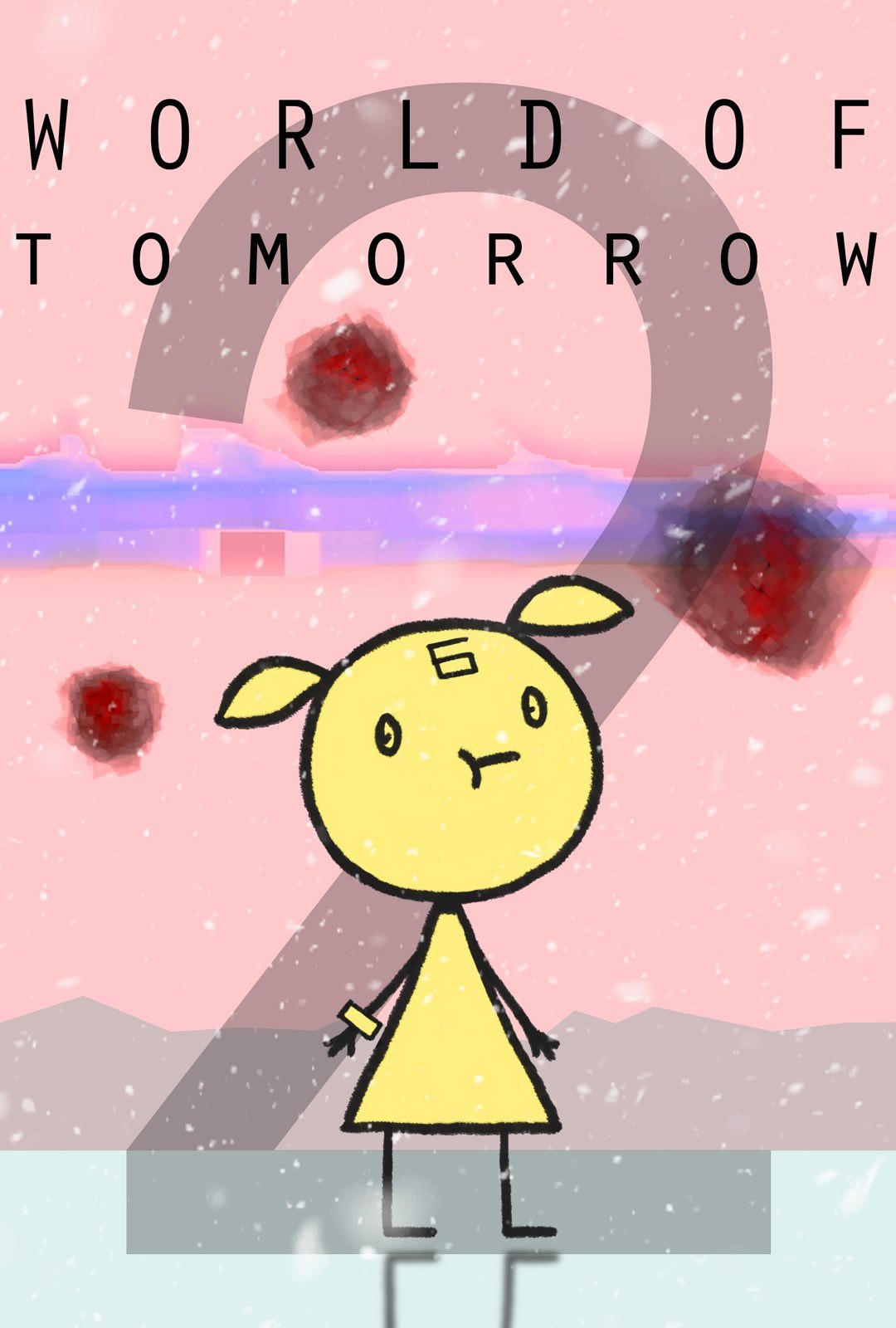
The subtitle to this continuation of the story is the perfect descriptor of Hertzfeldt’s style and thematic intention – The Burden of Other People’s Thoughts is both absurdly comical and deeply meaningful. It also is the underlying motivation that drives this film and gives it the nuance to take on some form of a story. Emily Prime is visited by Emily 6, a backup clone of her future self. The reason for this new iteration of Emily to visit is unlike that which we saw in the previous film, but something slightly more depressing: due to the fact that she is a clone that will likely never be used, Emily 6 is starting to lose her memories, and she needs the help of her original self to regain them. Entering into the mind of the young girl who doesn’t understand anything that happens, but is happy to go along for the ride, they start to discover that there is something a lot deeper to the plight of Emily 6. We soon learn that despite being a clone, she has developed her own personality, as well as the anxieties and insecurities that go along with it. It’s revealed that she has a sister, Emily 5, who has been renamed Felicia to allow them to be distinguished. Now laying in a catatonic state, orbiting the Earth, Emily 6 is not likely to ever see her sister again – and to add further complications, despite her position as just another copy of the young girl, Emily 6 is struggling with an existential crisis – how can she possibly engage with the memories implanted in her, if those memories weren’t hers to begin with?
It has always been truly astonishing the amount of narrative detail Hertzfeldt manages to compress into each of his films – even those that run at only a few minutes demonstrate a certain narrative complexity that is missing from even the most extravagant blockbusters that attempt to construct compelling stories with exponentially higher budgets and a lot less heart. World of Tomorrow Episode Two: The Burden of Other People’s Thoughts takes on the challenge posed by its predecessor – create a compelling and beautiful science fiction story that is complete and emotionally-resonant, in as short a time as possible. The result is a dizzying and beautifully bewildering experience – we are presented with a film too short to be considered an epic science fiction masterpiece purely on the technical level, but the scope of the film, especially in its underlying intention, says otherwise. Hertzfeldt doesn’t only redefine the limits of animation, he also challenges the notions of narrative conventions, breaking boundaries slowly but surely in his approach to exploring humanity in a way that has never been done before. The most wonderful part of Hertzfeldt’s vision is that what he portrays has never been done before – it is unique, individual and revolutionary, which is precisely why his films have flourished into these steadfast masterpieces that are almost immediately influential. Narratively and visually, the director is an iconoclast, someone with a singular way of telling a story that becomes undeniably powerful, and taking place in a quarter of the length of a regular film, it is truly a remarkable achievement.
One thing that we can never accuse Hertzfeldt of being is unoriginal – his films may appear simple and rudimentary in their style, but they possess underlying themes that are far more impressive than anything the audience has ever seen before. World of Tomorrow Episode Two: The Burden of Other People’s Thoughts is certainly not an exception, and following in the template set by the previous film, it attempts to dive deeply into the human psyche through an intimate science fiction tale that crosses dimensions in order to explore the roots of what it means to be human. The central theme of this film is memory and individuality. The central character this time is not only Emily Prime, who takes a slightly more submissive role in this adventure, and more Emily 6, who is struggling to carry, as the title suggests, the burden of other people’s thoughts – she has memories, but they are not her own, but rather the belongings of the person who she was created to replace – and considering she is the sixth clone, it is unlikely she will ever be needed. This prompts her to start experiencing some crisis of identity, developing into an independent individual who is experiencing a sense of hopeless ennui at the fact that she is an afterthought rather than a fully-formed being. The film looks primarily at memory – the playground for Hertzfeldt’s fascinating narrative is the mind of Emily Prime, where she and her new friend venture into a cognitive oasis, where they encounter the unique brain of a young girl with a wildly vivid imagination. World of Tomorrow Episode Two: The Burden of Other People’s Thoughts is remarkably inventive, and it does so much with a relatively anecdotal premise that could have otherwise been a tragic misfire had it not been executed by someone with the limitless talents of a director who is in such firm command of his craft.
Putting aside the narrative brilliance of the film, it would be foolish to not acknowledge the visual style, which is perhaps the best part of the film, as it works in tandem with the storyline to create one of the most heartbreaking films of the past few years. Hertzfeldt once again redefines the limits of animation with World of Tomorrow Episode Two: The Burden of Other People’s Thoughts, taking his style to an entirely new level, where the same elegant simplicity remains, but is situated in bigger and more audacious contexts – who could have possibly expected one of the most compelling and intelligent science fiction films of the decade would consist of stick-figures? The straightforward nature of Hertzfeldt’s animation has never been a limiting factor – we’ve seen that he is very much capable of more detailed, extravagant styles, but those would not have been nearly as effective had he employed them over his minimalistic approach, which is far more complementary to the deeply labyrinthine nature of the premise. The director’s use of colour and composition only adds to the outrageously brilliant aesthetic that is the epitome of the adage of “less is more” – and not only does Hertzfeldt employ this idea through all of his work, he allows it to be the driving factor behind his storytelling, as sometimes the most affecting pieces are those that deliver the message through simple, unfettered means and without resorting to excess in order to distract from the story. Hertzfeldt cuts right to the core with World of Tomorrow Episode Two: The Burden of Other People’s Thoughts, and the result is absolutely astounding.
It is quite frankly impossible to deny the chaotic genius that resides within the mind of Don Hertzfeldt. I still remember the first time I saw his work, I was expecting something innocuous and silly when in actuality it was some of the most beautiful work I have ever encountered. World of Tomorrow Episode Two: The Burden of Other People’s Thoughts is just another reminder of his unmitigated brilliance, his gloriously intricate knowledge of the human psyche, and more than anything else, a way for the director to explore his own curiosities. Hertzfeldt has always been a bit of an outsider – never someone who depended on the validation of others to make a career (imagine if he had seen his failures as the end of his career – we might never have gotten the astonishing Rejected), so his work always reflects a fiercely independent artist working to realize his own singular vision, and gives his films a certain intimacy, as it feels like these films are forming a direct connection between the artist and the individual viewer, where the rest of the world is momentarily isolated, and where we can experience a few moments of sincere, earnest visual poetry that defies categorization, breaks boundaries and becomes something truly unforgettable. World of Tomorrow Episode Two: The Burden of Other People’s Thoughts shows us that there is a glimmer of hope in even the most hopeless of situations, and what we believe to be true and sacrosanct is often the complete opposite, and reality is something mostly unknown and unquestionably beautiful. I implore you to find a more emotionally powerful, and hauntingly beautiful, film.
 The Postmodern Pelican