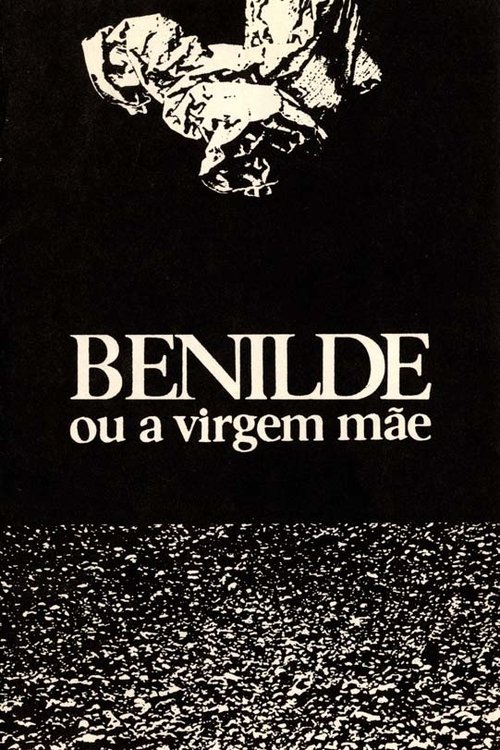
 Benilde (Maria Amélia Matta) is an innocent young Portuguese woman who discovers something that sends everyone she knows into shock – somehow, she managed to become pregnant. Her explanation doesn’t make this news any less difficult to comprehend, as she believes that the baby was the product of divine intervention, with the young woman, who purports to being a virgin, claiming to have been a beneficiary of immaculate conception, whereby some celestial being came down and blessed with a child. The result is a tense exploration of the various people in her life trying to come to terms with this utterly absurd notion, trying to get to the core of why she would possibly think they were ignorant enough to believe it, as well as trying to determine who dared deflower the young woman. The person that suffers the most is her fiance, Edoardo (Jorge Rolla), who is reeling in anger after discovering that the girl he was set to marry has had herself tainted by some other man, and as a result she calls off their engagement, as she now sees herself as being far superior to any earthly romantic commitment since Christ chose her as his vessel for potentially the next saviour. Of course, everyone (with the exception of the kindly and gentle elderly priest, who is played to absolute perfection by Augusto De Figueiredo, whose Father Cristóvão is the only inherently likeable character in the entire film) believes Benilde’s story to be nothing but a blatant attempt at hiding her lascivious ways – but her conviction in selling the truth of the situation, and the doubt evoked in the minds of those around her are enough to put the question of her honesty, and creates the idea that she may just be telling the truth.
Manoel de Oliveira is a man of superlatives – he held the record for oldest living film director, the distinction of the only person to have worked from the Silent Era to the Digital Age (he, in essence, saw the birth of both the talkie and the selfie), as well as being widely considered Portugal’s greatest film director, held in the same esteem as someone like Fernando Pessoa in his contributions to the nation’s artistic output. Benilde or the Virgin Mother (Portuguese: Benilde ou a Virgem Mãe) is one of his most fascinating works, an intricate character study about a group of characters exploring a range of philosophical boundaries. Mystery and deceit are interwoven into the fabric of this film, which tells an enthralling story about the boundaries between religion and secularism, and the role certain beliefs that are held to be unimpeachable truths can play in contemporary society, where reason and logic are perceived to be the most sacrosanct of qualities, and those beliefs which exist outside of the confines of what is considered to be socially and culturally acceptable are promptly victim to dismissal – yet this film takes the approach at looking at the possibility that there may be something deeper than none of us, whichever side of the debate we are aligned with, can possibly understand or even merely conceive of. de Oliveira’s merits as Portugal’s finest cinematic storytellers are on full display in Benilde or the Virgin Mother, which is some of his most fascinating work.
Benilde or the Virgin Mother has its roots in the theatre, which is not difficult to believe when you consider the style of the film. I wouldn’t necessarily call this a cinematic play, but rather a series of passionate monologues delivered by talented actors, who occasionally interact and help propel the film forward through their collaboration. Manoel de Oliveira deftly avoids all the pitfalls that come with adapting a piece originally written for the stage. Most of all, he finds no value in the restrictive confines of the theatre but doesn’t try and reinvent the form either, keeping everything very simple, but beautifully so. The simplicity of theatrical storytelling is one that is hardly ever given the proper credit when it comes to crossing over into film, and there are far too many examples of films taken from plays that are dismissed as being too “stagey”, essentially taking the form of nothing but filmed version of their original works, without any artistic merit. De Oliveira is not someone to limit himself to just filming a play, and instead endeavours to take this brilliant work and interpret in a way where it doesn’t lose any of its impacts, but also doesn’t remain restricted to the confines of the theatre. Benilde or the Virgin Mother is a film of dualities and contradictions, and it is a piece that occupies a very ambigious area between cinema and theatre, borrowing heavily from both forms of storytelling, and establishing a somewhat intermediary approach to the execution of this story, where the director traverses medium and conventions to deliver an astoundingly astute social commentary that is gorgeously tragic and often hilariously irreverent.
The design of Benilde or the Virgin Mother is quite remarkable on its own. Structurally, we can see the origins in theatre, as this is a film composed of three distinct acts, which are clearly marked in a way that hearkens back to the original idea of theatrical performance, whereby a play was performed in compartmentalized segments that may be entertaining, but are nonetheless predictable. De Oliveira takes the structure and imbues it with a certain technical elegance that is otherwise unprecedented with this kind of film. In Benilde or the Virgin Mother, the director boldly utilizes the camera not merely as a tool to record, but as a surrogate for the audience – the camera is our eyes, and we watch, perhaps almost voyeuristically so, as this grand drama unfolds, and how deception and manipulation run rampant in this dysfunctional family. The film’s constant use of cinematographic tricks – the camera peering downwards from above, or unbroken shots, normally in which we see extensive monologues delivered with astonishing delicacy and fiery passion, depending on the situational context. Benilde or the Virgin Mother has a certain grace in its execution – it is tightly-constructed, and brilliantly formed, and one may be able to find flaws somewhere in this film, but the ways in which De Oliveira goes in search of the truth in a piece that is relatively stagnant and normally hostile to attempts to bring it to a wider audience through adapting it to the screen, make this an exceptional piece, and something that far exceeds the sums of its parts, and becomes a flourishingly beautiful and unquestionably haunting European Gothic that works well in the context of it being both a constituent and revitalization of the baroque chamber drama.
Where precisely Benilde or the Virgin Mother derives its value is in the thematic underpinnings throughout the film. De Oliveira, a profoundly talented cultural theorist in his own right, understood that the way to bring success to this film is through philosophical debate, and absolutely no issue is as contentious as that of politics or religion, both of which are very evident here. In particular, science (and by extent, reason) is in conflict with religion (and its assistant, blind faith). In this film, the debate is very much between two very different groups – one that believes that Benilde was the victim of some divine intervention that brought her to be with child. The other group is one that attempts to justify her actions through logic – she clearly had some covert rendezvous, and returned bearing a child, being too ashamed to face the wrath of her father and fiance, both of which cite their stress and concern with the possibility that Benilde is living a second life. Yet, it goes deeper – the very idea of sanity and delusion play an imperative part in this film – consider how the titular character’s mother apparently died from going insane, or the “village idiot”, who is never depicted on screen, but remains omnipotent through his horrifying caterwauling, or through being the subject of constant discussion. De Oliveira deftly oscillates between the idea of passionate religious belief and a loss of sanity, never conflating the two, but not neglecting to imply that there may be some connection that makes them somewhat related. Benilde or the Virgin Mother uses its central theme of exploring the debate between scientific theory and religious belief to comment on society’s preoccupation with normality – in this perspective, everything that is not seen as being within the socially-acceptable confines is automatically dismissed as being abnormal and misplaced in decent society.
It is sometimes in these moments of challenging the status quo that Benilde or the Virgin Mother manages to make its most profound statements, especially when we consider that everything is kept entirely ambigious – we never actually know for sure whether Benilde was impregnated through her own indecent exploits, or if there was some element of divine intervention. The point isn’t to choose sides – as depicted here, both theoretical positions are ridden with flaws and are far from being sacrosanct. Rather, what Manoel de Oliveira is hoping to accomplish with Benilde or the Virgin Mother is to explore the divide between opinions, and how social mediation can sometimes alter the way in which we perceive each other. It is a powerful film – it begins as a gothic thriller, where nothing is what it seems, and the halls of that enormous house resonate with chilling anxiety towards the pursuit of the truth, but it ends as a meticulously-constructed melodrama that sees each actor being given the chance to deliver astonishing monologues, where their inner desires and insecurities manifest. Benilde or the Virgin Mother is a gorgeous film – it is not a work that is always remembered, as its obscurity indicates, but it is a piece of narrative storytelling that sees a master at his peak, providing us with a fascinating character study that allows him to go deeply into the human condition in a way that very few directors are able to. Demonstrating restraint and uncompromising brilliance, Benilde or the Virgin Mother is an exceptional film and a marvellous commentary on society and its innumerable flaws.
 The Postmodern Pelican