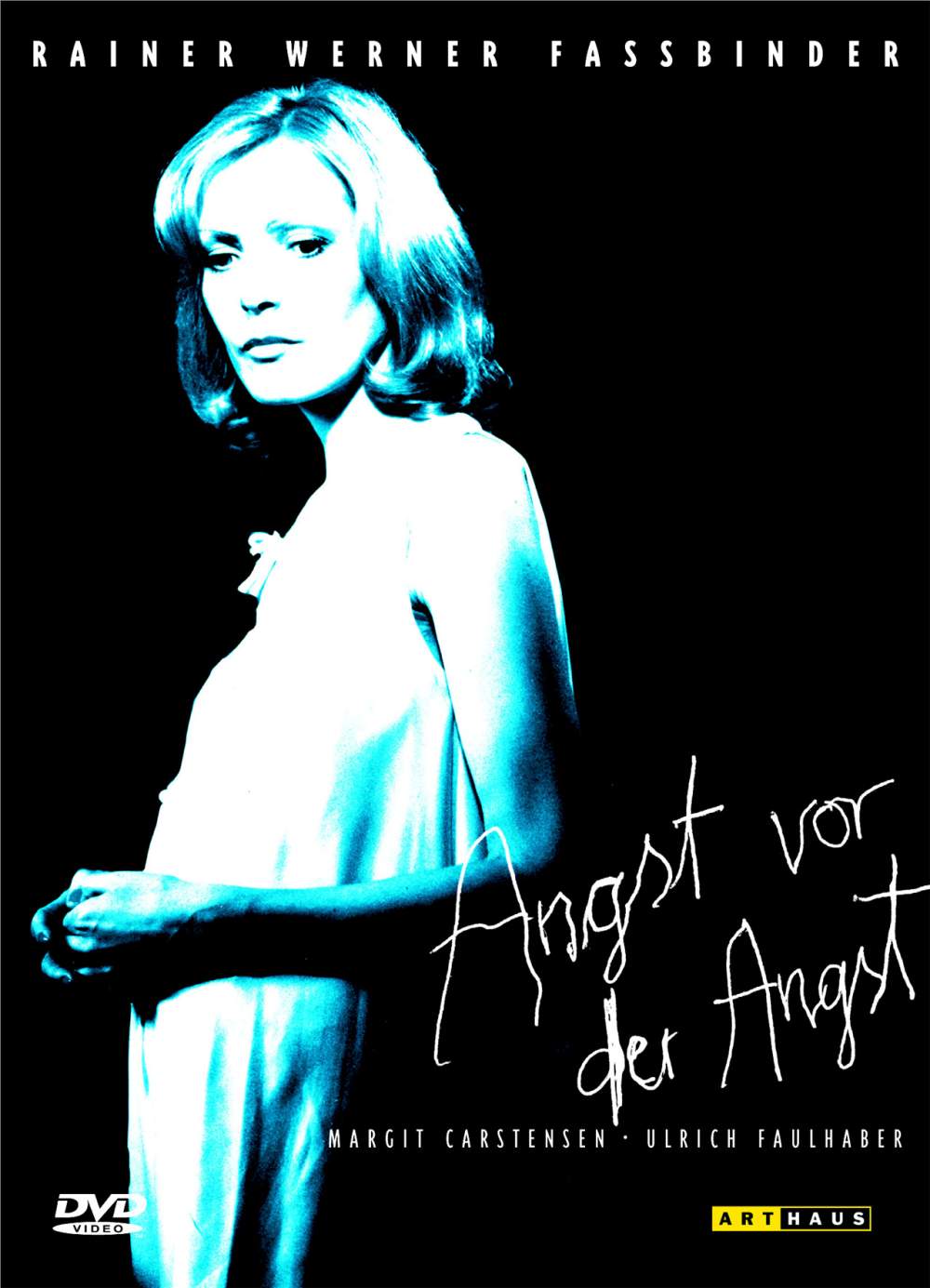
 Rainer Werner Fassbinder knew how to make three different kinds of films better than anything else – the comedic (Beware of a Holy Whore, Chinese Roulette), the melancholic (I Only Want You To Love Me) and the tragic (Fox and His Friends, Ali: Fear Eats the Soul) – and in his extremely prolific career, nearly all of his films can be categorized under one of these. One of his more obscure titles is Fear of Fear (German: Angst vor der Angst), a film that was made for television, and one that certainly aligns itself with the director’s more tragic works. Like the majority of Fassbinder’s work, Fear of Fear looks at one broad concept in great detail, presenting us with a protagonist who undergoes a deeply troubling journey to self-realization without much assistance from anyone who doesn’t expect something in return for their assistance. Perhaps not one of the visionary director’s major works (but when you have over forty directorial credits to your name in less than two decades of working, you can’t expect absolutely everything to be a definitive masterpiece). Yet, this film still features one of the most ferocious leading performances in any of the director’s films, and a story that is strangely resonant and deeply moving, even if the film itself can come across less as a work of intricate fiction and more like a glorified morality tale that was broadcast with the aim of reaching the ennui-laden housewives who Fassbinder seemed to think could relate to the plight of the heroine at the core of this film.
Margot (Margin Carstensen) leads a relatively happy life – her husband, Kurt (Ulrich Faulhaber) is a hard-working man who is intent on giving a good life to their family, which includes a second child that is just about to be born. Despite the disdain Margot receives from her husband’s vicious mother and sister (Brigitte Mira and Irm Hermann), who live just below them, Margot is content with the direction of her life. However, after the child is born, she descends into a deep depression, where all of her insecurities start to manifest – she worries that her husband doesn’t love her, that her children will leave her, and that she is not worth much as a person. She begins to feel a certain impinging mental obstruction – the titular “fear of fear”, which causes her to fall directly in the arms of the mysterious pharmacist across the road, Dr Merck (Adrian Hoven), who begins to take advantage of the ailing woman by offering her Valium in exchange for a torrid love affair, to which Margot readily accepts – not only does it provide her with the medicinal sanity she crazes, she also receives the love and attention she doesn’t get from those around her, and her loneliness, while far from being resolved, is momentarily put aside in her quest towards numbness – and whether through medication, alcohol or other reckless behaviours, she begins to see her worries fading, not realizing that they aren’t going anywhere until she addresses them properly.
Fassbinder’s films were often very beautiful, but they could also be extremely heavy-handed, especially when they took the form of cautionary tales, whereby the director selected one major theme and made a film around it. We can see several of these peppered throughout his career – he’s addressed LGBT issues, interracial relationships, post-traumatic stress disorder, abuse and numerous others. These films are almost always very effective, even when they do become somewhat harrowing to experience – Fassbinder was someone capable of inciting great joy in the viewer just as much as he was able to evoke existential crises because if there was ever a director who understood the human condition, it was certainly him. Fear of Fear takes on the subject of anxiety, which is somewhat non-traditional for a filmmaker who normally prioritized more interpersonal stories about identity and existing in a hostile world – suddenly, we are presented with a protagonist who is not the victim of society, but rather a victim of herself. She is a tragic figure, but she isn’t one that necessarily begs for our sympathy – Margot is a reckless character who is slowly descending into complete mental and physical decay through her self-destructive behaviour – yet it wouldn’t be right to say that her actions are necessarily her own fault. Fear of Fear is a portrait of a woman under the influence of her own personal demons, trying to overcome the quandaries that inflict her in the only way she knows how, which can make for motivating but nonetheless disconcerting viewing.
Fassbinder’s decision to look at anxiety in a way that is shocking but still somewhat touching was way ahead of its time. Made during an era when mental illness was far more stigmatized as it is now, Fear of Fear is still revolutionary by even today’s standards. We are introduced to a woman whose issues are not caused by anything other than her own personal problems, where she suddenly starts to feel insecure and without any direction, which causes her self-destructive behaviour. The way Fassbinder explores anxiety is fascinating – none of the characters in Margot’s life are necessarily bad people. Not even her biggest detractor, her mother-in-law, is entirely negative, only trying to help Margot because she knows she can do better than she is already. Yet, there is still a sense of claustrophobic terror that is shown through the protagonist’s rapidly-deteriorating plight, as she starts to feel the world is against her. Her anxiety only increases as the film goes on, and while she d0es try and momentarily overcome them, she is more intent on feeling results instantly than seeking any long-term help. Fassbinder’s representation of anxiety in Fear of Fear is tremendously fascinating, and it contains some of his most daring concepts, such as the presence of Herr Bauer, a mysterious man who always seems to be looming near Margot, especially in her darkest moments. We never know who he is, or what role he plays in Margot’s life, despite clearly knowing each other. Yet, at the film’s end, when Margot has been cured through therapy and self-introspection, she soons learns of Bauer’s own death: only the most oblivious of viewers would not see the connection between the protagonist’s anxiety and the mysterious man who exits her life at the same time as her proverbial fear of fear.
Fear of Fear is grounded by Margit Carstensen’s astonishing performance as the main character, a woman who is teetering dangerously close to the edge of a complete loss of sanity in the months after the birth of her second child. The character of Margot is one tailor-made for a great performance, especially one occurring during this particular era when filmmakers like Chantal Akerman and Marguerite Duras were crafting feminist works that rebelled against the patriarchy. Margot is not happy with her position in life – she is nothing more than a complacent housewife, someone whose sole reason to exist is based upon her perceived responsibility to keep the house clean, cook for the family and take care of the children. She slowly but surely starts to question her role, not merely as a wife, but also as a woman and begins to realize that she deserves more. The cause of her anxiety is not entirely clear – some have attributed it to post-partem depression, which certainly does play a part (interestingly, we only briefly glimpse Margot’s second child – I wonder if this was a narrative choice in order to demonstrate the detached feeling the heroine has towards this child, or if no one with a baby was necessarily very trusting of Fassbinder to look after it), but it can also be an example of a woman questioning her own position in society. Carstensen brilliantly gets to the root of the character, exploring the depths and complexities embedded within her in a way that is absolutely astonishing, portraying the fragility of Margot with such conviction, it stands as one of Fassbinder’s most heartbreaking characters. A naturally tragic figure, Margot is a character that arguably doesn’t fall victim to some social problem – all of her issues come from within, and are the product of her own fears and anxieties – but she does find herself experiencing a form of intense social derision by others who cannot comprehend that her behaviour is the result of her decaying mental health rather than any selfish or myopic desires to engage in excess.
Whenever I watch a new Fassbinder film, I always find something special in it (even his more controversial works have some merits), and while his major films are landmarks of European cinema, it is sometimes his smaller films that make the most impact. 1975 saw the release of what I consider to be his best film (Fox and His Friends), which automatically means Fear of Fear may pale in comparison. However, it is a fascinating film about mental illness and an empathetic melodrama that never looks down upon its subject, even in her lowest moments. Neglect and being positioned as a social pariah work alongside the broader themes of addressing anxiety, and all come together to form a delicate and melancholic depiction of a woman trying to rebuild her life and come to terms with her own fragmented mental state. It may be lesser-known Fassbinder, and its shortcomings are extremely evident, but it is a film that succeeds when we look at the imperfections as being indicative of a film that was trying to explore a deeper, more contentious issue that was revolutionary then, and extremely resonant now. A film about overcoming challenges (which is increasingly difficult to do when those challenges are self-imposed) and regaining the strength to embrace yourself, including all your flaws, and develop a sense of belonging in a world that may not always understand what an individual is going through. Fassbinder really knew how to get to the core of humanity through his films, and while Fear of Fear is not top-tier work from the director, it continues to prove his great understanding of what it means to exist, and the final product, while understandably a bit rough, is nothing short of a poignant, touching and fascinating example of meaningful social commentary.
 The Postmodern Pelican