 Turns out I didn’t learn my lesson after Hereditary. Ari Aster is clearly a director in need of some form of therapy (or perhaps a form of exorcism) if Midsommar has anything to say about it. I am not entirely sure if Midsommer is a film that I absolutely adored or vehemently despise, and I am even questioning whether or not this can count as a film. However, what is undeniable is that this is an experience – a horrifying, shocking, brutal and perhaps even nauseating experience that takes firm hold of the viewer and forces us into a position of submission, where we are bombarded with images and situations that are harrowing and without even an iota of morality or consideration for the audience – Midsommar is not a film for the faint of heart. In fact, its not a film for anyone, because it seems almost inconceivable to imagine a single person alive actually enjoyed this film – it certainly is memorable, and there is a great deal of artistic merit embedded within the film (although “artistic integrity” may be going a bit too far), which proves two things: Ari Aster is someone with the most perverted mind since John Waters in his rebellious heyday, as well as being an outwardly brilliant film director who has now confirmed himself to be one of contemporary horror’s most essential new voices, with Hereditary and Midsommar (along with some of his short films, like The Strange Thing About the Johnsons and Munchausen) making up a relatively small but unforgettable set of experiences that throw the audience head-first into horrifying situations, and the louder we scream, the deeper we are plunged until we teeter dangerously close to the edge of some psychological breakdown.
Dani (Florence Pugh, in a performance that is destined to become one of the great horror performances of the current decade) has only known tragedy in her life – afflicted with intense anxiety and paranoia that few can match, she finds her worst fears manifesting when her sister kills herself and her parents in some warped murder-suicide that leaves Dani almost entirely alone in the world. Her only companion is Christian (Jack Reynor), her boyfriend of four years. In an attempt to assuage her fears of abandonment, Christian invites her on a trip that he’s taking with a group of his friends to a midsummer festival in Northern Sweden, where they will be witness to the theatrical nature of the local folk history, and how they celebrate the changing of the season and the birth of new life, as well as the end of the lives of those who have left us, or are about to. What starts as a strange but otherwise eccentric festival soon turns into something far more sinister, as the visitors are plunged into an almost inescapable world, where the customs only grow more sinister, and the activities take on a deeply terrifying overture, especially when it becomes clear that nothing is what it seems in the small rural community located far from the rest of civilization in the Hälsingland region. There’s only way out, and it certainly is nothing close to how they arrived, as Dani and her fellow doomed compatriots soon learn.
Midsommar is an unbelievably strange film. Aster’s previous films all had something very unsettling about them, even when we detach the horror from them. What makes these films so unique is that, in terms of the underlying stories, there isn’t anything inherently horrifying about them – Hereditary was a film about grief, and Midsommar is a film about a declining relationship. This is the core of the film, and precisely why it is so unsettling, not because of the more traditionally horrific elements of the story, but because there is something about it that feels so familiar. Aster is an artist who has made it very clear that his films are directly influenced by his own life (so I’d assume those closest to him would be cautious when interacting with him, because you never know when you’ll find yourself a character in some twisted or macabre situation in whatever deranged horror film the director is going to hurl at us next), and in taking something so real and resonant, and building an almost absurd and heightened version of the world around it, the impact is a lot more profound, because suddenly, something that is so common is repurposed as truly horrific, nightmare-inducing chaos. Midsommar is probably the worst film to take your significant other to see, and I’d expect this film hits a lot harder for those who can resonate with the themes of this film (the troubled relationship, not the demented pagan rituals – but power to you if you fall under the second category).
As a film that exists alongside other works, Midsommar is very much a continuation of Aster’s endeavour to reinvent horror. Putting aside the thematic depth of the film, we can look at this as a revival of a dormant sub-genre, the folk horror, which was made famous by the iconic 1973 masterpiece, The Wicker Man, which was clearly a direct influence on this film, especially in the shared storyline of outsiders finding themselves ensnared within a world of strange and often disturbing rituals, which are as terrifying as they are mesmerizing. Midsommar revisits many of these concepts and does so in a way that is not only deeply unsettling but also truly fascinating. Set in the Swedish countryside, which has not been portrayed with such stark and uncompromising beauty since Ingmar Bergman depicted it in many of his masterpieces, Aster is able to explore the intersections between various concepts – urbanity impinging on rural life, modern beliefs coming into contact with strict, archaic principles, and the effects of outsiders finding their way into a world they could not possibly conceive of, and attempting (to no avail) to assert their own influence on centuries-old traditions, and most definitely coming up short every time. There isn’t much to this film – unlike his previous film, Aster is not too concerned with exposition here, disregarding a lot of the characters’ pasts and motivations in favour of bringing them directly into the present moment, where they are almost entirely unremarkable individuals who just so happen to find themselves lead to the slaughter through promises of an entertaining or insightful experience. Even if Midsommar had not been a horror, but just an exploration of folk traditions and the intermingling between cultures, it would have still been a positively riveting film, and one that has a lot of substance, which may occasionally go underutilized for the sake of the story, which constantly moves along, even when the audience is more fixated on the circumstances around it.
Yet, Midsommar opted to be a horror, and it certainly was an effective one. There is something about horror filmmaking that very few filmmakers seem to get right, despite the fact that the genre is arguably the most popular with audiences around the world. I’ve come to understand that viewers don’t necessarily go in search for whatever it is Midsommar peddles – they want cheap frights and brief jump-scares that startle us momentarily before moving onto the next moment. Audience have very little use for a horror film that lingers on for much longer after it has ended – the very essence of the genre is one of momentary thrills. Aster has added his voice to a burgeoning group of young auteurs who are redefining the genre and making a film that leaves an indelible impression on the viewer. Seeing Midsommar was akin to a traumatic experience – hearts were pounding, faces were pale and there was a loss for words from everyone who had just witnessed this bewildering and unhinged tale of despair and destruction. Midsommar is not a film – it is two and a half hours of unrestrained, relentless anarchy, where the audience is put through an experience like no other. The final moments of this film are amongst the most horrifying ever committed to film, which is truly strange, because Midsommar, when considered alongside other more palatable horror films, is not all that scary – much like The Shining (another film that served as a blueprint for this film), the terror is unleashed slowly and steadily, through growing suspense and an unsettling sense of tension that doesn’t manifest until the final moments of sheer chaos, where the audience finds themselves on the brink of some form of breakdown – it may not be pleasant filmmaking, but its certainly as memorable as it comes.
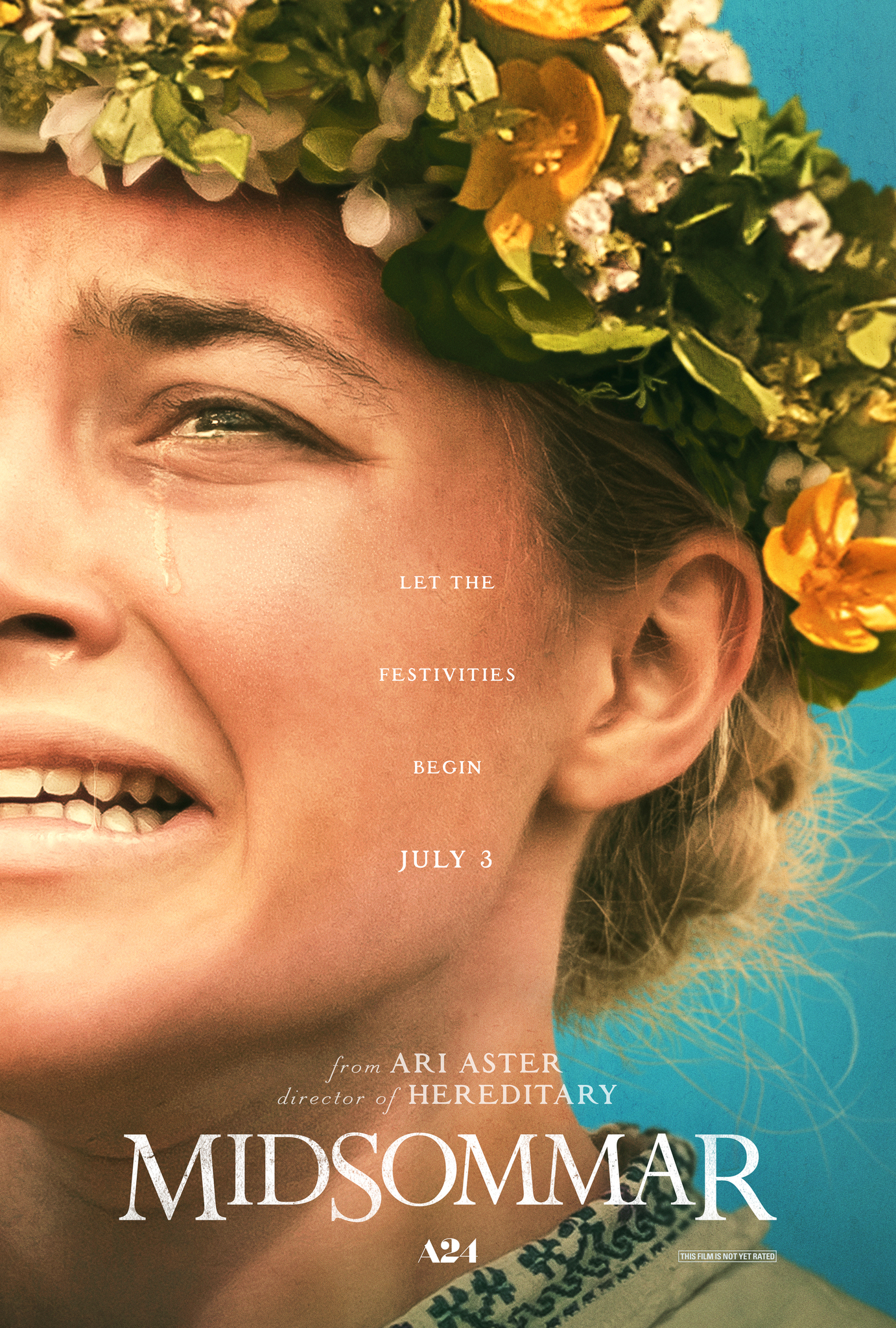
The quality about Midsommar that helps it most significantly is the fact that it is a gorgeous film. Unlike Hereditary, this film is made with a certain visual aesthetic that allows it to remain separate from all other horror films. For example, not a single moment of terror in this film occurs in the dark – everything happens in broad daylight, in the middle of beautiful fields and under the welcome blue skies of Swede. Aster’s intention in not only making a film that was stylistically the complete antithesis of his previous film’s more intimate, atmospheric appearance, but also an outlier in terms of other horror films. There’s something about seeing the terror inflicted on these innocent people in the middle of the day that is profoundly unsettling – what we would think would be limited to the shadows is instead shown in the open, which removes every bit of terror that normally comes with an effective horror film. Aster may be accused of prioritizing style over substance, which is certainly partially true: Midsommar is a beautifully made film and relies very much on its unique approach to presenting this story visually and still managing to be one of the scariest films of recent years that just needs to be applauded. It takes a lot to present us with something so outwardly complex through such simplistic means, and while the story itself may be lacking in some areas (including in terms of some of the continuity, which becomes somewhat distracting) and the fact that the film takes far too long to get to any discernible point of narrative departure (far too much time is spent establishing the history of this location and the traditions of the inhabitants), the way it is depicted is astounding, with the attention to visual detail and its relationship to providing us with an undeniably effective horror being quite intimidating but no less brilliant, proving that Aster is quite the visionary provocateur when it comes to terrifying the audience.
In the end, Midsommar is an experience like no other – it is a deftly-crafted, exceptionally well-made and undeniably creepy horror film that may not be anything special on the surface – it certainly is a lot longer than it should’ve been, and it can come across as being quite pretentious in how it presents the story. Yet below the surface is a pulsating sense of existential despair that can be truly affecting, and leave the viewer with an unquenchable sense of outright anguish. Ari Aster is a director who does not understand the concept of subtletly – he trades in simplicity for bold filmmaking that often manifests as unhinged portrayals of terror that truly cauterize the viewer and leave them truly shaken in a way very few horror films tend to be able to. It is a beautifully-constructed horror film that takes on broad themes in a way that is undeniably powerful. Ultimately, being puzzled by this film is not uncommon – to this very moment, I’m not entirely sure what I thought about this film, and whether or not I consider it a good film. Yet, if we break it down into intention and execution, Midsommar is a roaring success – it achieved its purpose of terrifying the audience through its intricate but potent combination of real-life situations and speculative horror. This is certainly not a film for everyone, and it definitely is suitably controversial. Yet, we can’t ignore that it is, for better or worse, one of the most unforgettable films of the year.
 The Postmodern Pelican