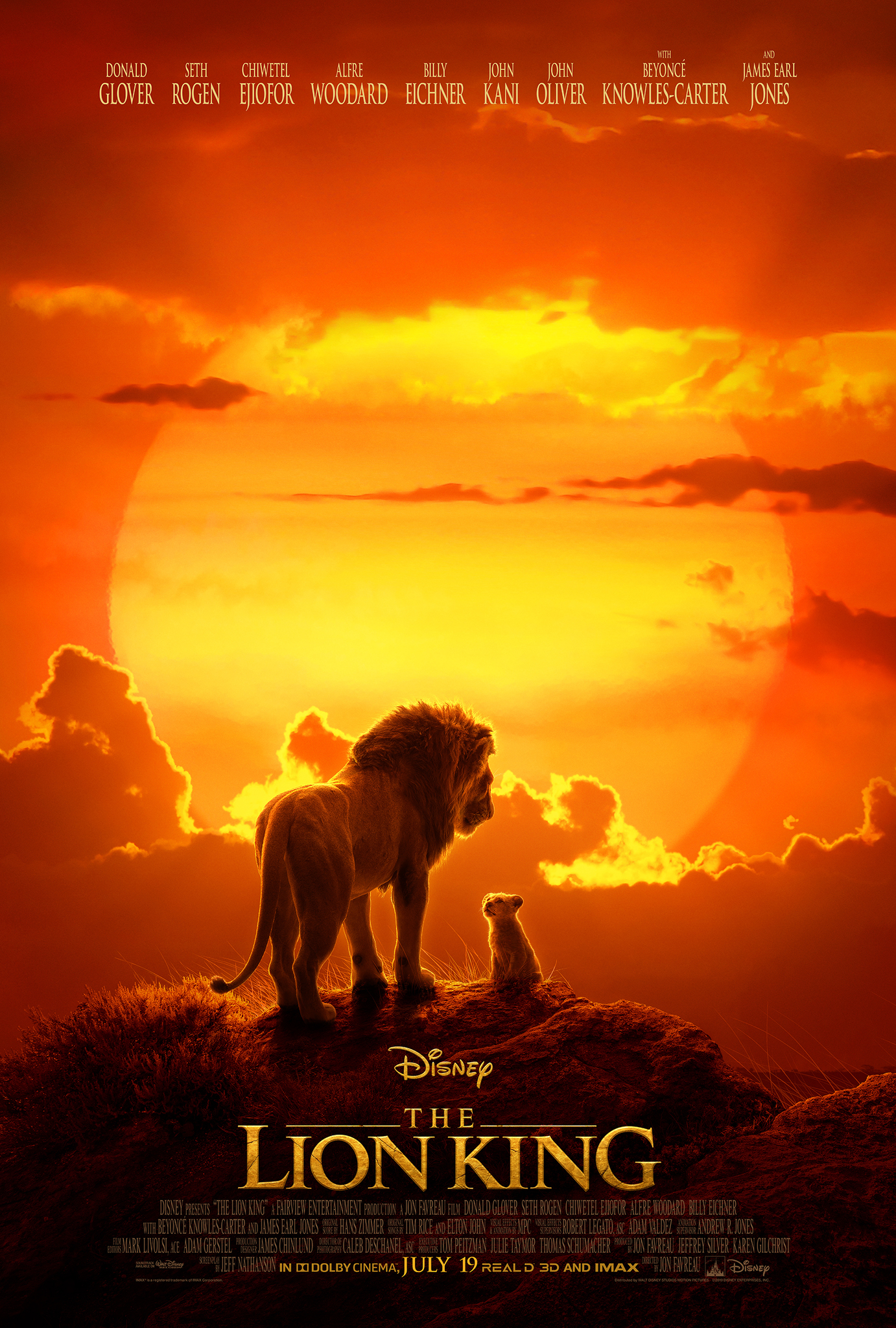
 Over the past few months, since the influx of promotion has started to arrive, it has become quite chic to deride the live-action remake of The Lion King – and for good reason. The original film is perhaps the greatest work to come from Walt Disney Studios, and it is undoubtedly their most beloved film, as well as being amongst the finest pieces of animated storytelling ever produced. There was absolutely no reason to remake this film, and the adage of “if it ain’t broke, don’t fix it” certainly does apply here – the 1994 version is about as perfect as any film of its kind can be, and the necessity to revisit this story was almost non-existent. The film unfortunately carries the burden of being just an attempt by Disney to cash in on one of their most successful commodities in this new wave of live-action remakes, and there is very little merit in the decision to remake it, especially from the perspective of being a shot-for-shot recreation of the original. However, having said that, if we put aside the useless nature of the remake, The Lion King is by no means an awful film – perhaps we can say it errs towards mediocrity, but considering it is almost entirely a replication of the original film, there’s not much to criticize here other than the fact that it just did not need to be remade. This film is, in all honesty, bland at worst, decent at best. Yet, its undeniable that the magic of the original film still remains here, albeit in a more muted form, and is likely that even the most hardened critic may be captivated momentarily by the charm and legacy of the original, which does still linger as a spectre in this film that may pale in comparison to its predecessor, but still stands as something entertaining in its own way.
It’s just too easy to criticize The Lion King. I was admittedly one of the more ardent critics lending his voice to the litany of complaints at this film. Everything about it just seemed wrong – its as if Disney had decided to take their greatest film, strip away all the heart and beauty that came with the visual style, replace the majority of the actors with new voices (despite the fact that a great many of the original actors are still alive), and just give us a more technologically-innovative version of the same story we have known and adored for a quarter of a century. There was, and I reiterate, absolutely no reason to remake The Lion King. I do concede that while I am much less angry with the final product as many are, the criticisms asserted about this film are not unfounded in the least. This film is, ultimately, just an attempt to make more money. There is no way to defend this film as an attempt to reintroduce this story to younger audiences, especially because younger audiences have already become familiar with the trials and tribulations of Simba and his Pride Rock peers through the constant omnipotence of this film as a landmark of animation, which remains just as fresh and exciting today as it did twenty-five years ago. Jon Favreau and the team behind this film were looking to take something familiar and instead of revisiting it in a way that would at least be original and somewhat of a departure from what we’ve seen before, decide to just give it a new coat of (excessively expensive) paint, presenting it to us as something apparently so innovative and new, when in actuality, there is very little difference between this film and the original, with the exception of two major qualities.
The first is the visual style. Perhaps we can soften our blows on the film by noting has this was potentially an attempt to just push the boundaries of computer-generated animation, showing how photorealistic imagery can be truly astonishing when done well (as Favreau’s previous foray into the territory proved, with the astounding The Jungle Book, which would’ve certainly been a better blueprint to have followed in the remaking of The Lion King). In spite of its shortcomings, the animation of this film is certainly not one of them. While it may lack some of the vibrant colours that made the original so visually distinctive, it compensates with some truly gorgeous animation that defies anything we’ve seen before (just take a gander at the “Circle of Life” sequence that starts the film, which is truly chilling in its unequivocal beauty). Of all the criticism levelled against it, one element that just doesn’t make sense to me is those who feel the animation is empty or lifeless – perhaps sporadic, contextless clips presented online don’t portray this film in all its splendour, but we can’t deny that a lot of great work went into the visual style of the film – and perhaps that’s where it went wrong, as too much time was spent on style, and not nearly enough on substance. The approach this film was clearly taking was one of realism, which naturally meant that the sometimes excessive use of colour, while unique to the original and one of the main reasons it is so beloved, as not of much use here, especially when considering (for the most part), they try and portray the African Savannah in as much reality as they could (even if, in actuality, anyone who has actually seen it knows it is far from being as colourless as this). The animation was certainly a marvel in The Lion King, and while it may be quite different in how it approaches the visual aesthetic, I wouldn’t necessarily call it a shortcoming, but rather a deviation that perhaps didn’t manifest exactly as expected.
The second difference is that it loses a slight amount of its charm in just presenting us with this story in a way that is supposed to be almost entirely the same as the original, while taking out some of the most significant elements that made the original so brilliant – and while these moments perhaps weren’t entirely distinctive, they do remain imperative to the heartfulness of the original film. A lot of the more absurd humour is removed entirely – take iconic moments such as Timon’s hula-dancing distraction, or the gorgeous staging of the “I Can’t Wait to Be King”, which is one of Disney’s most dazzling animated moments in the original, which is presented in a way that is a lot of fun, but still not particularly special or impressive and rather just fades into the panoply of entertaining but unremarkable moments populating the film as a whole. Some of the characterizations of this film is quite jarring – for example, Scar (as played by Jeremy Irons) was the embodiment of peak camp – deliciously sarcastic and deliriously sassy, he was a malicious figure, but one we couldn’t help be charmed by, and his actions, while evil, were often very entertaining. Chiwetel Ejiofor is a great actor, but his interpretation of the character, whether it was his own approach or that of the filmmakers, was considerably not nearly as good – Scar is now just terrifying, not possessing the deceptive charisma that made him such an effective villain in the first place, and it shows in the fact that the audience just can’t connect with the character in the same way. Perhaps its petty nitpicking, but when the original film is just about perfect, every deviation that takes away those qualities that made it so brilliant are bound to be noticed and contribute to the general unease that comes with experiencing this film. It didn’t ruin it for me as much as it did for other, but I couldn’t in good conscience not note some of the numerous flaws, big or small, that come part and parcel with revisiting such an iconic work.
Yet, for every criticism that we can find in The Lion King, there is a merit, one of them being the voice acting. The cast of the original film was almost perfect, and while this cast does deviate for the most part (except in the brilliant decision to bring James Earl Jones back to reprise his iconic role as Mufasa, as there is no one else that could possibly do that role justice), there are some really exceptional performances at the core of the film. The highlights are undeniably Billy Eichner and Seth Rogen, who steal the film as Timon and Pumbaa respectively, with their performances being evocative (rather than replicative) of the iconic work by Nathan Lane and Ernie Sabella, who made an indelible impression in animation history as the most irreverent animal comedy duo of all time. They make for a great pairing, and show how these characters work, no matter how they are approached, because they are just so endearing and impossible to dislike – it’s not a mistake that this unlikely odd couple has come to represent Disney in ways more significant than the majority of primary characters. Donald Glover is great as Simba, taking on a persona much more similar to what we’ve seen from the actor before (one of the film’s only major character differences, other than the aforementioned repurposing of Scar as less of a sassy camp villain, and more of a malignant, almost demonic entity), which also makes great use of his musical skills. Especially special to me was the casting of John Kani, a significant proponent of African representation in the arts (and famously the person who taught the cast of Black Panther isiXhosa to allow for more cohesive storytelling), as Rafiki, with his role being small but pivotal to the story, and Kani’s portrayal, as secondary as it may be, to make some impact, especially when considering he is covertly the element that holds the film together (or at least his character is), and a great uniting factor between the Hollywood pedigree of the film and the African culture that inspired it. The cast of The Lion King may be directly inspired by the actors who played the roles before, but it is clear they weren’t looking to deviate too much – and perhaps had they taken a more original approach in some ways (perhaps having taken a cue from the stage show and presenting Rafiki as a female, or even Zazu) could’ve given it some more nuance, but ultimately there is not too much to critique, nor necessarily praise, about this aspect of the film. It’s good, perhaps somewhat unremarkable, but still decent enough to make for an entertaining experience.
The music in The Lion King is some of the greatest ever made for a Disney film, and I am beyond thrilled that they kept it relatively intact for this film, because the lyrics and music of Elton John and Tim Rice was astonishing, and truly artistry in its finest form – the lyrics range from innocuous and adorable, to profoundly meaningful and utterly gorgeous. It may be strange to praise this film on music written and performed a quarter of a century ago – but when you consider that instead of just replicating these moments, they do try a new approach in certain instances that mostly do work. For example, the cast is all on top form, even those not particularly known for their vocal work (looking at you, Eichner and Rogen), Of course having two of the central characters played by Beyonce and Donald Glover (otherwise known as Childish Gambino), two of the most iconoclastic figures in modern music, does help, and their rendition of “Can You Feel the Love Tonight” was certainly gorgeous (we’ll disregard the fact that the song was set entirely during the day), as was the post-credits performance of “He Lives in You”, arranged by legendary South African composer Lebo M (who is given the due credit he deserves). The musical performances in this version of The Lion King were neither identical nor particularly deviant from what we’re familiar with, and somehow this does contribute to the positive side of the film, as this is perhaps the quality (other than the central story) that resonates the most with audiences, so to change it to much would be detrimental.
Ultimately, The Lion King just is not nearly as bad as some of the more hardened cynics would lead you to believe – ultimately, the only reason this film may not work is because it is perhaps far too unoriginal – as a shot-for-shot remake, almost the entirety of the original remains intact, which is precisely why this film has earned such criticism – I can’t fathom how people who profess to be fans of the original could call this film atrocious, when in actuality its following nearly the exact plot as the original, with only the most inconsequential of changes. This doesn’t mean that this film should be immune from criticism, but rather the reaction to this film, and perhaps any criticism directed towards it, can be attributed to the fact that it just didn’t need to be made. No one asked for a more lifeless version of the same story to be made, especially one in which absolutely nothing changes. Yet, it serves its purpose, and perhaps the best way to describe this version of The Lion King is with the muted resignation of “it is what it is” – it is neither good nor bad, but caught right in the middle, being a serviceable remake that does what the filmmakers intended it to do, and absolutely nothing else. It doesn’t contribute much other than dazzling visuals, a great cast and a return to the memorable music, but everything about this film that works is indebted to entire generations that have embraced this story, whether through the original film or on television or stage. The Lion King may be the most unnecessary movie ever made, but that doesn’t mean that it’s bad.
 The Postmodern Pelican