 Hell hath no fury like a woman bored.
From the first moment of Jeanne Dielman, 23 quai du Commerce, 1080 Bruxelles, Chantal Akerman takes us on a fascinating journey into the depths of the human condition, where we are presented with the story of an ordinary woman going about her average life and not much more. A sweeping social epic that is much longer than a film like this technically should be (clocking in at 200 minutes, its certainly a film that requires the investment of an entire afternoon), where absolutely nothing particularly interesting happens, this is a work that serves to be the definition of experimental cinema, and while it may be something that requires a great deal of patience and a lot of attention to detail, to deny its audacity and brilliance in the way it executes something as nihilistic as this story would be misguided, and would dismiss the laborious work that went into making this minimalistic masterpiece. There is a reason why Akerman is considered one of cinema’s pioneering female voices, and anyone who has witnessed Jeanne Dielman, 23 quai du Commerce, 1080 Bruxelles will attest to the fact that despite being quite a herculean task to complete, purely because it does test the limits of narrative storytelling over an exorbitant length, it is still very rewarding, and one of the most painstakingly-detailed films about the banality of life that has ever been committed to film. Adore it or despise it, this is an astonishing achievement if there ever was one.
Akerman’s intention with Jeanne Dielman, 23 quai du Commerce, 1080 Bruxelles seems to be relatively simple, at least on the surface – she’s intending to break humanity down to its bare minimum, and exploring the very nature of existence in a way that finds brilliance in a certain simplicity – the director herself commented that she approached this film like an author would the nouvelle roman, creating a work that tracks every single moment and action in a way that does not leave anything out. The film has almost become folkloric for its storyline (or rather, lack thereof) – the titular character is an ordinary woman living in Brussels. Her life is one routine after the other – she cooks for her son, she cleans their quaint apartment and she has sexual encounters with strangers for money, all of which form the daily ritual that she performs religiously, day after day. The film follows her over three days, and we watch as her routine slowly unravels as time goes on – small changes, such as overcooking her potatoes, dropping a spoon, or getting to her local cafe a bit later than usual (and hence missing her favourite waitress), seem to alter Jeanne’s life in some minuscule way, as she sees herself slowly growing disillusioned with her banal existence, which seems to be heading towards something much more devastating than she could possibly imagine if she doesn’t make some change. Day by day, we watch as even the smallest and most inconsequential changes to her routine, whether intentional or accidental, alter the course of the rest of the day, which leads to quite a gruesome conclusion as the catharsis of being liberated from the routine overcomes the main character in a way that is both horrifying and deeply satisfying.
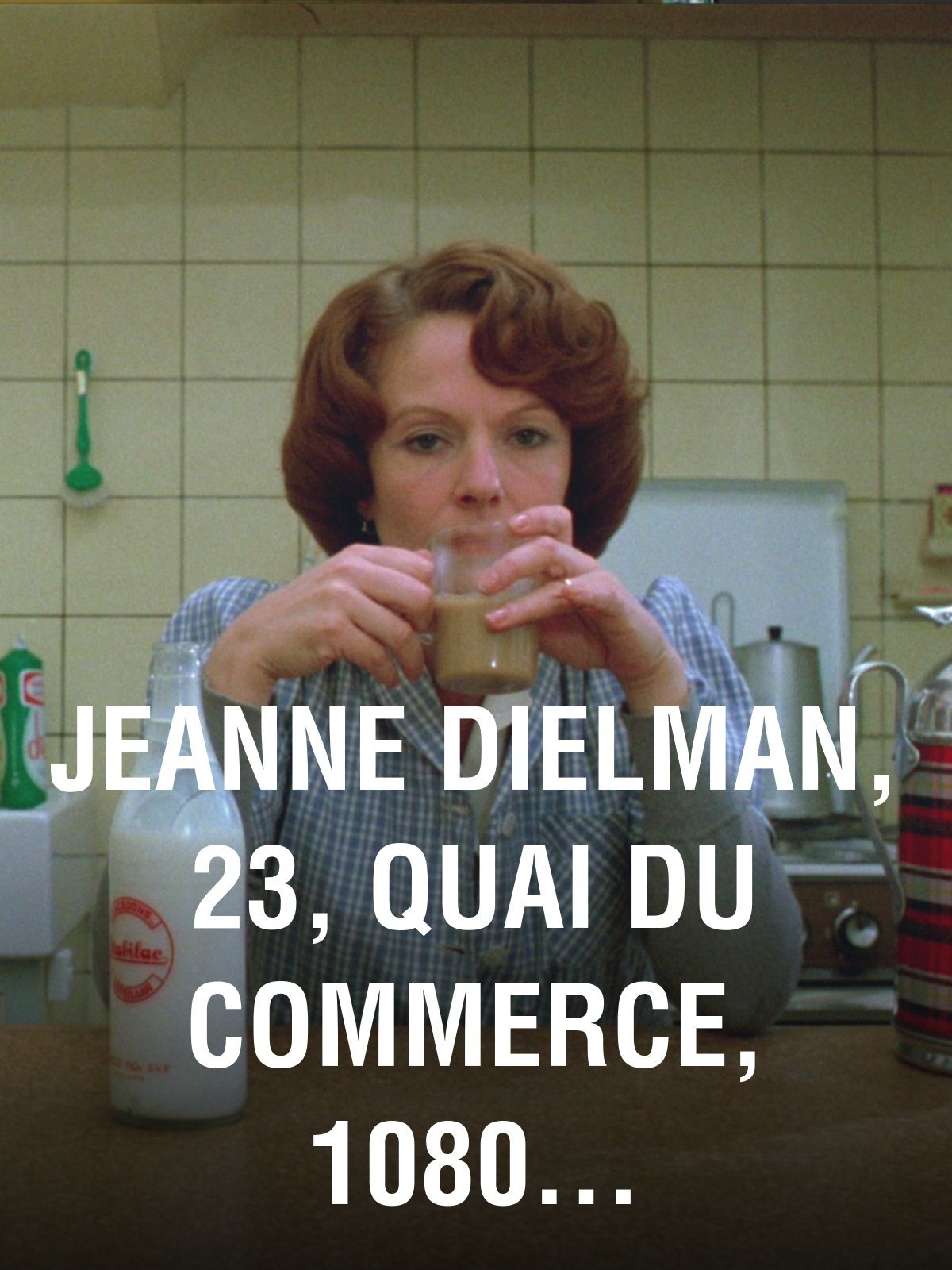
Delphine Seyrig was an extraordinary actress, and while her career was cut short in the early 1990s after an unfortunate battle with cancer, the mark she made on arthouse cinema is indelible. Jeanne Dielman, 23 quai du Commerce, 1080 Bruxelles is perhaps her most famous role, and it’s difficult to argue against the fact that this is her best performance – a character-study that is well over three hours in length, this is the kind of role absolutely any performer would sacrifice anything to grasp. However, its a role that required someone of singular talents, who could carry this film with a certain elegance that is just far more erratic than usual, and thus couldn’t be done with such conviction by anyone other than a performer at the very peak of their abilities. Seyrig was a very unconventional actress in her style of performance, and her perceived lack of vanity in her portrayals allows her depiction of the main character to be far more compelling had it been given to someone without the effortless subtlety that is demonstrated by the actress her. A performance that is more physical than anything else, the majority of the film is spent almost entirely wordless – it may even be possible to count the number of lines of dialogue Seyrig has throughout the entirety of the film, with the majority of her performance being entirely silent. By all means, this should be an easy role, at least from what it seems to entail – after all, Jeanne Dielman is not a particularly interesting woman, and her daily routine is composed of the precise chores that nearly everyone would do regularly as well. Yet, there is so much more to her performance than what is just on the surface. Seyrig is so perfect for the role, because her humility as an actress, at least in how she portrays her characters as being so empathetic, does well to complement the plainness of the role, which ultimately works to the benefit of the film, as it does hint at something far deeper, which is what makes this such a compelling experience – there always seems to be some hidden meaning lurking just out of view.
The titular character is not an easy woman to understand. We can credit this to Akerman’s steadfast refusal to ever let us anywhere near the inner machinations of Jeanne’s mind. There are so many moments of the character sitting quietly in silent contemplation, deep in thought. A more conventional film would populate these moments with voice-over narration, where we become privy to the emotional or mental state of the character and get a glimpse into their thoughts. Akerman’s intention is quite clear – we are not supposed to understand Jeanne, because she isn’t supposed to be a compelling character. She may be an ordinary woman, but the intention is not for the audience to form a relationship with the character. Her routine may be resonant, but as an individual, she herself is far from it. She is not an audience surrogate, and any attempt on our behalf to relate to her is merely superficial. She is an impenetrable character, and the fact that she is relatively unlikable without actually doing anything despicable until the film’s climax is a fascinating example of character development. Seyrig’s performance is one brimming with intensity, even if it isn’t overtly demonstrated for the most part. The many moments where she is entirely silent would otherwise appear to be quite dull had there not clearly been an underlying tension that only progresses as the film goes on. There is something very sinister simmering below the surface of this character, and Seyrig’s performance is simply astonishing because her ability to convey so much meaning without uttering a single word in these moments is indicative of not only a great performance, but of a profoundly talented performer.
Jeanne Dielman, 23 quai du Commerce, 1080 Bruxelles is certainly not a film for everyone, and its status as one of arthouse cinema’s most divisive constituents only confirms this fact. It’s an anomaly of a film – for every quality that would otherwise dissuade one viewer, there is another that is actively in pursuit of it. This is by no means a film that will ever appease everyone, and its reputation is not ill-earned. Like all great art, this film has numerous meanings and interpretations and considering she was amongst the most intelligent and insightful filmmakers of her generation, it is hardly surprising that Akerman would make a film so deeply complex in its innumerable themes and concepts, as well as its complete disregard for anything resembling resolution. It is a vague, often frustrating glimpse at life, presenting us with the director’s own vision of the existential ennui that comes with being average in a hostile world, and the pitfalls of being wholly unremarkable. This film has flourished in reputation over the years and come to be seen as one of the finest works of narrative fiction ever produced, purely because it dares to go against absolutely everything conventional about cinema – Akerman does not get nearly enough credit for the fact that not only was she a profoundly social filmmaker, who could tell stories that resonated through representation of marginalized and oppressed groups, but also because she was the most rebellious of her generation. Like her compatriot Agnès Varda, Akerman just did not play by the rules – in fact, she completely annihilated any sense of convention in her films, and whether in the realm of fiction or documentary, she challenged the boundaries of reality in a way that very few, if any, artist has been able to do with such profound and explicit earnestness and unhinged anger.
It has been said of Jeanne Dielman, 23 quai du Commerce, 1080 Bruxelles that it is a film where nothing happens – and in all honesty, even as an ardent proponent of this film, I tend to agree. Yet, it isn’t necessarily a shortcoming – sometimes the most overtly powerful works are those that are not exuberant or bombastic, where the message isn’t delivered in extravagant ways, but rather in a more subtle matter. The minimalistic nature of this film really is extraordinary and is precisely what sets it apart from other films which also seek to look at life as it is. In this film, banality is the central concept, with the director using it as a narrative tool. Akerman provokes the uneventful chores of everyday life as a way of commenting on the routine ways in which we exist. It almost feels as if Jeanne Dielman, 23 quai du Commerce, 1080 Bruxelles is composed out of the scenes cut out of other films, showing moments that are otherwise not even considered in most films: cooking, bathing, cleaning – these are all everyday occurrences, yet are rarely the focus, if they are even included in the first place. This film strings together the actions that occur in between major moments, repurposing them to be deeply significant, and deriving every bit of meaning from these activities that are normally performed without any thought to what they signify. Just like many of us, Jeanne is trapped in a routine – she may have the illusion of being able to do what she wants, but ultimately, while she may deviate from her routine in superficial ways, she ultimately ends up in exactly the same position, performing the same activities day after day – she is free to do exactly what society tells her to do. The film therefore questions what happens when a series of small but pivotal alterations to the routine occurs, and demonstrate how even the most marginal or insignificant of changes can push someone just a bit too far, and the internal cataclysm that can come with even the slightest modification of what we have adopted as being normal.
Jeanne Dielman, 23 quai du Commerce, 1080 Bruxelles also benefits significantly from the fact that not only does it have a fascinating story, it also hails from the mind of one of the most unconventional filmmakers of her time, with Akerman’s precise and direct approach to creating her art being impossible to ignore, and exactly what makes this film so memorable. This is a very innovative film, especially for the era in which it was made – structured over the course of three consecutive days, the film is composed of numerous individual moments, the majority of which take place in real-time. Only a handful contain any dialogue, and when there is some conversation, its normally on the most inconsequential of subjects – a letter from a relative, a discussion of dinner or just the relaying of a past event. It is easy to think that these dialogues just exist to show the simplicity of life, but when we realize that they do harbour some meaning, perhaps not in the content, but in their intention, it all starts to make sense – there is no metanarrative present in this film anywhere. Every time the viewer believes that an action is amounting to something, the tension is promptly deflated and life goes on like normal. Even the film’s climactic scene, where the titular character kills one of her clients, is performed like any other ordinary business – she stabs him in the neck with scissors and goes about her day as if nothing had happened. There is no coherent progression here, but rather a series of increasingly erratic changes that work towards an insatiable rigidity in the routine, which seems to always be on the verge of collapsing. Yet, Jeanne Dielman, 23 quai du Commerce, 1080 Bruxelles is not a film that gives up so easily – it relishes in its central themes, and its director’s own pursuit of some underlying existential understanding, based on her own nihilistic curiosities. The film’s composure – both its simple elegance, and its inventive form – is so abstract, but still so utterly brilliant, it never falters from its steadfast exploration of themes much larger than anything we ourselves can fully conceive.
There is very little doubt that Jeanne Dielman, 23 quai du Commerce, 1080 Bruxelles is an astounding achievement – it certainly is not an easy film to watch, but it is far from an unpleasant one. Akerman creates something truly extraordinary – a film with the scope of a great epic, confined almost entirely to one small apartment, she gets beneath the skin of the human condition, finding a certain elegance to even the most common of activities and evoking the spirit of existence in a way not even the most seasoned and iconoclastic of philosophers ever managed to do. Don’t let any criticism of this film deter you – Jeanne Dielman, 23 quai du Commerce, 1080 Bruxelles is quite simply an unforgettable experience. The length is admittedly somewhat excessive, but it would not have been effective in any other way – without it, the detail present in this film would have been lost, and the exhaustive representation of routine, which gives the film its nuance and effectiveness, would have gone entirely amiss. There may not be anything traditionally thrilling in this film, but it still manages to be truly enthralling, because the lead character is so fascinating, and watching her go about her day is almost hypnotic. The progressing banality of the film, with the most inconsequential changes, creates an uncomfortable tension that keeps the viewer transfixed, and eventually forces us into a state of almost unbearable discomfort, which is never satiated, rather continuing to build up until, much like the titular character, it comes out as overt frustration. This film is one where what appear to be the most unfortunate shortcomings are actually the biggest merits. It definitely is a film that benefits from an open mind and a great deal of patience, and if the viewer is willing to commit to it, they’ll find it certainly is a rewarding experience. There is a lot of underlying meaning to this film, and its message is impenetrable at the beginning, but revelatory by the end. Prior to watching this film, I had always wondered why Jeanne Dielman, 23 quai du Commerce, 1080 Bruxelles is considered such a centrepiece of arthouse cinema – having experienced this extraordinary work of art, I now understand: it questions existence, and looks at life in an almost voyeuristic way, as a series of individual moments not leading to some grand narrative event, but rather growing in tension until it reaches some metaphysical breaking point, and subsequently receding into a bleak but poignant portrayal of the meaninglessness of life, and the unrestrained beauty of banality.
 The Postmodern Pelican
Sight and Sound just named this film the greatest of all time. Personally, it is not even the best film of 1975. That title goes to Robert Altman’s masterpiece Nashville.