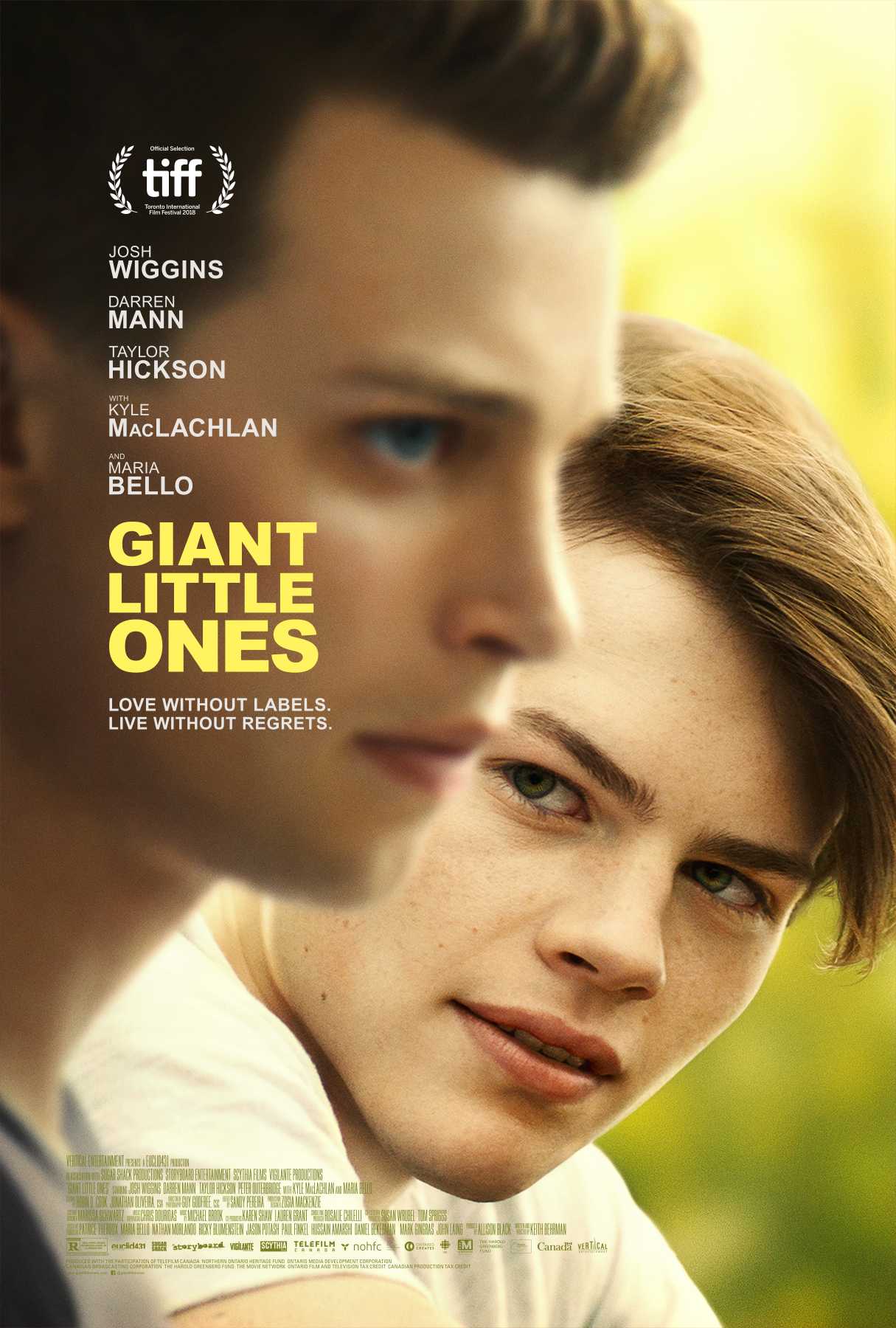
 Franky (Josh Wiggins) lives a pretty happy life. He has a loving family, is extremely popular at school, has many girls fighting for his affection and most importantly, has a solid friendship with Ballas (Darren Mann), who has been at his side since they were children. However, below the surface, there is something deeper troubling Franky. His family life is far from ideal, especially considering just prior to the events of the film, his father, Ray (Kyle Maclachlan) left his mother for another man, a move that angered Franky and made his lash out and cut off all contact with his father, who he sees as having betrayed his family and their trust by concealing such a huge secret for all those years. It’s only made worse when, after a night of heavy drinking, Franky and Ballas drunkenly end up having something close to a sexual experience, which terrifies both of them, as they had never actually considered that there may be something deeper to their friendship, or even that they possessed such desires. Franky attributes it to a drunken haze, whereas Ballas is far more bitter, and estranges himself from his best friend, and spreads rumours that Franky tried to come onto him when in actuality, all signs point the other direction. Now faced with disdain from his peers, who aren’t so much disappointed at the fact that he may be gay, but rather that he hid it from them and allowed it to manifest in a secret incident with his best friend, who is in a committed relationship himself. Very soon, Franky finds himself turned away from the circles he so happily was a part of, only to be accepted into new ones, with people who had experienced the same social rejection that he is currently feeling.
Giant Little Ones is a powerful film. A sincere and humble independent drama, it tackles some broad themes with a blend of kindhearted authenticity and unbelievable honesty, and looks at issues that aren’t often represented in quite this way, and usually relegated to the background in most other instances. This is a great addition to a canon of films that is ever-growing, looking at the intersections between society, sexuality and the self, delivering a heartbreaking but uplifting message about acceptance, tolerance and most importantly, finding the truth within oneself to be who you want to be, not worrying about the opinions of others. However, things aren’t always that simple, and most of the time what is easy to say is rarely ever just as easy to put into practice. Keith Behrman, in his second feature film (and his first since 2002’s harrowing independent drama, Flower & Garnet) crafts a beautiful film about friendship and identity that goes to some very dark places, especially in how it portrays the plight of the main character, who not only finds himself shaken by the realization that he might not even know who he is himself, but also that those who purport to be closest to you and will always stand by you through the most difficult of circumstances will have no problem in abandoning you as soon as it gets uncomfortable. Its a sweet and endearing film that has a great soulfulness, and stands as one of the year’s most brilliant hidden treasures.
At the centre of Giant Little Ones is Josh Wiggins, who takes on the leading role of Franky, a young man who is trying to find his place in the world. His life is relatively easy – he is well-liked and seems to be on the path to great things. However, he is not fully-realized as an individual yet, a stark fact that he discovers only after an uncomfortable incident, which changes his life – the film’s question is whether this was for better or worse, because it seems to be capable of shifting the entire course of his life, and showing him that even when we think we have absolutely everything about ourselves realized, there are some surprises that come to all of us and that in those moments of great internal vulnerability that we find out who we truly are. Its a beautiful performance from a young actor who seems to be well on his way to stardom, having previously appeared in some memorable films throughout his short but impactful career so far. Giant Little Ones is a film almost entirely anchored by Wiggins, whose dedicated performance is amongst the year’s most moving. The role of Franky is not too different from the archetypal conflicted teenager – he is genial, effortlessly endearing and possesses very few flaws of personality that would make him unlikable, other than his rugged stubbornness that serves to be the centrepiece of the film’s representation of his attitude to the world around him. Its beautifully evocative work from the young actors, who performance hints at a deeper maturity that makes it such affecting work.
Franky is a compelling character because he feels so regular – we all know someone like him, and thus his journey to self-realization is one that is even more endearing. We undergo the same journey as him – Franky discovers these underlying feelings alongside the audience, making this less of a revelatory film, but rather one that shows a young man developing and discovering his own identity. The same can be said for Ballas, but only to a lesser extent as he is merely secondary to Franky’s own metaphysical journey to understanding who he is, and the place he occupies in the world. There is certainly not a shortage of these kinds of stories, whereby a teenager comes to terms with the fact that despite thinking they know everything, sometimes we don’t even know ourselves all that well. This is presumably what the title refers to, at least from my perspective. At the age of sixteen, we think we know everything, and consider ourselves something akin to giants in the world. Its a tendency of the teenage years and one of the most interesting parts of growing up is developing that momentary arrogance that we are proverbial “big fish in a small pond”. However, as I am sure everyone agrees, we don’t realize how little we actually know – at that point, we’re the “little ones” – we still have so far to go, and while the seeds of our future selves are sown during this time, we don’t realize how we still need to learn so much about life. Its one of the main messages of this film, and precisely what makes it so compelling, because whether or not we can relate to this story, the resonance of the themes is potent, making for a truly poignant experience.
Wiggins is supported by a great cast of supporting players, many of which give extraordinary performances. Darren Mann is wonderful as his best friend who later turns on him after an unfortunate experimental encounter. Ballas is a character who is just as conflicted, and the film is careful to not portray him entirely as a villain, but as someone who is also trying to understand his own identity, but fighting out against what he is realizing to be true, rather than working through it like his friend does. Taylor Hickson is exceptional as Ballas’ younger sister who has had her own experiences in the past that have made her a social pariah, and an unlikely friend to Franky, who she soon sees as being not an adversary, but someone just as confused as her. The heart of the film is Kyle Maclachlan, whose small but pivotal role as the protagonist’s father gives the film an immense amount of emotional gravitas. As the man who had to make the difficult decision of breaking apart his perfect family due to the fact that he just couldn’t hide his own identity any longer, Maclachlan is at the core of the film. His role in the first act is relatively subdued, appearing only momentarily as a platform upon which Franky can express his anger and hostility, as well as work through his embedded prejudices. Yet, in the second part, his role is considerably more pivotal, with his performance being a masterful example of restraint and sensitivity. This is one of the year’s best performances, an intricate and lived-in performance by one of the most unheralded character actors of his generation, whose empathetic portrayal of a man trying his best to rebuild his own shattered life, but also be a good father is truly memorable.
Interestingly, Giant Little Ones is not a film that can necessarily be considered a “gay film” despite the fact that it has overt queer themes represented throughout. Its a film about two issues that are directly related to the concept of homosexuality, which makes it a very unique example of contemporary social situations. The first is that of identity. The two main characters in this film are young men who are undergoing a crisis of identity, questioning who they are after a fateful event that would be otherwise natural had they not attached this stigma of abnormality to it as an instinctual response. The second theme is tolerance – by the end of the film, we don’t know how Franky identifies in terms of his sexual orientation – a discussion with his father brings the conclusion that it doesn’t matter who someone is drawn to, love knows no boundaries. Its a trite and cliched saying, but this film embodies the concept of “we fall in love with souls, not bodies”. Its clear that Franky and Ballas loved each other – and whether that be as friends, or something deeper, it just means that they found kindred spirits. Unfortunately, considering the awkward stage of life they’re in, they naturally rebel, because to a teenager like them, nothing is worse than standing out, and this incident, while entirely normal and not deserving of the tension they subsequently experience, thrusts them into a difficult position, in which the only natural response is to fight back against the cause. This film shows that it’s alright to question who you are – even Franky’s father, in his middle age, didn’t know who he was. We are all growing and developing, and ultimately, we can never know for sure who we are, or who anyone else truly is. However, we can practice tolerance, and this film’s message may be a bit heavy-handed, but the intentions are earnest and honest: kindness costs absolutely nothing, and it could help someone struggling with their identity find comfort in knowing that they’re not alone.
Giant Little Ones is a terrific film. Its a sweet and charming independent drama that wears its heart on its sleeve, and has a great exuberant joy lurking beneath the sometimes bleak social commentary. It may not be the most well-written of films (some of the dialogue is very stilted, as well as some of the moments of humour feeling very much out of place), but it makes up for it in its easygoing, earnest pace, its beautiful meditations on life and lamentations on how we all go through these difficult experiences, and its admirable sensitivity to issues a lot bigger than what we normally see represented in these kinds of films. This is a more mature story, one that doesn’t necessarily pander to teenagers as much as it shows the teenaged years in a way that is melancholic and profoundly moving. Its a remarkably simple film, but one that packs an impactful message that never falters. Whether it be in the astonishing leading turn from Josh Wiggins or the incredible supporting performances, this is an emotional experience that shows us that it is alright to be different and that if everyone were to be the same, the world would be hopelessly dull. Its a beautiful celebration of individuality, and a comforting reminder that not everything needs to make sense – we should focus on the journey rather than concerning ourselves with the final destination because if we don’t, we might miss the beauty that comes even in the hardest of times. Just wonderful, warm and endearing work, and one of the year’s most unheralded films that deserve to be seen and adored.
 The Postmodern Pelican