 Before he was the cinematic stalwart he is seen as today, the creator of such inventive and brilliant visual odysseys such as Crouching Tiger, Hidden Dragon and The Life of Pi, Ang Lee was just another young Taiwanese filmmaker crafting intimate dramas that portrayed his home country and its rapidly changing social and cultural situations with as much earnest honesty as possible. One of the defining works of his earlier career is Eat Drink Man Woman (Chinese: 飲食男女), a quaint but lovable comedy-drama that shows Lee focusing on several important themes that are both pivotal to the cultural context of the film, as well as being universal – family traditions, love and most of all, food. It is a delightful film, a beautifully-constructed exploration of the human condition and a steadfast celebration of all of life’s idiosyncrasies that make existence such a challenging but ultimately rewarding experience. Lee may have made an indelible impression for his broader, more resonant works, but I will always stand by my belief that he is at his very best when he’s at his most simple – previously films like Brokeback Mountain and Sense and Sensibility alluded to this, but Eat Drink Man Woman quite remarkably just confirms it – Ang Lee isn’t only one of the modern era’s most audacious directors, he’s also one of the most empathetic and insightful.
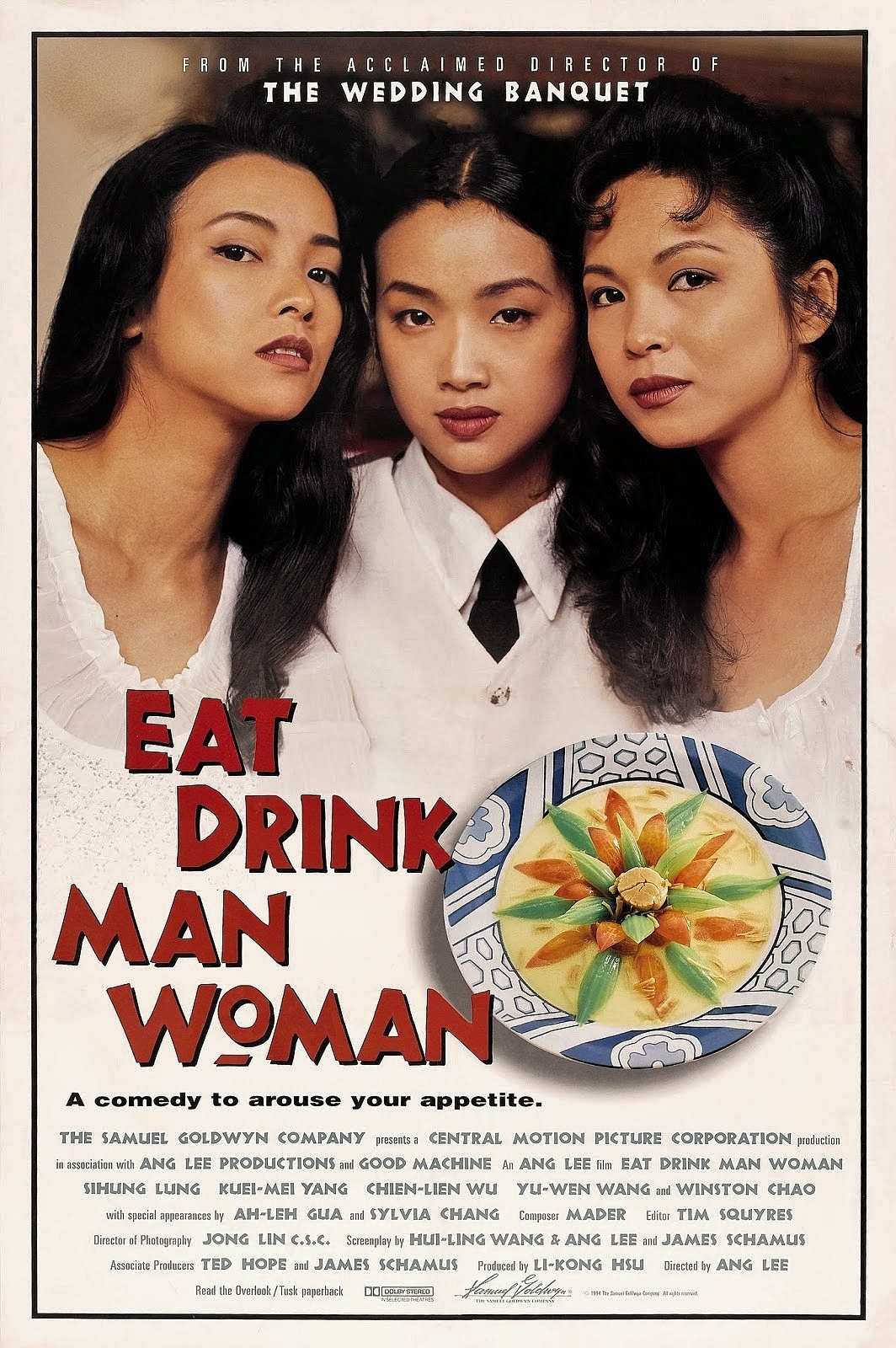
Eat Drink Man Woman is set in a small town in Taiwan and focuses on Mr Chu (Sihung Lung), an elderly man who is a renowned chef, but has retreated into semi-retirement, putting all of his trust in his young proteges to carry his restaurant and do his name proud. He doesn’t completely dismiss his passion for cooking, as he and his family have a weekly ritual – every Sunday, Chu cooks an elaborate banquet for his three daughters, who gather around the small dining table in their modest home and share in the food that their father so lovingly prepares for them. However, each of his three daughters also brings their secrets to what they call the “torture chamber”, as each one of them is living their own lives that are as different and tumultuous as the experiences of any young person trying to navigate the world. Jia-Jen (Kuei-Mei Yang) is a lonely Chemistry teacher who is derided by her students who see her as needlessly strict. Jia-Chien (Chien-lien Wu ) is an executive who is making an impact on the airline industry, rising in status in a very short time due to her audacity and motivation to do well. Jia-Ning (Yu-Wen Wang) is still in college and makes a paltry living in a fast-food restaurant. Each of Chu’s three daughters is trying exceptionally hard to stay within the confines of their traditions without being limited to the simple life of their ancestors, finding love, nursing broken hearts and rebelling against a generation vehemently against the old ways. Yet, despite their differing paths and their varied personalities, they still gather every Sunday without fail, to share in their experiences and depend on the other in the way only those closest to us can.
What makes Eat Drink Man Woman so effective is that it has two very strong qualities that helped establish this film as a definitive entry into this generation of New Asian Cinema. The first is that it is extremely modern – Lee doesn’t intend to show any disdain or disrespect to the culture in which he grew up. Rather, he attempts to modernize it, showing Taiwan as a country guided by its historical principles, rather than defined by them. The younger characters in this film understand the importance of their cultural background, they just choose to follow a more modern path, one defined by experiences that extend outside the quaint kitchens of our childhood homes, and into the world at large, where each person becomes a global citizen, one of the billions of people around the world, separated by geographical borders, bound by shared desire to experience the world as far as possible, even if its from within one’s own hometown. Eat Drink Man Woman is a remarkably refreshing film when it comes to showing the disparity between generations – there is a symbiotic respect occurring between the different groups, who may not understand the customs and values of the other, but still respect them earnestly. A film that shows the metaphysical movement between generations can only be made effectively when it is coupled with clear compassion for the culture, and empathy for the experiences of people of different generations, and its in this approach to telling this story that Lee manages to make something truly special, because even when it begins to falter and appear to be exposing the harsh incongruency between individuals, the director pulls everything together with his empathetic vision, delivering a film about a region undergoing major cultural, social and economic change.
The second quality of Eat Drink Man Woman that we can view as being indicative of its success is its simplicity. While this may be an effective story about modernity in contemporary Taiwan, what makes this film so compelling is that Lee opts to make something so effortlessly light and endearing, it almost feels deceitful to say that it contains some profound social commentary. This is an extremely funny film, one with the most gentle of touches of humour flowing throughout like a calm but steady breeze, one that never really incites much overt laughter, but creates a genial, pleasant atmosphere that allows these moments to come to fruition naturally and without any direct force. Less of a film with a concise plot structure, and more of a snapshot of life during that era, a series of moments experienced by different individuals of the same family, interwoven as a poetic and often deeply sentimental mosaic of life and its various moments that may appear inconsequential on the surface, but harbour deeper meaning below the surface. For a director like Lee, who has been renowned for his ability to navigate complex plots and deliver remarkably difficult stories, to have made something so dependent on the strength of the story rather than the intentions of the film may appear incongruent – but considering he is someone who has shown himself adept at both intimate, character-driven stories and more challenging, difficult films, it is hardly any surprise that even when tasked to deliver something as subtle as Eat Drink Man Woman, Lee does so with utter perfection. He is someone who has certainly helped define the modern era of visually-oriented filmmaking (even Billy Lynn’s Long Halftime Walk has some merits and deserves reevaluation), I do hope Lee does take another foray into this form of minimalistic storytelling because this is where his talents flourish the most.
Like any great film about the human condition, Eat Drink Man Woman is entirely dependent on two aspects: the script and the cast. We have already established how brilliantly-written this film is, especially in how it represents the rise of modernity in a way that is profound without being deriding, as well as the simplicity of its execution. The premise was there, and all that is left is how the actors interpret it. The performances in this film are extraordinary – Sihung Lung is certainly the standout, playing the central role of Mr Chu, the patriarch of the family at the core of the film, and the impetus for a lot of the stories that are woven throughout this epic family odyssey. His blend of pathos and humour are extraordinary, and in playing a representative of the older generation, he is given the chance to play someone hesitant of the wave of modernity, but still cognizant enough of its inescapability. He is firmly rooted within his traditions, which manifest in his love for cooking, not only because it reminds him of his country’s rich history, but also because it symbolizes family unity, where everyone can sit around a table and share their secrets and experiences with those who are closest to them. Its a beautifully subtle performance from Lung, whose exceptional control over a character who is supposed to be the anchor to a family defines this as one of the most moving performances in the entire film. The three daughters are all excellent, but it is Chien-lien Wu who takes the most focus. Playing the second-born daughter, she is caught in the middle, not only in terms of the familial structure but also in life. She is the one whose career can actually flourish the fastest and take her the furthest, but she’s also the one who harbours the most sincere sentimentality to the traditions, understanding that without the customs of her ancestors, and the way of life she grew up with, she would never have been able to succeed in the way she did. Wu is the heart of the film, with her experiences being the most resonant, and considering this film ends with her achieving her only true goal – finally earning her father’s respect – it isn’t entirely wrong to say she is the driving factor of the film as a whole. The cast in Eat Drink Man Woman are all astonishing, and like any ensemble, they are each given their unique moments, and what allows this film to soar isn’t these individual moments on their own, but rather the sight of them all coming together in perfect synchronicity.
Eat Drink Man Woman is a wonderful film – it feels both intimate and epic. In terms of the former, its not much else other than the story of one family and their individual lives, with their unique experiences interweaving into a complex portrait of a group of different people who share a common background. Yet, it feels so much bigger than just being about one family – Eat Drink Man Woman almost appears as if Ang Lee is trying to represent an entire era into a single story, whereby the concepts of family, romance and modernity all come together through the lives of the Chu family, demonstrated in their individual journeys and manifested in their weekly dinners, where they bicker and debate, as well as laugh and share moments of genuine joy. Taiwan was a country in flux at the time of this film’s inception, and it would be foolish to not consider that there was some broader socio-cultural undercurrent to this film – Lee does mask it relatively well, only allowing it to peer from beneath a well-guarded boundary of sentimentality and heartfelt comedy, but not entirely ignorant of the higher concepts that were present at the time. It is gorgeous work, a deeply compassionate exploration of the human condition, and the tenacious drive to move forward, to use our cultural background not as the rulebook, but as a guiding force to living our own lives and going about our own individual journeys. Life is filled with so many basic passions – as the title so elegantly reduces existence to simply “eat, drink, man, woman” – but it is our own nuances that give it meaning. In all honesty, Eat Drink Man Woman is a towering achievement and a truly wonderful piece of cultural storytelling.
 The Postmodern Pelican