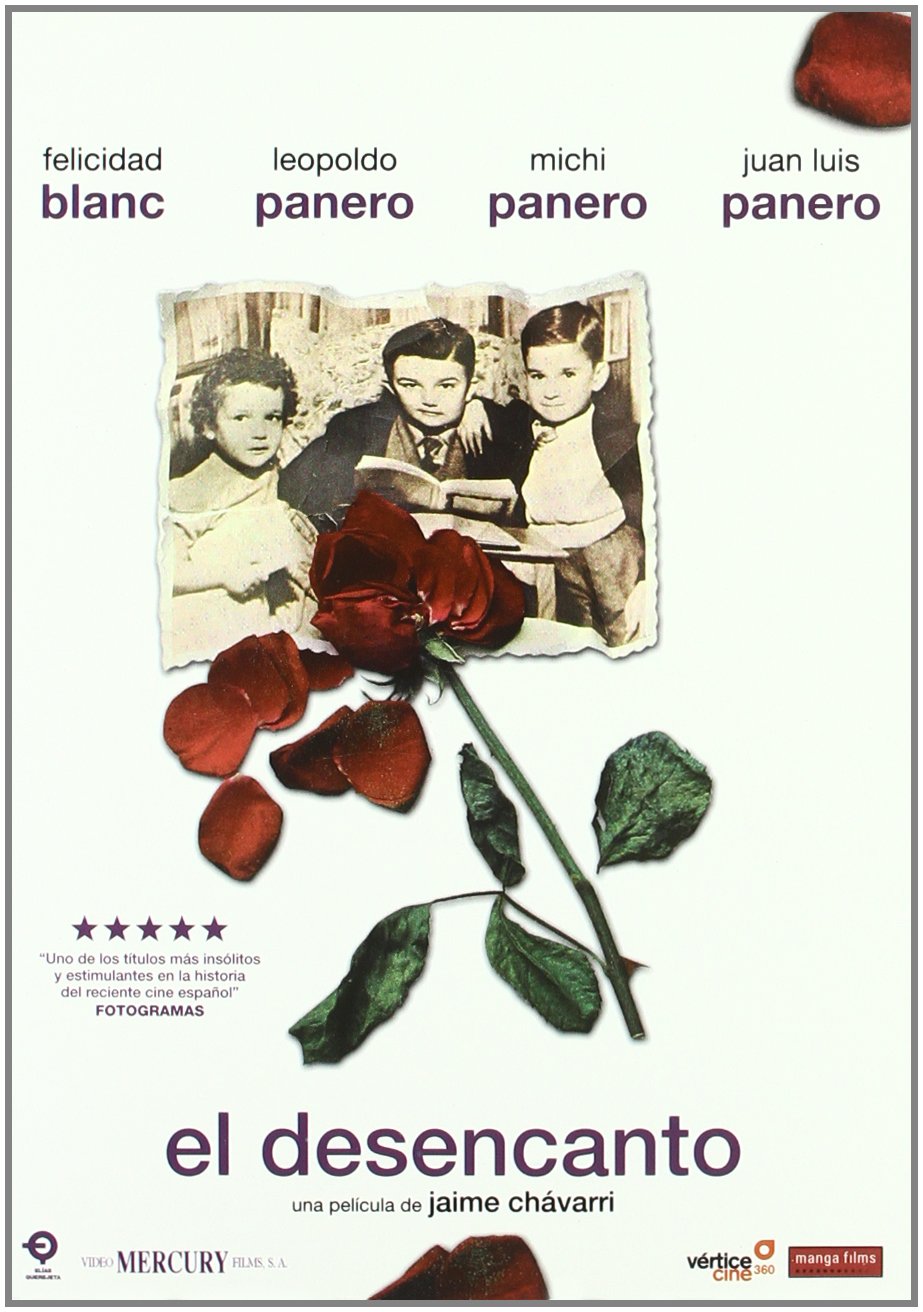
 Over the past few decades, the private lives of some individuals have become increasingly public with the rise of reality television and more intimate documentaries. We can point to two specific early examples of personal life being public entertainment. The first is An American Family, the PBS documentary series broadcast in the early 1970s that chronicled the daily life of the Loud family. The second is the work of Albert and David Maysles, who essentially helped create the cinéma vérité style of filmmaking. Grey Gardens was a watershed moment, not only for the Maysles as filmmakers but for every documentary filmmaker who came after them. The influence of Grey Gardens can be seen the following year in El desencanto (The Disenchantment), the astonishing documentary by Jaime Chávarri, which serves as a chronicle of the life of Leopoldo Panero, or more specifically his wife and three sons who talk about the late poet and explore their relationship with him over the years. A fascinating film that is built entirely on the subjects and their testimonies, El desencanto is a powerful, beautifully-composed documentary that looks at a lot of themes and focuses on certain ideas that would otherwise go amiss had Chávarri not opted to foreground them and explore them in significant detail, making this film one of the finest to come out of post-Francoist Spain, and a gorgeous time-capsule of an era that saw a country in rapid transition.
Truth is a tricky concept – one would normally think if any film genre was wholly committed to the truth, it would the documentary. Anyone who has seen some of the less-ethical documentaries produced over the years will know that this isn’t the case – non-fiction filmmaking can be the most poignant and moving, but also the most deceiving, with manipulation being rife in some of the more notorious contenders, which try and make the audience feel something by force rather than providing commentary on a certain issue and looking for organic reactions. The reason to bring this up is that Chávarri was someone who was clearly interested in the truth, going so far as to positioning El desencanto not solely as a testament on the life and death of a famous writer, but also as a film about uncovering the truth hidden in the lives of our most admired public figures. In this film, there is a clear duality drawn between reality and fiction – but not in the traditional way we’d normally expect, but in a more subversive manner that is oddly more honest and provocative. Towards the end of the film, one of Panero’s sons mentions there are “two stories” that can be told about their family – the first being the epic, romantic and heartbreaking tale of an iconoclast who fought against all odds and came through as one of his nation’s finest artists, leaving behind a powerful legacy upheld by the perfect family he created. This is the story audiences wanted to hear, and filmmakers wanted to make. These stories are triumphant, heartwarming and rousing. They’re also fundamentally inaccurate, with the second kind of story being the truth – the private lives of the Panero family, and their various affairs that happened behind closed doors and away from the public. Tales of heartbreaking, marital problems, time in prison, emotional abuse and even some suicide attempts are what defined this family, not the towering achievements of their patriarch. Unfortunately, as noted by his son in this moment, audiences don’t want to hear such stories. Perhaps now, when we have stopped deifying public figures and holding them accountable as humans who are not immune to reality, such a story would be better received. Yet, who at the time would possibly want to hear about a man who may have been talented, but was also not without fundamental faults of his own that were far more sinister than even his greatest works.
Like most of the audience residing outside Spain, I wasn’t entirely aware of who Leopoldo Panero was before watching this film. By the end of it, I felt like I had become a minor expert in his life, based entirely on the film’s daring approach to exploring who he was and what he achieved, despite being made a decade after his death. He lives through the testimonies of his widows and sons, who collectively relay the poet’s life and achievements through their stories. Some of them are glowing and offer only praise to a man considered a genius. Others are not quite so flattering – but they’re honest and fascinating. Yet, despite being entirely focused on the man, there is not a single image of him anywhere in this film. Not once do we see any form of visual representation, or any of his work shown. Not even the statue erected in his honour is seen – it appears as the opening and closing shots of the film, but remains shrouded in a veil as it has yet to be revealed to the public. What makes El desencanto so daring is that despite being promoted as a film focused on the life of Leopoldo Panero, this is not a film about him as a person or poet, but rather a film about his family and how he influenced them each individually. The key to this is that not even the people being interviewed are aware that the filmmakers aren’t entirely concerned with Panero’s career or achievement, but rather on his influence as an individual. The focus is on his family, and this is where El desencanto is most effective – it presents us with a powerful and heartwrenching tale of the burden of being close to someone who is so revered and beloved by the public, but so mysterious and elusive when it comes to those in his family. So many of these kinds of stories tend to err towards defending the subject as some tortured genius whose actions were acceptable because he or she was acting in the interests of their art. This film, without even knowing it, made a statement that resonates with audiences today as well: no matter who you are and how much power you have, you should be held accountable and understand that you can do better.
To be fair, Leopoldo Panero wasn’t necessarily a bad man – there aren’t many instances of his family speaking ill about him. Even his sons, who certainly had difficult relationships with their father, still clearly respect him. There’s a quality to this film that is so distinctive – all the characters speak about Panero like he is still present, waiting just offstage, listening to every word and ready to react should they not say something complimentary or flattering. Whether or not he did everything his sons claim he did the film paints a very unique picture of him as a subject, as they are all clearly still intimidated by him, even in death. Some would call it respect, others fear. Perhaps the most accurate description is to consider it a mix of both. The family, for the most part (especially his sons), don’t speak always of fond memories and are not afraid to speak frankly, but even at their most harrowing, their testimonies clearly have some respect embedded deep within them. The hold Panero had on his family manifests here, as we see them trying to overcome the fact that this important man is no longer there to defend himself, and can be spoken about directly. Yet, they still hold him in the highest esteem, even if he did not always warrant it. The private lives of artist are often folly for tabloids, with the more sordid tales being the most sought after. But El desencanto paints a very different picture, showing how someone who has since departed remains omnipotent – and just like their legacy, their actions towards others linger on long after their lives have ended.
As a documentary, El desencanto is a pivotal piece of early realist non-fiction filmmaking. This kind of film was normally restricted to underground filmmakers, with Shirley Clarke and the aforementioned Maysles Brothers holding the fort in the USA, whereas a few European filmmakers peddled their craft but without as much exposure as these more realistic films would come to receive in subsequent years. No longer was a documentary meant to be about “something”. It was perfectly acceptable for a director to find a worthy subject and interview those who have some insight into that subject without necessarily becoming too involved themselves. It leads to an almost voyeuristic experience, with Chávarri stepping away from any active role and allowing the film to exist solely on the testimonies of the small group of people involved – most of the film isn’t even spent talking to the director, but to each other, which gives the audience the impression that we are witness to a very private set of conversations, which evokes far more gravitas and realism to the film. These characters are not searching for approval from the audience – they almost act as if the audience doesn’t exist (yet they still openly indicate they are aware that they’re in a film, which is a concept that isn’t often glimpsed in many of these kinds of documentaries that propose themselves as “fly-on-the-wall” films). A documentary doesn’t need to have a structure, and this one certainly defies any guidelines, with the conversations being disjointed and arbitrary, but ultimately effective, as Chávarri didn’t intend to make the definitive film about Leopoldo Panero, but rather chronicle his family and their trials and tribulations. Ultimately, it is a wonderful documentary, one that transpires naturally and without any unnecessary manipulation. It is an authentic, stark documentary that tells a simple but fascinating story, and stands as one of the best early examples of gritty documentary realism. It’s a beautiful film that is equal parts amusing and harrowing, and is more than deserving of its place in the canon of great non-fiction filmmaking.
 The Postmodern Pelican