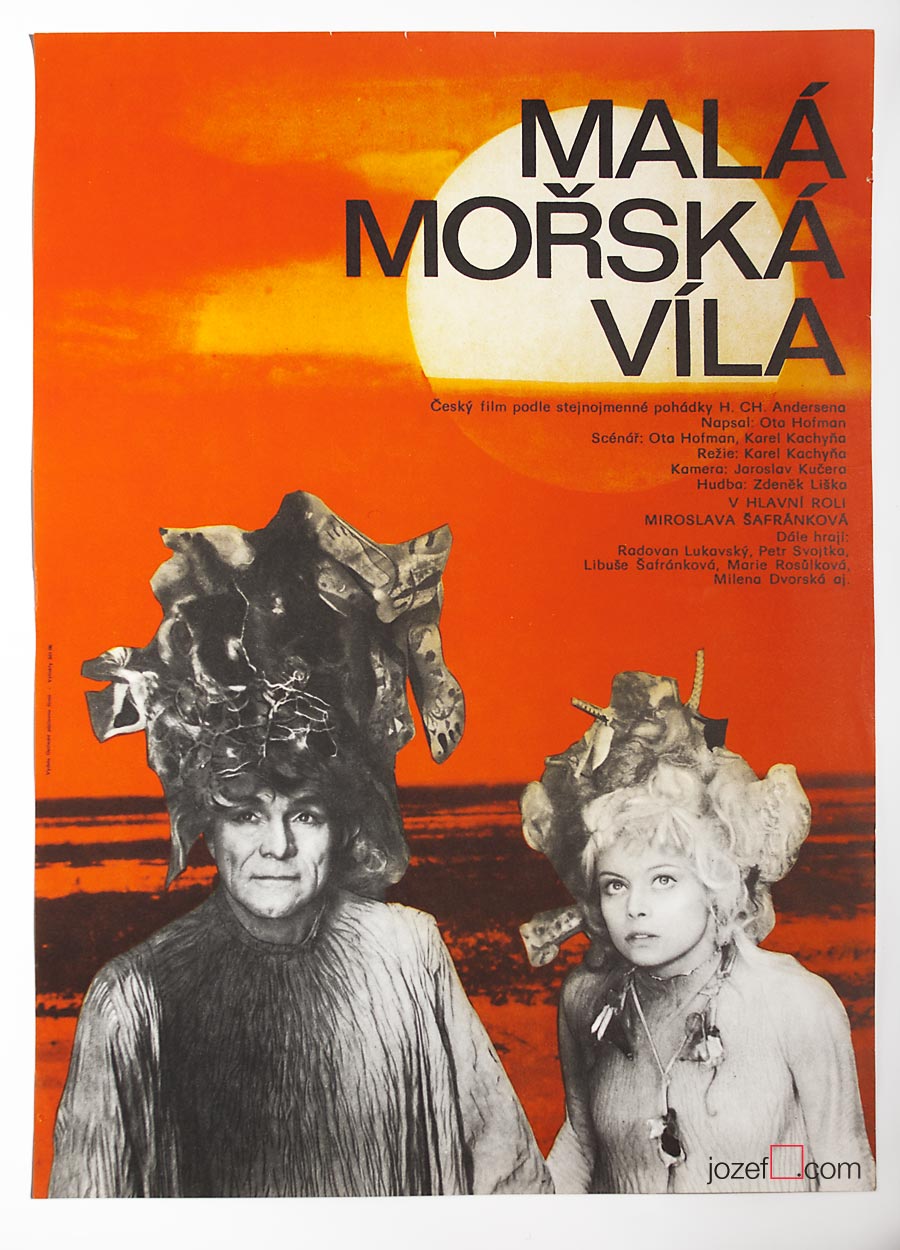
 I often wonder how the original authors of fairytales would react when presented with the different ways their stories have been interpreted over the years. One writer, in particular, I wonder about is Hans Christian Andersen, who is responsible for some of the most legendary stories of folklore and fantasy ever written, with his work spawning an endless panoply of productions over the course of the centuries since it is been written. One of his most famous works in The Litte Mermaid, which was most famously adapted as an animated film in 1989 by the Walt Disney Company, with this iconic film remaining by far the most popular version of this story – but there have been times we have ventured under the sea to an aquatic world that doesn’t necessarily contain singing fish, a Jamaican crab and transgressive drag queen-inspired villains. The most fascinating version of this story is Karel Kachyňa’s The Little Mermaid (Czech: Malá mořská víla), an interpretation of this story that is far darker and bleaker than the more innocuous adaptations of this story, but also a beautiful, challenging work that is undoubtedly magic manifested onscreen. There is very little chance that this version of The Little Mermaid will ever be held in such high esteem as the more famous adaptations, which is unfortunate, as what Kachyňa does with this story is nothing short of astonishing, and just about as breathtaking as a film like this can be.
By now, I’m sure every one of us is well aware of the premise of The Little Mermaid – a young, naive mermaid, the heiress to the monarchy that rules over the entire sea, grows bored of her comfortable life and goes in search of excitement. Her curiosities surrounding the world above get the better of her, and she falls in love with a handsome prince. Wanting desperately to enter into his life, she seeks the help of a powerful but malicious sea witch, who gives her the chance to become human, in exchange for her beautiful voice. Our protagonist obliges – who needs a voice when you can be human and in love? Of course, there are complications along the way, and our heroine is faced with severe problems that she foolishly didn’t consider before undertaking such a task of becoming human. This seems to be the common thread in almost all adaptations of Andersen’s story – and Kachyňa’s version bears remarkable similarity, albeit differing in two ways – firstly, it is far less extravagant and relies less on excessive effects as a result of the smaller budget, and secondly, this is far more analogous with the original story, insofar as it is darker and more profound in the exploration of the themes – it may not be the triumphant, lovable Disney classic, but if you’re looking for a fascinating and no less gorgeous approach to this famous story, you could definitely do worse than this extraordinary version.
Kachyňa was a visionary filmmaker, and many of his films, especially The Ear (or Ucho) remain pivotal moments in the period known as the Czech New Wave, a cinematic era that is amongst the most fascinating, not only because of the stories being told (normally being socially-charged and rife with political commentary), but because filmmakers such as Kachyňa and his contemporaries were exploring genres and telling unique stories, blending broad conventions and common, well-known stories and tropes, with their rich history of folklore and fantasy. Some of the most imaginative films ever made come from this period, and whether they are original pieces or adaptations, they are truly enthralling to experience. The Little Mermaid certainly stands as one of the very best, with the filmmakers taking a well-known story and infusing it with rich, evocative imagery and a certain thematic undertext that speaks to concepts far above the confines of a simple fairytale. In many ways, this version of the story is one of the more mature interpretations, retaining Andersen’s bleaker and more harrowing tone, but not sacrificing the childlike wonder we all experienced when hearing these fairytales when we were much younger. Reading reactions to this film from those who have seen it throughout the year confirms that while this may not be widely seen, it is one of the most admired by those who have, and it remains one of the more revered versions of the story and is in dire need of revisiting by a wider audience who would be able to witness this gorgeous spectacle for themselves.
The Czech New Wave, as mentioned before, was defined by certain qualities, and one of the less-positive ones was the shortage of funding for projects like this. The Little Mermaid certainly has a decent budget, more than sufficient to realize Kachyňa’s vision, but in a way where certain issues are overcome through sheer cinematic creativity. The film embraces difficulties in realizing some aspects of the story, and the result is even more magical, because not only is it so unconventional how this film was made, the suspension of disbelief lends the film an undeniably enchanting appearance. The underwater scenes, filmed in what appear to be subterranean caves, are bewitching, all the merpeople wearing gorgeous blue and green outfits, which contrast beautifully with the lush red and gold hues that our heroine will soon be encountering. The production design is simple but effective – Kachyňa doesn’t neglect to use every resource he can to evoke the magic of this story, but there is a certain charm that comes with the rugged, practical effects that go into this film. There are no special effects, with the magic being contained within the costumes and the production design, which are filled with exuberance and energy, far more than if this film was made now, where the temptation to use more contemporary methods of artificial magic would’ve stripped this film of its captivating nature that puts the viewer into a pleasant, giddy trance of pure awe. It is rare something so simple can evoke such a visceral reaction, but there is just something about how Kachyňa adapts The Little Mermaid that just remains astounding, even by modern standards.
Anchored by a strong performance by the spellbinding Miroslava Safránková, who gives a compelling performance as the titular character who goes unnamed throughout the entire film, being referred to only as “Malá morská víla” (“the little mermaid”). She navigates the film well, both directly in terms of its broader status as a retelling of a classic fairytale, but also in the underlying story, with Kachyňa imbuing this film with a much deeper meaning than what we just see on the surface. This is a film less about a mermaid simply wanting to enter into the human world, but rather an analogy for growing up. The Little Mermaid is repurposed as a very unconventional coming-of-age story, featuring all the elements of a more traditional film about a young person caught in the awkward period between adolescence and adulthood, which represent the broader concepts of innocence and experience. This film depicts the process of someone becoming keenly aware of the world around them, and falling victim to their curiosities, being driven by the primal urge to explore and provoke the unknown. It isn’t only the human world that enchants our protagonist – it is also her romantic awakening, where she falls in love with a human, who she hopes will return her love should she become human. She goes to any length to ensure this happens – but when it comes at a price, she has to adapt to changes in her life, and realizes what we all do in those challenging years: just because we know what we want doesn’t mean we need to pursue it all the time.
The quirky awe and wonder that occur alongside this story in other cinematic versions are not entirely lost here, but they’re replaced more with mesmerizing glimpses of the world beneath, combined with lush extravagance in the moral world, which don’t only make this a beautiful film, but also a very meaningful work when we see how Kachyňa oscillates between the two different worlds as motifs for the process of maturing and growing up. The Little Mermaid is as dreamlike and surreal as the Czech New Wave has been known to be, making full use of the fact that many of these directors had tremendous imaginations and the ability to realize their visions through any means necessary, and with terrific performances from a great cast, and a general sense of pathos and good-hearted humour, this is an entrancing, gorgeous film that approaches Andersen’s story with respect and firm adherence to his central themes, not trivializing underlying themes, but also extending them to be subtle but effective commentaries on more resonant subjects. There is something so undeniably profound about this film, and whether it be the unique way the story is told, the impressive and enthralling design, or just the thematic underpinnings, it would be foolish to consider The Little Mermaid as anything less than an astonishing, carefully-constructed masterpiece of surreal cinema.
 The Postmodern Pelican