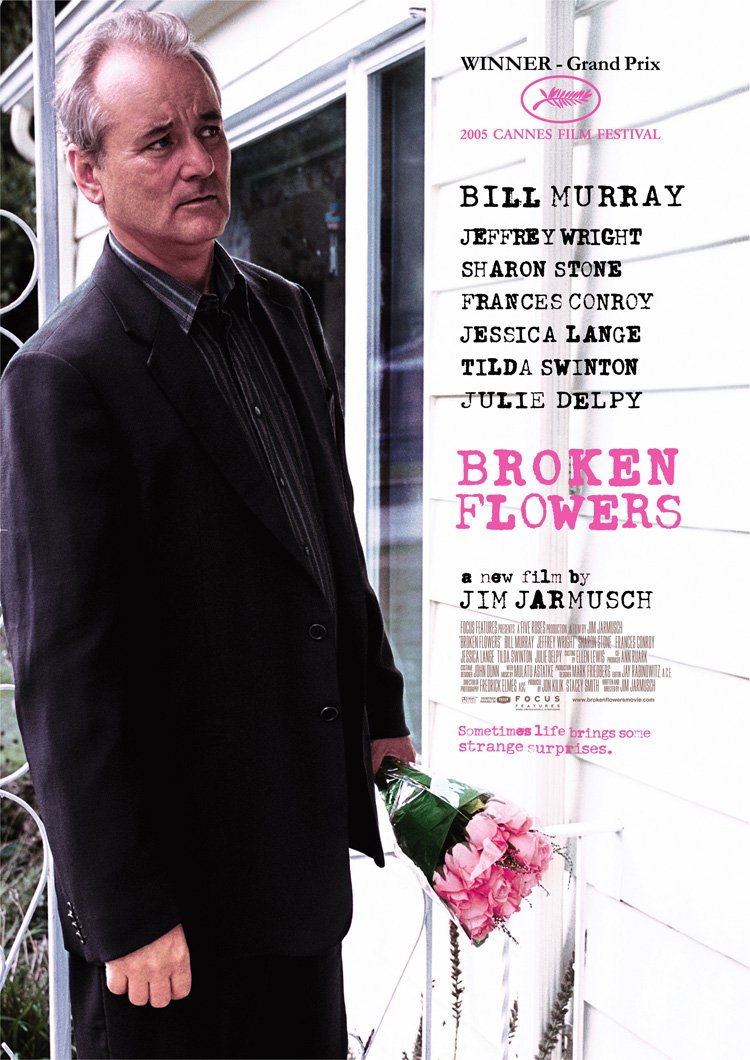
 Don Johnston (Bill Murray) should, by all means, be a happy man. He is quite wealthy, having made a fortune in the computer business. He is in his retirement years, content to live them out in relative peace. However, things start to decline rapidly – his girlfriend Sherry (Julie Delpy) grows weary of his dour, distant personality and leaves him. He also discovers that he has a son when an anonymous letter arrives in the mail, stating that his sexual exploits twenty years before had accidentally made him a father. The former lothario starts to question which of the many women he had seen in that timeframe are most likely to be the mother of his son – and with the help of his mystery-obsessed neighbour (Jeffrey Wright), Don sets off on a journey to visit each of the women in the hopes of determining which of them sent him the mysterious letter. Of course, there is far more to this story, as each encounter paints a portrait of the past, and implies why they went their separate ways in the first place. Through laborious travail, Don is determined to seek out his former partners and extract any potential information to the identity of his son, perhaps not only so that he can have closure and embrace his role in fatherhood, but also so that he can earn the status of actually having contributed something, and not just being a retired slacker who leaves very little positive impact on the world, if any.
Jim Jarmusch makes strange films – perhaps not in the traditional sense because especially when considered with some of his peers, his films range from bleakly nihilistic to outrageously funny, but a quality they all have in common is how pleasant they are to experience. Broken Flowers is considered one of the director’s best films, with audiences being given direct access to his unique version of a few broader themes – the man-in-crisis motif (which seems to be a common plot thread in most of his films), the mystery film and the road movie. Framed as an irreverent, buoyant comedy (aided considerably in the presence of its legendary leading star and its coterie of brilliant supporting players), this film is actually far more complex than just a simple film about a jaded bachelor going in search of the mother of his son. Its a profoundly moving character study about one individual’s compulsion to find answers – perhaps not to the most direct questions he is investigating, but rather to the quandaries deeply embedded in his subconscious, yearning to find some resolution. It is hardly incorrect to call Broken Flowers anything less than a towering achievement of contemporary independent filmmaking, and considering this hails from a director who helped define modern indie storytelling, to see something so different from him proves that not only is Jarmusch a man firmly in control of his craft, he’s also an artist consistently on the prowl to reinvent genres by telling these stories through his revered lens of lush, subversive satire and minimalistic warmth.
Bill Murray – is there any contemporary actor who is as enigmatic as him? He’s the rare veteran who made his name not only in broad, mainstream comedy but also in smaller, more niche independent and arthouse features. Amongst his finest performances can come from his collaborations with Jarmusch, who is one of the many auteurs that have consistently fallen victim to Murray’s deceptive charms as an actor, utilizing him at every possible opportunity. Broken Flowers is not only the best collaboration between the two – its also one of Murray’s greatest performances, rivalled by perhaps only Lost in Translation, a similarly-complex but heartfelt dramatic comedy about a man searching for meaning. Jarmusch works extremely well with Murray because not only is he able to harness his many strengths, he also recognises Murray’s shortcomings as an actor, and rather than challenging him to play a character so hopelessly outside of his wheelhouse, the director rather creates someone who relies on Murray’s unconventional charisma to persuade us to connect with him, not because he is genial, but because he is just so lovably misanthropic, it becomes endearing. The performance makes incredible use of Murray’s deadpan sensibilities without making him dour or unlikable – underneath the harsh exterior is a tender soul, which is manifested in Murray’s brilliant performance, bolstered by Jarmusch’s effortless knack for writing these complex but resonant characters.
Jarmusch’s films are always intricately composed in terms of their ensembles – they’re just as much about the leads as they are about the supporting players, and even when you have one actor dominating the film, as is the case here, there are always memorable performances that come on behalf of the bit players scattered throughout the film. First and foremost, we have to mention the terrific Jeffrey Wright, who proves himself to be one of the most chameleonic actors of his generation. In this film, he plays Winston, the adorable Ethiopian neighbour and friend to Don who helps him put together this mission to find answers. He may only have a handful of scenes, but Wright steals every one of them and finds a perfect balance between humour and pathos in his portrayal of the character. However, the premise of Broken Flowers is centred around our protagonist visiting each of the women that could be the potential mother to his son, which allows for a quartet of brilliant actresses to lend their talents to the film. The first is Sharon Stone, who plays the rebellious Laura, who is still clearly taken by Don’s charms. Its terrific seeing Stone in a smaller film, because she certainly has the acidic sentimentality that fits well with Jarmusch’s style. Frances Conroy, a tragically underrecognized actress, plays the flower-child-turned-real-estate-agent, who has settled into suburban life and is hesitant to allow Don, a reminder of her previous self, to impinge upon her comfortable but banal life. Jessica Lange has the biggest role of the four potential mothers, playing the zany but intelligent animal communicator who harbours deep feelings towards Don, upon which she wouldn’t dare to act. Tilda Swinton, unfortunately, has the smallest role, being on screen for less than two minutes as the most damaged of the women, who is still raw about Don’s philandering ways. Broken Flowers isn’t so much built upon the individual performances, but rather the results when all of them are considered together – in isolation, these are minor, straightforward roles that don’t amount to anything special, but when viewed from the wider perspective, their value as pivotal pieces of this puzzle of personalities become clear. It is understandable why each of these visits is brief – the film is not about the women, but about Don revisiting the past to come to terms with his own shortcomings. However, it would’ve only made these performances all the better had there been something more for each of them to do. There was a much longer film lurking in Broken Flowers, and perhaps going too far into these characters would’ve made it unnecessarily lengthy. However, they’re just fascinating enough to warrant it, and their brief but memorable appearances prove this. Perhaps that was the point – they’re left to be mysterious on purpose. I would not put it past Jarmusch to pull such an elaborate prank: make your characters enigmatic on purpose to allow for the audience to pay even more attention.
In this regard, Broken Flowers is a film that deconstructs ordinary narrative structure without being particularly outrageous or inventive. The film is composed as a series of short, interconnected vignettes centred around the overriding story of a man searching for the mother of his son, looking for answers along the way. Each of these meetings is framed as an individual event working towards the larger story, and while they can’t stand independently, they are also flexible enough to not be weighed down by what transpired before, or what is about to happen. Jarmusch gives each of these stories space to breathe, having them be a constituent of a bigger narrative without needing them to be the impetus for the rest of the film – these visits, as we soon learn, contribute very little, if anything, to the central theme of the film. The film ends without any resolution to Don’s investigation, but rather closure for a number of other issues he didn’t even know needed it. This film is about the past without actually explicitly portraying it – the carefree wonder years are relegated through stories shared between these long-lost acquaintances, with the actors being responsible for evoking the past, and depicting the process of abandoning the ignorance of their youths in exchange for adult responsibilities that drive them away from who they once were – the image of each is preserved from their brief romances decades before, and the arrival of these new iterations of vaguely-familiar individuals is jarring, and makes for compelling, and often hilarious, philosophical ruminations on ageing and the passage of time.
Jarmusch takes all of these complex concepts and reduces them into a single coherent independent comedy that deftly derives humour from pain, seeing the director utilizing his unique independent film style (no doubt gained from his fascination with the French New Wave, with the film being dedicated to Jean Eustache, who looked at similar themes with The Mother and the Whore, also blending subversive realism with gritty melodrama) and combining it with a slightly more mainstream approach, whereby, at least on the surface, we are led to believe that this is just an entertaining comedy-drama with a sour but lovable Bill Murray at the core. Broken Flowers certainly is Jarmusch experimenting with more populist form, and it is in many ways his most accessible film to date – but it is a great blend of both storytelling methods, and this film comes to mean a great deal more when we see how the director takes a familiar concept (a story that has been told in some way in a variety of different forms) and infuses it with his brand of acidic nihilism. One of the reasons Jarmusch is so revered is that even at their most seemingly-banal, his films always tell a resonant story, containing some element of real-world wisdom from the wise filmmaker, who approaches each film not only as the chance to experiment with form and genre, but also to relate his narrative experiments with themes that are very redolent to the viewers’ experiences.
Ultimately, in his desire to make a film far more than just a typical road movie, Jarmusch was perhaps inadvertently created a poignant story about journeys. It may be cliched, but Broken Flowers is really just a film about an old man who is lost in life, going on a journey to find answers to a very simple question, but learning a lot more along the way, to the point where the initial quest doesn’t even matter. The story doesn’t have any traditional resolution (and it left intentionally ambigious), but it does show the importance of a metaphysical voyage towards self-realization. The film may end with Don not knowing who the mother of his son is, but does it really matter? The answer is certainly not, and the final moments of this film show our protagonist in the middle of the street, eyes closed in an expression somewhere between exhausted contentment and joyful resignation, we realize that he has found the answer he was searching for – and whatever that may be is never made clear. Jarmusch made a gorgeous film with Broken Flowers – it is very funny, but also deeply meaningful, and it has a great heartfulness that is uncommon, even for the bitterly compassionate director who essentially creates unlikable characters we have no choice but to utterly adore because of how interesting and nuanced they are. This film may lack the finesse of some of his more audacious films, but it does show Jarmusch moving towards a more self-aware narrative style that may be a far cry from the films that established him as a mainstay of the independent cinema but is no less wonderful. Its a great film from a really terrific director, and a potent reminder of how brilliant he and this rag-tag cast of performers can be when given a compelling, unique story.
 The Postmodern Pelican