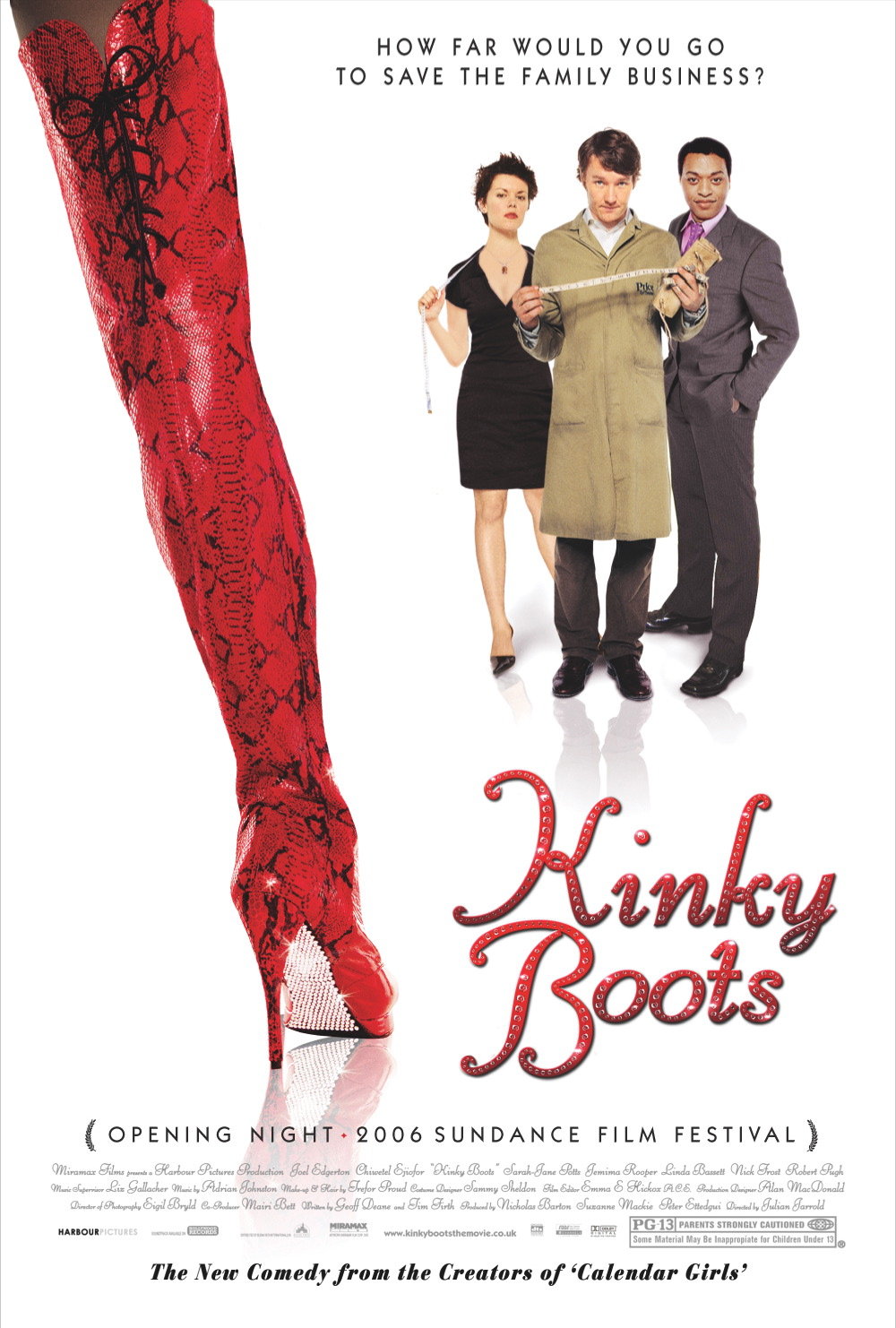
 Sometimes, its enough for a film to just be fun and nothing else – not everything can be audacious, challenging cinema. On occasion, I’ll venture into a film that I know will have very little impact other than being a diverting good time, and that’s more than adequate when the mood calls for it. Kinky Boots is one such film, with the story of a working-class shoe factory avoiding bankruptcy by going into the business of producing boots catered towards the drag queen community being quite resonant with many viewers who find this film’s blend of biting social commentary and familiar warmth not only entertaining but also very endearing. It isn’t a film that takes itself too seriously, but does contain some important statements on issues way larger than the way its delivered (which is better than the alternative – there’s hardly anything worse than a film that thinks its more important than it actually is) and is essentially nothing more than an enjoyable film about tolerance, friendship and following your ambitions, especially in times of survival. The impact of Kinky Boots is not to be underestimated – joining a prestigious group of warm, lovable LGBT-themed comedies like The Birdcage and The Adventures of Priscilla, Queen of the Desert (amongst others), this was something of a rare occurrence at the time, a mainstream film that looks at queer issues in a way that wasn’t heavy-handed, but rather bubbly and exuberant – and as films of this ilk have shown, sometimes that’s the best way to get your message across.
Set in Northamptonshire, Charlie Price (Joel Edgerton) has just suffered the tragic death of his father, and amongst the things he inherits is his pride and joy – a shoe factory. Charlie’s father was a man dedicated his entire life to the making of shoes, with it becoming his livelihood and his raison d’etre, which is a quality his son does not share. On the verge of going bankrupt, Charlie (who knows next to nothing about shoemaking) is forced to find a way to keep that factory open – not necessarily for financial gain (he had aspirations far higher than simply running a factory), but for the sake of the dozens of people employed in the company, who would suffer were they to be made redundant. His salvation arrives in a pair of six-inch stilettos, going by the name of Lola (Chiwetel Ejiofor), a highly-successful London-based drag queen who Charlie encounters by chance. The two form an unlikely friendship when Charlie figures out that he can keep the factory open and running, but only if they try to capture a niche market – and in this instance, its that of drag queens who have previously suffered from flimsy footwear far too weak to carry their weight. Lola begins helping Charlie design these shoes, in the hopes that both of them will gain something from it. However, Lola very soon learns that the small village doesn’t harbour the same acceptance that the big city does, and there is a continuous quest for acceptance from even the most bigoted of villagers, who don’t particularly abide by the idea of someone as non-conforming coming in and taking over. Yet, there is a happy ending, there always is, along with a lesson about tolerance.
Joel Edgerton and Chiwetel Ejiofor are the main reasons behind the success of this film, both of them giving committed and very meaningful performances that sometimes compensate for some of the narrative shortcomings. Edgerton, at this point not a well-known actor, was perfect as the insecure and anxious Charlie Price, a man with a heart of gold but very little traditional courage, which he managed to overcome through his tenacity, and his willingness to go to any lengths to help others, which is precisely how he comes to meet Lola in the first place. Ejiofor, also giving one of his very first major roles, is a lot of fun as the genderfluid friend of the protagonist who helps him extend his business beyond the realm of simple dress shoes, and into something far more niche, allowing him to have dominion over a large, but different, market of consumers. As good as Edgerton was, Kinky Boots belongs entirely to Ejiofor, who gives a spirited performance far better than the material he has been given. As Lola, the actor plays her in a way that is very different from a lot of similar characters, with his interpretation being one not built out of imitation of female behaviour, but rather inspiration. Its not the most nuanced or intricate of performances, and it does very feel clunky at times (at first, there seems to be the perception that Ejiofor just put on a dress and a wig and called it a day), but as the film progresses, and we begin to become more familiar with the character and all of her idiosyncrasies, we start to connect with the performance a lot more than initially thought. Kinky Boots has become a worldwide phenomenon, with this story being adapted into a hit musical by Harvey Fierstein and Cyndi Lauper, and while the Lola character has been interpreted beautifully by a range of other actors subsequently, explored more deeply and with more sensitivity, the seeds of this memorable character were sown by Ejiofor, who gives an imperfect, but still wonderful performance.
There is nothing particularly special about Kinky Boots other than the underlying message. In all honesty, this is the perfect diversion for a quiet afternoon, a fun and entertaining comedy that is as quaint as it is sentimental. If we can extract any overt meaning from this film, perhaps its that it has, at its core, a message of acceptance and tolerance, which is a timeless concept, and one that is explored with sincerity and compassion here. This film was promoted as “Priscilla, Queen of the Desert meets The Full Monty“, and in many ways, that’s the perfect description for this film, because not only is it a rollicking, entertaining jumble of upbeat music and broad comedy, its also about ordinary people doing whatever they can to make a living, as well as looking at the intersections between high camp performance and working-class sensibilities, which very rarely are seen as compatible, and naturally evoke some sense of bigotry in those who aren’t open-minded enough to approach these unique individuals with the respect they deserve. Kinky Boots is just one of several films that takes a steadfast stand against hatred and intolerance and simply intends to show how sometimes challenging your notions of what “normal” entails can bring about wonderful results.
Yet, as entertaining as this film is, Kinky Boots is not without its flaws – it certainly is quite cliched, and there are so many familiar narrative beats, it feels like we have seen this film already many times – the viewer can easily predict exactly where this story is going to go, and the real dramatic tension is almost non-existent, as we know ultimately everything will be resolved. The same can’t be said for the numerous plot holes present throughout – the film introduces us to several different story threads, but only actually cares to explore a small fraction of them. Lola’s relationship with his father, the reasons why Don (Nick Frost) is so against the presence of a drag queen in his small town, Charlie’s fiancee’s infidelity and numerous other plotlines go entirely unresolved and leave the film feeling somewhat empty. It is not a shallow film – it does care deeply about these characters, but not enough to allow them to deviate from strict conventions in any way. There is a lot of meaning at the core of this film, its just almost entirely dismissed in favour of an inspiring but otherwise predictable story about overcoming challenges in unexpected ways.
Kinky Boots is not a bad film, and I respect it for its compassionate and sincere portrayal of social issues, ones that are almost too big to fit into the quaint confines of this small film. It should be given credit for taking a true story that would otherwise be relegated to the special interest section in a local newspaper, and transforming it into a compelling and enjoyable film that may not be particularly innovative, nor original in any discernible way, but overcomes these narrative challenges with a blend of humour, pathos and empathy. Kinky Boots is not a major film, and it doesn’t do or say anything we haven’t seen before. However, as I said in the introduction, not every film needs to be profound – some of them are allowed to just simply be fun, and when it comes to having a good time, this film seems to know how to do it just right. It is funny, heartfelt and really just a bundle of warm and sincere emotions. It has a wonderful story at its core, and in spite of its predictability, this film is just as lovely and inspiring as the true story it tells. It may not make big strides narratively, but it does have a vast social message underlying it, and ultimately, that means more than the somewhat flimsy execution of this otherwise delightful film.
 The Postmodern Pelican