 We’ve come a long way in terms of art. No longer is it the realm of a select few that work meticulously to create grand pieces, but now the domain of anyone who wants to express themselves and convey a certain message. Whether or not you adhere to this subversive new way of artistic expression is inconsequential, because modern art is not merely about appearance, but also intention. Naturally, with the rise of new forms of art, we saw the rise of new forms of responses to that art in the form of audiences, colleagues and seemingly most importantly, the critics. The latter is important to this review (and trust me, I am fully aware of the irony here) because Velvet Buzzsaw, the newest film from the brilliantly demented mind of Dan Gilroy, is centred around the art world, and focuses on a plethora of people – the artists themselves, who toil to create their pieces, the collectors and curators who not only promote the artworks, but also nurture the careers of their creators, and the critics, the individuals assigned the responsibility of reviewing pieces and exhibits that can either bolster the career of any aspiring artist just as fast as it could annihilate it. Gilroy previously made a dark urban fairytale with Nightcrawler, and he returns to the same twisted and satirical world here, reuniting with a few of his previous collaborators and crafting something that almost indescribable – there are numerous layers lurking within Velvet Buzzsaw, it is easy to lose track of what this film is trying to convey. Needless to say, while it may not be the most consistent of films, it is certainly something extremely memorable, but its up to the viewer to determine if that’s a good thing or a bad thing.
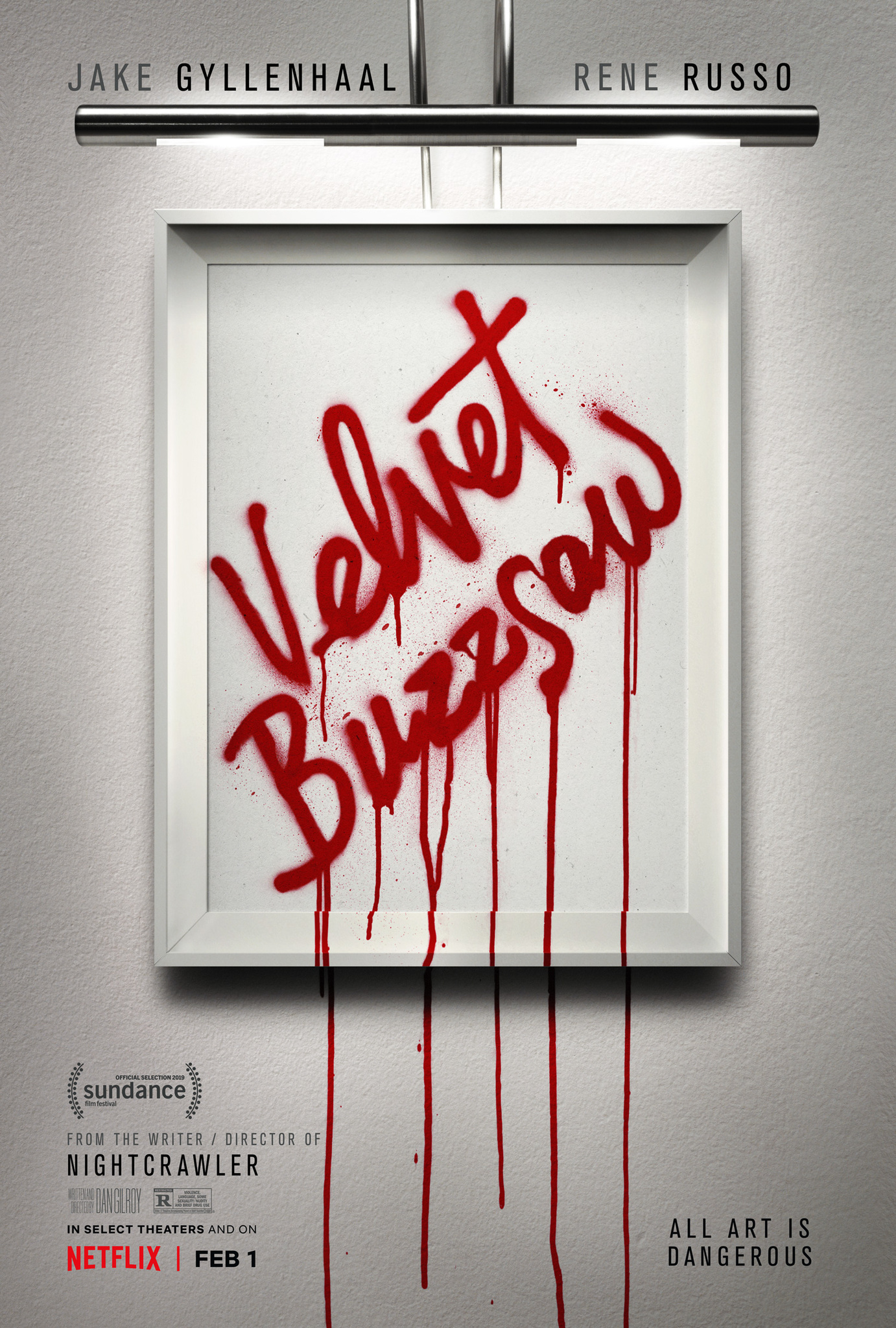
What is art? How precisely do we define art, and how do we know if it is a failure or a success? These are the probing questions at the core of Velvet Buzzsaw, a thrilling venture into the heart of the art industry. Josephina (Zawe Ashton) is an aspiring art curator working for Rhodora Haze (Rene Russo), a punk-rock-singer-turned-art-dealer who runs one of the most esteemed galleries in Los Angeles. One of the central figures in the contemporary art movement there is not an artist at all, but rather a critic named Morf Vandewalt (Jake Gyllenhaal), known for his merciless and often overtly cruel negative reviews that have harboured as many careers as they have ended. If Morf likes your artwork, you are officially an esteemed artist. If he doesn’t, then you might as well find another line of work. Yet, in spite of the vitriolic nature of the industry, there is a certain symbiotic balance that governs these professions. However, when Josephina comes across a large collection of paintings by an unknown artist, she unintentionally sets off a chain reaction of supernatural chaos. The artist, named Vetril Dease, was a troubled man with a chequered past, filled with tragedy and mental instability. In death, he becomes an overnight sensation, with his work captivating absolutely everyone who encounters it. However, it becomes evident that there is something far more sinister behind his work, and it becomes clear that Dease’s spirit is left upset and chagrined by the industry’s greed and corruption, and anyone who profits from the fruits of a lifetime of hardship are soon doomed to suffer grisly fates, whereby their selfish intentions supersede the very nature of art.
Robert Altman had a certain quality to his films, whereby despite the subject matter, they often utilized large and eclectic casts, whereby the story was channelled through them. In an interview, Gilroy conveyed the same sentiment towards Altman’s work and confirmed that it was inspired by the director’s knack for bigger ensembles working together to create a mosaic through which the story could be told, implementing it into this film. At the forefront of the cast of Velvet Buzzsaw is Jake Gyllenhaal, who gives a camp performance for the ages. As the sexually-ambigious Morf Vandewalt, he gives one of his most eccentric performances, a great companion piece to his polarizing performance in Okja (which I personally adored), but with this one being far less one-dimensional, and more measured. Zawe Ashton may not be a household name, but if her performance here has anything to say, she is bound to be one. As Josephina, she goes from insecure and humble young protégé to Rhodora Haze (an icy but brilliant Rene Russo) on the outskirts of the industry, to the very definition of the arrogance of the art world. An admirable quality of Velvet Buzzsaw is that it prioritizes character development, and each of the central characters represent a different side of the industry, but gradually grow – Gyllenhaal goes from a shrill, loud-mouthed critic who enjoys deriding the works of others simply because he enjoys it, to a fragile and terrified man scared for his life, or Josephina’s transition from innocence artistic ingenue to despicable veteran was a definitive feature of this film, and a prime reason why it overcomes some of its inconsistencies in its story. John Malkovich, Daveed Diggs, Toni Collette and Tom Sturridge (who is one of the very few actors who has successfully captured an accurate South African accent) have memorable supporting parts and contribute to the tapestry of characters that make this film so compelling.
The modern art world is not without a sense of humour, and it is well aware of its status as being the arbiter of some of the most obscure and deranged creations ever put together. We have just emerged from the postmodern age, where art was governed by a certain playfulness and dismissal of conventions, and now entered into metamodernism, where the same playfulness still abounds, but with a sense of sardonic humour alongside it, as well as a sense of reflection and the ability to make fun of oneself. This is very true in Velvet Buzzsaw, which is mostly a satire of the modern art world, being an outrageous send-up of the industry and its numerous pretentions – just consider the various ways in each of these characters meets their demise. They are not ordinary deaths in the conventional sense, but rather brutal destruction by art itself. Whether it be a character being hanged by his own ascot in the middle of his gallery, a curator getting her arm sawn off by an experimental sculpture, someone being pulled into a painting by killer monkeys, having your neck broken by a robot or simply through your own tattoo turning on you, there are numerous deaths in this film that are as hilarious as they are violent, and they don’t only incite laughter, but also provoke scathing commentary on the industry itself. I’m reminded of one scene, where one of the victim’s corpses lay in the middle of the gallery, with visitors believing it to be a part of the exhibit (we’ve all heard the humorous story about the woman who dropped her bag in the middle of a gallery and had crowds fawn over this piece of genius art) – the arrogance of the industry can never be underestimated, and unlike many satires, this feels terrifyingly real compared to the heightened commentary in other satires. This film provokes the boundary between the artist and the art and shows the blurring that can occur when one takes art too seriously when they run the risk of putting themselves on display. It is humorous, its bleakly subversive and its hopelessly dark, which is exactly what great satire should be.
Imagine being destroyed by the very thing you create. Now consider being killed by something you didn’t create, but rather critiqued. Velvet Buzzsaw is a commentary on criticism as a whole, as demonstrated by the central role of Gyllenhaal’s character, whose entire livelihood is simply to criticize, the entire industry seemingly resting on his shoulders, with artists and curators waiting in bated breath to hear if their newest work will flourish or shrivel as a result of his opinion, which we are shown is far less objective than it would seem. Like I mentioned before, the irony of writing this is not lost on me. There is a certain quality of the modern reviewer, regardless of medium or subject, to be a source from which an opinion can be found, with their thoughts going into the discourse surrounding a particular concept or subject. There isn’t a single reviewer of anything in existence that can propose to be the definitive voice of any area, which is, unfortunately, something very often forgotten. The character of Morf Vandewalt is the living embodiment of everything wrong with the criticism industry – he is more pretentious than the artists he brutally derides, and his adept ability to tear down any work and determine its success may appear hyperbolic, but it is very real. Gilroy isn’t mocking the criticism industry – if anything, he is acknowledging it for its power in helping certain works, especially those of newcomers and unknowns, be seen. It seems only natural that someone who made a career through destroying others’ art meets his own demise at the hands of the very thing he derided. For what its worth, Morf’s death did involve his passion, and not many people can attest to that.
Velvet Buzzsaw is an odd piece, and it is almost impossible to categorize it into any particular genre, defying several conventions. Firstly, it is definitely a satire, a darkly comical look at a particular industry and the people that populate it and define it through their pretentions. Yet, it is almost a very unsettling film, and there are moments of unhinged terror peppered healthily throughout, more than enough for this to be considered a clear horror film, albeit one with a darkly comical spin. Gilroy found a perfect combination between the genres, with Velvet Buzzsaw finding its place squarely within the ambigious area between them, borrowing abundantly from both sides of the genre divide. It is far too hilarious to be a purely disconcerting horror film but too terrifying to be a clear comedy. This makes this film all the more gripping, and the viewer will be undeniably captivated by the unique vision presented throughout. Velvet Buzzsaw is not a film that will be loved by everyone – if anything, this is a film made to be divisive. Its destiny is not to be the definition of critical acclaim, but a deeply polarizing piece that divides audiences. My reaction is one of glowing acclaim, but another response that is more repellant is not only natural – it’s encouraged. I have very little doubt that while this film won’t be appearing on any list of universally-beloved pieces, it will find its home within the small but firm confines of a dedicated cult following, which is exactly the context in which a film like this should be able to flourish.
Whether it be the performances from the cast (all of which appear to be having a lot of fun with these roles), or the brilliant concept bolstered by meticulous attention to detail, or the thrilling execution of these incredible ideas, Velvet Buzzsaw is a terrific film. It may take a while for it to find its footing, and it may be incoherent at times, along with leaving numerous plot threads unresolved, and some character motivations being questionable at the least, but it is ultimately a great film. It may be better suited for aficionados of satire and horror more than mainstream audiences, and it will certainly unsettle just as many people as it annoys, but that’s par for the course when it comes to a film like this, one that takes a bold and defiant approach to an inconceivably complex concept and delivers a message through audacious means. Whatever your reaction, you can’t deny that this is a film that lingers with you, and leaves an imprint on the viewer in a way that seems almost disconcerting. This film questions the nature of art and our response to it, and through some subversive filmmaking, it makes a powerful but no less entertaining statement, but one that will also have you looking over your should. I guess the lesson underlying this film is that it is far easier to deride than it is to praise. At the very least, Dan Gilroy found a way to ensure he gets nothing but glowing reviews. Who knows what fate will befall me if I gave Velvet Buzzsaw a negative review?
 The Postmodern Pelican