 In 1996, Danny Boyle established himself as a filmmaker to watch with his sophomore film, the dark comedy Trainspotting, which would go on to become a cult classic, and an iconic piece of renegade filmmaking. Something about Trainspotting (both the film and the novel it is based on) just made it a sensation – whether it be its tale of youthful recklessness, or its unconventional setting around working-class Edinburgh, or its upbeat, devil-may-care punk underpinnings, Trainspotting found its way into the zeitgeist and became a pivotal piece of independent filmmaking, and a massive reason why many filmmakers went on to provoke certain conventions to tell a resonant story in unique ways. Now, two decades later, Boyle has returned to this familiar city, revisiting these characters after they have all grown into (dys)functional adults, and venturing into the sinister but darkly comedic interactions between a quartet of individuals who should, by all good judgment, be despicable, but are rather oddly endearing, just as they were twenty years ago. T2 Trainspotting is obviously a sequel that pales in comparison to the original, but that doesn’t mean it is bad by any means – in fact, in spite of some flaws, T2 Trainspotting is one of the more satisfying film sequels of recent years.
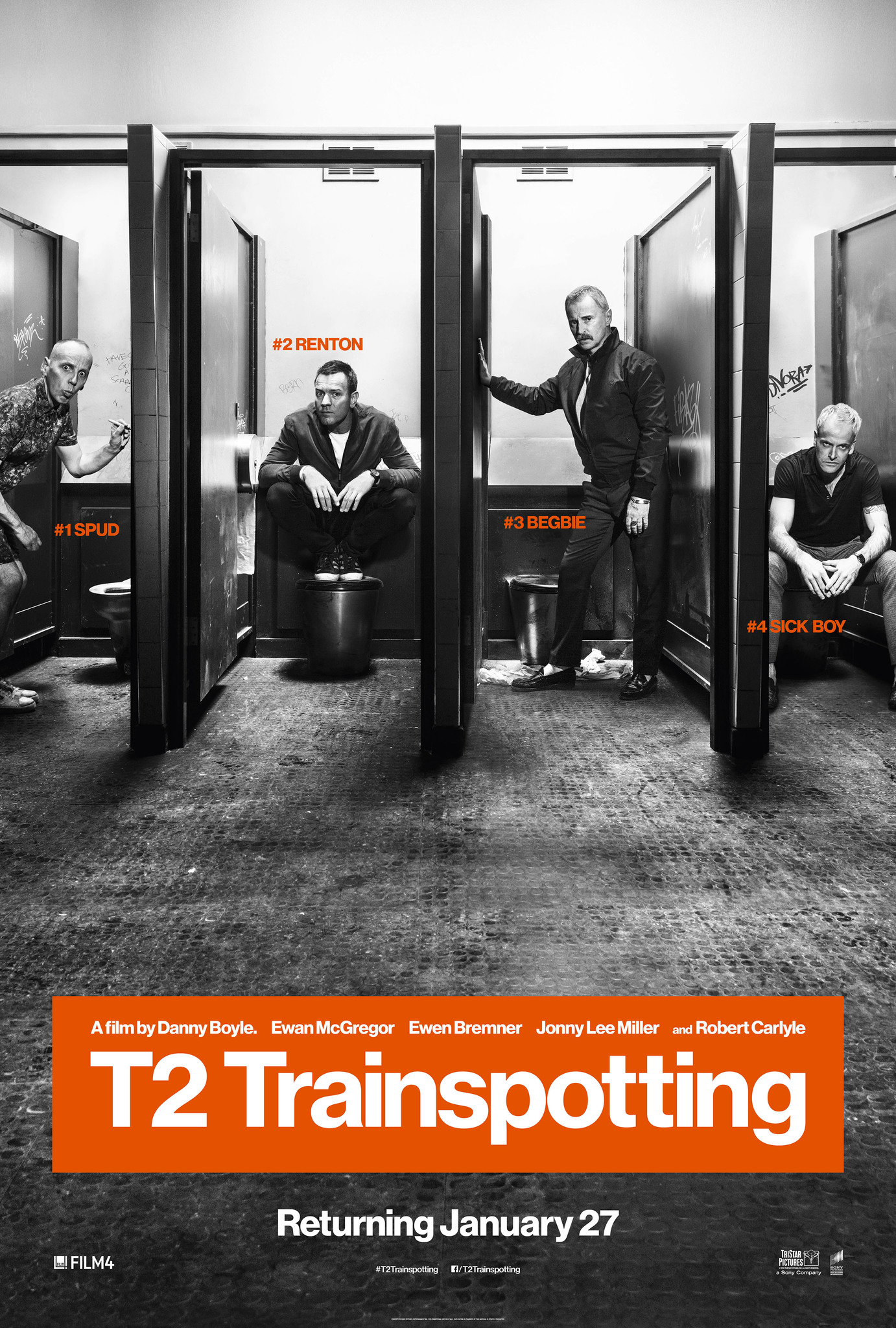
T2 Trainspotting allows us to catch up with the main characters from the previous film and gives us access into their lives since we last went on those drug-fueled, Iggy Pop-scored adventures with them in the 1990s. Mark “Rent-Boy” Renton (Ewan McGregor), who previously escaped with the money he and his friends made from selling drugs, has made a life for himself in Amsterdam, with a wife and a relatively comfortable career. However, a combination of both the impending termination of his job and a looming divorce, in addition to a life-threatening heart attack, makes Rent-Boy reconsider his actions and sees him returning to his old haunts all around Edinburgh, where he plans to make things right with those people who he wronged. First is Daniel “Spud” Murphy (Ewen Bremner), the simple but well-meaning runt of the group who has been trying so hard to get clean and pull his life together, only to be forced, time and again, to return to his old friend, heroin. Simon “Sick Boy” Williamson (Jonny Lee Miller) runs his aunt’s pub, which is failing due to the lack of business and is forced to make a living through secretly filming prominent members of the community engaging in immoral and sadistic acts with his girlfriend, Veronika (Anjela Nedyalkova). Sick Boy is furious that Rent Boy disappeared with his share of the money years before and hatches a plan to get him back. However, can the return of his best friend and the revival of old camaraderie from their younger days be quashed by anger relating to material wealth? For Sick Boy, it is difficult to decide, but not for Frank Begbie (Robert Carlyle), who is apoplectic about the fact that his former friend took his money and left him to serve a massive prison sentence. The notoriously shrewd and impressively resourceful Begbie successfully executes an escape, and soon finds himself back to his old ways, robbing houses, with the reluctant participation of his son. Naturally, as soon as Begbie hears of Rent Boy resurfacing, his sights are firmly set on vengeance.
At first, I was extremely ambivalent to T2 Trainspotting. Even before watching the film, I was very hesitant and had my reservations. The first film was as close to a perfect film as it was ever going to be, and instead of being brought down by its flaws, those small imperfections were precisely what made it so iconic in the first place. There was a certain element to the original film that would have been lost with a sequel – Trainspotting was made near the beginning of the careers of each of these people involved, and since then they have all gone on to have remarkable careers. The quality that would be lost is that very youth and the inexperience that came with their reckless but ambitious immaturity. It occurred to me that Danny Boyle went from films like Trainspotting and Shallow Grave (dark, twisted pieces about the perversity of humanity), to films like Slumdog Millionaire and 127 Hours. These aren’t bad films – they just suggest Boyle has grown up and perhaps lost that punk spirit that made his earlier films so grotesquely brilliant. The same goes for the actors – these are four men who have turned into perfectly respectable performers with thriving careers. Gone were their days of playing strung-out youths addicted to heroin and petty crime. Ultimately, everything about the concept surrounding T2 Trainspotting just seemed inauthentic and perhaps slightly desperate. There was very little chance they actually got this film right, and the sheer impossibility of them even capturing just an iota of what made the first film so iconic just seemed so astronomically high.
How wrong I was. T2 Trainspotting is by no means a perfect film, and it pales in comparison to its predecessor. But that certainly does not disqualify it from being a roaring success of a sequel to the cult film that defined a generation. I can’t deny that this film isn’t particularly impressive at the start – it takes a while to adapt to it because just like the original, T2 Trainspotting is not the easiest film to watch. Not only does it focus on serious topics that are pretty much taboo in mainstream society, the filmmaking itself is often impenetrably complex (this film may just be the most edited film I’ve seen recently – not necessarily well-edited, but just extremely edited) and the story itself isn’t entirely coherent at the outset. There were points throughout the first two acts of T2 Trainspotting that I felt disillusioned, and despite being quite captivated, the essence of the original was missing, namely a combination of the deranged surrealism and the genuine soulfulness that made the first film so compelling. However, by the time this film reaches its narrative peak in the third act, it hits the ground running and doesn’t stop, taking the viewer on a thrilling, comical but nonetheless touching journey of these characters as they question reality and their own morality, dealing with issues that were nothing more than distant concepts, suddenly becoming their grim realities. I’m still not sure of everything T2 Trainspotting was trying to say, but I do know one thing for sure: it said it all extremely well.
T2 Trainspotting is a riveting experience for fans of the original because while these actors have all gone on to other projects throughout the years, seeing them return to these iconic characters is a terrific thrill. These characters have all grown older, but not wiser. They have experienced life and changed, but not necessarily for the better, and the film looks at their interactions and is less about a particular heist that will benefit them, and more about their interpersonal relationships, built on twenty years of resentment and missed opportunities arising from a fractured friendship. Ewan McGregor is as genial as ever, playing the endlessly likeable Mark “Rent Boy” Renton, whose return to Edinburgh is the impetus for the events of the film. However, just because McGregor is as endearing as ever doesn’t mean his performance is without complexity, and he actually challenges himself more here than he did in the original. In 1996, he was just a young actor playing a young man. In T2 Trainspotting, he is a middle-aged man trying to relive those days of youth. This is a common element in all of the major performances in this film – Jonny Lee Miller in particular remains the most unchanged of the characters, still sporting the bleach-blonde hair and the juvenile tendencies that were displayed in the original.
Robert Carlyle is just as despicable – it is odd that despite being a part of the core friend group in both films, Carlyle’s Begbie is purely antagonistic, and serves as the main villain in both instances. He is also relatively unchanged, other than being angrier and far more vindictive – but even in the sporadic moments of tenderness, Carlyle shows great skill. Ewen Bremner is surprisingly the best of the cast – his performance as Spud is equal parts hilarious and heartbreaking. He was initially the comic relief, but here flourishes into the most purely good of the characters, whose simple disposition and almost childlike innocence make him impossible to dislike. In T2 Trainspotting, he has traded the adorable dull-wittedness for a more world-weary, haggard and bleak perspective, which makes for really heartwrenching viewing. Bremner steals every scene he is in, regardless of whether he is providing upbeat levity or agonizing despair. T2 Trainspotting also features cameos from returning performers such as Kelly McDonald and James Cosmo, who may not be particularly important to the film as a whole, but help bring us back to the iconic world Boyle introduced to us years ago.
Interestingly, there is a contrast between the two films, and this is exactly where T2 Trainspotting earns its merits because while it is very similar to the original in terms of its setting and execution, the themes are almost completely different. The first film was focused entirely on a group of young men relishing in the days of being wild, while the sequel sees them atoning for those early days and trying very hard to repair their fractured lives – some of the men, such as Rent Boy, have gone on to have ordinary lives, but at the expense of nourishing the soul and being truly happy. Others, such as Sick Boy and Spud, are stagnant, and no matter how hard they try to escape their social situation, they always fail. Trainspotting is about growing up, while T2 Trainspotting is about growing old – and the concepts pulsating through the film are essentially the same, but the underlying approach is starkly different. T2 Trainspotting, much like the previous film, is a deeply philosophical work, a film that questions reality and society in a way that is fascinating and complex, but never inaccessible. Boyle’s ability to adapt Irvine Welsh’s astonishing book into a film that blends existential quandaries with a certain punk rock sensibility has made for compelling viewing on two different occasions. T2 Trainspotting, with its combination of unhinged energy and plethora of existential complexities, is a thrilling and thought-provoking experience.
One of the elements of the original Trainspotting is the use of the song “Lust for Life” by Iggy Pop, which enjoyed a massive rebirth in popularity in the late 1990s for its use here. T2 Trainspotting definitely makes good use of music, but this song, in particular, doesn’t make an appearance until the very end. It is teased throughout – the opening song is “Shotgun Mouthwash” by High Contrast, who sounds eerily similar to Iggy Pop, and throughout the film, when Rent Boy returns to his childhood bedroom, he constantly tries and fails to listen to it, right up until the haunting final moments of the film, where Boyle has McGregor, now much older, almost entirely recreate the iconic dance scene from the previous film. This is just one example of Boyle and the team behind T2 Trainspotting making a truly compelling film, one that is well aware of the film that came before (splicing in footage from the first film in a way that is notable but elegant), but never depends on it to define it as a film on its own. T2 Trainspotting is a noble sequel to an iconic film, and it may just be the first time a cult classic has received a worthwhile follow-up. T2 Trainspotting is an excellent film, and while it may falter a bit towards the beginning, by the end of the film, we have been suitably enthralled and enraptured by the unhinged brilliance of a film that asks some important questions without ever taking itself too seriously. Funny, sardonic and meaningful in how it looks at the human condition, T2 Trainspotting contains everything we love about the original film, and much more. A truly tremendous attempt at following a great film without ever needing to cheaply replicate what made it so brilliant in the first place.
 The Postmodern Pelican