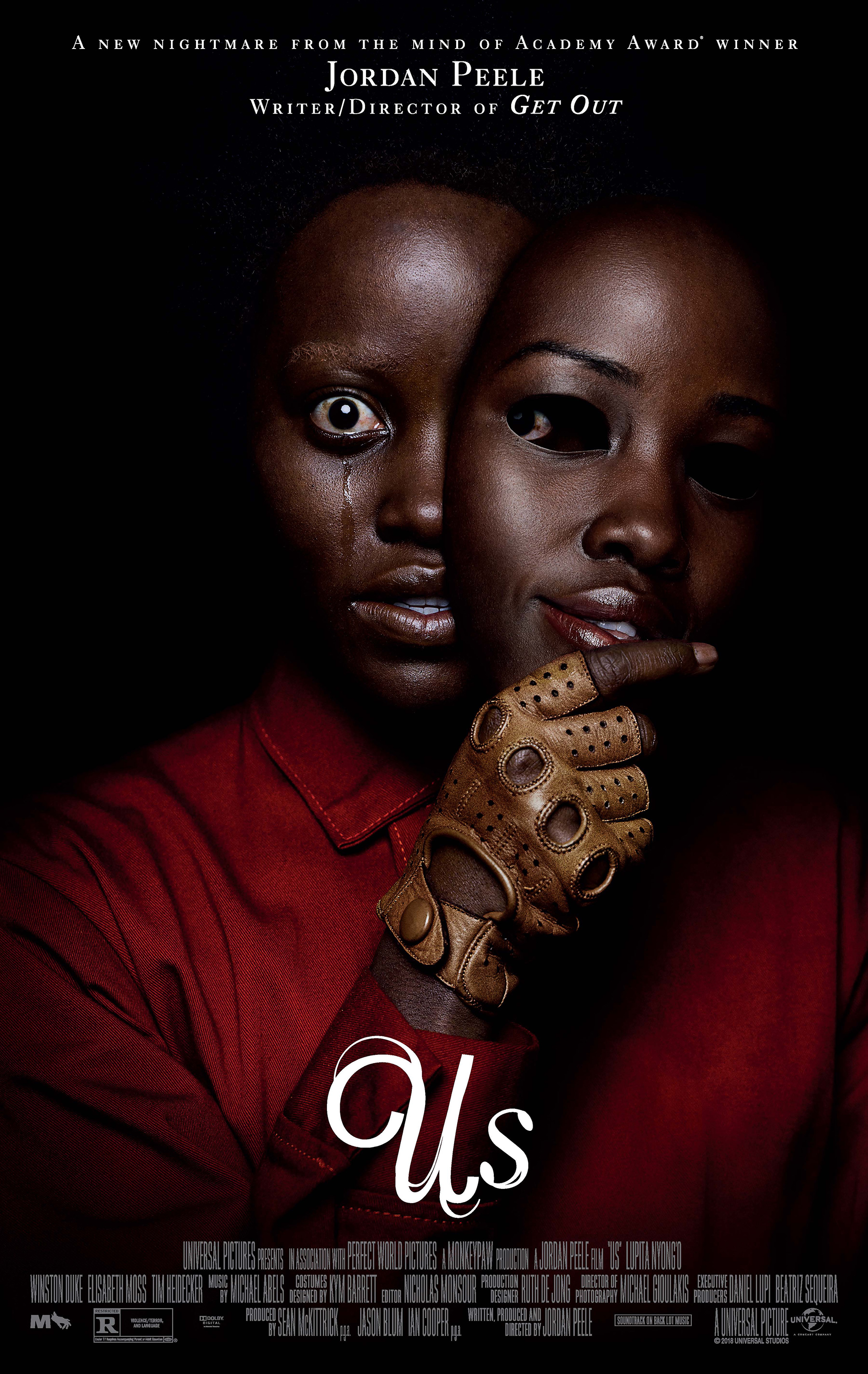
 Jordan Peele has always had his finger firmly on the pulse of the human condition – this was evident in his groundbreaking comedic work on Mad TV and Key & Peele, but it has been proven to be one of his most remarkable talents through his transition into a horror film auteur, the likes of which we haven’t seen since the age of Alfred Hitchcock, William Castle, Todd Browning and The Twilight Zone (a reboot of which Peele is currently hosting and producing). Peele’s sophomore film, Us is an incredible return to the genre for a director whose keen sense of social understanding and potent eye for detail has established him as one of cinema’s most unlikely stalwarts. This film only proves that his debut film, Get Out, was far from a one-time hit, but rather the beginning of a promising career by an artist whose steadfast commitment to making subversive, twisted and brilliant films that blend terror and social commentary into unforgettable affairs. Us is an astonishing achievement – something that just captivates the viewer, viciously grabbing our attention and forcing us into a world of deceptive, disconcerting and utterly mortifying moments, where our grandest fears are realized, especially those that were seemingly unaware of, but begin to fear after this film has ended. Peele has awoken us to a new form of terror – that of ourselves. Us is a remarkable film, and if this doesn’t provide enough evidence for Peele’s impending status as a filmmaker we should be taking very seriously, then absolutely nothing else will.
Horror is built out of a simple binary the majority of the time – there is “us” and there is “them”, one being against the other. “Us” refers to the protagonists, the ordinary individuals who have some horrifying turn of events transpire, usually by the presence of “them”, whether that be a monster or any other malignant entity, person or force that intends to harm the innocent. Even the most original of horror films make use of some kind of conflict between the forces of good and evil, and place emphasis on the “fight or flight” response that occurs in instances whereby good people are confronted with horrifying situations at the hands of the bad. Us is a film that goes another direction while still remaining within the realm of traditional horror, and quite poetically asks the following question: what if the most terrifying monsters we could imagine are ourselves? There are so many works that deal with the concept of proverbially “turning a corner” and being confronted with someone identical to us – the trope of the double, or the doppelgänger, is not one unique to artistic expression, being a constant theme that has fascinated artists and psychologists for centuries. Yet, Peele takes a common trope and makes it even more unsettling by presenting us with the concept of not only encountering our double, but our double being our mortal enemy, our most potent adversary that intends to destroy us. Rooted firmly within our own meddling neuroses, where our insecurities and anxieties about who we are manifesting in a story that sees them embodied as terrifying creatures that actively hunt us for reasons that aren’t made evident until the end. To date, I can hardly think of a concept in any horror story that has unsettled me more than this one – and Peele’s uncanny ability to tap into something that with doubtlessly make all of us uncomfortable is quite outstanding, and makes Us a very unique kind of horror, the kind that stays with the viewer long afterwards, leaving an indelible impression.
It is enough to be able to make an effective horror film that scares the audience, but even the most frightening don’t linger on as much as something like Us tends to – while the jump-scares and suspense of many horror films may thrill us and give us a momentary rush of adrenaline, it is the lurking dread that is present throughout this film that will doubtlessly define this as one of the most deranged horror films of its generation, the tense discomfort present from the outset. This is all due to Peele’s skill in seamlessly blending horror with social commentary – and much like Get Out, Peele understands that a horror film can be entertaining, but it also has the potential to be something far more profound, and can actually stay with the audience, should the filmmaker intend to put in the effort. Get Out was a film that deftly navigated the thin line between satire and horror, and Us, while certainly not anything close to a comedy (despite a few sporadic moments of cathartic levity), is just as subversive, and builds horror upon a certain social issue, rather than finding the relevance in a scary story. Us presents us with so many questions, but never gives us answers, which hints at the fact that Peele was making something intended to be thought-provoking and insightful – and the discussions this film has already stirred and will continue to evoke into the foreseeable future, shows that Us is a film made to incite discussion – its a masterful blend of unhinged horror and social commentary that work together in tandem to create something that relishes in its ability to remain wonderfully vague, never professing to give us any solutions – because much like this film and its ambiguous messages, we can’t ever truly understand the machinations of society, the underlying psychology of humanity, or the disconcerting secrets hidden just out of sight – and we can certainly try and solve them and find solutions, but the deeper we go, the more sinister things become. Passive ignorance is often a representation of weakness, but it can also be blissful. Yet, in the shadows or in our very reflections lurk something far more sinister, as Peele so brilliantly demonstrates.
Lupita Nyong’o gives a performance that will doubtlessly enter the canon of great horror performances – and as a whole, the cast alongside her is incredible. It is difficult to not give a great performance in a film like Us, especially because it is a film crafted by someone who travailed for most of his career in sketch comedy, which places emphasis on character development and the formation of individuals – too many horror films use the characters as a channel through which the story can be told, rather than constructing meaningful, well-envisioned individuals. Moreover, everyone in the film plays two characters, which is an enthralling exercise, because it creates an imbalance of perception. Nyong’o is both the hero and the villain, the representation of good and evil, the images of both light and dark. We emphasize and despise her, and want nothing more for her to both succeed and fail – and in many ways, it isn’t that Nyong’o is playing the same character with differing personalities, rather extending it much deeper, creating two singular individuals that are almost unrecognizable from the other. Nyong’o is an actress who took a while to establish herself as a working actress, and despite her powerful work in 12 Years a Slave, she did struggle to find roles that could match her talents. Her recent career choices have proven differently, with her performance in the tentpole blockbuster Black Panther, and now Us, indicating that she is an actress with superb capabilities, and a certain set of skills that make her quite extraordinary. Winston Duke is terrific as her husband (and his double), with his genial and upbeat persona being a highlight of the film and the major reason why Us is able to be both so terrifying, and so entertaining. Shahadi Wright Joseph and Evan Alex handle the material they are given brilliantly, playing their roles with a maturity that takes their portrayals far beyond the archetypal representation of children in a horror film. Elisabeth Moss (destined for her big film breakthrough soon) and Tim Heidecker are tremendous in smaller roles as the spoiled friends who meet a very grisly death. As a unit, the cast of Us work tremendously well together, finding a balance between their dual roles, and committing admirably to characters that may not be easy to play, but certainly, are amongst their most compelling work to date.
One of the aspects of Us that I adored the most is the part that reminded me the most of great horror and suspense auteurs like Hitchcock, insofar as Peele is not just making a surface-level horror film – this is a film crafted meticulously, with every detail meaning something. Get Out proved that Peele is a maestro of foreshadowing, and using earlier scenes to set up pivotal moments later (a remnant of his background in sketch comedy, where every detail is imperative to the central setup and eventual punchline). There is something elegant about the means through which Peele constructs this story, whereby this isn’t a film that moves in a linear fashion – there is no coherent methodology to how this film is built, rather being constructed as a puzzle, a series of concepts sewn together in a dizzying, unsettling tableau of social horror, where we are lead down various avenues, some of them being fruitful, others not so much. Peele also effectively cavorts with the story, imbuing Us with a certain playfulness, one that is filled with red herrings and subtle clues that makes viewing this film an active experience – and every moment seems to harbour some deeper meaning, a clue to something that is yet to come. It is impossible to state after one viewing whether some of these details were inconsequential, or if they have some deeper significance. If there is one way to force masses of people into viewing your film multiple times, is by creating something that is as enigmatic as this, where there seems to be some hidden meaning that we feel the inherent desire to solve. Whether or not there is anything below Us isn’t important – what matters is that despite being so unhinged and terrifying, Peele has made some something so compelling and fascinating, it requires attention and engagement from viewers. If you are fortunate enough to watch Us with an audience, you’ll understand how the director evokes such a unique energy from the viewer, which is almost unprecedented in contemporary horror cinema.
Of course, it isn’t up for debate whether or not there is a deeper meaning to Us, especially because this is a well-constructed horror film that takes on the task of deconstructing the genre and looking directly at the very nature of terror – and we need to ask, what is specifically that makes Us so horrifying? The point that lingers on the most is that this is a film focused on the notion of being confronted with ourselves, being a victim to a warped, twisted version double of who we are, and therefore gives it some gravitas. While the most horrifying films normally present us with twisted worlds of the supernatural, everything about Us seems plausible. The opening epigraph, which takes the form of a haunting anecdote about the presence of unused tunnel beneath the United States, sets off a film that is terrifying by virtue not of the violent events or grisly occurrences, but because of how it projects our own hidden insecurities into a tangible form. The concept of the “uncanny” – the familiar, yet unsettling – is definitely at the core of Us, because what is most disconcerting is not the entirely unknown, but the warped known, what seems so familiar, yet being slightly off, different from our expectations. Us only increases in how sinister it is, resulting in a third act that is dire in how utterly unrestrained it is, and despite knowing that this is all fiction, there is a seedling of doubt that makes us believe otherwise, causing us to wonder if there may be some deeper truth to this film, even if it is only psychologically true.
Us is a film that is quite unlike any other contemporary horror film – and after watching Get Out, audiences collectively asked themselves “what does it mean?”, because Peele makes films that extend far deeper than what we initially see. These are allegorical works, films that approach their concepts with a blend of the visceral and the symbolic, and while this requires some thought from the viewer, it can be quite a transcendent experience to deconstruct and unpack all the hidden meanings present throughout the film. This is solely credited to the mind of its creator, who imbues this film with a nuanced brilliance that does nothing if not stirring thought. Us is a film made by a bona fide storyteller, someone who has an uncanny ability to construct a world brimming with meaning, and not being afraid to take his story to unexpected places for the sake of his art. Us is certainly not a superficial horror film, but rather a masterful journey into the mind of an artist who is incredibly creative and perhaps a tad deranged, in the best possible way. Only someone with a demented world view, and a profound understanding of society and its small intricacies could ever hope to construct something like Us, a film that will doubtlessly become a classic of the genre, and even more than that, an artistic work that will be discussed an analyzed for a long time, because in spite of any shortcomings, Us is a potent and unforgettable film and one that demands sincere pondering.
Us is a terrific film, and I don’t think it would be amiss or premature to call this one of the most imaginative horror films of the present century. It is always refreshing to see someone revitalize a genre, bringing their own unique talents to the taut conventions and redefining the limits of narrative storytelling. With Us, Jordan Peele has made something extremely memorable, a film that is relentlessly creepy from beginning to end, filled with meaning that begs for interpretation. It is not the easiest film to watch – and despite some moments of levity scattered throughout, this is a film that rests solely within the realm of pure horror, with the frights being real, and the suspense being palpable. It is quite bewildering that Peele managed to make something like Us, a film that relishes in how it is able to crawl beneath the skin of every viewer, inciting paranoia and fear into all of us, which last much longer than any of the more superficial, paranormal-centric horror films normally consumed with rigour. Us is just unforgettable, and a film that you just can’t get off your mind, for better or worse. There is something beneath the tranquil surface of this film that is quite frightening, and so far, no one (including myself) has been able to quite figure it out – but whatever it is, it is terrifying, brutal and destructive – and can we recover from the realization that what we are looking at is just our own reflection?
 The Postmodern Pelican
I first watched Us in its opening weekend. Sitting among a group of friends, I didn’t get it. None of us did. We sat in a coffee joint after the film and discussed it. We figured that the bad girl kidnapped the good girl. Did the trauma make the good girl a bad woman or was she a good woman seeking vengeance for missing her life? Where did the bad girl come from? Most importantly, what was the point of the rabbits?
Quite honestly, I didn’t care enough to go back for a second viewing to discover answers to my questions. After Lupita Nyong’o won the Best Actress prize from the New York Film Critics Circle, I was ready for a rewatch. Almost a year had passed. The second screening was revelatory for me.
Alfred Hitchcock is arguably the most successful filmmaker who explored the duality of the human condition. We see it in the unexpected meeting and subsequent tie between tennis player Guy Haines and tennis fan Bruno Anthony in Strangers on a Train. This duality of good and evil is explored more adroitly in the two halves of the split personality of Norman Bates in Psycho. Most feel Hitchcock most effectively explored this duality of the good person and the evil in Vertigo in which an obsessed Scottie Ferguson attempts to create his vision of a dead woman, not realizing that she is the same woman he once knew.
Us director Jordan Peele seeks to explore the duality of his creation Adelaide Wilson and Red. In psychology, Carl Jung explained that a duality exists in human nature. He wrote in the 1930s, “Every good quality has its bad side, and nothing that is good can come into the world without directly producing a corresponding evil. This is a painful fact.” That means we as people cannot achieve a wholeness to ourselves until we achieve balance between our two oppositional selves. This explanation of duality begins to make sense cinematically when we review Hitchcock’s embrace of duality as well as the other side of herself that young Adelaide meets in the hall of mirrors one night on the Santa Cruz Boardwalk.
Whoever chose the Santa Cruz Boardwalk as the setting for Us made a wise decision. The small seaside community of Santa Cruz, California boasts one of the highest crime rates in the nation. The chance of a person being a victim of crime is one in 14. Watching a neglectful father allow his elementary school age daughter to wander unaccompanied through the seedy amusement park at night is troubling. We sense danger. The slow reveal that the danger stems from within ourselves is fascinating.
Perhaps the most sinister moment of the dark story is the final moments. Adelaide has rescued her youngest child from the underground lair of Red, Adelaide’s alter ego. She finds her son Jason imprisoned in a locker in the rabbit-infested underground maze. She and Jason find their way back to the surface , meet their family, and Adelaide is driving an ambulance away from the scene with Jason sitting in the passenger seat behind her. In a beautifully played moment, Nyong’o looks at the boy. We see the character’s slow realization that this may not be her son but an alter identity. As she grapples with this, we can see the wheels recognize that such a being taking the place of a child is exactly how she arrived in the world. Her expression shifts and we see the woman accept the boy no matter his history.
I like Us. But we are still left with the question of those damn rabbits.
In Jungian psychology, animals are an important symbol. Rabbits represent that duality of nature. A docile creature that is hunted as prey, rabbits know their paths of escape but can change to violence when necessary. They can flash sharp teeth and splayed claws. Their cry when uttered can be one of rage as they defend their territory. Not unlike the characters we meet in Us.