 The odd couple is a trope that has been omnipresent in literature for as long as it has existed, and for good reason – even at their most dull, these kinds of stories do prove to be quite compelling, because it allows two contrastive characters to be paired, with hilarity often ensuing as a result of how incompatible they are, as well as eventually finding out that they aren’t that different after all, which can only give rise to heartwarming, and often extremely funny, storytelling. In The Upside, we receive yet another remake of the French film The Intouchables (after adaptations hailing from India and Argentina), with the true story of a quadriplegic billionaire becoming friends with an ex-convict being one that clearly captivates audiences and leaves us profound moved – and while it is clear that The Upside is not close to the original (which was a film with its own flaws), it is a diverting and endearing little film that never feels inauthentic, as well as deftly defying certain cliches a film like this tends to rely upon, often opting for a more elegant method of storytelling. The Upside is not a film that the viewer will remember past the afternoon they watched it on, but it is certainly one that will fill you with the right amount of warmth to make this a truly lovely work.
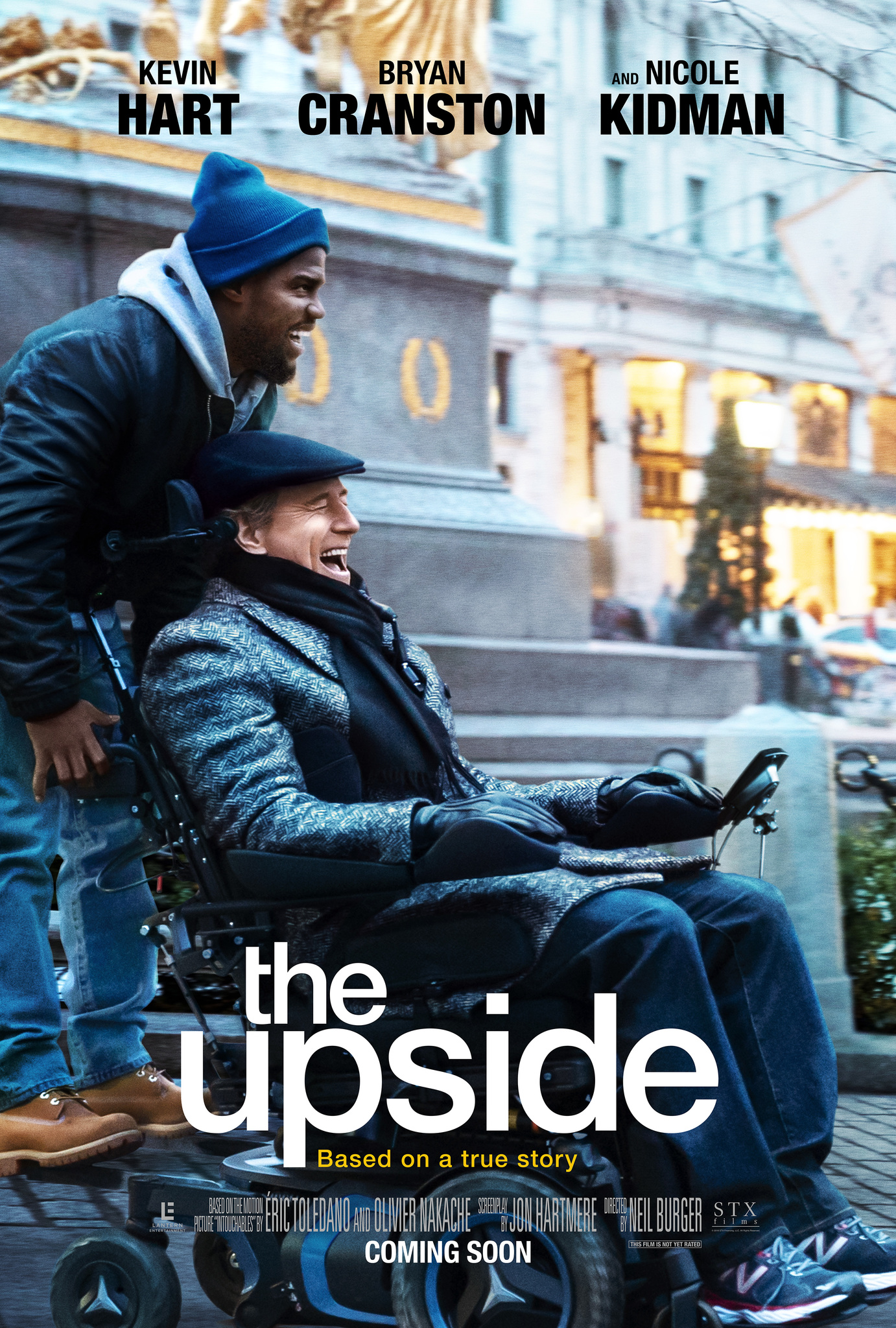
Phillip (Bryan Cranston) has everything – wealth, fame and an endless amount of respect from the world, based on his career as a financial and investment expert and a bestselling author. However, the death of his wife years before, as well as an accident that renders him a quadriplegic leaves Phillip in a deep depression, with only very few people managing to engage with him, such as his business partner (Nicole Kidman), who does her best to support her friend, helping him to see the bright side of life again, as much as possible. As he no longer has function of most of his body, Phillip requires the assistance of a full-time carer, someone who quite literally acts as his arms and legs, taking care of him and being an extension of himself – a position termed a “life auxiliary”. The present candidate just so happens to be Dell (Kevin Hart), an ex-convict trying to reintegrate into society, and doing his best to atone for his past. He and Phillip encounter each other purely by chance, and what eventually is just a formality to satisfy Dell’s parole conditions eventually evolves into a fruitful endeavour for both men – Dell finally has a job that not only pays well but helps him prove his remorse for his actions, and Phillip has a carer who is not obsessed with the details, and rather understands the frustrations he is feeling. Their employment relationship eventually flourishes into a deep friendship, where both men find it within themselves to actually grow as individuals, seeing that even in the most dire situations, there is some hope, the proverbial “upside”.
Casting the two lead roles in this film would certainly prove to be quite difficult – and as far as the original film goes, it would be extremely difficult for anyone to come close to the pitch-perfect performances provided by François Cluzet and Omar Sy, who give brilliant performances in an imperfect film. Bryan Cranston seemed to be a good candidate for the role of Phillip, the fictionalized counterpart to the real-life Philippe Pozzo di Borgo, as his years as a veteran character actor allows him to tap into the introspective nuances of the character – and we cannot underestimate Cranston’s impactful performance here, as while his portrayal may obviously be far from physical, his approach to the character leaves a lasting impression, one that sees Cranston abandoning the more excessive aspects of his previous performances, rather opting for something far more subtle. The casting of Kevin Hart in the role of Dell was met with much less enthusiasm from my side. Despite being an actor who is undeniably popular, Hart is not someone who inspires much confidence, especially not in a role that requires a performer that can balance comedy and drama with almost effortless ease. However, while I won’t claim this to be a revelatory performance on behalf of Hart, he does put in considerable effort, and he proves himself to have far more depth than one would expect. It is certainly not as natural a performance as the role demanded, but it was possibly the best Hart could do considering this film was unchartered territory for him as an actor, and while there are some moments that allowed him to use the charms that have made him amongst the most successful comedians working today, it was mainly intended to show Hart through a slightly different lens – and it did work, but I wouldn’t expect much more of this kind of work coming from him. However, at least he’s proven himself to be somewhat capable
However, the performances by Hart and Cranston, while good, are hardly remarkable. Individually, there isn’t anything special about what they do here, other than Hart showing a more vulnerable side, and Cranston exercising his position as a great character actor. Yet, the film succeeds not on their individual performances, but rather on their chemistry, looking at them as a duo. The odd couple dynamic is only good if both sides are committed to the premise – there isn’t much use for a two-hander when one is weaker than the other, or if they don’t work well together. Hart and Cranston have remarkable chemistry and manage to play off each other with such ease, we start to believe in the core friendship here. They are both adept at sparring with the other, easily overcoming the sentimental nature of the film and building this not as anything more than just a story about friends. Cranston, in particular, is a chameleonic actor, not only being able to play nearly any role but also having the enviable ability to flawlessly interact with his fellow performers, bringing out the best in him. Arguably, The Upside is technically more Hart’s story, and Cranston is just the impetus for his voyage of self-discovery and his movement towards remorse and rehabilitation, but we simply can’t ignore the extraordinary bond shared by these two actors in this film. The Upside does have flaws, but one of its few (and brightest) merits comes in the form of the dynamic between the two leads, which makes the final scenes of this film all the more heartwarming.
Tonally, a film like The Upside is difficult to get exactly right – it is both a heartwarming comedy and a heartbreaking drama, and there is just as much hilarity as there is tragedy throughout the film, especially considering what brings our two protagonists together is unfortunate circumstances – without bad situations, they would never have met, so it is almost as if fate had led them through difficult times in order to reach the self-realization that this film proposes. The director of the film, Neil Burger, has hardly proven himself as someone capable of these kinds of projects, nor does the screenwriter, newcomer Jon Hartmere. The Upside is not a particularly groundbreaking film, and the filmmakers had three previous films (as well as countless similar ones) to use as a blueprint – so the success of The Upside should probably be credited not to the prowess of the filmmakers here, but rather to those that came before them that guided them in how this film should be executed – it is a formulaic film, without any doubt – but it succeeds in how it utilizes the formula, always playing it incredibly safe and never diverging from the tried-and-tested conventions that make these kinds of films popular. The balancing of comedy and drama in this film, while not particularly innovative, does lend it a good amount of warmth, and it manages to stay relatively stable, keeping a consistent tone that can veer towards the more comedic or the more tragic, depending on the requirement for that particular moment. Essentially, The Upside works not because it tries anything new, but because it knows its confines and stays firmly within them.
Yet, by the end of the film, I realized how The Upside actually did diverge narrowly from other films of this ilk, mainly because it often manages to avoid many cliches. Undoubtedly, this is a film that quite makes liberal use of cinematic conventions, but it also never opts for the easy route. There are some indications scattered throughout the film that it may go in one particular direction (the perpetual mentions of Phillip’s DNR request for example), go unnoticed by the end, which is both positive and negative, because while it does mean that there was space in this film used for unnecessary plot points, it also allows this film to have some slight element of being unexpected. This is a film based on a true story, and obviously it is wrong to manipulate a story like this to the point where it changes the truth, but there is a perceived morality to this film, insofar as it holds the characters in highest regard – it cares more about the humanity of the film, as opposed to evoking false emotions. The Upside is a film that has a massive heart at its core, and it is profoundly human, which is quite a welcome change, considering how we’d expect this film to be one that manipulates us into feeling something – and it does, but everything feels so much more genuine here than it has elsewhere. There is a great soulfulness to this film that is unmistakable and undeniably poignant.
Ultimately, The Upside is a good film – perhaps it never comes close to the realm of being great, and it may eventually just fade into obscurity as there is nothing here we haven’t seen countless times before, especially considering how it doesn’t contribute massively to the genre, and remains almost entirely within the boundaries of what we’d expect from this kind of story. It is not a particularly special film, nor is it one that will become memorable, as there doesn’t seem to be much to set this apart from similar films. However, it is a sweet and endearing comedy that unites two very different performers in interesting roles, allowing them to flourish wonderfully, growing into fascinating individuals that allow them both to extend themselves as actors, with this film being an interesting addition to their careers. The Upside really is a terrific film, one that may not shatter boundaries or reinvent narrative storytelling, but it may just break your heart, and when it comes to diverting but meaningful entertainment, you can certainly find much worse than this. The Upside means well, and often that’s all that matters.
 The Postmodern Pelican