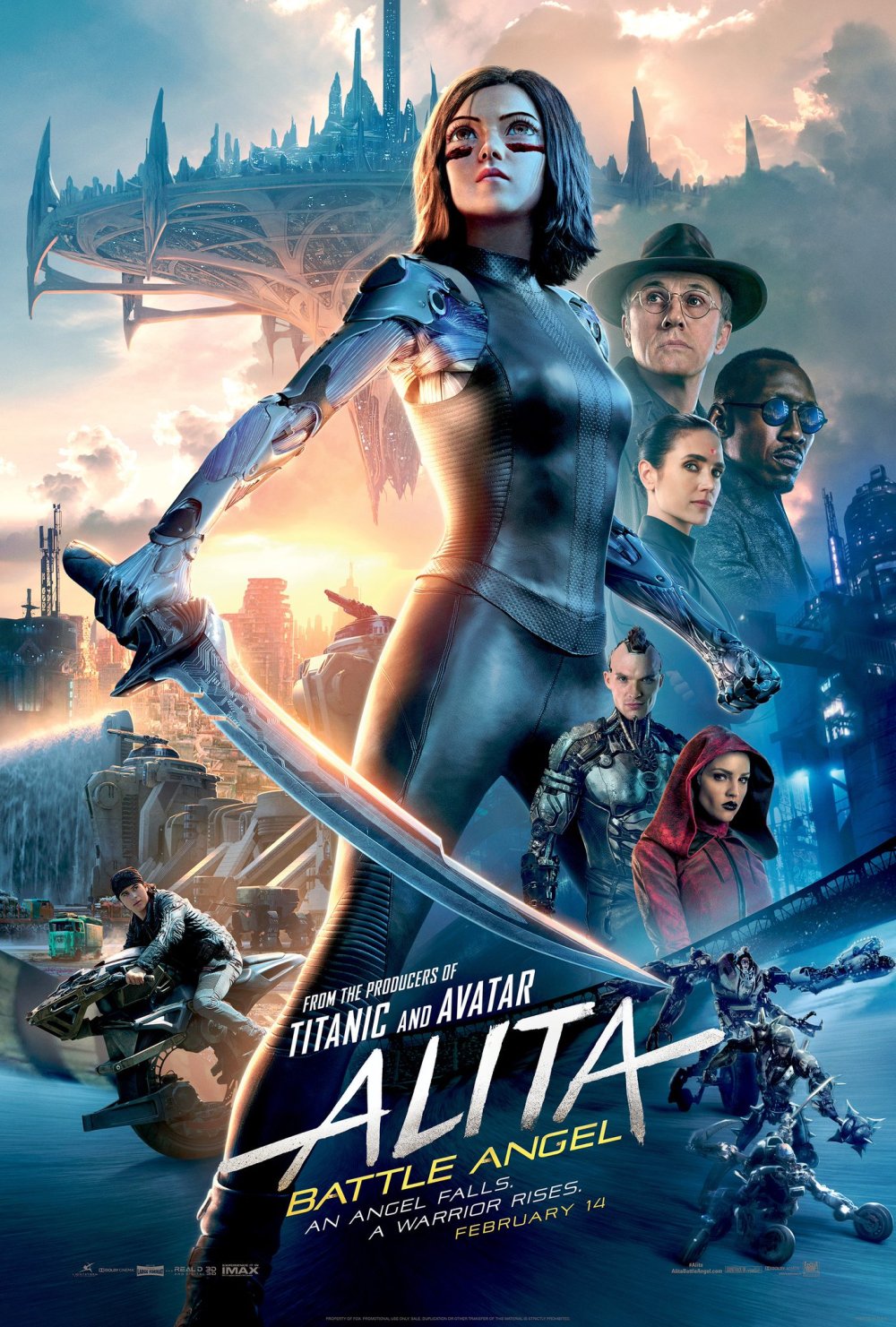
 A dystopian world, around six hundred years into the future. Dr Dyson Ido (Christoph Waltz) is a mechanical engineer and scavenger who finds the processing core of an unnamed cyborg, who he rebuilds and subsequently names Alita (Rosa Salazar). Beneath the innocent exterior lurks the heart of a fighter, with the capacity to do battle the likes of which no one in the city has ever seen. Naturally, Alita becomes a target, especially for the villainous Vector (Mahershala Ali), a corrupt sports official who also serves as the vessel through which the malignant Nova watches over the citizens from his kingdom above, in the mysterious city of Zalem, where every citizen of Iron City aspires to go. As she starts to develop, Alita learns more about her past, and begins to realize there is something deeper to her than just a cyborg – a secret that extends back hundreds of years, to when she was one of the most powerful weapons used – and with the help of a few others, she transitions into the powerful Battle Angel, who is a true force to be reckoned with, and the source from which Iron City might just be saved from annihilation.
On the surface, there isn’t anything particularly exciting about Alita: Battle Angel – in essence, it is just another of the endless stream of attempts to start new cinematic franchises from another medium, as well as being a product of the continued fascination between American cinema and Japanese culture. Adapted from a manga, Battle Angel Alita, this film is cut from the same cloth as Ghost in the Shell and Power Rangers, insofar as they are more brooding, gritty adaptations of more exuberant works that are a lot darker than the original material – where this film differs is that while those were not particularly noteworthy, and didn’t pay adequate tribute to their source, there is a great amount of effort put into this Alita: Battle Angel. We can probably trace this back to the involvement of two men – Robert Rodriguez and James Cameron, who brought this film to life and worked laboriously on perfecting it for years now. It is a collaboration between two artists that are unexpectedly paired up, with Cameron’s eye for technical detail and innovative technological prowess intermingling with Rodriguez’ knack for the artificial and the excessive, as well as both filmmakers’ passion for this project is very clear. It works well, and while Alita: Battle Angel may not live up to its full potential, and may be slightly forgettable considering the , the experience of watching it is certainly one that isn’t one the viewer will necessarily forget, and there are more merits to this film than there are shortcomings – and with the endless parade of attempted franchise-starters, to have a film that is quite decent and actually does warrant a sequel is quite remarkable.
Surprisingly, an area that manages to thrive in is in perhaps the most basic – the performances. These kinds of films hardly ever focus on characterization, and the actor is normally the vessel through which the story is told. Right from the outset, we take notice of the effort being put into creating realistic characters and casting actors who have the capabilities to convey their individual traits. Christoph Waltz momentarily steps away from the villainous roles that have defined his career and rather takes on a more warm, paternal role as the loving scientist who fosters Alita and helps her flourish into a powerful fighter. Waltz has certainly done better work and has branched out into more mainstream fare, and while he does have a substantial amount of failures in his career (does anyone remember Green Hornet or Water for Elephants?), Alita: Battle Angel is one of his more successful endeavours outside of prestige filmmaking. His performance is warm and endearing, and he grounds a film that so frequently tries to be otherworldly. Mahershala Ali also similarly steps into a more mainstream role here, taking on the largest antagonist role, and while he is an actor who is known for his powerful and impactful performances, Alita: Battle Angel sees Ali abandoning that and playing a more sinister character that is perhaps not entirely complex, but still a change of pace for the actor. Rosa Salazar, unfortunately, had to take on the lead role, which would otherwise be a great opportunity for a young actress, but considering the titular character is built mostly around the computer-generated effects, Salazar isn’t more than a body and voice for a character that has been engineered through special effects rather than through her performance. She does put in an admirable effort, but it is less of a performance and more of a presence, which is necessary, but some more development on her part, at least on the levels given to the more traditional characters, would’ve been ideal. There is an actor who appears very briefly in this film that I had not read about, and his uncredited appearance at the end was bewildering – how someone of this stature would not only agree to be in this film but also to be the set-up for the presumed sequel was equal parts excessive and extraordinary. I won’t mention who, because it was a joyful surprise, and one that managed to evade being publicized, so for anyone who intends to watch this film (and I suggest you do), there is quite a shock waiting at the end.
James Cameron and Robert Rodriguez, for better or worse, have always been at the forefront of making technologically-innovative cinema, and even when they do fail, they still manage to be noteworthy for their audacity. Their films may not be the most well-written or original, but to deny the effort that goes into the visual effects would be foolish, as they clearly care deeply about the medium. Alita: Battle Angel stands in contrast to other similar films because it appears like this is honouring the world more than it is trying to be an adaptation of the source material – this is manifested in the clear attention paid to creating the world, which takes preference over the story. It is difficult to blame the filmmakers though – storytelling has never been the strength of either filmmaker, and they understand their shortcomings and rather allow their more creative side to come to the fore. This results in a film that may be narratively barren but is certainly astonishing to look at, and a film like Alita: Battle Angel isn’t demanding. For what this film lacks in originality in plot it makes up for in dazzling visuals. The detail is extraordinary, and the design of this film is remarkable. There might be flaws, but the least we can say about Alita: Battle Angel is that it powerfully evokes the unique spirit of manga and anime, which makes it amongst the most successful live-action manga films Hollywood has produced (although to be fair, that’s not particularly difficult to achieve), at least in terms of how it dedicates itself entirely to its concept.
On the subject of world-building, Alita: Battle Angel is a film that does have flaws, but if they could be corrected in subsequent sequels, the universe this film begins to construct has great potential. In any work of speculative fiction, it is difficult to effectively build a world that can stand on its own terms but still remain within the realm of reality. Japanese culture has always been amongst the most imaginative, and it only makes sense that Alita: Battle Angel was borne from revolutionary Japanese science fiction. This film doesn’t only stand as an entertaining film on its own, it is a great introduction to a world that we will be home to some wonderful storytelling should further films be made. Alita: Battle Angel has the enviable trait of being a middling film with great promise, which is much better than a mediocre film without any potential. There are problems in this film – it is often poorly-written, with the dialogue often being stilted and giving the false illusion of being profound when in actuality it is just jumbled meandering passed off as bold assertions. It is also quite convoluted at times, not making too much sense – this can be seen in the wide array of villains present in this film, with nearly half a dozen antagonists appearing throughout, a classic case of “too many adversaries spoil the tension”. A more direct approach to a story like this could’ve resulted in a more pleasant watch, but this is hardly too much of an issue, especially when the villains in Alita: Battle Angel are actually interesting. This is a film that doesn’t feature anything we haven’t seen many times before, and its poor development does let it down at times, but ultimately it doesn’t matter, because these are small issues and can easily be repaired for what I am hoping will be a tremendous improvement in subsequent films.
Ultimately, Alita: Battle Angel delivers exactly what it promises – it may be bold, but it is also unassuming and quite simple, never aspiring to be anything other than an entertaining adaptation of its source material. It is perfectly adequate filmmaking, and a terrific momentary diversion, and while it will not change anything about the way speculative fiction is made, and it often relies too much on the tropes of the genre, but it doesn’t fall victim to predictability, and actually does present us with some unexpected surprises. It may not have the status of the more prestigious blockbusters, but it is a scrappy, enjoyable attempt at science fiction, and with some more work, I can see this flourishing into a decent franchise, and in hoping that it retains its heart and its attention to detail, it’ll certainly be something I seek out in the future, granted it is made. Rodriguez and Cameron did quite well with Alita: Battle Angel here’s hoping they can do even better next time.
 The Postmodern Pelican