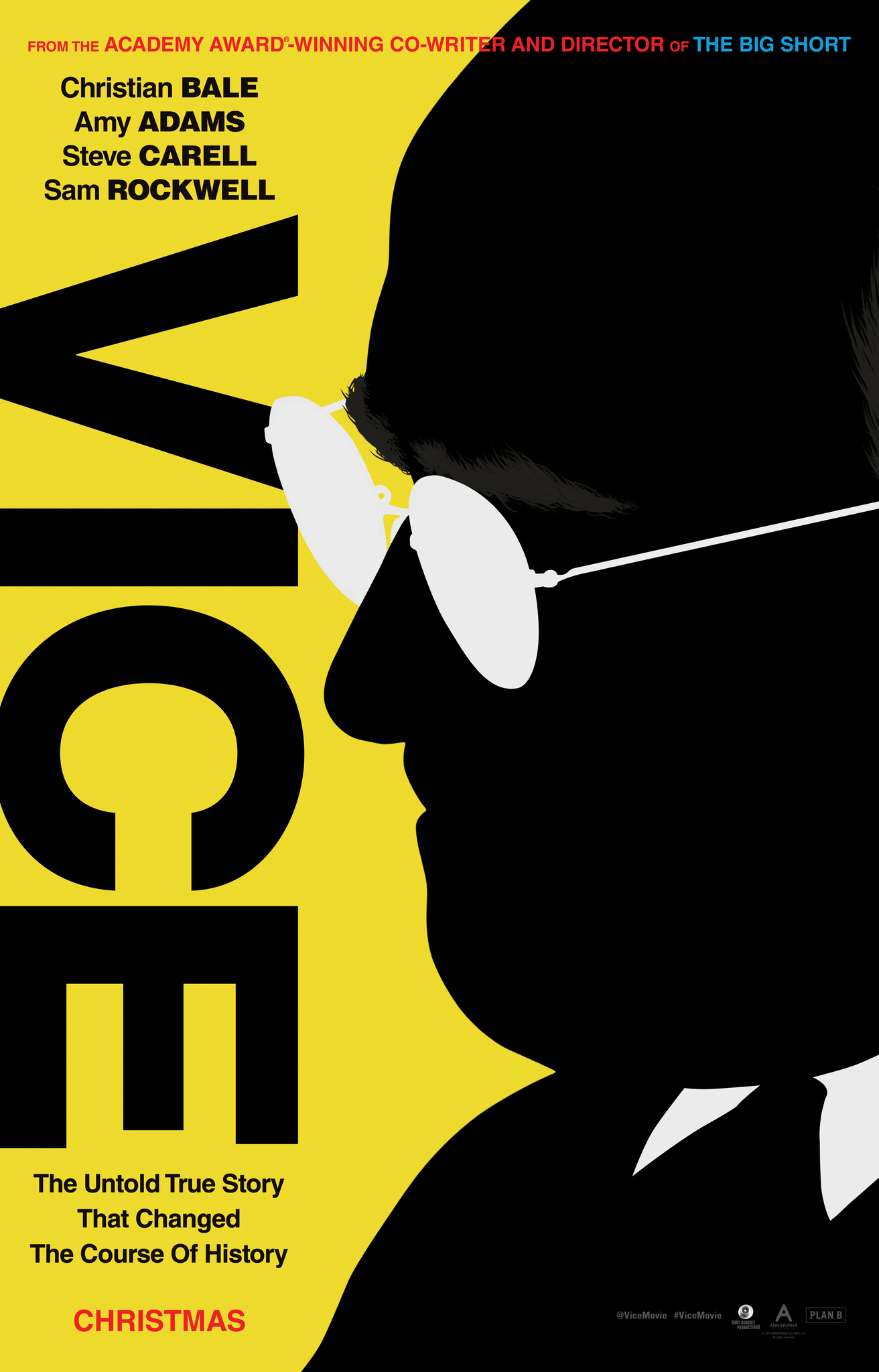
 2018 was an amazing year for film – I feel like I mention this every year, and perhaps my expectations are just getting lower, or films are just getting better (perhaps through the increasing prestige being attached to independent films, which are slowly growing in wider viewership through different distribution models). My list of the best films of 2018 is currently in the final stages of completion, and it is a laborious, difficult task if there ever was one. There have been many astonishing films this year – but there have also been the clunkers, the bad films that range from hopeless mediocre to utterly awful. I narrowly avoided some of the more prominent culprits, but a few did manage to weasel their way into my path, one of them being Vice, which may just be the year’s worst film, for a number of reasons, which we’ll get to momentarily. Adam McKay has been in a director who I never considered beyond his mindlessly entertaining comedies such as Anchorman and Talladega Nights, and not even his alleged “breakthrough” with The Big Short left me quite cold at best. Vice, however, is not close to being as worthwhile as even his worst film, because not only is this a film that blatantly disrespects the audience, it just squanders an idea that could’ve been one of the year’s most fascinating films, turning something with an enormous amount of potential in something that is nothing short of a tonal, narrative disaster. Essentially, the reason why Vice is so deplorable isn’t that it is a film made by someone incompetent – it is a director who has shown himself to be extremely capable as a writer and filmmaker making something just utterly awful. Had this been a debut feature, or something by a director who didn’t have as much experience as McKay, we could be a bit kinder. But this kind of dreadful storytelling is unforgivable when it is coming from someone who clearly believes himself to be making a good film.
Dick Cheney is a fascinating individual – a deplorable, cruel and extremely dangerous war-monger, but someone whose rise to power is one of the most captivating in modern political history. His political career was always going to make for enthralling viewing, and regardless of which side the story would take, whether liberal or conservative, there was no doubt that a film about Cheney would be quite an experience. Unfortunately, McKay clearly doesn’t respect his audience, and often seems to put more value on representing Cheney as something of a misunderstood genius, without ever daring to glorify him or position him as a hero. I feel one could write entire dissertations on how McKay portrays Cheney here, because to its merit, Vice tries something very different in showing him as neither good nor evil, but rather through a more neutral lens, with moments of pure malice inserted strategically to deftly avoid allegations that McKay, a dyed-in-the-wool liberal, was sympathizing with Cheney and his actions. The personification of Cheney in Vice is something to behold, and that isn’t meant as praise, but rather as a clear example of precisely how not to tackle a political figure. We live in a world divided by the unnecessary boundaries of the left and the right, and especially in American politics, where someone is compartmentalized into either category and subjected to being adored by one side and abhorred by the other. Of course, this is to be expected – no film about politics can ever be entirely neutral and objective (and one of the film’s only moments of genuine insight comes early on, when it was briefly mentioned how news programmes were no longer forced into objectivity), but if someone is going to make a film about a politician, especially someone like Dick Cheney, it does help if some effort was put into choosing a side and staying within it. We can’t fault McKay entirely, because it is a situation where had he gone too easy on Cheney, we would’ve been derided for empathizing with him, and had he brutally slandered him, Vice would’ve been written off as a piece of liberal propaganda. Perhaps someone who started as a writer on Saturday Night Live and as a creator of Funny or Die, where the political commentary is often kept to short sketches, isn’t the best person to make a concise and thorough political satire of this length and intention?
In terms of the performances, one would think that McKay, who has derived some memorable performances from most of his actors, would at least allow this film to be populated by some worthwhile performances. Unfortunately, this is not the case, and I can’t recall a single good performance from Vice. Christian Bale is an actor who is known more for his dedication to transforming himself for the roles, than for caring for the role itself. So much of Vice, whether it be the publicity leading up to it, or the film itself, was focused so much on Bale gaining weight to portray Cheney, morphing his body into that of the former Vice President (as if overweight, middle-aged men are in short supply), very little space is actually left for us to realize that Bale just does not give a good performance. He has given terrific performances in the past, even in those that required him to transform, such as The Fighter and American Hustle (where he may not have been awe-inspiring, but he was still quite good), but Vice is just focused on Bale’s transformation, which overshadows the glaring flaws in his performance. Looking the part is certainly helpful in portraying a real-life character, especially one that is as well-known as Dick Cheney, but there needs to be something more, something that shows that the actor actually embodied the spirit of the character. For what its worth, Bale was not entirely awful, and there were some decent moments, but not enough to qualify this film or his performance to receive the attention it has. If gaining weight and going bald was the grounds for a good performance, where’s my profile in Variety?
Beyond Bale, Vice has a cast of established actors occupying various roles, usually, as Washington insiders, pivotal pawns of the political pandemonium struck up by Cheney, who took his position as the most powerful vice president in history very seriously. Amy Adams, who is just effortlessly magnificent in everything has a thankless role as Cheney’s long-suffering wife, who has to stand by her husband through thick and thin, watching him rise to power, with the occasional decline in health (and the more common decline in popularity) making him a very difficult man to be married to, one would assume. Initially, it would have appeared as if Adam’s character was being positioned to be akin to Lady Macbeth, a dedicated wife who helps her husband achieve his ambitions through silver-tongued manipulation and a great deal of persuasion – there is even a scene in this film where Bale and Adams speak in iambic pentameter, mimicking the style of Shakespeare. Throughout the whole film, Adams’ performance seems to be leading up to something, until finally deflating into nothing more than just a reactionary, supportive wife performance that anyone could have given. There is really nothing to this performance that is worth noting, and Adams deserves far better. Sam Rockwell falls victim to the same transformative narrative as Bale, with impressive prosthetics morphing Rockwell in George W. Bush. The difference is that unlike Bale, Rockwell actually puts some effort into playing the part, embodying Bush and his mannerisms, tics and eccentricities. Rockwell isn’t in the film much, but he does give a decent performance when he is on screen and is the closest Vice has to a good portrayal (insofar as Rockwell actually appears to be something close to human). Steve Carell also puts in some effort, but just can’t elevate the dullness of his character of Donald Rumsfeld beyond bleak mediocrity, as is also the case with Tyler Perry as Colin Powell, whose presence here is just a gaudy, unnecessary attempt by the actor to reinvent himself as a dramatic actor. Vice has a large cast, and several inspiring actors – the fact that no one is actually giving a good performance is worrying, but what can we expect from a film like Vice?
The main problem with Vice, as alluded to previously, is that it is disrespectful – not to its subject, but rather to the people involved in this film (with none of these actors being given much to do, other than a couple of them being present to showcase the transformative nature of acting), as well as the audience. While we couldn’t dare say McKay is particularly enamoured with Cheney, he’s clearly interested in the story, and he is far too focused on telling the story on his own terms, he disregards the audience entirely. McKay is the worst kind of artist, the type that perpetually believes he is the smartest person in the room, and with both The Big Short and Vice, he makes it very clear that he thinks he’s operating on another level of cognition, and thus needs to deliver these stories in a way that is palatable and less complex, as if the viewer would be entirely lost had it not been for McKay’s method of writing and directing. One would normally think that in doing this, McKay would just be trying to engage with the audience, but it veers heavily into the realm of condescension, where he insults the audience’s intelligence. This may sound harsh, but the level of patronizing present throughout this film is often extremely bothersome and detracts from the film as a whole. McKay seems to believe the audience is not able to understand the machinations of the political systems, and the result is a film that doesn’t benefit anyone – for politically-minded viewers, they’ll come out of this film feeling as if they had just spent two hours being spoken down to by the filmmaker behind Step Brothers, and for those who go into Vice in the hopes of becoming enlightened on the American political system, they’ll leave thinking it is confusing, muddled and more than anything else, dreadfully boring. As odd as it is to say, Dick Cheney deserves a better film than Vice, or at least his tumultuous political career warrants something at least halfway decent.
Moreover, Vice doesn’t know what it wants to be. It isn’t even sure if it is aiming to be a comedy or a drama. As much as I disliked The Big Short, at least that film was certain that it was a darkly comic satire – Vice is caught between genres, and not in the intelligently ambigious way, but rather in the way that the constant oscillation between the genres makes for gaudy, uninspired and often extremely jarring viewing. The first hour of Vice is nothing but a montage of moments from the earlier days of Cheney, jumping between the 1970s and the early 2000s, with the frantic editing of a low-grade informercial, and the intelligence of a rejected Saturday Night Live sketch. The tone is also extremely inconsistent, constantly switching ambience to the point where it becomes a chore to watch. Not only does it feel tonally unsettling, but it also puts too much effort into each one, and fails on all accounts, never reaching the ambitious heights it clearly is trying to. It tries so desperately hard to be outrageously hilarious and ends up being painful. It attempts to be profoundly insightful, resulting in convoluted political jargon delivered in narrative doses normally found on television networks aimed at the toddler crowd. How can a film be simultaneously contrived and condescending? I’m almost tempted to praise Vice purely on the fact that it fails so spectacularly on every account, it would be only logical that it was intentional, and it would redeem the film somewhat if McKay was clearly trying to parody the system, but that’s certainly not the case, as, throughout the film, it is clear that McKay thinks he is making the next great American political satire.
There are many reasons to despise Vice, but the one aspect of this film that is perhaps the worst is that it had potential. Dick Cheney is one of the most significant political figures of our time, and a film about his rise to power could be thrilling in the right hands. We can’t even say that Vice was doomed from the start based on those making it, because McKay, for all of his faults, is still an industry veteran who has worked continuously for decades, as well as the cast being filled with some established performers. Vice fails precisely because it has guaranteed prestige, and it wastes all of it, intentionally opting to cheapen a story that could have otherwise been one of the starkest and brilliant political satires of our time. Vice has, beneath its mediocre execution and overwrought arrogance, some very clever ideas – and much like The Big Short, McKay is able to put some interesting concepts into the film without exploring them to their full potential. Vice has a large number of gimmicks, and while some of them do work, the abundance of them impinges on the effectiveness of the film. There is just far too much going on in Vice – it is quite literally a gag a minute, and it is an exhausting exercise for the audience to keep up. It just doesn’t work, and one would think someone like McKay, who has shown himself capable of deriving great comedy out of remarkable restraint, would have done a bit better than this.
Vice is a film I have no hesitation in calling one of the year’s worst, and even though there are some sporadic moments where I thought this film was improving, it never failed to remind us how much better this film was than the viewer and had this film not been so pretentious, I might have been a bit kinder on it, because there are some parts of the film that hinted towards something quite decent at the core – but every merit was rendered redundant when the massive flaws were made clear. It is almost inconceivable a film with this pedigree could’ve been such an utter disappointment. It isn’t even that Vice was entirely awful – had it been, it would’ve opened the possibility for this to be a cult classic. Unfortunately, it just becomes an overlong, frantic and irritating jumble of sounds and images, poorly strung together by something resembling half-baked political satire, with performances that are either wholly dependant on the physical transformation (Bale and Rockwell), or bland and forgettable (Adams and everyone else with the misfortune of appearing in this film). Vice was a film that made its quality known right from the outset, and forces us to sit in anxious anticipation, but not for the political machinations present throughout the film, but on the possibility that this film may get better. It never does, and just ends with a scene that could be described as “bitterly grotesque” (and that’s putting it kindly). Needless to say, I don’t think I’m going to wait eagerly for McKay’s next film unless it is a return to form for him. I never thought I’d feel nostalgic for the days of Anchorman or The Other Guys. Yet, here we are.
 The Postmodern Pelican