 England in the 18th century – an era filled to the brim with stately manors and state-like manners, enormous, overflowing dresses and an abundance of appearance-altering cosmetics, allowing people to constantly reinvent themselves every morning, especially those in the upper-class who found their homes in the drawing halls and ballrooms of the wealthiest and most influential people in the country. There is another side to the era that isn’t as well-known when it comes to modern portrayals of the year, which is one that director Yorgos Lanthimos, the maestro behind bona fide masterpieces Dogtooth, The Lobster and The Killing of a Sacred Deer, introduces us to in his most recent offering, the exceptional The Favourite, a devilish exploration of excess. With his trademark wit (as well as a masterful screenplay by Tony McNamara and Deborah Davis, whose hilarious script it only made better by the masterful historical detail put into this film), Lanthimos takes us on a journey into the depths of the British bourgeoisie, allowing us to be witness to their tendencies towards duck-racing, rabbit-breeding, pigeon-shooting betrayal, as well as a truly inciting lesbian love triangle – all of which are the staple of any good period drama it would seem – what is a costume drama if it isn’t filled with pulsating, animalistic queer sexuality? In all seriousness, Lanthimos has made perhaps his most accessible film to date, an extraordinary dark comedy that veers off into the territory of come clear cinematic forefathers – Stanley Kubrick and Peter Greenaway perhaps being the clearest inspirations for this film, both thematically and visually, and the result is something that has left me quite shaken, a postmodern masterpiece in every sense of the word, a film that subverts expectations (while still allowing us to be privy to Lanthimos’ trademark sense of humour) and rises to the ranks as perhaps the year’s greatest cinematic achievement. The Favourite is many things – an absurdist masterpiece, a unique costume drama, a fascinating historical account and a delightfully complex portrayal of political machinations in an era that is hardly represented with this elegance and wit. I am certain that once I have managed to digest The Favourite and come to terms with its panoply of themes, that I’ll be ready to proclaim this the best film of 2018.
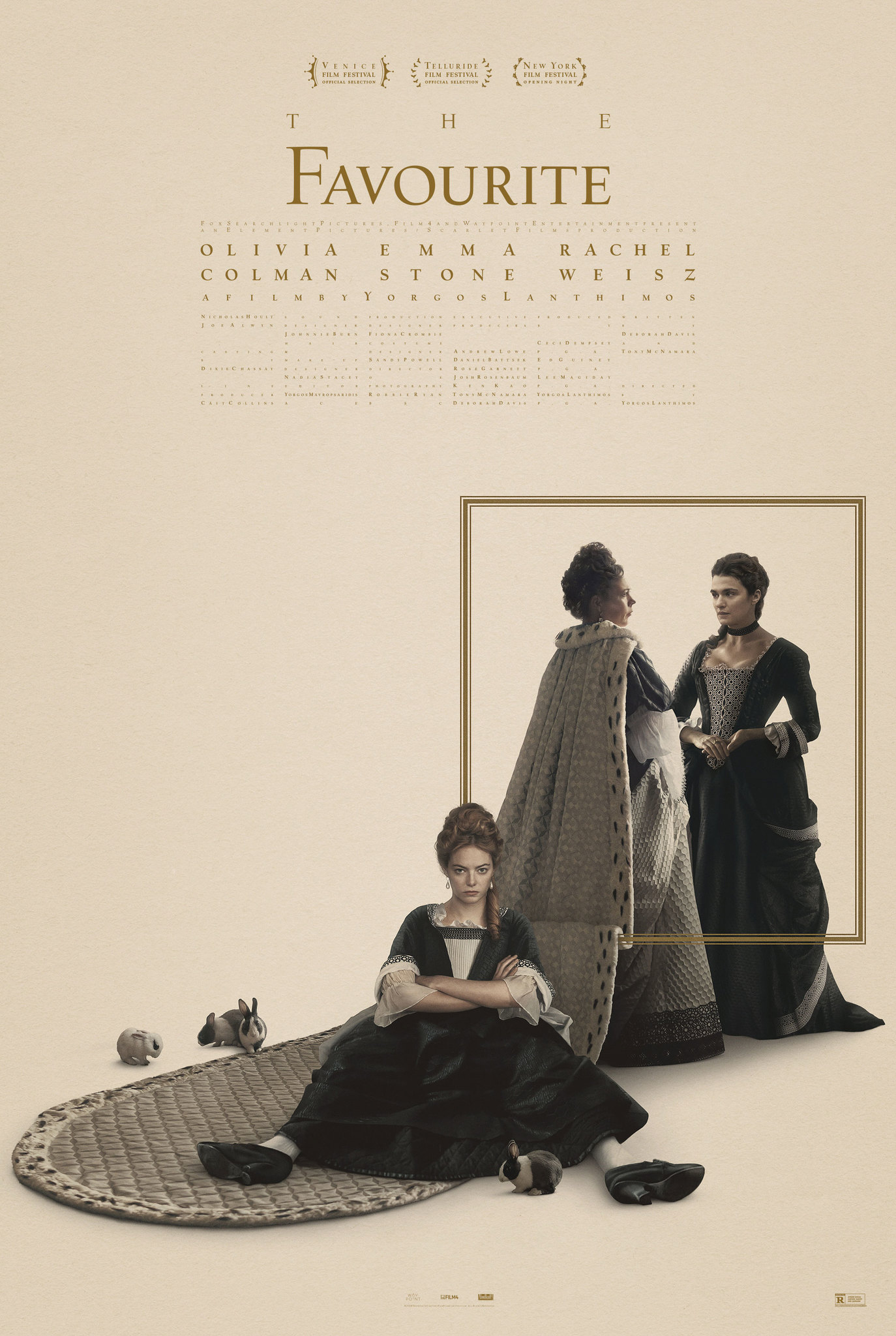
If we look at the history of Great Britain, it is often neatly compartmentalized into various eras, usually defined by the reigning monarchs and their families and the multitude of historical events that occurred in each individual epoch, creating a distinct and unique quality to each period. Cinematically, the focus has been mainly on the periods in which the Tudors, Georgians or Victorians reigned, but in between those eras stood one of the most enigmatic royal figures in the nation’s history, and one of the most fascinating yet unexplored individuals, Queen Anne, who reigned from 1702 to 1707 (and as history will tell us, not particularly well). At the outset of The Favourite, we are introduced to Anne (Olivia Colman) and her closest confidante, the manipulative and shrewd Sarah Churchill (Rachel Weisz) who is a political companion to the queen in public, but a much more personal companion in secret, helping her both professionally through the trials and tribulations of being a monarch of a warring state (England is at war with the French, and is losing terribly) and as a sexual companion. Anne is someone who has lost seventeen children and suffers through debilitating diseases that only compound with her rapidly-declining mental state, Anne is not entirely concerned with anything outside of her enormous castle, much less a war she isn’t particularly invested in, with Sarah taking the role of the de facto head of government in the queen’s stead, although not officially. Enter Abigail Hill (Emma Stone) an impoverished former lady who has now been forced to beg Sarah (who just happens to be her cousin) for a job at the queen’s residence, in the hopes that she may make a living, being given the position as a scullery maid, abused and ridiculed by her colleagues. Very soon, however, Abigail catches Anne’s eye, and it is made very evident that Sarah is not the only person in that family capable of cunning manipulation, as the two women struggle to become the favourite of Queen Anne, earning her ultimate affections as well as the wealth and status that comes with being the reigning monarch’s closest companion. A tale of intrigue and deception set to the lush background of the eighteenth century, filled with thrilling manipulation and shocking deceit, as we watch the brutal battle between two women who lust for their queen’s love, both in regally and carnally.
It wouldn’t necessarily be wrong to not realize that The Favourite is much more than just a period drama, but something much deeper and far more innovative, because the premise does not entirely convey how twisted this film actually is, and suitably masks the true heart of this film, presenting it as an amusing but otherwise quite sophisticated affair, when it is anything but this. In a world starting to focus on a range of diverse, inclusive stories that place focus on non-normative individuals, it is this, a dark comedy set in the hallowed halls of the most powerful people governing eighteenth-century Great Britain that manages to be the queer masterpiece of the year, a riotously hilarious but also extremely stark portrayal of the inner-workings of the Royal Court in a way often not represented in such brutal honesty, foregrounding sexuality not as something necessarily always erotic or filled with romantic passion, but also a mode of bargaining and earning power and favour. The Favourite is Jane Austen by way of the Marquis de Sade – it never avoids portraying the era as one filled with deception and debauchery, where wholesome activities were rare and even the most senior of politicians would engage in sordid activities, such as betting on a duck race, as well as the reigning monarch engaging in secret homosexual relationships with her confidantes and servants, who manipulate her for favour – yet still retaining a certain elegance, and a strict social structure that divides the country and its people.
Even without the queer themes of the film, The Favourite still manages to be an overt subversion on what we have come to expect from these kinds of films – and when you include the fact that this film is focused on women that are not only in pursuit of wealth and influence but also driven by their raging lust, you come to understand precisely why The Favourite is so much more than just a conventional period film – it is a riveting costume drama with an abundance of absurd dark comedy, brutally vicious characters and raw sexuality, pulsating with a passion that proves this to be one of the more fascinating forays into the social context of previous centuries. Within only a matter of minutes, The Favourite strips away every convention that normally pervades these films, and replaces them with a hilariously acidic commentary on the era otherwise missing from more serious films – and for this reason alone, the fact that it dares to be a film that doesn’t merely allude to its central theme but rather proudly demonstrates it with almost shockingly graphic sincerity, The Favourite is the year’s best film – what other period drama can boast that its central driving force is a lesbian love triangle between the Queen of England, her closest confidante and a young servant? Yet, even beyond its intention, there is so much more about this film that needs to be discussed.
In looking at The Favourite, we need to note the performances, because this film is almost entirely built on the trio of women that occupy the central storyline – and we should start by considering Olivia Colman, the extraordinary character actress who delivers one of the most brilliant performances of the year. Colman is exquisite, giving a ferocious portrayal of Queen Anne that is unwavering in its complexities – starting the film as a frail but willful individual, content to do what she needs to do to serve her country as a monarch (granted with the assistance of Sarah Churchill) – but as she grows weaker, she also deteriorates into mental instability, becoming a shadow of her former self – a delusional, unstable and often volatile woman whose outbursts and growing insecurity make her an unfit ruler, thus allowing her to be taken advantage by those who lust for her power, falling victim to the deceptive charms of those who appear to mean well, but have much darker intentions. Colman is just an extraordinary actress – whether on television or in film, in comedies or dramas, or in leading or supporting roles, she is frequently astonishing, and she is perpetually rising as not only a reliable character actress but as an established leading performer in her own right. The Favourite gives Colman so much to do – it allows her to chew the scenery with great might, constructing a character that is a bundle of contradictions – she is often extremely funny, with a great deal of hilarious one-liners, as well as many moments of unhinged madness, but she is also capable of such remarkable introspection and nuance, such as in the more intimate scenes where she shares some lucid thoughts on the past, or when she realizes what everyone else has known for a while – Queen Anne has gone mad. Colman certainly gives one of the best performances of her career, and her work in The Favourite will endure as something very special, a portrayal of a complex figure by an actress who understands the many different facets of the character and goes all the way in interpreting her as a fully-realized, fascinating individual.
The two women fighting for Queen Anne’s affections are played with great brilliance by two incredible performers. Emma Stone has risen from populist darling in mainstream comedies to a mainstay of the arthouse scene, and her performance in The Favourite is probably the one that sees her challenging herself the most as an actress – playing the deceptive Abigail Hill, Stone has to grapple the different layers of her character, playing her as despicable, but not unlikeable, as well as taking this character to some very sinister places without crossing the moral boundaries too severely. It is Stone at her most bitingly sardonic, and in every instance when we are believed to believe Abigail is the protagonist of The Favourite, Stone reminds us how she is far from admirable and is perhaps the most vicious of the characters – a manipulative opportunist who has her sights firmly set on earning power. Stone is contrasted with Rachel Weisz, whose performance as Lady Sarah Churchill is also amongst her personal best, a character armed with an acidic retort and a hunting pistol, often using both in situations that call for Sarah to assert her dominance. Weisz is a terrific actress, and she is normally so endearing – and while The Favourite sees her at her most bitter, her brilliance persists, creating a character responsible for some incredible one-liners that will undoubtedly make The Favourite a quotable classic for years to come. It also helps that all three ladies of The Favourite have effortless chemistry, interacting with each other with such ease, understanding their fellow performer and working together to create a truly visceral, riveting cinematic experience. When it comes to choosing the best of the three central performances in The Favourite, the adage of “nothing is impossible” just doesn’t apply, because Colman, Stone and Weisz are all beyond astonishing. A special mention should be made towards Nicholas Hoult and Joe Alwyn, who had the unfortunate pleasure of playing male characters in a female-dominated film, and while they are appropriately overshadowed by their female co-stars at every opportunity, they do make their impression, especially Hoult, whose manipulative Robert Harley is equal parts terrifying and hilarious, and it establishes Hoult as not merely a rising star, but as a potentially brilliant character actor. The cast of The Favourite is just pitch-perfect, and everyone is doing their finest work here.
It was mentioned previously only slightly, but The Favourite is a rare kind of film, mainly because of how it focuses almost entirely on the role of women, thus making it one of the more fascinating historical films from the perspective of representing femininity. How often do we find these kinds of works that are too focused on the escapades of their dashing male leads and their various adversaries, most of which are usually male as well, thus forcing women in auxiliary roles – the caring mother, the wicked spinster or most troubling of all, the damsel in distress. Women in these kinds of stories are often portrayed as nothing more than objects – overly sexualized entities that only serve to be either the cause or solution of the central conflict. The Favourite certainly takes a very different approach, and by focusing almost solely on the women, to whom this film undeniably belongs (even if Nicolas Hoult gives a scene-stealing turn that is extremely memorable), The Favourite is allowed to explore the role of women in eighteenth-century society, taking them beyond the confines of the gold-soaked parlours and placing them in positions of power, whether officially or otherwise, creating the perception that these are not just characters with a singular purpose, but as complex, fascinating individuals who exceed the one-dimensional portrayal all too often seen in films that approach these stories from the male gaze. Queen Anne, Sarah Churchill and Abigail Hill are fully-realized characters – individuals with their own unique attitudes, personal struggles, grand ambitions and impressive abilities, and to witness their perpetual conflict, their battle of wits throughout the film is a delight. Their performances are wicked and filled with sardonicism, bitterness and hateful acidity – and they deliver three of the best performances of the year, male or female.
Yet, even beyond the spiteful sparring, The Favourite has deeper purpose, with the film venturing into portraying the role women played in the era, how they were pivotal in influencing the way the kingdom operated, and how they certainly are worthy adversaries to men, rather than the trophies that they return home to each evening. The Favourite is one of the year’s most brilliant feminist statements, being unflinching in how it approaches this story, as well as respecting the characters enough to give them their own space to flourish, showing admirable dedication on the part of both the performers and those who helped create these characters, with the result being a hilarious but meaningful meditation on the struggles of womanhood in a male-dominated culture.
The Favourite is not only noteworthy for its themes, but also because of its extraordinary visual aesthetic – Lanthimos is not someone who has ever avoided imbuing his films with a very unconventional style, and the way his films look are almost as iconic as his darkly comical approach to the stories. Working with cinematographer Robbie Ryan, who is slowly becoming a force of his own with an impressive career in an array of great films, to create the idiosyncratic appearance of the film – fish-eye lenses, stark long-shots and unbroken takes create an extremely memorable experience that doesn’t only lend itself well with the director’s odd style, but contributes to the darkly comical approach that becomes increasingly unsettling. Sandy Powell, one of the stalwarts of contemporary cinematic costume design, works her incredible talents again to create an arrangement of gorgeous gowns that are worn by the characters. Fiona Crombie, in charge of the art department, designs a film that is visually lush, with the production design being absolutely extraordinary, deceptively beautiful but clearly hiding some sinister secrecy that becomes increasingly clear as the film goes on – what is most striking about The Favourite is not only does it somewhat mirror some similar films visually, it takes the expected aesthetic – gorgeous costumes, lush production design and sweeping cinematography – and combines it with a story that is much darker than its contemporaries, thus showing that unexpected stories, ones of bleak deception and pulsating sexuality, can be found in the most conventional of places. I mean this in the best way possible, but we need to ask this: how can a film so gorgeous be so utterly filthy?
Finally, having said all of this, how do we combine them into one coherent motivation as to why The Favourite is a unique, subversive and brilliant film, one worthy of being named the best of the year? We can find this in how the dark humour in this film blends with the other elements of the story to create something not only extremely absurd, but also undeniably unsettling, and perhaps even a tad terrifying? The Favourite certainly bears a great deal of similarity to Lanthimos’ other films, and even though this may be his most accessible, it has the same bleak undercurrent as the others, as well as being a very twisted dark comedy, just not in the traditional sense. It is certainly a darkly comical film, but not one that necessarily thrives on its ability to elicit a laugh, but rather on how it approaches the comedy to create a palpably disquieting atmosphere, one that disturbs the audience and leaves us both mesmerized and bewildered. Consider, for example, the final scene – how can a single shot be so absurd yet hypnotic? Breaking down some of these moments, it becomes clear that The Favourite was more than just an excuse to have three unique characters deceiving one another to earn respect and influence, but to explore deeper and more profound themes, ones that often go amiss in these kinds of films, which usually exchange innovation for lavish design. The Favourite is an impressive achievement, managing to be visually gorgeous, narratively-profound and thematically-complex, which is definitely a rare feat, but one Lanthimos and his merry band of outcasts involved in the making of The Favourite clearly demonstrate as being entirely possible.
I found The Favourite to be an exquisite film, an enthralling exercise in period drama from the warped mind of Yorgos Lanthimos, who is consistently proving himself a formidable opponent to any contemporary auteur who hopes to have the same effortless control of his craft as him. It is a film about many different concepts, looking at excess and the hideousness of grandiosity, both of material wealth and more worryingly, of the individual, where delusions of grandeur and the allure of influence can be a truly corrupting force. Wickedly funny, delightfully filth and gloriously sardonic, there just aren’t many films like The Favourite, which focuses on the love triangle between three women, looking at sexuality not as a portrayal of erotic desire, but rather as a tool for acquiring power, which is a theme central to the film. Brute power, the pursuit of influence and raw sexuality interact into this complex period piece that transcends categorization, foregoing the conventions of the genre and devolving into something simultaneously hilarious and terrifying. Featuring astonishing performances from three actresses who are at the apex of their craft with this film (I dread the moment someone asks me which of the three I thought was the best – there is no way to choose between these incredible performances), and whether it be Colman at her most deranged, Stone at her most manipulative or Weisz at her most acidic, The Favourite is built on their dedicated portrayals. As a whole, this is a film that has so many merits, but none as remarkable as its sharp intelligence and its ability to evoke the period in truly subversive ways – a potent script, precise direction and an incredible commitment from everyone involved in creating the aesthetic of the film. It is a film that is idiosyncratic, but not necessarily weighed down by its eccentricities, as well as deftly avoiding stagnancy. The Favourite never rests on its laurels, even when it is at its most brilliant – it persists as a uniquely brilliant and utterly compelling experience, resulting in a gloriously dark and biting satire, as well as one of the more disturbing films to be made on its subject. Its portrayal of the lust for power and the limits (or lack thereof) one will go to achieve their goals will cauterize the audience and leave a lingering impression that will remain with the audience for the longest time. No other film this year has stayed with me as much as The Favourite, and there is no hesitation in naming this the year’s greatest achievement.
 The Postmodern Pelican