 Giovanni’s Room changed my life. In less than two hundred pages, James Baldwin managed to evoke a series of deep-rooted emotions and crafted a truly resonant story, with its explosive representation of sexuality and the crises of identity that many of us experience, and its powerful forays into the philosophy of the self, an exploration of insecurities and our existential ponderings, has remained with me all these years, and firmly established Baldwin as one of the greatest American writers to ever live, and someone I feel so deeply connected to. I consider myself an ardent devotee to the works of Baldwin, and I was overwhelmed with excitement when it was announced that wunderkind filmmaker Barry Jenkins would be adapting one of the maestro’s more obscure (but nonetheless extraordinary) novels into what was sure to be a masterpiece. If Beale Street Could Talk is a film that we should only discuss in the frankest, direct terms: this is a new American classic, film history appearing before our very eyes, mesmerizing visual poetry being indelible. This is a film that is so astonishing in how it handles its scope, allowing the audience to escape into its unquestionably gorgeous visuals and its truly captivating story, transporting us to another place and time entirely. When asked to describe the style of this adaptation, I could only mention how If Beale Street Could Talk as having the style of a James Baldwin novel – powerful, moving and extremely complex, and more than anything else, defiant of all categorization. Jenkins may have an incredible breakthrough with his sophomore feature Moonlight, but there is very little doubt that If Beale Street Could Talk is his finest achievement yet, and establishes the director as a true force to be reckoned with in the film industry, a stalwart of true cinematic artistry.
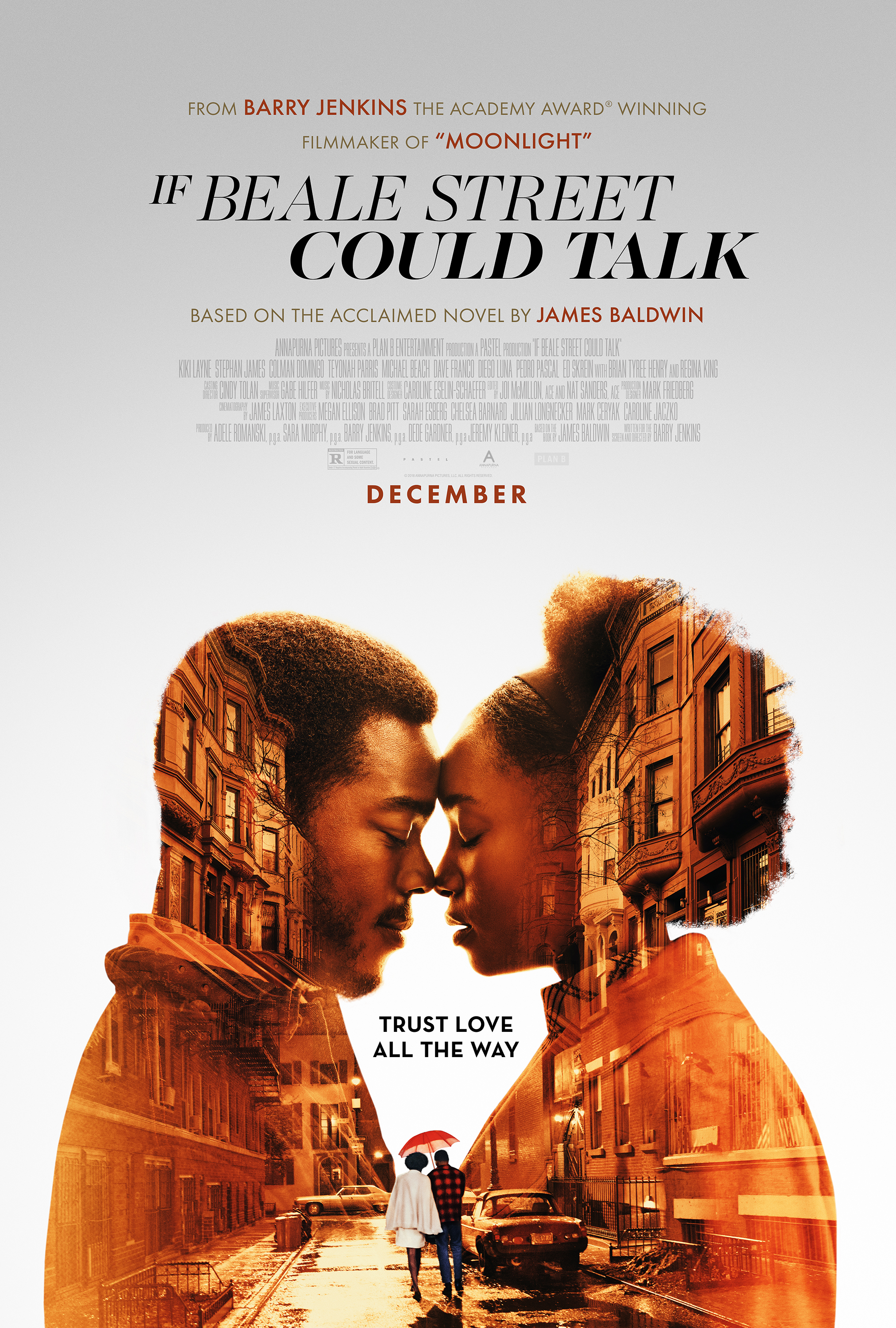
Harlem in the 1970s – Tish Rivers (Kiki Layne) and Fonny Hunt (Stephan James) are deeply in love. When Fonny is arrested and falsely accused of raping a woman, he is sent to prison where he is likely to meet his demise. Knowing of her soul mate’s innocence, Tish sets out to find a way to prove it, taking on a vicious societal system that is still growing after the nadir of the Civil Rights Movement, with the laws becoming more tolerant, but the institutionalized beliefs being far from accepting to everyone in the way they should be. With the help of her parents (Regina King and Colman Domingo), and a selection of other individuals, Tish does everything within her power to help prove Fonny’s innocence, which is only complicated by the fact that she has recently discovered that she is pregnant with his child, giving her even more reason to relentlessly pursue justice. It is likely that Fonny only ended up on the wrong side of the law due to the lethal combination of a tense encounter with a malicious police officer (Ed Skrein), and the fact that despite being a good-natured, charming and hard-working young man, the colour of his skin will also count against him in a society that is still hostile to those who are different due to the institutionalized bigotry prevalent in even the most progressive of communities, where the individual quality of character is superceded by the colour of one’s skin in the eyes of the public.
When looking at If Beale Street Could Talk, there are a number of qualities that define this film as a bona fide masterpiece. First of all, the viewer is immediately struck by the visual scope of this film – very few films this year look as gorgeous as If Beale Street Could Talk, with cinematographer James Laxton crafting a warm and endearing representation of New York City in the 1970s, projecting an image of a bygone era in cinema’s most beloved city through the lens of his camera right from the outset, when the central couple walk down an autumn-soaked street, right until the haunting final moments. The colours are vibrant, the shots are astonishing, whether long or short, and everything just feels so perfectly composed. Jenkins has always had an eye for detail, and working alongside Laxton, they developed a truly memorable film that is heart-achingly poignant in its pulchritude, and breathtaking in its intricacies. Absolutely every moment in If Beale Street Could Talk is carefully selected, plucked confidently from Baldwin’s audacious book and transformed from deeply meaningful text to true visual poetry. I constantly found myself in stunned awe at this film – there are moments in this film that will undoubtedly become pivotal constituents of the pantheon of great cinematic moments – and to put it reductively, If Beale Street Could Talk is a montage of nothing but beautiful, meaningful and meditative moments, and it frequently rendered me at a complete loss for words.
There are few filmmakers working today I’d trust more with Baldwin’s work than Jenkins, whose meticulous attention to detail, and endless wisdom in knowing that to adapt a novel like this is not simply translating the story from page to screen, but rather the multitudes of themes, concepts and most importantly, the general ambience of the era. This is precisely where If Beale Street Could Talk thrives – it isn’t just a film that chronicles the love story between Tish and Fonny in a time and place which is simply in refusal to allow them the same fundamental human rights and social decencies that others take for granted. It is a film about very important themes, a depiction of a temporal moment, in a specific location – contrary to the title, If Beale Street Could Talk is not set on the iconic street in New Orleans, but in Harlem. Much like with Giovanni’s Room, Baldwin wasn’t too concerned with the physical location of the title, but rather its more metaphysical implications, its underlying importance in terms of society. In the most straightforward terms, If Beale Street Could Talk is a cinematic ode to being young, black and in love in a social climate that celebrates two of those qualities, as long as the third is not included. The story of Tish and Fonny is not one that is the definitive representation of the era, but rather an example of the injustices many faced at that time, and still sadly face to this day. Baldwin didn’t position his characters as the most remarkable individuals, but rather as representations of ordinary people faced with the challenges presented on a daily basis – whether it be race, sexuality, gender, class or any form of identity that sets us apart, the intention of Baldwin’s work, and If Beale Street Could Talk in general, is to depict a moment in history, and it does so truly beautifully.
It was imperative that Jenkins cast the right actors to interpret Baldwin’s work, because, with the exception of his gorgeous imagery and fascinating philosophical ponderings, Baldwin would always imbue his characters with such complexities – they are not simply vessels for the story, but rather the prime motivation, physical manifestations of his own experiences and curiosities. Kiki Layne is astonishing in her breakthrough performance, playing Tish with a mix of fierce confidence and heartbreaking anxiety. I wouldn’t quite call If Beale Street Could Talk a coming-of-age story, but it does have some minor qualities, such as the character’s transition from innocence to experience – scenes of Tish and Fonny playing as children are effectively juxtaposed with moments of palpable romantic tension. If Beale Street Could Talk is her journey into adulthood, her voyage into the depths of responsibility, only made worse by her incessant need to prove the innocence of the man she loves – not only as a way to be reunited with Fonny, but to be a way forward for every young black man falsely accused due to the colour of his skin. Stephan James is already establishing himself as a talented young performer, and his work in If Beale Street Could Talk is astonishing. He is a deeply gifted actor, having the ability to hold the screen without so much as a word, with his performance conveying the deep complexities of a character like Fonny. Layne and James make an astonishing duo, and If Beale Street Could Talk is built beautifully on their relationship. In terms of the supporting cast, we simply cannot ignore the extraordinarily elegant Regina King in her best performance to date as Sharon, Tish’s loving mother who would do anything to help her daughter, and Colman Domingo who brings the necessary gritty gravitas to the often ethereal film. King and Domingo frequently command the screen with such ease, and while Layne and James are undeniably the stars of the film, If Beale Street Could Talk would not have been the same had it not been for the committed, brilliant performances from these two veterans doing some of their very best work. Finally, we need to mention Brian Tyree Henry, who has had a breakthrough year by appearing in many films, and confirming that he is a true talent, and someone we need to keep a keen eye on, because his talent is seemingly endless, and his work here is utterly prodigious.
There is just something about If Beale Street Could Talk that is just overwhelmingly powerful – how Jenkins translates this text (no easy feat, as anyone who has read Baldwin’s work will tell you – it doesn’t necessarily lend itself to the visual form particularly easily) into such a remarkable film should not go unrecognized. This is just a gorgeous film, a simple but moving story that exposes a time in history where the country was coming out of a period of injustice and inequality, but still being plagued with the despicable behaviour of many individuals who were prone to only widening the social gap based solely on the colour of one’s skin. This is a film that just strikes you as undeniably powerful – whether it is Laxton’s breathtaking cinematography, or Nicholas Britell’s stunning music (the score for If Beale Street Could Talk will undoubtedly go down as some of the greatest – there is something so otherworldly about this sensational music – dreamy yet visceral, delicate yet impactful), or the general ambience created by this film. This is a film that captivates the audience, engrossing us within the themes it presents to us – the opening lines of the film, taken from Baldwin’s novel, establish this is a profoundly moving experience, a striking journey into the metaphorical experiences of an entire group of people. I don’t quite understand everything this film was trying to convey – it is not a film that immediately makes its intentions entirely clear, but rather one that requires thought and reflection, and considering the sheer might of this film and its execution, it is difficult to not sit in stunned silence, being beautifully overwhelmed by this incredible work.
If Beale Street Could Talk is an astonishing achievement, and one of the year’s most extraordinary films. Barry Jenkins dares to be the first filmmaker to adapt a narrative novel by the incredible James Baldwin, and not only does he do so with finesse, nuance and utter brilliance, he effectively conveys the tone and themes of the novel in a way that is singularly unforgettable and deeply moving. This is filmmaking at its very best – beautifully-constructed, emotionally-resonant and absolutely stunning in every way, narratively and aesthetically. Jenkins continues to impress audiences and critics alike with his masterful control of his work, and it is his effortless ability to convey such extraordinary emotions through the most subtle, delicate filmmaking that makes an indelible impact. If Beale Street Could Talk is a film that will certainly be remembered and appreciated as a pinnacle of great filmmaking for years to come, and will take its place amongst the ranks of true cinematic masterpieces. It is a potent, poignant and gorgeous film, and it stands as one of the year’s most incredible achievements, and one of the very best films of 2018. I just cannot stop thinking about this film – and when a film lingers with you this long, then it is nothing if not extraordinarily special.
 The Postmodern Pelican