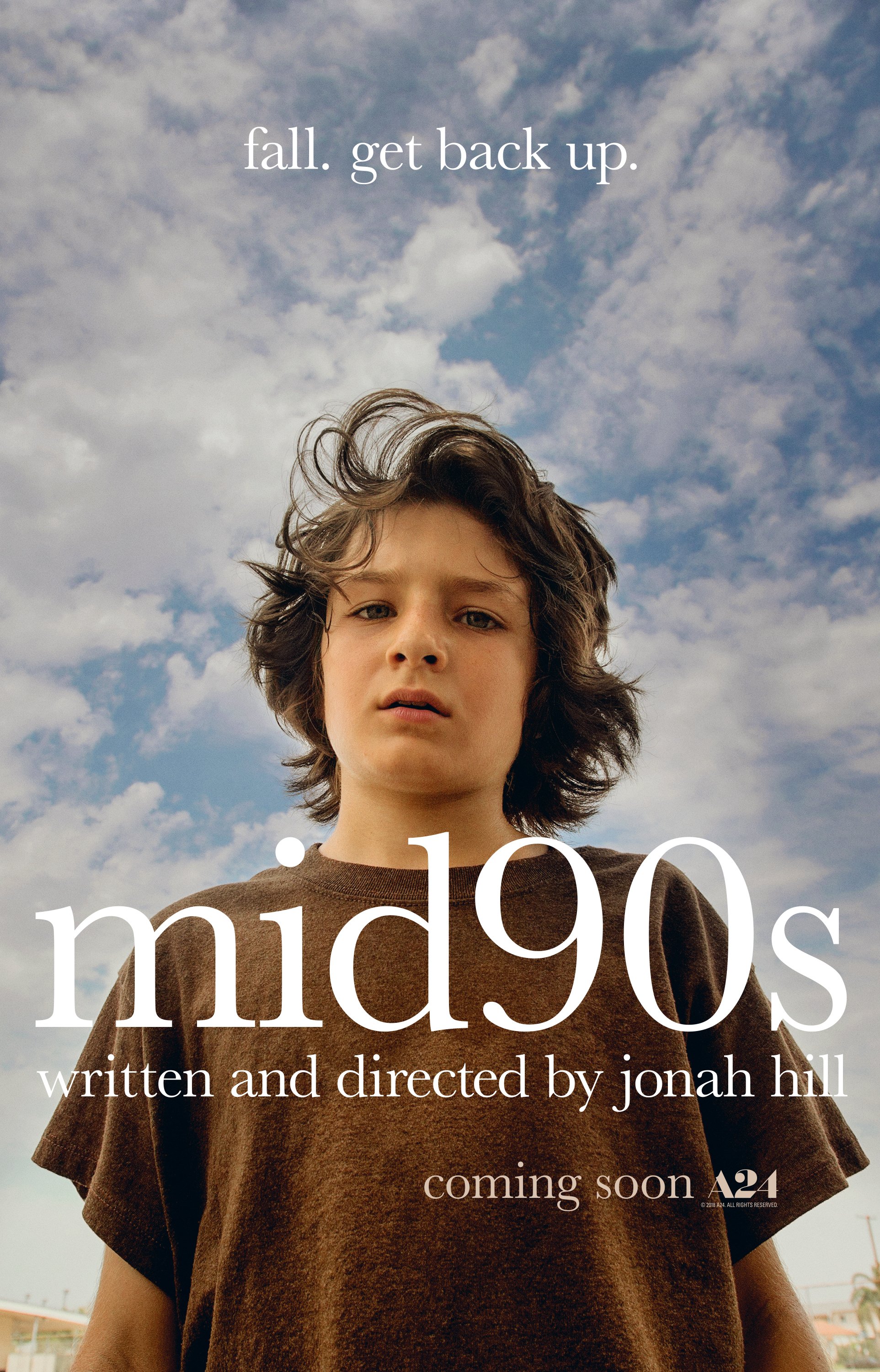
 Nostalgia is a powerful drug, and the entertainment industry seems to be addicted. In recent years, we’ve seen the trend where artists attempt to emulate the past in order to stir up memories and create a sense of warmth and familiarity. Some of these works turn out to be lifeless and uninspired when the nostalgia factor is subtracted, while others manage to be incredible achievements. The latter category is far rarer, and it isn’t often that an artist can get it perfectly right. Luckily, one person who did get it right was Jonah Hill in his directorial debut, Mid90s. This year has seen some notable debuts from a variety of industry folk who would have otherwise never really be considered likely to helm major films, – look at Paul Dano’s remarkable chronicle of a declining marriage in Wildlife, Boots Riley’s unique social satire Sorry to Bother You, Bo Burnham’s manifesto of the anxieties of high school in Eighth Grade or arguably the year’s most popular (non-superhero) film, Bradley Cooper’s A Star Is Born. Perhaps an opinion most people don’t hold, but when comparing all of these films, Mid90s is probably the best – mainly because it is the most deeply personal work, and it is perhaps the year’s most resonant film.
Stevie (Sunny Suljic) is a 13-year-old loner in Los Angeles in the 1990s. His loving single mother (Katherine Waterston) has a variety of boyfriends, and his older brother (Lucas Hedges) is abusive, constantly beating and humiliating his sibling, with the family being far from the ideal nuclear family. Not having any friends, Stevie encounters a group of older boys that have a penchant for skating, and being instantly captivated by their devil-may-care attitude, he befriends them in some form of symbiotic relationship – they give him a sense of belonging, and he is a novelty to them, a unique addition to their posse who gives their ragtag bunch an even more unconventional appearance. However, Stevie is easily-influenced, and his choice of friends are not the most responsible of teenagers – and very soon, the young and inexperienced boy is experimenting with drugs, alcohol and sexual encounters, maturing long before it is appropriate. Constantly finding himself in life-threatening situations, and causing considerable concern to his loving mother, Stevie is enamoured with the reckless life, finding the danger he is constantly in truly intoxicating – friends take preference over family, and fitting in is far more important than being reasonable to Stevie – but how long until the choices he makes bring him into considerable trouble, and will his newfound friends be there for him in a time of massive crisis?
Sunny Suljic had a remarkable breakout with Yorgos Lanthimos’ terrific The Killing of a Sacred Deer, and returning with another prestige film, Suljic is establishing himself as a remarkably talented young performer. Mid90s is a tricky film because it is centred on a child, but it requires an actor that can convey both the naive innocence of youth, as well as the worrying maturity – the character undergoes a significant change, and Suljic rises to the opportunity to play this very complex character. It is an intricate performance, one very rarely seen in films about childhood, with this kind of maturity not necessarily being a priority. Suljic is really good, as are the actors who portray his friends, each one having moments of genuine brilliance. The standout of the cast is Na-kel Smith, who gives the most nuanced performance in the film, with his portrayal as Ray being absolutely astonishing, a perfect blend of exuberant confidence and fragile insecurity – and his ability to create such a complex character out of what was essentially a one-dimensional archetype was remarkable, with Mid90s being a breakout turn for Smith, who I fully expect to become a talented mainstay in cinema. Lucas Hedges plays against type as Stevie’s abusive older brother, and while he is certainly very good, his character is underdeveloped, and I wish the film had given this character more space, because it was an undeniably fascinating one, and Hedges is giving one of his most idiosyncratic performances. The same can be said for Katherine Waterston, who excels in the small moments as Stevie’s gentle but concerned mother, but is otherwise relegated to the background for the most part. Mid90s is very clear in its intentions, and it succeeds in showing the central dynamic between Stevie and his friends, but if Mid90s had been solely about his relationship with his family, it would’ve been just as exceptional. As a whole, the film has a tremendously talented cast, large and small parts, each with their own unique, memorable moments that leave quite an impression on the viewer.
Mid90s is an odd film to approach because while one would expect this to be the archetypal film about youth, it is not as coherent as it would seem, which is its most significant merit. Hill has made a film that is less of a narrative work with a lucid, straightforward story, and more of a film that serves to be a snapshot of an era – he is clearly intending to portray the 1990s as he remembers it – a time when youth would pass their time by spending days on the sun-baked pavements, skateboarding and causing mischief – of course, these kinds of stories are represented in every era, and it is not contained exclusively to the 1990s, but this film doesn’t serve to be the definitive statement on the era either – to the contrary, it is intended as Hill’s own private manifesto to how he perceived his childhood. It isn’t clear how much of the film is autobiographical – but there are certainly some very meta clues that indicate that this is Hill drawing from his own experiences, such as one character intending to make his own film one day (which we eventually learn is also entitled Mid90s). It is difficult to pinpoint exactly how Mid90s excels as a film, because it has a certain stream-of-consciousness that doesn’t lend itself to much description, being far more visual and emotional than comprehensible in any coherent words. In essence, Mid90s is a film that needs to be experienced rather than explained.
The key to the success of Mid90s is in its approach to its themes – the 1990s is an era distant enough to make for an inert period piece, but recent enough that many of us can remember it, or at least relate to some of it through our memories, or the memories of others. Hill brilliantly evokes the spirit of the period in a variety of ways. On the narrative level, there are clear references to the past, both overt and subtle – the technology (mobile CD-players and cars), the politics (an unsettling mask of Bill Clinton is used a few times in the film) and the general mentality of the 1990s all go into the narrative of the film, creating a mesmerizing mosaic of the recent past. Visually, Hill evokes the 1990s through the cinematography – he takes the opportunity to present the film in a way that is quite unconventional – the use of VCR at some points in the film emulates the recordings of a bygone era, especially the final moments, where Hill effortlessly replicates the exact kind of home video that I personally remember – low-budget but with enormous ambition behind it, rough around the edges but with a certain gritty beauty beneath it. The general look of the film was quite ambitious on its own, and cinematographer Christopher Blauvelt (whose previous work includes aesthetic masterworks The Bling Ring, Certain Women and The Disappearance of Eleanor Rigby) did well in emulating the distinct appearance of the era, filming Mid90s on 16mm film and in 4:3 aspect ratio, almost unheard of outside of independent cinema – and the final product is visually as gritty and realistic as the story it tells. As a whole, Mid90s is a stunning film, albeit one that isn’t conventionally so – but Hill’s eye for detail and his ability to replicate an era through authentic means, rather than relying on surface-level nostalgia, warrants an immense amount of praise.
Beyond anything else, Mid90s is a great film for its approach to its story, or more precisely what it does with a familiar story. The coming-of-age narrative has been ever-present, and we are witness to several of them a year – yet this one stands out for a number of reasons. Firstly, the personal connection Hill feels towards this story is extremely evident – this is film clearly influenced by the director’s own childhood, and whether or not these events actually occurred in his own life, the underlying themes are very potent and come from a place of genuine understanding. Stevie is a complex character because he has to undergo the same process every child protagonist has to, just with more intensity. It is the traditional structure of a young person going from innocence to experience, earning various kinds of education – emotional, physical and sexual. In Stevie’s case, he grows mature in the ways of being independent (or at least fooling himself to believe that he can survive on his own terms) – very few films take such a bold stance portraying how someone develops, and it can sometimes be excruciatingly tense and very uncomfortable – in his review for the film, AO Scott remarked how this is a film “about kids, [but] it is certainly not for them” – and Hill deserves kudos for making a film that creates a sense of nostalgia without shrouding the gritty, uncomfortable details life tends to bring. Moreover, even though Mid90s is set in a particular place, and during a specific time, the themes it is built upon are endlessly resonant and without boundaries, and everyone in some way can relate to Hill’s extraordinary depiction of childhood.
Mid90s is a film I went into without any set expectations – on the surface, there is nothing about this film that would suggest it was entirely original. If anything, it could be considered a blend of any of the recent slate of coming-of-age stories released by A24 and the transgressive films of Harmony Korine, who was clearly so much of an influence on this film, he even briefly appears in it. Yet, it still manages to diverge on its own terms, becoming something so engrossing and meticulously constructed. Hill seems to understand that in order to evoke the warmth of nostalgia, an artist can’t just depend on pop culture references, but rather needs to imbue the work with a certain tangible atmosphere, showing the period in a way that isn’t seen through rose-tinted glasses, but rather in stark, gritty and explicit honesty. It is amongst the year’s most audacious achievements, and it proves that Hill isn’t just a talented actor and comedian, he’s also got a tremendous amount of skill as a writer and director, and with the right projects, he could truly flourish into quite an artist, and Mid90s is a daring debut if there ever was one.
 The Postmodern Pelican