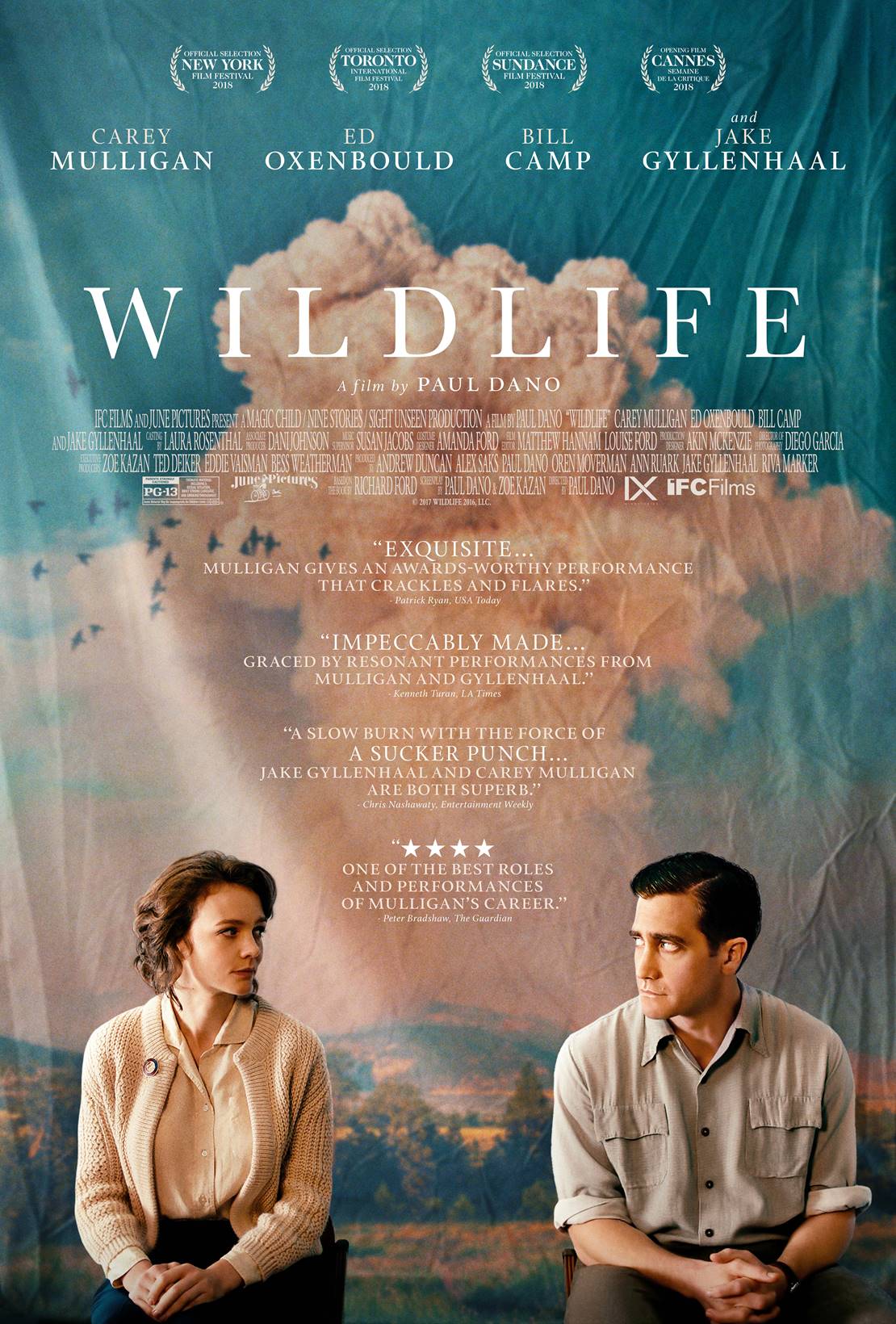
 Jerry (Jake Gyllenhaal) and Jeanette Brinson (Carey Mulligan), along with their son Joe (Ed Oxenbould) are the quintessential 1960s suburban family – he works a menial but solid job, she is a dedicated housewife and mother, and their son is a hard-working student with wide ambitions. They are a nomadic family, constantly moving, a result of Jerry’s constant changing of jobs. However, there is a deeper tension underlying the family dynamic, mainly the strain the marriage between Jerry and Jeanette is starting to take, especially after Jerry finds work as a firefighter for a large wildfire, abandoning his family temporarily, leaving his wife and son to fend for themselves, learning how to live without his income, and his influence. However, the question remains: when Jerry inevitably returns, will things revert back to normal, or will his absence have had much more grave consequences on their seemingly-perfect nuclear family, with their suburban Montana home being the stage for multiple confrontations and existential crises as each of these individuals adapt to the unfortunate changes in their lives.
Paul Dano certainly has made an auspicious directorial debut with Wildlife, an adaptation of the novel by Richard Ford. Working alongside his long-term creative and romantic partner Zoe Kazan, Dano has crafted one of the year’s most subtle but moving films, a film that is equal parts striking family saga and intense character-driven drama, a study in existential exploration set to the background of suburban America in the 1960s, an era characterized as one of profound change, but still one looked upon with great nostalgia, and not nearly with the dissenting eye provided by Dano and his camera, flawlessly portraying the deception and drama underlying the perfect world, the archetypal American Dream, exposing the tragic underpinning that perhaps are not broadly evident, but extremely poignant when we investigate society on the individual level. In short, Wildlife is a delicate, elegant drama that is one of the year’s finest achievements, a slow-burning character study that quite possibly has the makings of a new American classic, something that perhaps may not be particularly noteworthy right now, but will certain amass a following in subsequent years, where this tense but beautifully-constructed social exploration will be appreciated as a stark but powerful portrayal of life and all of its unexpected moments.
Jake Gyllenhaal has flourished into an extraordinary actor, and while he may not be as distinctive as some of his contemporaries, he has slowly built up a career defined by a broad range of roles in a variety of genres. Wildlife is simply just another addition to his impressive array of films, especially in terms of his quasi-renaissance that has seen him on both sides of the morality spectrum. Wildlife is certainly a film marketed on his talents as a leading man, and even though we are slightly chagrined to discover that he is in far less of the film than we thought (disappearing for the entire second act), he definitely makes an indelible impression, commanding the screen when he is present, lingering on as an omnipotent memory when he is absent. The true lead of the film is Ed Oxenbould, a young actor also making tremendous career choices that prove him to be a talent to keep one’s eye on. Wildlife is a film about a declining marriage, told through the eyes of the couple’s teenage son – and the film eventually metamorphosizes into a coming-of-age tale, where we see Joe’s growth from innocent to maturity, not through simple ageing, but through being forced into experience – he is made to grow up with his father’s departure, which leaves him without a positive male role model, and with his mother’s own struggles to come to terms with the fact that she can finally become her own person, not merely being defined by the men in her life.
Mulligan, in this regard, gives the finest performance of her career – and this is certainly impressive considering that over the past decade since her breakthrough performance in the exquisite An Education, she has appeared in several notable films, being consistently brilliant in nearly all of them. Jeanette Brinson is one of the most quietly fascinating literary characters of recent years – she is, at the outset, a content housewife, someone quite happy to raise their son and be a doting spouse to her working-class husband. Yet, even from the beginning, we can sense some despair in her character – she silently demands more, conveyed through a subtle expression or a quiet moment of deep introspection. As the film progresses, Mulligan’s performance begins to take shape, with the actress crafting a complex character that is perhaps not entirely likeable – a large portion of Wildlife is spent demonstrating how, in her search for deeper meaning following her newly-minted independence, she is capable of not only liberating herself from the shackles of heteronormative suburban expectations, but also of making some truly poor decisions. In many ways, Jeanette is the antagonist in her own story – her quest for herself results in a carnal lust, an unquenchable desire that sends everything she and her family hold dear into a downward spiral of despair and heartbreak. The question isn’t whether or not Jeanette was right to make these choices, but rather demonstrating how these choices, for better or for worse, can change not only one life but several. Mulligan has never been better, and Wildlife, while essentially a film focused almost equally on the family as a whole and the three people that constitute is, does place emphasis on Mulligan’s character, with the actress creating a fully-formed portrayal of a woman under the influence of patriarchal control, with a spirited, fully-dedicated performance that is one of the year’s most exceptional.
There is something about Wildlife that just fails any coherent description, a certain raw brutality that perhaps isn’t necessarily disturbing in the traditional sense, but is deeply harrowing in the context of what this film is trying to convey. Wildlife is a film about suburban life in the 1960s, the archetypal simplicity evoked with the almost taut predictability of a Norman Rockwell painting. However, it doesn’t necessarily fall into the pattern of showing how simple life was, nor does it attempt to create the illusion of nostalgia, hearkening back to the proverbial “good old days” that many of us, even if we didn’t live through them, yearn to return to. Wildlife deconstructs typical notions of suburban life, not only of the era or the location but rather of the underlying concepts associated with it. Literature has always relied heavily on the nuclear family and their ordinary lives, how the father works hard to support his family, how the mother dotes on their children, who spend their days in the joyful recklessness of youth, enjoying the warm summer afternoons on the sun-tinted football fields, returning home to their white-picket-fenced homes. All of this is portrayed in Wildlife, albeit not from the position that this was necessarily true (while also not dismissing its existence, because as implausible as such a perfect life would be, most people do strive to have their lives resemble this kind of utopian simplicity), showing that there is far more to these lives, something that is just not shown in all honesty.
Wildlife is a film that really takes aim at suburban life, and the family dynamic, and even though it is far from being the deconstructed satire of other works that try and expose the false hope lying within the promise of the perfect suburban life, its best to describe the message through David Lynch’s unique but resonant justification for his similarly-themed, but far more sinister, suburban drama Blue Velvet, where he noted how “if one looks a little closer at this beautiful world, there are always red ants underneath” – and in this case, the central conflict is caused by the declining marriage of Jerry and Jeanette, a heartbreaking portrayal of familial dysfunction – while it isn’t common, it is not unheard of for such a concept to be portrayed in these kinds of films (although often being relegated to a minor plot point, a result of the central conflict rather than the cause of it, as was the case here), Wildlife demonstrates the complexities that come with this kind of situation, how just like the perfect marriage doesn’t exist, the flawless divorce is similarly elusive, filled with despair, second-guessing and deeply harrowing struggles. Wildlife is one of the most potent portrayals of a declining marriage in recent years – and for anyone who has seen a relationship falling apart, whether they were involved or merely a witness to it, Wildlife will be a painful reminder of the panoply of disconcerting, seemingly-insurmountable emotions, the inescapable pain and the bleak mindset that one experiences in a period of domestic upheaval. On a purely personal level, Wildlife resonated with me, and I could see so much of myself in Joe, who had to stand passively aside while he watched his parents fall out of love – it is a distressing period of torment, but as this film shows, everything comes to pass, and the distress may make an indelible impression on us as individuals, it can ultimately result in strengthening of spirit, and a painful but vital reminded that absolutely nothing is perfect, and some things, as much as we’d like them too, simply cannot remain the same forever.
Therefore, considering everything we’ve noted, it is clear that Wildlife and thus Dano certainly had his work cut out for him in making this film. The film is perhaps not entirely difficult in terms of execution, being a small-scale character-driven drama, but there was still a plethora of complex themes Dano and Kazan needed to incorporate into the film, and they successfully crafted a beautiful film that is as narratively-fascinating as it is visually stunning. Dano takes a film that is small in scale, but inundated with complexities in its message, and brings everything together with the deft precision of the auteurs he has worked with through his storied career as an actor. For the most part, Wildlife is an intimate and almost gritty realist story, but there are some moments of astonishing beauty that show Dano not only telling a resonant story but also imbuing his film with a certain directorial flair. He narrowly avoids the predictable pratfall the majority of actors-turned-directors face in their debut features, namely the tendency to over-direct the film, but still inserting moments of unparalleled beauty throughout. Dano has been a consistently brilliant actor for over a decade now, but with Wildlife he shows that he is more than a talented performer, and establishes himself as a young filmmaker with extraordinary potential – and if Wildlife is anything to go by, I think we should be expecting more brilliant work from Dano, who crafts such a powerful, evocative and beautiful film in a way that deceives us into thinking that this isn’t a debut film, but the work of a seasoned veteran.
Ultimately, Wildlife is one of the year’s most beautiful films, a paced but impactful film that tells a resonant story, one that does not avoid taking its story to unsettling territory for the sake of truthful representation of the broken promises of the American Dream, and how the utopian view of a patriarchal suburban society, governed by the quintessential nuclear family, is not only implausible, it is quite possibly damaging, both to society as a whole, insofar as it creates indelible expectation, and to the individual, who is raised to hold these false virtues to be inexplicably true. Dano has made a film that is delicate in execution, roaring in its intention, and with tremendous performances from Jake Gyllenhaal, Ed Oxenbould and Carey Mulligan, who gives the finest performance of her career to date, and some truly exceptional filmmaking prowess, it is not surprising that Wildlife is a film that leaves the viewer profoundly shaken. An intricate character study that covers impressive thematic content, and will doubtlessly resonate with many viewers, Wildlife is an astounding film, and one certainly worth seeking out for any of the reasons we’ve discussed above. Truly an extraordinary achievement, and a singularly unforgettable experience.
 The Postmodern Pelican