 In contemporary cinema, there are few names quite as exciting as David Lowery – a filmmaker who rose from relative obscurity a few years ago, evolving into one of modern cinema’s most talented auteurs, for a number of reasons, crafting exuberant masterpieces such as the gritty crime drama Ain’t Them Bodies Saints, the exceptional philosophical masterpiece A Ghost Story and the only worthwhile reimaging of a classic Disney film with Pete’s Dragon. The director’s incredible talents, both narratively and visually, are best exemplified in his most recent film, the crime caper The Old Man & the Gun, based on an extraordinary true story. Lowery has a certain style that is difficult to pin down, and each and every one of his films has a certain easy-going, ethereal quality that makes them almost otherworldly, even when they are within the realm of gritty realism. The Old Man & the Gun is, on the surface, not a major work that immediately demands much attention – and in many ways one can easily be distracted from the external narratives, especially that of its star and his participation in this film, but when you get down to it, this is an exceptional film – a melancholic, often extremely funny and audacious throwback to a more simple time in American filmmaking, where a film could be both exhilarating and heartfelt, moving without taking itself too seriously. This is a slow-burner of a film – it won’t make too much of an impact immediately, but it will exist as a masterful work and gain the status of being a classic of contemporary American filmmaking, a touching and beautifully-constructed film that almost exists on its own unique terms.
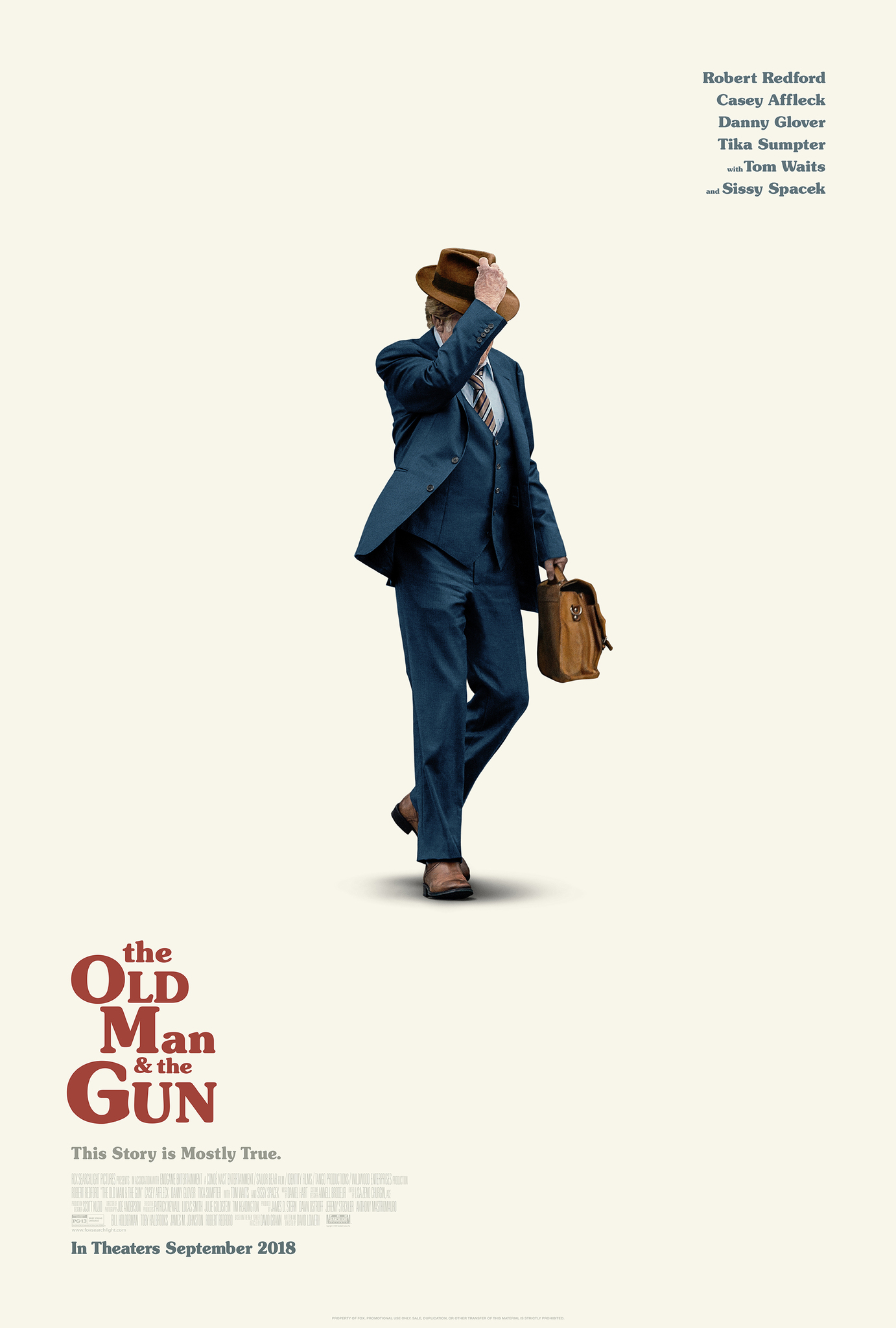
Forrest Tucker (Robert Redford) is not a complex man – he drives around the country, interacting with various people and hoping to brighten the day of anyone he comes across, perhaps even going as far as to help them out a variety of difficult situations, always being armed with a gracious smile and a genuine fondness for his fellow man. He also engages in a slightly unusual pastime – he robs banks and has been doing so for quite some time. Over the past few decades, he has successfully conducted hundreds of heists, alongside his two colleagues (Danny Glover and Tom Waits), and has escaped from prison on some sixteen occasions. Now well into his seventies, Forrest is showing no signs of slowing down – but his latest heist piques the interest of John Hunt (Casey Affleck), a local detective who takes it upon himself to investigate the syndicate he has dubbed “The Over-the-Hill Gang”, with its leader being of particular interest, especially considering even those who Tucker directly interacts with on his crime sprees always mention how he conducts himself as an absolute gentleman, who will smile with genuine earnest and impart anything from a kindhearted compliment to sage wisdom while holding someone at gunpoint. While John is hunting for Forrest, our anti-hero is falling deeply in love with Jewel (Sissy Spacek), a feisty but sweet-natured widow who falls for Forrest’s deceptive charms, even when she discovers how he has made a living all his life. The two stories run parallel until finally converging in the third act, where we see the complexities that come with a case like this, and how the experience of being human takes preference over the idea of abiding by the rules we are taught to follow.
Whether or not we consider ourselves devotees, it is difficult to disagree with the fact that Robert Redford is a legend, a true veteran and one of Hollywood’s most iconic stars, someone who has consistently, for over half a century, given us memorable performances in a range of unique and inspired works, as well as being a talented filmmaker in his own right, crafting some bona fide masterpieces of his own. The Old Man & the Gun has been marketed as Redford’s final film before his retirement – and while he is far from the only performer to announce his retirement from acting, he does stand as someone who chose the right film to end his iconic cinematic career. The Old Man & the Gun is the perfect swan-song for Redford, who gives one of his best performances to date, returning to the roots that made him a star decades ago. Forrest Tucker is more than just an elderly man who robs banks – he is a complex individual, someone who is fully-realized as a character, has his own unique motives (yet not the traditional kind that would normally be mentioned as the reasons for these crimes) as well as being profoundly human. Redford’s performance is extraordinary – his ability to imbue this role with such intricate personality, finding the balance between all the facets of Forrest Tucker’s character, conveying every emotion regardless of its significance, proves to me that Redford is one of the finest actors of his generation, someone who is not merely an icon because of his longevity in the industry, but also because he is a supremely talented performer. The Old Man & the Gun is the perfect showcase for everything Redford excels at – genuine empathy, endless charisma and a certain exuberance, a star quality that is almost folkloric in the industry, with Redford being one of the last remaining relics of the greatest era in American cinema.
The Old Man & the Gun extends beyond Redford, with the film being composed of two separate stories involving our titular anti-hero, following two people who are fascinated with Forrest Tucker and drawn into his world, albeit for very different reasons, and both performers are exceptional. The first is another 1970s icon, the brilliant Sissy Spacek, who also gives one of her strongest performances to date as Jewel, the sweet and endearing widow who Forrest falls in love with purely by chance. Spacek is an extraordinary actress, and there are few performers who can command a screen quite like her, with her performances always being dynamic, complex and utterly brilliant. As the voice of reason in the later stages of Forrest’s life, she manages to humanize him and get through to him, understanding him fully and completely, and in a way that he had yet to experience. There is a point made that Forrest was not only someone who would escape prison – he would also consistently evade commitment, having no qualms in leaving his family behind for the sake of his criminal tendencies – yet, it is to Jewel, the sensitive but wise woman that Forrest returns, and perhaps he is there to stay. Casey Affleck (who previously worked with Lowery on Ain’t Them Bodies Saints and A Ghost Story, both of which are amongst Affleck’s finest performances) plays John Hunt, the dedicated detective who takes it upon himself to prove his mettle and catch one of the country’s most notorious, evasive criminals – and when he eventually realizes Forrest’s motives towards his actions, not even his oath to uphold the law can come into conflict with his moral centre, which profoundly understands that Forrest Tucker is not just any ordinary criminal. Affleck is brilliant, and while it doesn’t allow him the wide showcase for his talents, it is still a quiet but deeply moving performance – Affleck is at his most subtle and introspective, navigating the depths of a character who is not particularly adept at his job, but rather consistently dedicated to doing the right thing. I’d even argue this film is not solely about Redford and his adventures but also focused on Affleck. After all, the title of the film is The Old Man & the Gun, and while logically this would refer to the weapon Forrest carries with him, it could also be an allusion to Hunt, and how this is a film about two men, pigeonholed by social expectations – Tucker is simply “the old man” acting in mysterious ways, and Hunt is “the gun” sent out to bring him to justice – but as the film shows, there is far more to these characters than we’d tend to think, and they may not be so different after all.
The best way to describe The Old Man & the Gun is not through words, but through evoking a series of emotions, a variety of sensations I am sure many of us are familiar with – the tranquil, breezy Sunday afternoons spent with family, the heartstopping feeling of driving a bit too fast down a quiet, isolated highway, the mysterious beauty of watching the sunrise on a hillside and the calm melancholy of looking back at the peaceful summers of our youth. Lowery is not merely a great filmmaker, he is an evocateur, someone whose films are not so much about the story as they are about the experience of feeling these palpable sensations that strike a resonant chord and linger on in the mind of the viewer. The Old Man & the Gun is a truly unconventional crime film – despite being a film about crime, particularly the intense felonies of armed robbery and prison escape, it is never frantic, and rather meanders on with the lovable pace of a classic turn-of-the-century Americana adventure novel – The Old Man & the Gun can easily be compared to Public Enemies had Mark Twain written it. One of the characters, when describing the crime, even remarks that the crime is “pretty funny” – and only in a film like this can something like chronic armed robbery be considered not only sedate and entertaining but also deeply affectionate. It doesn’t justify the actions of our main character, but it also doesn’t villainize him as some criminal mastermind hoping to bring malice or harm anyone – despite the title of the film, our main character doesn’t once fire his weapon. He’s just an old man doing what he has always done – robbing banks and escaping from prison, and Lowery makes sure to remain firmly within these confines – Forrest Tucker was a simple man with a set of very unconventional hobbies which he dedicated his life to, and the film respects his story enough to make him one of the most endearing cinematic heroes of the past few years.
Considering everything we’ve said above, The Old Man & the Gun is one of the most unconventional crime films of the century for a number of reasons. Firstly, it is almost too gorgeous to be seen as a gritty crime film, but also not nearly stylish enough to be compared to adrenaline-pumping heist thrillers. Lowery is a director who makes his influences very clear, and Terence Malick is certainly an omnipotent inspiration in nearly every frame of the film, both in the ethereal, dreamlike nature of the story and the complex but beautifully intricate narratives. On a purely technical level, The Old Man & the Gun is filled with a visual pulchritude that is almost poetic in its beauty – cinematographer Joe Anderson works alongside Lowery to evoke the spirit of the 1970s – the Super 16 mm film stock gives the film a gorgeous graininess that is a clear throwback to the films that made Redford an icon half a century ago. The landscapes are beautiful as well, with the film traversing nearly the entire country over the course of a few years, and it feels like we are on the same journey. Lowery is an exceptionally gifted filmmaker, and there are some terrific moments of directorial flair that stand as some of the finest I’ve seen in a while – two scenes, in particular, are of significance: the first is a scene relatively early in the film, where Forrest conducts a heist, with the action not being scored by archetypal heist music, but by Affleck’s character telling an old joke. The other is towards the end of the film, a montage of our protagonist’s several escapes from prison, a rousing sequence that alludes to the great classic capers of past decades, even incorporating footage of a younger Redford. The Old Man & the Gun is a truly unique film, a crime story as dedicated to demonstrating the evocative power of the supra-narrative aspects of a film, with the visual nature of a work being as important in creating a certain atmosphere. There just aren’t many films like The Old Man & the Gun, and its brilliance on a variety of cinematic levels just can’t be ignored.
Yet, putting everything else aside, when all is said and done, The Old Man & the Gun is a film that is concerned with one primary concept – humanity. This is a deeply touching, extraordinarily straightforward but undeniably real film, looking at the experience of simply being alive. This is the common underlying theme in every one of Lowery’s films, and it carries over into this film, with The Old Man & the Gun being an intricate exploration of who we are, and the individual’s own motivations to live their lives on their own terms. Very often, this is a film that proves that sometimes reality is stranger than fiction, and if we weren’t told that Forrest Tucker was a real person, we might not believe such a story was even conceivable. The Old Man & the Gun is an easy-going film that has states its intentions very clear and delivers its message through tranquil, elegant filmmaking. The performances are astonishing, especially from Robert Redford, who delivers a powerhouse performance in his final film, making The Old Man & the Gun an extraordinary parting letter for one of the greatest actors of his generation, a true cinematic iconoclast. David Lowery continues to be someone who transcends the limits of cinema, providing us with audacious, meticulous and utterly brilliant filmmaking. The Old Man & the Gun is a film I need to ruminate on, contemplating the panoply of themes while meditating on the fragile beauty of this film. It goes without saying that The Old Man & the Gun is one of the year’s finest films, a complex and beautiful film that is a seamless blend of caper comedy and philosophical drama, and by the time the film ends, we are in a state of blissful awe, because without realizing it, The Old Man & the Gun has left an indelible impression on our minds, and its not something we will soon be forgetting.
 The Postmodern Pelican
The Old Man and the Gun, based on a true story of Forrest Tucker, a bank robber who was better at escaping prison (16 documented times) than the actual criminal activity that provoked incarceration, has a thought provoking title. The title echoes Ernest Hemingway’s classic novella The Old Man and the Sea. There is much to ruminate on that similarity.
Hemingway’s Pulitzer Prize winning text was a simple story. Santiago was defined by his age. He couldn’t escape it. Neither can Forrest. The end of life adjusts how people perceive you. However, here the second half of the title refers to how these men define themselves. Santiago defines himself by the sea. Fishing is a lifestyle, a provider of sustenance, a self defining sense of adventure. And the same is true for Forrest and his gun. Forrest revels in the thrill. When he sees a televised interview with a police officer seeking him, he is drawn to the man. The adrenaline of such moments are addictive.
Robert Redford has been a star since the early 1960s. That’s a long time. He never really changed his trademark coif or sought to hide his great physical beauty. Even in Jeremiah Johnson when he had a huge bushy beard, the physical beauty was still evident. Like so many celebrated strikingly handsome men, their appearance prompted their acting to be underrated. The camera embraces Redford’s laconic demeanor. We are comfortable in this man’s presence. This easiness seduces us as viewers and we don’t really see the effort that is generated to create character. There is a scene in this movie when Forrest is out for a slice of pie and sees John Hunt, the law enforcement officer who is seeking him, seated at the counter. When Hunt visits the toilet, Forrest cannot resist following him in the public restroom for a conversation. Redford is so charismatic that it becomes easy to overlook how his eyes dart with life, his breath quickens, and he stands straighter during the brief encounter. Redford’s subtle performance heightens the drama.
While Redford is good in The Old Man and The Gun, his acting is easily overshadowed by his co-star Sissy Spacek who plays Jewel, a widow who attracts Forrest. Spacek hasn’t had a role this good in some time. She had been relegated to old lady character bit roles as comic relief in other actresses’ films like The Help. Here Spacek is set free to remind us how truly great she is. There are several set pieces that give Spacek long silent periods where the actress lets us inside her head to see her grapple with her desire and her own good sense. Forrest and Jewel are shopping. She tries on an expensive bangle. While the clerk’s attention is diverted, Forrest steers Jewel out the door. Nothing is said. We watch Jewel find excitement in the crime and then recall her own good sense. She stops. They return to the store. She firmly makes Forrest pay for the item. None of this is spoken. Spacek is golden here.
The second memorable set piece occurs when Jewel discovers Forrest’s pistol. We study Jewel as she rides home, goes inside, opens the door for Forrest and a brief rather chaste kiss, makes tea, and then allows herself to think about the situation in which she finds herself. Spacek is so attuned to the camera that we know each precise thought, the temptation, the affection, the rationalization, the decision. This is a welcome return to form.