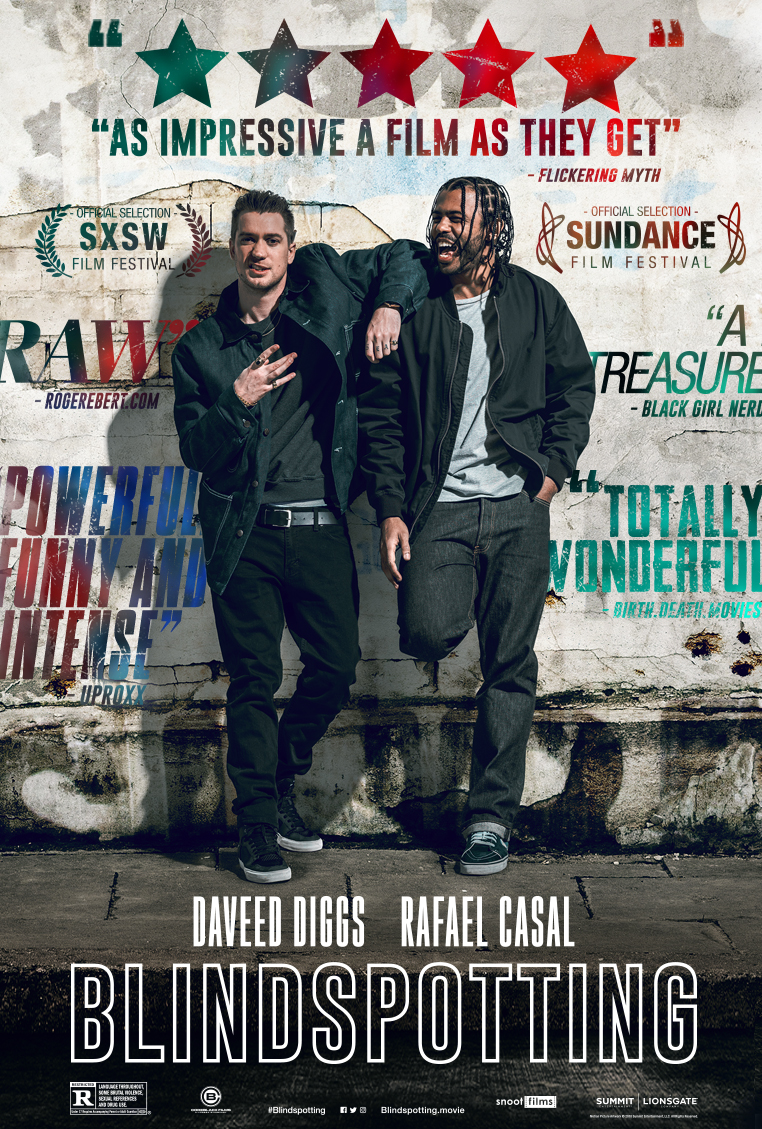
 Cinema is an art form that primarily strives to entertain, to tell stories that allow audiences to escape for a brief period of time and often sit in blissful ignorance to the outside world. However, there are many instances where cinema also intends to educate the audience by conveying a certain message that has real-world resonance and bears significance to issues beyond the screen, to allow us into a world where we can still be entertained, just through the lens of a more realistic story. One of the year’s most exceptional films in this regard is the independent film, Blindspotting, which is a rare combination of masterful comic satire, as well as a bleak portrayal of society, a stark representation of real issues that are still unfortunately very present, and remain important in the discussions we have with each other, especially on the subject of race. An eye-opening voyage into the unsettling state of contemporary race relations in America, Blindspotting is an unflinching, darkly comic and often extremely disturbing depiction of the plight of the black man in a country plagued with problems, even over half a century since the most pivotal moments in the Civil Rights movement made substantial progress for equality and justice. Blindspotting is not just a good film – its an essential work of poignant artistic expression, and it stands as one of the year’s most astounding, and also extremely shocking, achievements.
Collin (Daveed Diggs) has recently been released from prison after serving some time for a minor incident involving a fight he got into while working as a bouncer at a local bar. He now works for a moving company alongside his best friend from childhood, Miles (Rafael Casal) in the city of Oakland, attempting to hold down a job to show that he is a functioning, law-abiding citizen. With only three days left until he is officially off probation, Collin is determined to remain on the straight and narrow, in order to avoid more incidents and to prevent his period of punishment from being extended, which is increasingly possible, especially considering Miles is an erratic, volatile loose-cannon, who hasn’t had to face the consequences of his own actions, with Collin constantly being caught in the proverbial crossfire of Miles’ unstable behaviour. Collin’s attempts to return to normalcy is interrupted when he is witness to a brutal incident – a young black (and presumably innocent) man is gunned down in the streets on evening by a police officer, and this occurrence causes Collin to fall into traumatic shock, having to deal with seeing an event that brought an end to an innocent life, where allegations of racial profiling and police brutality simply cannot go ignored, and form the core of what motivated the instinctual, hasty murder. Collin and Miles engage in a series of misadventures over the following days, with Collin’s memory of that traumatic incident lingering in his mind, haunting him and causing him to truly realize the true malice lurking beneath the seemingly tranquil image of American society, where, despite what we are often led to believe, harmony and justice is a fantastical concept, one that is implausible and unfortunately impossible by the hostility underlying everyday society.
Daveed Diggs makes an explosive leading star debut in Blindspotting, and while he is best known for his work in the original ensemble of the astronomically-successful stage production Hamilton, it is quite clear that Diggs is not going to be solely associated with that production for much longer, because Blindspotting proves that he is as natural a star in front of the camera as he is on stage, and will certainly become a mainstay of contemporary cinema. Blindspotting was a passion project for Diggs and his co-star Casal, who wrote the screenplay and attempted to get this film made for nearly a decade, and it is very clear that this is something that strikes a chord for the actors, as their anger towards society is palpable. Diggs is extraordinary – the way he is able to command the screen at any given moment, whether it be with an elaborate, passionate account of the plight of people like him, or a simple gesture or minor glance, Diggs occupies every frame of the screen with a raw performance pulsating with genuine emotion, layering it with hypnotic complexity. Blindspotting redefines the term “passion project”, because every moment of this film is imbued with such extraordinary commitment from the two leads, who are not merely attempting to tell a story – they are trying to change hearts and minds, and stir thought and discussion. Diggs gives one of the year’s most astonishing performances, a far cry from what we’ve seen him do before, and it is quite clear that he has a definite future in cinema, if this is the kind of performance he is capable of giving. One of his final moments, a combination of a social soliloquy and rap performance has to be the year’s most striking sequences, and leaves us shocked and mesmerized, in extreme awe at the amount of genuine emotion and bold audacity the actor brought to this film.
Interestingly, as established a performer as Diggs is, Blindspotting is most memorable because of Rafael Casal and his performance, which truly surprised and was enough to draw my attention to Casal, an actor I have yet to encounter, but will certainly be watching very closely, because he has an abundance of talent. Miles is a complex character – he is a white man living in a mainly black neighbourhood, working in menial labour and growing up surrounded by a panoply of cultures that influence him to becoming the person he is – yet, despite the fact that he is engaged in many of the same sordid activities as his friends, as well as genuinely being ingrained in the community (not simply another product of gentrification, another underlying theme of the film), he will always be a white man living in a society with an unhealthy bias towards black men and thus he will always, regardless of his behaviour, an unfair advantage over others – perhaps its a stark assertion, but if there is something Blindspotting avoids, it is concealing its true opinion on the state of the country, and it is quite explicit in conveying precisely what it thinks. Casal’s performance is one that perhaps doesn’t exceed Diggs (Blindspotting is most certainly a two-hander, with both performers being symbiotic and working in tandem to create honest characters that depend upon the other), but rather exists on its own, having an individual arc that perhaps isn’t as fully-explored as that of Collin, but still being remarkably fascinating and imbued with a depth that constructs Miles into a compelling, honest character. Blindspotting is a film about race, and it avoids the mistake many other works do in looking at it from a single perspective – perhaps we can’t say this is a film presented from “both sides” (because in all honesty, there was no need for a film like this to try and advocate shortcomings on both sides), but in looking at race relations from two different perspectives, focusing on two men united by similarities in personality, but separated by differences in qualities that supercede them as individuals, such as their race, their class and how society perceives them different, Blindspotting actually manages to make a stark statement on social issues. Diggs and Casal give two of the best performances of the year, and their portrayals are so authentic, the passion so palpable, and their talents so clear. They’re definitely amongst the most significant breakout artists of 2018, and their careers are certainly going to be watched with great enthusiasm if Blindspotting is anything to go by.
In no uncertain terms, Blindspotting is one of the angriest films I’ve seen in a very long time, and considering how cinema (specifically independent cinema) is becoming hyper-aware of social issues and not holding back when it comes to portraying these problems through stark storytelling, that certainly is saying something. This is a film with the same palpable fury that gave many filmmakers such as John Singleton, Charles Burnett and Spike Lee their breakthroughs and established them not only as talented filmmakers but as social commentators, whose anger towards the institution manifested in their daring, often risky, works. This is a film so heavily rooted in the apoplectic reaction Diggs and Casal felt towards society and the racial imbalance within, it becomes very clear that they were not making a film with the sole intention to exist as a piece of entertainment, but as a bold and unwavering statement on the underlying cruelty of society. Racism has unfortunately been a topic in American cinema almost since its inception, and throughout the years, there have been countless films that have taken aim at exploring race relations – almost equally split between those that try and reduce racial disharmony to “misunderstanding” through good-natured portrayals of friendship and coming to terms with one’s biases through getting to know someone on the other end of the racial divide (one of this year’s biggest films, which I won’t name, has this very concept at its core, and it is disappointingly regressive, to say the least), whereas others are pulsating with anger, looking to expose the injustices in a way that could be misconstrued as being aggressive, but only intend to unsettle the institution and bring genuine change. Blindspotting is the perfect blend of the two, with the core of the film being friendship, but not one presented in a way that seemingly “solves” racism, but rather shows that it is a social issue far from being entirely binary, and there is certainly an area of unfortunate ambiguity in these kinds of issues. Blindspotting never justifies this brutality – in fact, it openly derides it – but it also avoids entirely demonizing the racial boundary as a whole. It is a film that shows that nothing is binary, and injustice is not solely the responsibility of the perpetrator, nor is it the fault of the institution on its own, but rather a combination of the two, and both levels – the social and the individual – need to be revolutionized and held accountable before any genuine change can be seen. It is not a matter of the individual changing their hearts, its if the system as a whole can. As Lee said in his seminal work, fight the power.
Blindspotting almost defies categorization, navigating the difficult territory between comedy and drama. It is a seamless combination of the two, often being extremely funny, but not without some poignant emotional gravitas alongside the levity. At its core, Blindspotting is a buddy comedy, a film about two bumbling young men working as movers for an array of colorful characters moving into Oakland, bringing their external perceptions into a city not known for its tourist value (as alluded to earlier, the rapid spread of gentrification is a central theme in this film, and while it doesn’t directly do so, it does serve to be the catalyst for a fair amount of the events in this film). The chemistry between the two leads is very clear, and they bring life to a film focused on two ordinary men just trying to make a living and hoping to derive at least some fun out of their dreary routine. Blindspotting has some genuinely hilarious moments, but it counterbalances it with the serious subject matter. Blindspotting is an anomaly – it refuses to be dour or entirely grave, and it is lighthearted without being parodic, and serious without being heavy-handed. Blindspotting operates successfully on every level it tries to achieve – its comedy is witty and endearing, and its drama is poignant and often intense and rousing, with the climactic scene of the film being some of the best ever committed to contemporary filmmaking, both in terms of its narrative and its central message. The tone shifts are deft and almost unnoticeable, and there are instances where we are caught off-guard, but the emotional core of this film is very evident, as is its very important social message – and what better way to deliver this message than through a buddy comedy?
Films like Blindspotting don’t come around very often. It is a film that is just a fascinating bundle of contradictions – it is warm and endearing, but also cold and haunting. It is hilarious and heartfelt, but also deeply disturbing and extremely terrifying in many instances, being raw in how it presents its central story. Equal parts buddy comedy and social drama, Blindspotting is one of the year’s most genuine masterpieces, a passion project from Daveed Diggs and Rafael Casal that is bound to stand as a vital piece of contemporary independent filmmaking. This is an exhilarating, gorgeous and absolutely rousing film that stirs thought and incites discussion through its bold approach to an issue that is becoming far too much of an epidemic to ignore. This is the kind of film that helps society realize the hideosity lurking just out of sight, and it is an eye-opening journey into modern American society, where injustice runs rampant, and can only be solved by genuine concerted efforts on both the individual and broad social level. Blindspotting is one of the year’s finest films, an assertive and often uncomfortable manifesto that defies expectations and flourishes into something absolutely, undeniably extraordinary.
 The Postmodern Pelican