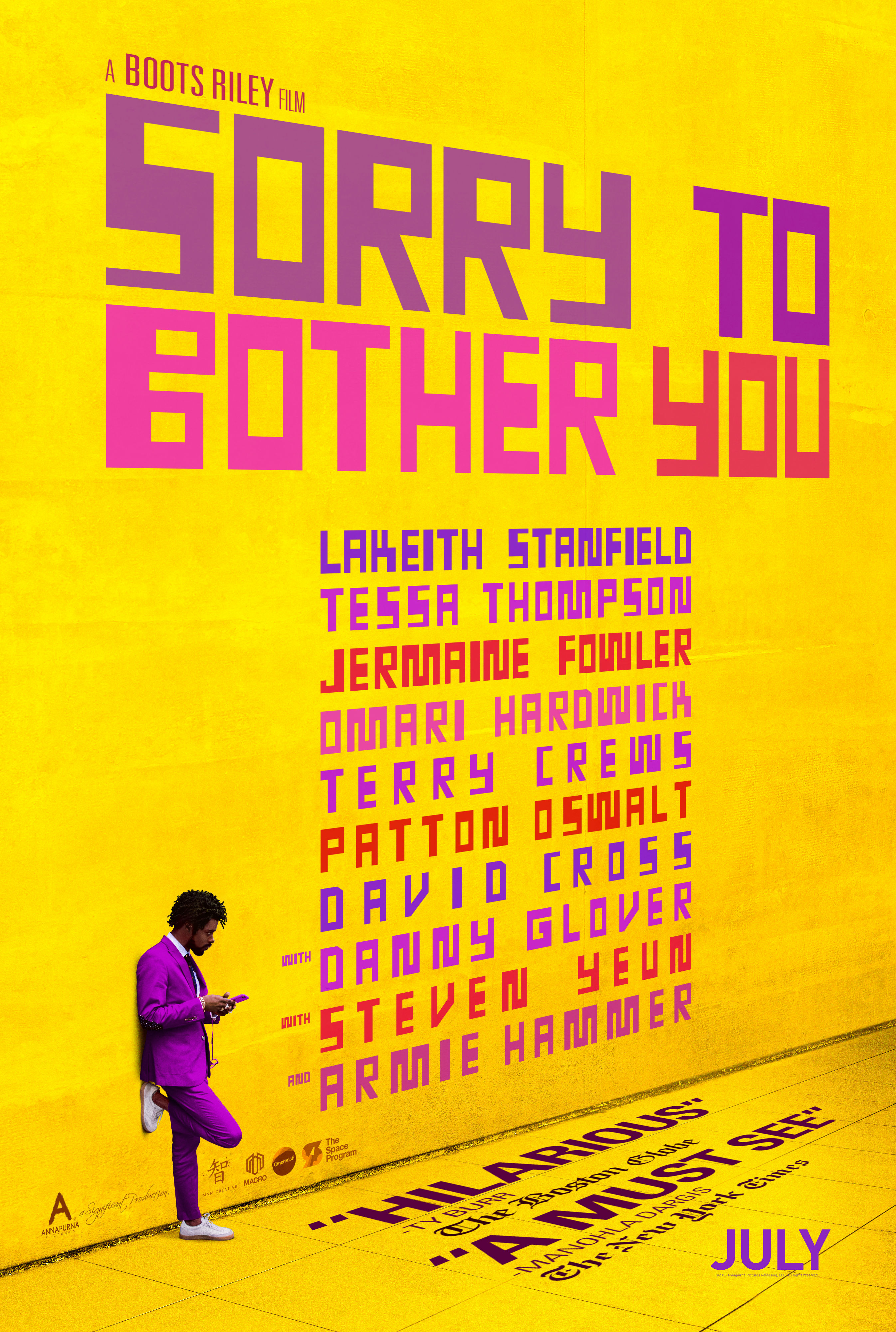
 There is a great deal to love about Sorry to Bother You, one of the year’s most audacious films, and a great debut from musician Boots Riley, but the most impressive aspect of this film is its ability to be incredibly to the point and direct in what it is intending to convey – so I’ll do the same and cut to the chase – with Sorry to Bother You , Riley achieved something utterly extraordinary, crafting a film that is a steadfast provocation of form and content, a deliriously funny absurdist masterpiece that never takes itself too seriously, despite the important underlying themes present throughout. It is an elegant but outrageous film that stands as one of the year’s most progressive films, a social statement on the world we live in, as well as being undeniably hilarious and often very heartfelt without resorting to cliche, as well as featuring some tremendous performances and a directorial style that suggests that Riley is far more than just an innovator of music, but also someone with a clear directorial vision that makes him an exciting newcomer to the independent film industry. Sorry to Bother You is the kind of film that reaffirms my utter admiration towards independent filmmakers, especially those that strive to present us with unique and memorable stories. Sorry to Bother You is a carefully-crafted comedy that stands as the year’s most biting satire, a potent film about race relations that is unflinching, honest and more than anything else, endlessly entertaining.
Cash Green (Lakeith Stanfield) is down on his luck – he is trying to find a job for a number of reasons – to help support his girlfriend Detroit (Tessa Thompson), to help his uncle (Terry Crews) pay off his house and, most of all, to allow Cash to start his own life and earn a living instead of just drifting through his slacker lifestyle. He begins working for RegalView, a telemarketing company, and the proudly-black Cash discovers that his race is his biggest impingement of success, and as soon as he adopts a “white voice” (in this instance provided by David Cross), he finds the success comes all too quickly, and he finds respect and admiration within his company that leads to promotions and a newfound reputation that anyone would be envious of – but as he progresses, in terms of the company as well as socially, he discovers that there is something far more sinister lurking within his workplace, a conspiracy that can change the way one looks at the world, something carefully hidden from public view, despite it being extremely pivotal to the way society is run – and it is up to Cash to decide between keeping quiet and allowing his success to continue providing him with wealth and respect (which is increasingly difficult for him to come across), or standing up for the injustices he has been witness to, and it doesn’t help that his newfound success positions him as someone inherently very important, all because he manages to persuade people that he is white, and thus the pinnacle of success. There are also some very dark twists and turns in this film that never fail to surprise the audience and lead us down some very unexpected avenues in this dynamic and enthralling, and often extremely disturbing, social satire.
Lakeith Stanfield has started to ascend as an actor (an it couldn’t come sooner enough), with a variety of roles in a range of films and television shows allowing him to showcase his talents and establish himself as a bright young star, capable of a range of impressive and meaningful projects that make various statements and have different purposes, with Stanfield’s consistent talents always being utilized well. Sorry to Bother You is his biggest role to date, and its fair to say it proves that not only is he the reliable supporting presence from shows such as Atlanta, and successful films like Short Term 12 and Get Out, but a remarkable leading man in his own right. There is something about his performance in Sorry to Bother You that is strikingly brilliant – a certain charm that is downplayed enough to make him a resonant everyman, but clear enough to allow his character to be the perfect protagonist for this kind of absurd story, which needs someone who can play off the surreal aspects of this film with nuance and dignity, but also not sinks into the odder aspects of the film, never normalizing it, but also not making it seems inauthentic. What is most noticeable about Sorry to Bother You is that it is a very strange film, with Stanfield being the proverbial “straight man”, the ordinary character that serves to not only be the audience surrogate but the foil to the more eccentric characters, and it is clear that he is having a good time playing the role, bringing a certain hipster elegance to this otherwise ordinary character. Stanfield certainly is flourishing as an actor, and the most exciting part of Sorry to Bother You isn’t only that he gives a terrific performance, its that it shows how good he actually is, and makes us look forward to whatever he is doing next – I know that I am patiently waiting in anxious anticipation, because he is a tremendously gifted actor.
Other than Stanfield, Sorry to Bother You has a great ensemble – Tessa Thompson, also a supremely talented performer, proves herself to be capable of both mainstream fare (Creed and Thor: Ragnarok being recent highlights), while also being excellent in smaller films such as this one. Her performance as Detroit is one that may not be the focal point of much of the film, but she’s certainly consistent and even in the small moments where she is the focus, she manages to make an indelible impression. Armie Hammer has a small but pivotal role as the film’s main villain, albeit one that only makes his official appearance towards the end of the second act. Hammer is adept at playing a range of roles and Sorry to Bother You allows him to abandon the dashing and heroic character he has played a few times before, and play someone malicious and demented, yet so effortlessly charming, and even in his handful of scenes, he’s excellent. Omari Hardwick, Jermaine Fowler and Steven Yeun (who is certainly well on his way to worldwide exposure as a star, with his recent film work showing him to be far more than just his star-making turn on The Walking Dead) are reliable and bring a unique tone to the film in their own way. Special mention should go out to David Cross, Patton Oswalt, Lily James and Steve Buscemi, who are unheralded gems, lending their voices to “white voice” portions of the film.
Sorry to Bother You is an anomaly of a film – it is almost impossible to fully explore every aspect of this film, because while it has a relatively simple concept, and its execution, while stylish and in many instances visually gorgeous, was unfurnished and quite straightforward (the best kind of surrealism is always the kind that doesn’t rely on excess but on restraint), but there is just so much that can be derived from this film. The central theme of Sorry to Bother You is obviously that of race, and it looks at the experience of being a black man in America in a way that would appear to be quite bombastic and exuberant, but under the surface, is quite dark and filled with despair. The main character is a young African-American man without qualifications, looking for an entry-level job to make a living and to earn some status, even if it is just a telemarketer. Moreover, even in such a basic job, he finds himself being at a disadvantage for his race – not even his external appearance, but simply his voice. It is heavy-handed for sure, and certainly is the kind of film that will undoubtedly ruffle a few feathers on both sides of the political correctness continuum, but sometimes the most potent statements are made in the most direct and bold ways, and Boots Riley pulls no punches in exploring the more disquieting aspects of race in a way that is dauntless and seemingly without fear. Importantly, Sorry to Bother You makes the statement that none of us are necessarily authorities on these issues, and rather each person has their own experience, which can evoke a dialogue – and sometimes the most life-changing dialogues are those that feature an abundance of “white voices” – its bleak and terrifying, but it is a truthful assertion on the unfortunate state of our culture, and Riley’s intrepid film is testament to the institutionalized malice in society. Sorry to Bother You doesn’t attempt to solve racism (unlike certain other films released this year tried to do), but rather to expose social hypocrisy through the only universal language – laughter.
However, Sorry to Bother You extends far deeper than just being about race relations, making some other bold assertions. Capitalism is a pivotal concept, and this is where the film soars the furthest – it takes aim at consumerism, looking at the soulless products the world is forced to consume, as well as looking at how these products are made. Sorry to Bother You has an abundance of parody items – television shows, products and brands that are thinly-veiled allusions of recognizable items, mocking the commercial world and how it is an endless assembly line of lifeless production, motivated by the omnipotent entity known as the Almighty Dollar. Riley is biting in how he approaches the subject, creating a utopian world where everything is produced by the sinister WorryFree, a company with a stranglehold on the world’s industry, and by extent the population at large. The allusions to sweatshops and mass-produced industry has clear links to the concept of communism, right up to the idea of communal living and lifetime contracts that keep employees complacent – there are even some hints towards slavery, but Riley deftly defies exploring this too deeply, because as fascinating as it would have been, it didn’t serve much purpose in this already concept-laden satire. The fact that this extremely absurd film has resonant allusions to the real world is equally admirable (on the part of the satirists involved in its production) as well as deeply unsettling.
Sorry to Bother You is an extremely high-concept film, but one that is remarkably down-to-earth, opting for a very simple approach to its ideas. Riley, who has his roots in music, clearly brings the same manifesto of the most powerful messages can be profoundly moving if they are kept simple and delivered in a way that is dynamic and memorable, but not excessive. Sorry to Bother You is a film that shares many of its qualities with the science fiction genre, as well as liberally borrowing from the absurdists and surrealists of the past, using them as inspiration for the creation of this very unconventional, but still undeniably resonant, social satire. There is nothing necessarily speculative about this film, yet there is something slightly off about everything, something not necessarily unrealistic, but rather uncanny, familiar yet subtly different, enough to unsettle us. The filmmaking itself is stark and dazzling, and Riley clearly has an eye for flair, with the film being filled with small details, both visually and narratively, which makes this quite a unique filmic experience. The absurdist inspirations in Sorry to Bother You are seemingly endless, yet this film also stands as a steadfast work of bold originality in its own right, and everything about it is so unique, which qualifies it to be one of the year’s most extraordinary achievements, on both a narrative and visual level.
Sorry to Bother You is the kind of film that isn’t initially taken very seriously and is perhaps, at worst, divisive and polarizing enough to not make it universally loved, until it eventually becomes a cult classic. A film this odd can never be fully embraced, nor can it be entirely ignored – and it is only a matter of time before it becomes clear what a masterwork of social satire this film is. Featuring an astounding leading turn from rising star Lakeith Stanfield and a large supporting ensemble, and a writer-director that masterfully shepherds this very odd film in a way that keeps it simple yet allows it to reach the full potential of its brilliant concept. Sorry to Bother You is certainly one of the year’s best films, an ingenious social satire that is fully committed to its ideas, crafting a bleak social satire through the lens of unabashed absurdity, which creates a disconcerting but ultimately riveting cinematic blend, resulting in one of the year’s most fascinating works, and one that will definitely stand the test of time as the pinnacle of truthful, exuberant satire, and precise, biting social commentary.
 The Postmodern Pelican