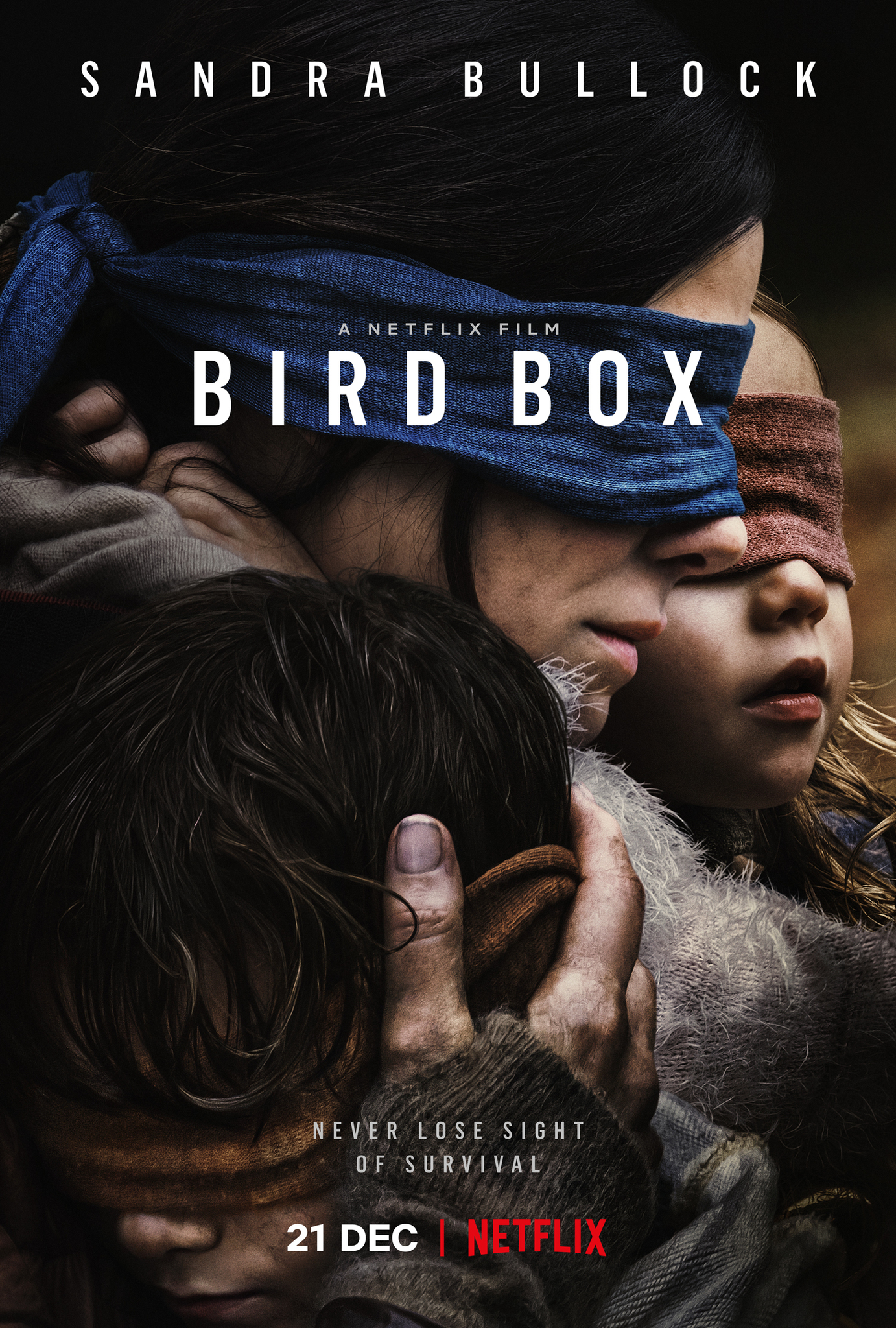
 When it comes to horror film (or any work that has the intention of creating fear or terror in the audience), I hold a few principles in very high regard – but the most important concept of horror cinema is what I call the Unseen Principle, which states that while seeing what we fear is terrifying, not seeing it, but knowing that it is there, possibly lurking just out of sight, is far more unsettling and is enough to give us an existential crisis, and perhaps a sleepless night or two. The idea of not knowing what is lurking around us, but having the suspicion that there is something there, despite not being able to see it, is the central premise of Susanne Bier’s Bird Box, an effective survival horror that has the makings of a true cult classic – perhaps not the sense-oriented masterpiece that we can find in Mike Flanagan’s Hush and John Krasinski’s A Quiet Place, I found Bird Box to be suitably enthralling cinema, an unhinged journey into fear, paranoia and social disorder that is nothing more than controlled chaos, a complex character-study that both stands alongside and challenges similar films. A precise, but imperfect, horror, it is one that doesn’t necessarily intend to terrify, but rather create an atmospheric, rural gothic thriller that doesn’t overtly shock the viewer, but rather lingers with them in a haunting sensation that is more disconcerting had this film been more traditionally constructed. In short, Bird Box is a terrific film, one that acknowledges its imperfections and balances them out with a highly-original concept, creating one of the year’s most fascinating horror films – and considering what a tumultuous year 2018 has been for horror, to end it with something like Bird Box is quite fitting.
Malorie (Sandra Bullock) is an artist who is heavily pregnant with the child of a man who abandoned her. Despite this, everything seems to be working out for her – she has a sister (Sarah Paulson) who dotes on her constantly, the perfect studio apartment for her to indulge in her painting and the knowledge that she is about to be joined by a new addition to her life in only a few short months. Unfortunately, everything takes a turn for the worse when it is discovered that there is a pandemic of mass-suicides occurring across the world, slowly starting to appear in the United States. For some reason, thousands of people are committing suicide in gruesome ways, motivated by some unknown agent that causes them to fall into a frenzy of insanity, leading them to end their lives, Malorie’s sister being one of the casualties. A group of survivors that Malorie encounters surmises that the world is infested by demons, who take the form of someone’s worst fears, forcing them into irreparable insanity that can only be stopped by suicide. Over time, our group of survivors try and do exactly that – but slowly start to find themselves in harm’s way, constantly on the verge of being exposed to these beings that remain unseen, but are always within reach, looking for their next victim. Malorie now has to find a way, five years after this outbreak, to protect her and her two children from meeting their demise, and making their way to safety before they inevitably end up just like their less fortunate friends and family, driven to suicide by way of complete insanity.
It has been quite remarkable how horror films went from being the realm of grindhouse, B-movie sensibilities, being nothing more than escapist terror, to being very auteur-driven, with many horror films managing to attract some impressive talent – Bird Box is not an exception, and the ensemble assembled in this film is quite extraordinary. Led by the peerless Sandra Bullock, Bird Box is a great showcase for her talents, allowing her to return the more genre-driven roots of her career. The film is an ensemble effort, but its Bullock who is the heart of the film, and her journey is the one we resonate the most with, and every moment of fear and despair reflected in Bullock’s performance seems so authentic and honest. While she doesn’t strike the same chord of brilliance she has on many occasions, Bird Box is a tremendous opportunity for Bullock to play another fascinating character dealing with a difficult problem and overcoming the innumerable obstacles to keep her and others alive – and when you consider some of her best film work includes Speed and Gravity, it becomes clear how talented Bullock is not only as a dramatic actress but as an action heroine. This is very quietly one of the year’s best performances, and while this film may be divisive, I don’t think its unlikely that Bullock’s performance will be seen as objectively great and will certainly stand the test of time in terms of great horror film performances.
In terms of the broader ensemble, there are several performers that stand out – but not always for the right reasons. The cast of Bird Box is split between great performances and performances that are not particularly good, and several of the shortcomings come from certain members of the cast. In terms of the better performances, Sarah Paulson is as charming and natural as we’ve come to expect in her very small role (I wish we could’ve seen more of her character), and she takes someone who is essentially a plot-device, appearing in only a few scenes, and creates a character who lingers on for much longer than some of the more prominent characters. Trevante Rhodes is also excellent as the de facto leader of the survivors, and the eventual romantic interest to Bullock’s character (I’m not sure precisely why Bird Box needed to have a romantic undercurrent, as it adds nearly nothing to the film and often makes it more cliched than it is already), and he is slightly more than just the dashing hero, and does manage to convey a considerable amount of nuance in his otherwise archetypal character. Rosa Salazar and Colson Baker (otherwise known as Machine Gun Kelly) are good in their role as young adversaries who become lovers, although their exit is too sudden, especially considering how much more could be done with these characters. Finally, other than Bullock, the best performance in the film comes on behalf of Tom Hollander, who makes a third-act entry as the film’s most visible villain, a sinister and psychotic man who derails the survival plan and ends up causing a cataclysmic turn of events. In terms of the less-ideal performances, John Malkovich (an actor I normally love) gives perhaps his least-impressive performance to date, playing the same cynical, short-tempered character he is often stereotyped in – this is a performance someone would give if they were trying to parody Malkovich and his worst tics, rather than something I’d expect Malkovich himself to give. Danielle McDonald, a rising star from films like Patti Cake$ and Dumplin’ is also disappointingly underwritten, playing an ordinary woman without much of an emotional arc, yet we are supposed to empathize with her. Finally, Jacki Weaver, who seemed to be on the verge of being one of our best character actresses, once again takes on a brief role that isn’t particularly noteworthy, usually just being in the background. Weaver is a great actress, but she just doesn’t get the work she deserves, often being relegated to these meaningless roles. The cast of Bird Box is not as consistent as one would hope, with some performances being great, others not so much. It is always difficult to assemble a flawless ensemble, and Bird Box, while still a very good film, just doesn’t have the most consistent set of performances. It doesn’t detract too much from the film, but some more work in developing some of the smaller characters would’ve made Bird Box a much better film.
Like many great recent horror films, Bird Box isn’t content with just scaring the audience – and in many instances, it goes against horror conventions to deliver something a lot more layered and complex. This isn’t necessarily a film with much of a social message, but rather something more personal. Unfortunately, a lot of criticism has gone to this film for portraying mentally-ill people as being the villains, and while this is a very hasty criticism, because the film doesn’t actually antagonize mentally ill people, but rather has the villains be people who have “seen” the entities and somehow survived – it is much of a statement on cult mentality than it is on mental illness. In this regard, Bird Box is quite successful, especially because whatever it is that is terrorizing the world’s population and driving them to suicide, it is never shown. This ties in exactly with the point I made earlier – the unknown is far more terrifying than what we can see. To not show the demons is an admirable decision, but it works exceptionally well, and lends the film a certain level of gravitas, making it appear more realistic than it would had they attempted to portray what are supposed to be the embodiment of one’s most harrowing nightmare.
However, Bird Box is not without its flaws, and there are many moments where I felt this material would’ve been more appropriate for a different medium, such as television, because to compress what is clearly a fascinating story, one with many different characters and viewpoints, into a single two-hour package was always going to be difficult, and there is a great deal that is left unresolved. There are a number of questions this film never answers – what precisely are the cause of these entities appearing on Earth, and what form do they actually take? How come some people manage to survive, others meeting their demise almost instantly? Why do the infected survivors so desperately want to garner more victims? These are frustrating questions, because leaving them without answers is not the kind of ambiguity that stirs thought, but rather glossing over essential details that could’ve elevated this film and helped create a more complete whole, a post-apocalyptic horror that doesn’t only look at the end of the world, but also what causes it. The problem is that Bird Box knew exactly how much potential it had, and it acknowledges it very intelligent concept, but never lives up to the more fascinating aspects of its premise, resulting in something that is gorgeously-filmed (we just need to look at the scenes where Bullock and her two children navigate down a river, blindfolded, to realize the aesthetic beauty of this film), but an otherwise middling film that stands as a bit of a missed opportunity in several regards, but still manages to be an enthralling and compelling film based on its many strengths.
I found Bird Box to be a great film, although one that isn’t without flaws. It seems to break even between the merits and the shortcomings, such as having an audacious concept, but not utilizing it to its full capacity, or having a star-studded cast of tremendous performers, but having half of them give underwhelming performances in underwritten roles, or challenging the audience with a horror film that alludes to the concepts of mental health, social order and religious belief, but never truly engaging with them in a way that appears anything more than merely superficial. Bird Box is essentially just a mindlessly entertaining horror film, one that touches on some deeper themes, but not enough to actually qualify it as much more than just a high-concept horror film. It isn’t a film that will redefine the genre, nor will it leave too much of an impression, but it is well-made, diverting entertainment, often quite terrifying and brilliantly suspenseful, and the ending is extraordinarily beautiful and is a fitting conclusion to a harrowing two hours of intense terror. Bird Box is destined to be a cult classic, and while it doesn’t rise to the challenges set by its original premise, it is suitably entertaining, which is, in the end, more than enough for a film like this.
 The Postmodern Pelican