 In 1964, the world was introduced to the first cinematic representation of one of literature’s most beloved creations, Mary Poppins. Julie Andrews’ made her explosive debut as the titular nanny and set herself up for a career of iconic roles, all because of her iconic portrayal of Poppins. Now, five decades later, we return to the world created by P.L. Travers with Mary Poppins Returns – and from the outset, we need to know there are two ways to view this film – either we look at Mary Poppins Returns as a pale successor to an iconic children’s film, an attempt to rely on nostalgia and the enduring power of a true classic without doing much entirely original, or we can view it as a diverting bundle of joyful fun, a journey into the dizzying, exciting and surreal world of everyone’s favourite nanny and her adventures in the lives of one family. I can see the arguments for the detractors of this film, but I firmly stand in the camp of people that loved Mary Poppins Returns – and while it is important to acknowledge that this film doesn’t come close to the brilliance of the original, to deny its resonance and own individual merits is misguided – Mary Poppins Returns is a very magical film, and it soars on its own terms, bringing with it a true sense of wonder, an abundance of heart and proof that sometimes keeping things simple is the key to success for a film – it may be predictable, but it compensates for it with heart and soul, of which this film certainly has in spades.
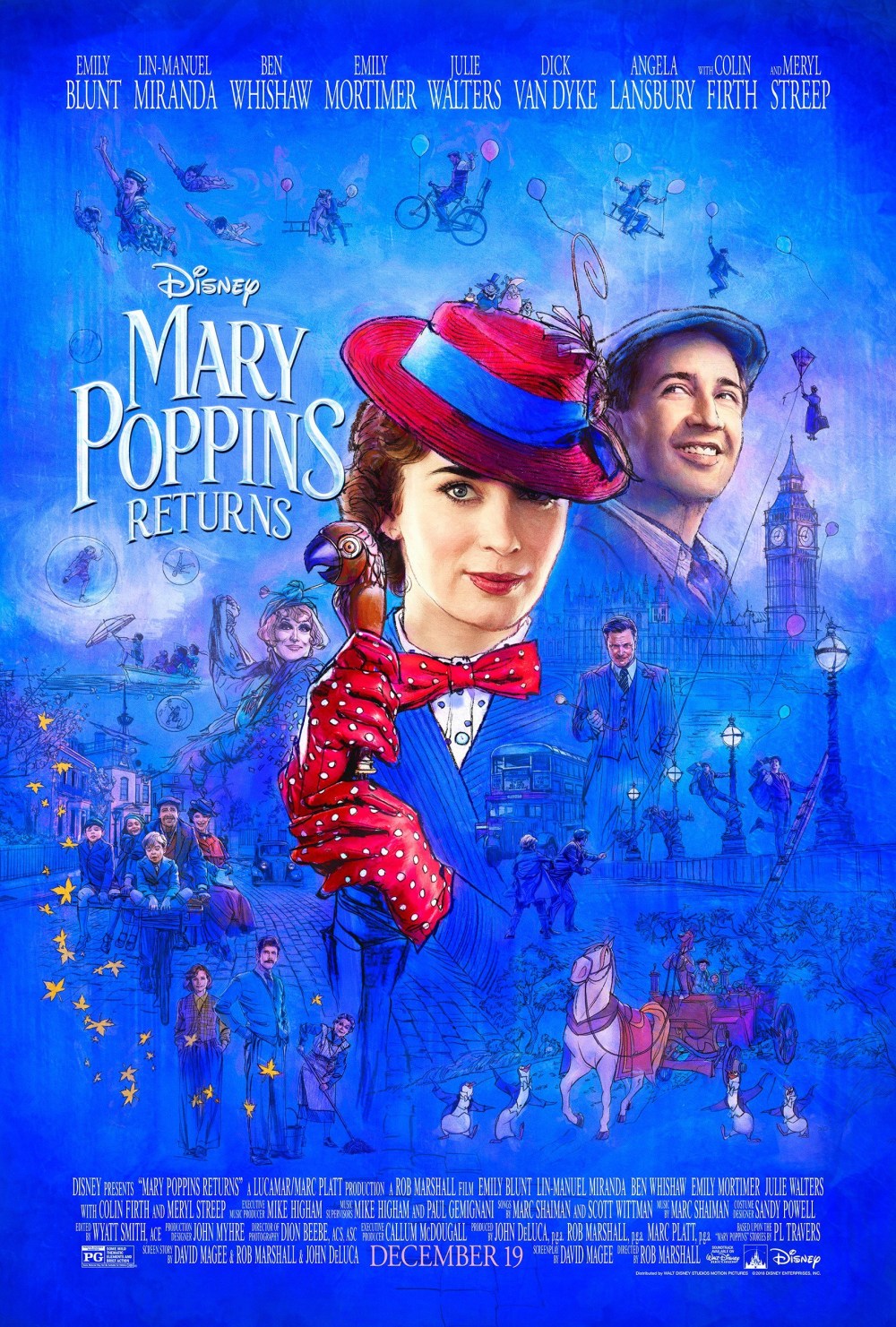
Julie Andrews has been a true stalwart of the entertainment industry for decades, and her defining role is most definitely that of Mary Poppins – no one has been able to capture the spirit of her performance with quite the same precision and elegance. It was always going to be a terrifying challenge for anyone tasked with playing the character, especially when it was all but certain that she’d be held to the impossibly high standard set by Andrews in 1964. I do like Emily Blunt, and she is certainly one of her generation’s most versatile actresses – but even I was dubious about her casting, especially considering that, despite her talents, she doesn’t possess the same pixie-like elegance that made Andrews’ performance so unique. One is bound to be disappointed in comparing the performances – so the best remedy is to look at Blunt’s performance on its own, and she certainly was very good on her own terms, and how she interprets Mary Poppins is different, but nonetheless noteworthy. The most surprising part of Mary Poppins Returns is how the title is far more honorific than descriptive – throughout the film, Mary Poppins takes a secondary role to the children characters (as she did in the original, albeit not quite as prominently as here), with Blunt being able to both command a scene when she is the focus, as well as blending in when it is necessary. She really is great in the film, and she makes the character her own, which is perhaps the best method for playing this character, because Andrews is inimitable, and attempting to challenge that notion is bound to end grimly.
The trio of children in Mary Poppins Returns are definitely very good, and extend far more than just being vehicles through which the story can flow – Pixie Davies, Nathanael Saleh and Joel Dawson make their mark at quite an early age, and prove to be promising young talents, capable of mighty emotional gravitas in their performances. This is a very deceptive film – we expect it to be a film where Mary Poppins is the central focus, and while she mostly is, we find ourselves connecting far more profoundly with these younger characters, who have to resolve their loss of childhood innocence with a tragic turn of events that have forced them to mature before their time. The three young actors are remarkable here and give wonderful performances that exceed our expectations. Ben Whishaw gives probably the most moving performance as Michael Banks – a bundle of contradictions, for he is an artist forced into an office job to provide for his family, a child at heart who has been forced into dour adulthood and, in the words of The Balloon Lady at the end of the film has “forgotten what its like to be a child”. Whishaw’s performance is smaller than some of the others in this film, and it may often be the most unassuming, but he manages to make the most impact with his fragile, empathetic portrayal of a man who has lost someone very special to him, as well as being on the verge of losing everything he holds so dear. It is a genuine, honest performance from an actor who frequently avoids caricature in his construction of a character who is seemingly ordinary, but far more complex than he appears. Lin-Manuel Miranda finally makes his inevitable leading film debut and proves himself to be as exceptional an actor in film as he is a creator of audacious works for the stage. Putting his astonishing work in Hamilton aside, it is good to see him extending himself – and here’s hoping that he continues to do interesting work – even the most ardent detractors can’t deny that Miranda is not someone to rest on his laurels for too long, and I’m curious to see where he is going to fit in cinematically in the future – he certainly has the charisma and the talents to be a welcome presence in any film. Emily Mortimer does her best with a character that isn’t as well-developed as the others but still is endearing and charming, mostly due to Mortimer’s earnest performance. Mary Poppins Returns also fittingly showcases some very special cameo performances from Meryl Streep (who I firmly believe is at her best when she is having fun with a performance, which is very evident here), the extraordinary Angela Lansbury, giving a wonderful performance that helps end the film on a truly magical note, and the legendary Dick Van Dyke – I am perpetually in awe of Van Dyke, who, at the age of 92, dances through this film with the same joyful exuberance as he did in the original over fifty years ago. Kudos to this film for having Colin Firth, one of the most effortlessly likeable actors working today, in the role of the villain, rounding out a cast of exceptional performances, each one being as impactful as the next.
It seems almost absurd, but who would’ve guessed that in a year like 2018, which has seen some very controversial and challenging films provoke audiences into a variety of discussions, Mary Poppins Returns would be one of the most divisive films of the year? A fair amount has been written on this film, and it is possible to see the approach the detractors are taking, and some of the points being made are certainly quite relevant, even if one doesn’t fully agree with them. Disney has made some truly extraordinary films, but their track record with sequels is not particularly compelling – there aren’t many successes in the studio’s frequent attempts to revisit their films and the fact that they remain relatively underseen, often being given direct-to-video releases, should be an indication to their quality. Mary Poppins Returns was always going to be unfairly compared to the original – it is difficult enough to make a compelling sequel, and to do so with perhaps the studio’s most enduring live-action work (and perhaps their best film, if we are being daring) was a herculean task. It is impossible to not sympathize with this film in the face of these often unnecessarily harsh criticisms, because Mary Poppins Returns is certainly not a bad film at all and is far more deserving of praise for its merits than to be criticized for its flaws, many of which are not entirely the fault of the film, but rather the result of impossibly-high expectations, and if we look at it very simply, and without comparing it to its predecessor, we see a film very different from other films being produced today – and as a sequel it may be inferior, but on its own, it is a fine achievement.
With the rise in technological advancement, cinema has always been at the forefront of daring experiments in the visual form – and the worry I had with Mary Poppins Returns was that it would be too concerned with utilizing the bevy of new resources at its disposal, losing a lot of what made the original so charming. The fact that it didn’t isn’t only wonderful, it is also the entire reason why Mary Poppins Returns is as good as it is – it keeps everything relatively simple (but not without an abundance of heartful flair) without losing the spirit of the original – this film is the first Disney film I can recall to utilize two-dimensional animation since the studio’s 2009 film, The Princess and the Frog, and in the extended sequence that has been shown consistently in promotion for this film, we see the characters returning to the same realm of mixed-media, where the live-action and the animated worlds collide in beautiful ways – and what may appear gaudy and outdated by today’s standards is actually quite remarkable. Mary Poppins Returns puts a great deal of effort into replicating the aesthetic of the original film, whether it be through the beautiful production design, the unconventional animation techniques, or in the music, which may lack the memorable factor many of these modern musical films rely on, but are suitably brilliant in their contextual use. I cannot abide the criticisms of this film when they take aim at the fact that this is a lesser version of the original – it was never going to achieve the same brilliance, but that doesn’t mean the necessary effort wasn’t put in to allow this to be a truly magical experience on its own terms.
Two pertinent questions need to be asked when looking at Mary Poppins Returns – who was this filmed aimed at, and what was it trying to say? The first question is one that is seemingly far more difficult to answer – I wouldn’t say this was a film motivated by the nostalgia that has been the catalyst for Disney and its subsidiaries revisiting their popular projects, but it was one that did bank on the fact that for the last fifty years, children have grown up with the character of Mary Poppins, and even those who are now well into adulthood will want to revisit a familiar character in a new context. However, this leads to the unfair comparisons between the original and the sequel, which leads me to believe Mary Poppins Returns wasn’t really intended to be seen as a sequel, but rather a reinvention of the character (as opposed to a remake or a reboot, which would’ve not only been far less successful, but also an insult to the brilliance of the original, which should always remain untouched) – an introduction to this character for new generations. In my screening, the people that seemed to be enjoying this film the most where the younger children, those who possibly had yet to encounter the original – their laughter seemed more genuine, and there was certainly a palpable engagement that just didn’t resonate through those who had gone in expecting something of a certain standard, and feeling downtrodden when those expectations weren’t met. Mary Poppins Returns is a great film, but one that clearly means something different for every viewer – and it is important to view this film as a singular, unique and independent film, because it really is a wonderful achievement and one that doesn’t warrant the endless criticisms for not being a carbon copy of the original.
The second question is one that is far more puzzling – and it is one that isn’t easily answered. Mary Poppins Returns is not a film only about a flying nanny helping a family in dire need of her wisdom and otherworldly sensibilities. There is a thematic undercurrent here (one that it shares with the broader works in the series by Travers) of childhood innocence, or rather the threat of its loss. The central characters in this film are three young children and their father, who have been faced with difficulties that are seemingly insurmountable, especially considering they are one of the countless casualties in what is called the “Big Slump” that has afflicted many individuals, as proudly noted by the antagonist of the film. Mary Poppins Returns is a reminder, more than anything else, about the value of childhood – not necessarily juvenile childishness, but the innocent, youthful wonder that we possess in our earlier years, but find being eroded by the cynicism that comes with maturity, and the fact that the world is a much brighter place with the right outlook, and how a little optimism and some daring faith can sometimes help us overcome the most difficult of circumstances. Mary Poppins Returns is deeper than just being the return of the titular stern but loving nanny, but a profound manifesto on the value of youth, and a confirmation of the oft-repeated adage “growing older is mandatory, growing up is optional” – and more than anything else, this film serves to be a lovely reminder to not take life too seriously, and to, on occasion, just let go of our inhibitions and look at the world and its beautifully eccentric idiosyncracies with the awe we felt in our earliest years.
There are a lot of discussions to be had about Mary Poppins Returns – and at the very least, at least it is inciting some discussion, even if it is redundant considering this film never aims much higher than just to be a well-meaning, pleasant and utterly magical experience that can unique adults and children in gleeful wonder. Emily Blunt is practically perfect in every way as a very different kind of Mary Poppins – outwardly stern, inwardly sensitive, and it is a great performance for a consistently marvellous actress. The rest of the cast, whether it be pivotal central roles from young performers or upcoming stars or the array of special appearances from true legends, Mary Poppins Returns has a cast perfectly adept at representing this unconventionally beautiful world. The filmmaking is extraordinary, and hearkens back to the golden age of Disney films, bringing the exuberant joy of the bygone era into the current century, blending the past and the present together to create something quite extraordinary. Even on its own terms, Mary Poppins Returns may not be the most innovative or unique film made this year, and it often relies on the same traditions we’ve seen countless times before, but this is inconsequential when we realize that this isn’t supposed to be a revolutionary work – it is an entertaining, diverting dosage of unhinged fun, two hours of relentless humour and heart, and a blissful journey into another dimension, where even the impossible is possible. It may not redefine the genre, but it certainly leaves the audience in a giddy state, filled with glee and with the broadest smile stretched across our faces. Mary Poppins Returns is a lot of fun, and considering reality is often increasingly downbeat, someone that is nothing short of a celebration of life is a welcome diversion, and makes this one of the year’s most enjoyable experiences.
 The Postmodern Pelican