 Good evening, ladies and gentlemen, and welcome to my seminar. The title of today’s discussion is “A Beginners Guide to Making a Generic Musical Biopic”. If you look under your seats, you will find the starter pack for this course. It contains everything you need to make a bland, lifeless biopic of the legendary musical iconoclast of your choice. It contains the following elements that you will likely find useful in your effortless endeavour to portray the life of an entertainment icon:
- The traditional “cradle to grave” structure, showing the predictable rise and subsequent decline of a musical genius, and their rise to fame with all the expected pratfalls along the way.
- A moderately talented leading performer who is satisfactory in the central role, but with his or her performance being overly reliant on the physical transformation they have undergone to make them look like the spitting image of the person they are playing.
- Storylines focused on our lead character selling out and pursuing monetary gain over artistic merit, with such lines as “you broke up the band!” and “you sold out!”, spoken in an exasperated cry, a result of some emotionally-wrought confrontation between band members. An added bonus – there is the predictable reunion scene, which is only made more effective if there isn’t much discussion, and everything occurs far too easily.
- Manipulative emotional content, which leads the audience to think that they are watching something moving, when in actuality they are being played just like the panoply of instruments present in the film.
- An abundance of nostalgia, usually through the music that we are familiar with and love (and likely brought us to the cinema in the first place), which typically masks the troubling storyline that doesn’t do justice to the life of its subject.
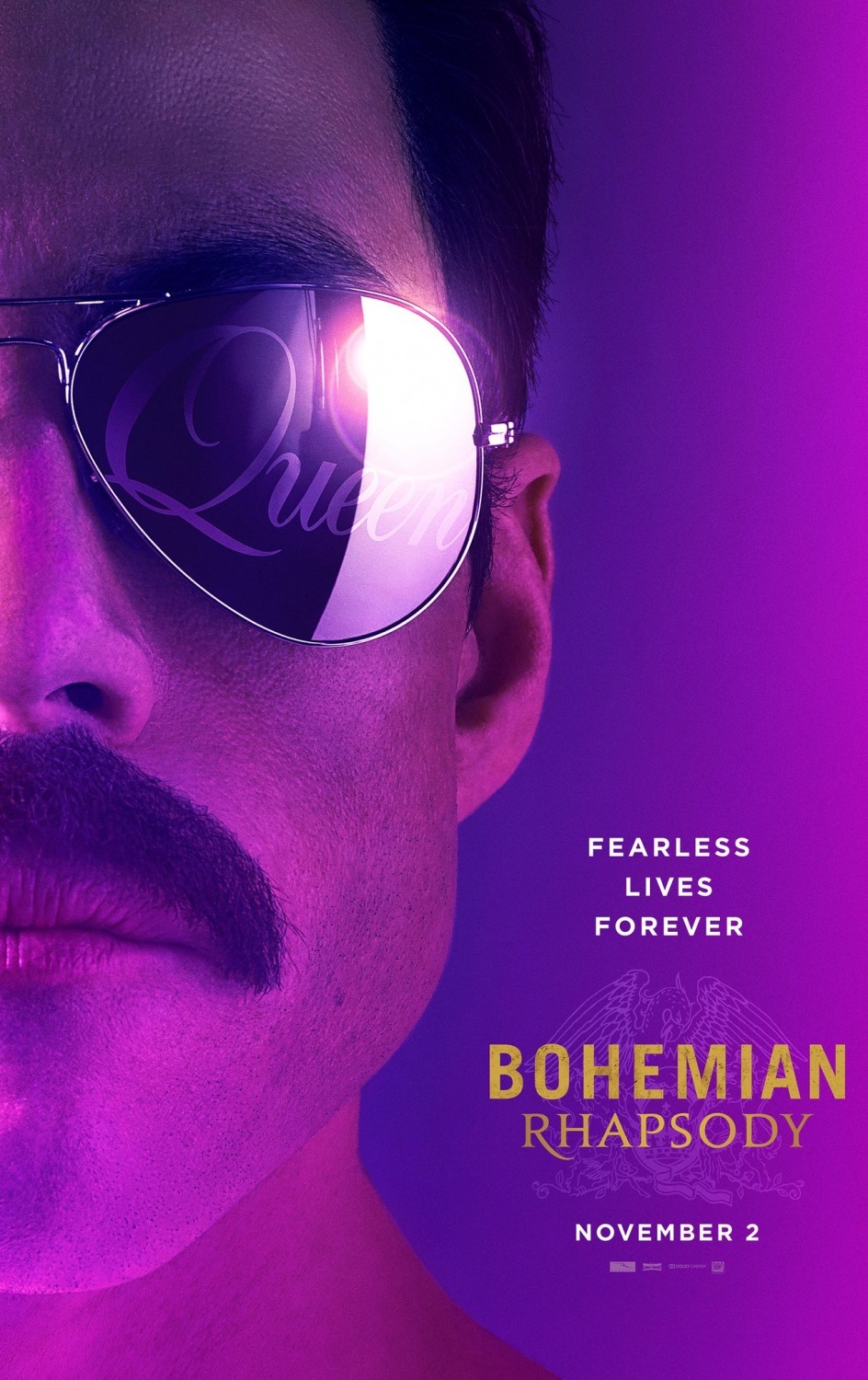
For exemplification of these concepts in action, we can look towards Bohemian Rhapsody, the recent film dramatization of the legendary band Queen, and their iconic frontman Freddie Mercury. Very rarely has a film been so faithful to the pursuit of unhinged mediocrity as this one, and it truly establishes itself as nothing more than a dull, by-the-numbers musical biopic that lacks even an iota of life, settling for a predictable structure that adds nothing of value to a genre already too reliant on a certain set of conventions. It proves to be a masterclass in dishonouring the legacy of one of the greatest (perhaps the greatest) performers of all time, a man who has inspired countless of people for decades. There is nothing that can convince me that Bohemian Rhapsody was in any way the best possible showcase for Freddie Mercury’s incredible story, as well as a truthful history of one of the world’s most beloved rock bands. It does have some moments of value peppered throughout, but for the most part, I wasn’t only disappointed by this film – I was quite frankly embarrassed by it, and while it is difficult to not completely deride this film (because in the end, it does have some merit, but nearly every film does), it is just impossible to call this a faithful film that does justice to its subject. Bohemian Rhapsody exists in a region beyond mediocrity, and not even its scattered moments of authenticity can compensate for the total disregard for the legacy of Freddie Mercury, with the honest truth being that this is not a very good film.
At the outset, let me be frank: I love Queen, as does much of the world’s population (as evident by the band’s enduring popularity), and I was constantly enthralled by the possibility that we may be getting a film that commemorates their legacy and does their legendary career, especially that of the iconic Freddie Mercury, the service it deserves. The film has been in production for years now, and I have followed its development faithfully throughout – tonight was the culmination of an eight-year wait, anxiously watching the film develop, changing leading star and director consistently until finally settling on the combination we eventually received. I was always going to give Bohemian Rhapsody the benefit of the doubt – because how could a film about Freddie Mercury and the rise of Queen possibly be that bad? Well, it didn’t meet any of my expectations, and set a new standard for trite, predictable biopics – and while the conventions mentioned above may work for other performers, when it comes to Queen, a band that almost unites the entire world through how unconventional and experimental they were, it just didn’t work, and the result was something atrociously disappointing, and everyone deserved better – the cast, the audience and the band itself (perhaps not Roger Taylor and Brian May, because as executive producers on this film, they are partially complicit in the troubling nature of the film), and most especially Freddie Mercury himself – to see his inspiring story reduced to something so dull was shameful, and he deserves something far better than this.
Rami Malek is a good actor, and his status as a performer is consistently rising – and Bohemian Rhapsody would appear to be the role of a lifetime for any actor, albeit one that is incredibly difficult, and regardless of whoever played the role, they would be subjected to intense scrutiny to the point where their performance would be dissected and commented upon in a way very rarely seen – Malek had the terrifying task of being the actor responsible for bringing Freddie Mercury to life in this film, and at the outset, I will say this: he did try his very best, and he can’t be blamed for the shortcomings of the film, and his commitment was admirable. However, saying this, his performance wasn’t void of some glaring flaws, such as the fact that besides looking the part, I didn’t find myself seeing too much of Mercury in his performance, and while he did have the look down perfectly (an admirable effort from the costume and makeup departments, who did exceptionally well in creating the illusion that we were watching Mercury on a purely visual level). The lip-syncing was quite awful, but I understand it – no one could ever sound like Freddie Mercury, and no one should even dare try, so the only logical choice was to use Mercury’s own voice in the musical moments. Yet, there was something so inauthentic about Malek’s performance in this regard – he physically transformed into the icon, but he didn’t capture his spirit all that well, and while he did a great imitation, it doesn’t extend much further than being a decent impression of Mercury. The rest of the band were played by actors who did their best but were also victims to the trouble of physically resembling their real-life counterparts, but not being much more than that – however, it is far less noticeable here, because none of them were nearly as exuberant as Mercury, so its easier to hide behind striking resemblance when your character isn’t meant to make an impact – still, kudos to Gwilym Lee, Ben Hardy and Joseph Mazzello for their dedicated performances, and surprisingly, they are quite decent in the roles.
The cast is the least complicit in this whole affair, because as far as we’re concerned, they were just following orders – the problem comes in the way that this was an incredible, inspiring story condensed into a film that follows the exact same beats that we see with nearly every mainstream musical biopic – there are elements of the rags-to-riches story, the rise to astonishing fame, the self-destruction that comes with said fame, and the quintessential break-up/reunion story – and this can often be very touching, and it isn’t necessarily bad, because it is a tried-and-tested formula that works in the right contexts, especially when it is done to bring life to individuals who don’t have particularly compelling lives outside of their artistic output. The problem is, we all know and adore Queen, and the reason we watched Bohemian Rhapsody wasn’t necessarily to only see the music we are familiar with, but to experience the true story of the band, seeing their trials and tribulations behind the scenes, as well as following the life of one of music’s most fascinating figures. How the creators behind Bohemian Rhapsody possibly think reducing Mercury’s life to a series of episodic moments that are not only entirely predictable but wholly uncompelling, would be a good idea? The film doesn’t do his story justice – and while it certainly does explore the queer side of Mercury’s life, it is kept relatively distant, and is not explored in its best capacity – a brief montage of Mercury entering a leather bar, or his sexual tension with various men throughout the film may be somewhat progressive, but it is done more for dramatic effect rather than to comment on the queer, counter-culture icon that Mercury was, not acknowledging the struggles that have made him such an inspiring figure to multitudes of people – the performance of “I Want to Break Free” just seems meaningless in light of how Mercury’s personal life and struggles were not given the credence they deserve. Not to mention, despite being one of the most important and inspiring people in the fight against HIV/AIDS, his battle is reduced to only a few emotional scenes, and the height of his struggle was relegated to a pre-credits mention when it could’ve made for some truly powerful storytelling, as well as helping provoke important discussions around a sadly growing issue. Arguably, this wasn’t necessary and I am being overly-critical – there was a decent amount of sincere sensitivity in portraying Mercury as more than just a legendary performer – but when we consider how Bohemian Rhapsody could’ve been a watershed moment for queer representation on a broader scale, as well as inciting discussions on deeply serious issues, the rather toothless execution was quite disappointing, if not sadly worrying.
Honestly, if there is a reason to see Bohemian Rhapsody, is is because of the music – and I can’t stress how influential Queen was to the world of music – both musicians and music-lovers alike, across all genres, generations, nations and creeds, have found themselves being influenced by their music, whether directly or through the way they changed the landscape of music. Bohemian Rhapsody often serves to be just a replication of some of the band’s most iconic moments, a construction of a chronicle of the band set to a shot-for-shot reenactment of their most memorable performances. The film, to its credit, does note how impactful the music of Queen was – it was original, it was unique, and it was queer – not necessarily in terms of sexuality, but rather in how it subverted expectations and changed the way bands made music, and how audiences respond to it. Their music was incredible, and at least Bohemian Rhapsody gets this aspect of the film right – and it is often extremely compelling, but only because the strong, potent nostalgia that this film is over-reliant on deceives us into thinking that we are being entertained by this film, when in actuality we are just experiencing a visual interpretation of Queen’s greatest hits again. Yet, its impossible to watch this film and not want to sing along – and while it does falter in its narrative, it does capture the unhinged, joyful anarchy that Queen inspired, which is indeed worth something, but not too much.
This film does, however, commit the fatal sin of trying to justify the artistic process – one of the characters even remarks that art is redundant if you try and explain it – and the irony of this coming in a scene where the band is justifying “Bohemian Rhapsody”. Here are two thing I find to be almost unimpeachable truths: “Bohemian Rhapsody” is possibly the greatest song ever recorded, and “Bohemian Rhapsody” is not a song that can be understood, nor should anyone attempt to understand it. This film understandably places the song at the centre – and for good reason, because its release was a definitive moment for Queen and for music in general – but far too much emphasis is placed on justifying this song, rather than just letting it be the powerful masterpiece it is – and the sequence where we see reviews of the song flash across the screen was laughably bad, and statements like “meandering” seem to be commentary on the film itself, rather than the song, and there is just some uncomfortable self-referencing throughout this film, such as when Mike Myer’s prickly music executive says that “Bohemian Rhapsody” will never inspire teenagers to roll down their windows and blast the song – a blatant wink to Wayne’s World that would’ve been clever had it not been so heavy-handed. Too much of Bohemian Rhapsody is spent on explaining, and it is counter-productive, because it strips Queen of its mystique and gives the audience unnecessary access to aspects of the band that we just didn’t need to know, and it adds nothing of value, other than portraying Queen as just another band, with the ordinary struggles of any other band. This would be good, if not for the fact that we’re dealing with a band that is of historical significance, and their insecurities are not nearly as fascinating as their art. Still, we have to admire the film for taking the approach to humanizing the band – the execution was just the biggest problem, and brought this film down substantially.
Here’s a major plot twist for you, dear reader: there was one part of Bohemian Rhapsody that I actually loved – unfortunately, it occurs right at the end. The entire film leads up to the band’s memorable Live Aid performance in 1985, arguably the greatest live performance in music history outside of Woodstock. This part of the film is so good, it makes me think Bohemian Rhapsody was conceived entirely around this performance, and the rest of the film is just an attempt to justify replicating this iconic moment. When watching this sequence, I was struck by sincere emotion – it was a spectacle with a tremendous amount of grandeur that actually seems quite genuine – and the oscillating between the roaring audiences in Wembley Stadium and viewers watching it around the world was powerful, and actually managed to be quite riveting, a poignant portrayal of how Queen’s music profoundly touched people all around the world, and resonates across any social boundaries. Music truly is a universal language, and this aspect of Bohemian Rhapsody is extremely well-executed – and in all honesty, this is the only part of the film that is preventing it from being entirely dismissed. Malek gives his most compelling effort here, and he actually perfectly replicates Mercury’s performance, getting every nuance of his stage persona right, and the emotional impact is not to be underestimated. The last twenty minutes are quite astonishing, and this film’s moderate score here is entirely the result of these parting moments. However, as sincere and impactful as it is, it doesn’t justify the preceding two hours of dull, lifeless filmmaking, which may have been building up to something worthwhile, but at the expense of boring the audience through its saccharine filmmaking and orchestrated emotional reactions. It is certainly very good, but not enough to surmount the bigger problems with this film as a whole.
I tossed around a variety of Queen-inspired dismissals to use in this review. I considered calling Bohemian Rhapsody “a big disgrace”, or saying that as far as bland musical biopics go, “another one bites the dust” – I wanted to remark that the film ends with “Don’t Stop Me Now”, which could’ve easily been a description of how I felt when leaving the cinema, or how it is followed by “The Show Must Go On”, which I would profoundly disagree with, with the show not needing to continue to torture the audience. Yet, its almost mean-spirited, because despite being littered with problems, Bohemian Rhapsody definitely does make an impact in some ways, and its underlying message is far more important than anything tangible. I was extremely disheartened by this film – Freddie Mercury is a figure who I idolize, and in whose story I have found so much inspiration when going through my own personal crises, so to see such a flawed representation of his life was disappointing, but it was not unbearable. In the end, as ambivalent as I was on Bohemian Rhapsody, nothing about this film could possibly cause me to change how I perceive Queen and their music – and in the very least, we can praise the film for not tarnishing the reputation of the band or Mercury, because despite showing him as a flawed individual with certain proclivities and a dependency on certain vices, he was still an amazing performer and an endlessly inspirational individual. I would never dissuade someone from seeing this film – it is not a travesty as far as musical biopics go, and it is suitably entertaining. Yet, this shouldn’t be seen as the definitive tribute to Freddie Mercury, and its flaws often prevent this from being the film Mercury’s legacy deserves.
The most saddening part of Bohemian Rhapsody is that there is a really good film hidden in it somewhere – it just takes the conventional approach to structuring it like nearly every musical biopic made in the past three decades, and it may be entertaining for some, but it is otherwise a hollow experience, and as much as I was holding out hope that it would do this incredible story justice, it just ended up being a deeply-flawed film without too many redeeming qualities outside of the astonishing climax, or the sporadic moments of genius. I sincerely wish Bohemian Rhapsody was better, because what could’ve been a defining moment in biographical filmmaking just ended up being trite and predictable when the life of Freddie Mercury and the career of Queen was quite the contrary. In the end, just remember (in their words of Queen’s greatest song) – “Nothing really matters, anyone can see, nothing really matters, nothing really matters to me” – except for their music, which will last for a lifetime, and the soaringly inspirational story of the young immigrant who became the greatest performer the world has ever seen. That is what matters, and in the least, Bohemian Rhapsody reminds us of that fact, which almost makes the film worthwhile.
 The Postmodern Pelican