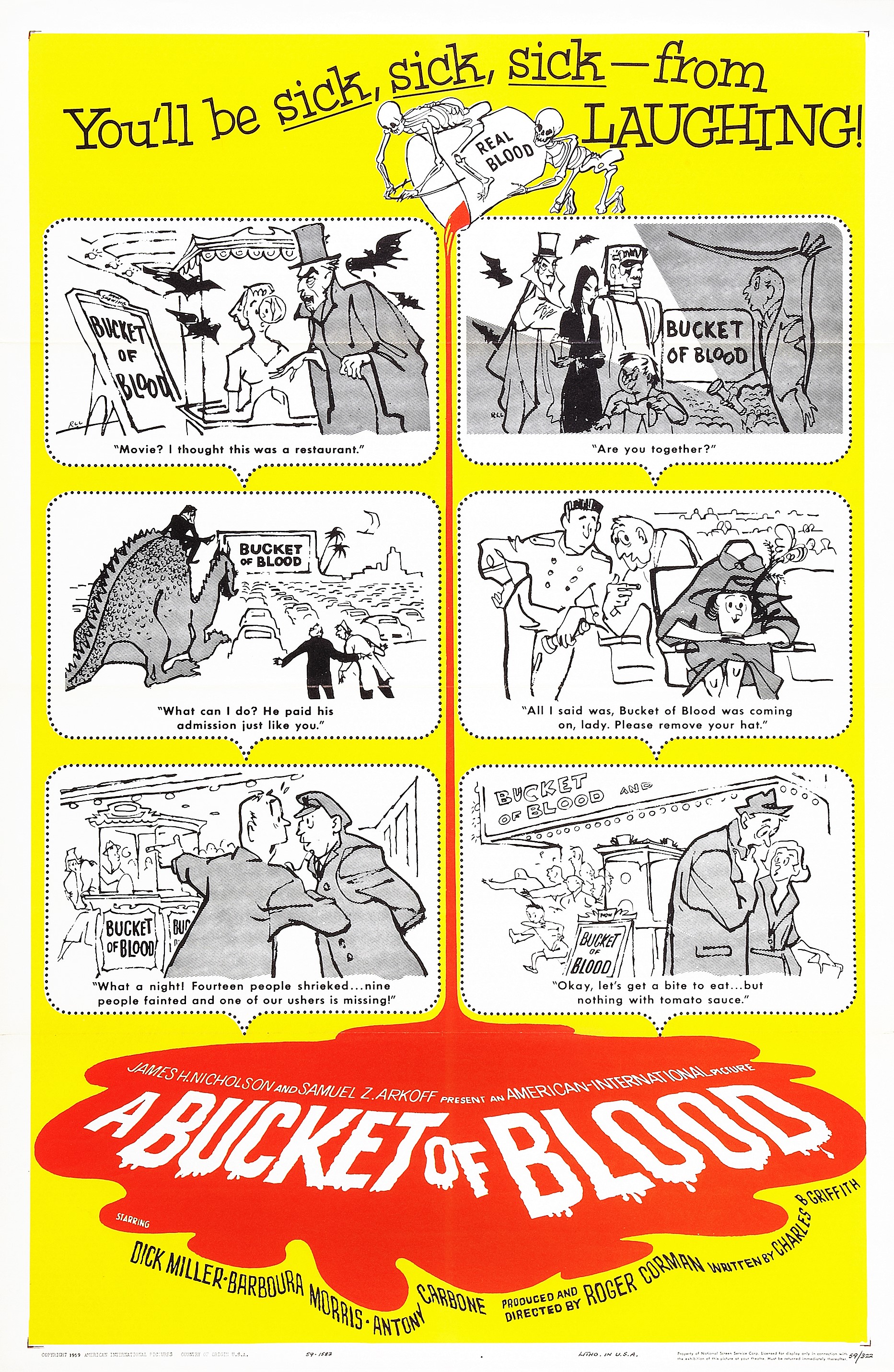
 You need to have good taste to appreciate bad taste, which is an adage oft-repeated by the great stalwart for transgressive cinema, John Waters. One of the forefathers of the movement that took audiences on repulsive journeys into some very darkly comical places was Roger Corman, who remains one of the greatest filmmakers of his generation for a reason – firstly, his longevity in the industry, with Corman still being very active in filmmaking, well into his nineties. Secondly is his prolific output, producing or directing multitudes of films over the past half-century. Thirdly, and most pivotally is his status as one of the first true independent filmmakers – his work was free from the constraints of any studio executives and their demands. His films were cheap, produced fast and more than anything else, toweringly original. Many of which have remained quite significant, with his experimental work Little Shop of Horrors persisting decades later, as a wildly-popular stage musical and beloved film. However, what we’re focusing on here is one of his other noteworthy films, A Bucket of Blood. Produced in 1959, much like Little Shop of Horrors, it was made at a transitionary period for Corman, in between his low-budget monster films, and just before his stylish Edgar Allan Poe-inspired adaptations. It is quite a fascinating achievement, a film that cannot be considered anything other than a devilishly clever dark comedy that blends Corman’s inert comedic sensibilities and his passionate adoration of the more horrific sides of human nature. In short, if there was any doubt that Corman is one of the greats, A Bucket of Blood will diminish any dubiousness.
A Bucket of Blood plays like a warped parody of House of Wax and similar films, blending the gothic artistic horror of those films with a more satirical, relevant setting. Corman sets the film mainly in The Yellow Door, a club frequented by beatniks, who gather there to take drugs, spew meaningless poetry and interact with their fellow pretentious elites. The focus of the film is not on them, but rather on Walter Paisley (Dick Miller), the club’s dimwitted but kindhearted busboy who strives to be seen as equal to the patrons, who he almost idolizes (despite the fact that they are nothing more than sycophantic pseudo-intellectuals). An accident involving his landlady’s cat turns into unintended art, and his clay sculpture “Dead Cat” starts to earn him quite a great deal of attention. He starts to create more sculptures, with the patrons not knowing what sits beneath the hardened clay, and in order to keep his input high, as well as retain his acclaim and rising status, Walter takes to dabbling in psychopathy, and his victims, whether deserving or not, soon find themselves the toast of the town, immortalized by the unassuming, simple busboy-turned-artist. There aren’t any buckets of blood, so much like The House that Dripped Blood, the title is a misnomer.
Dick Miller is one of those character actors who is almost entirely ignored, because with the exception of a few films like A Bucket of Blood, he is relegated to bit parts, normally as the ordinary everyman who is killed in violently spectacular ways – and whether it be in the films of Corman, or in those of his proteges such as James Cameron or Joe Dante, Miller is a reliably good presence. A Bucket of Blood offers him a leading role, and he’s terrific as Walter Paisley. I doubt that such a role would require the most eloquent of thespians, but rather someone who could effortlessly play Walter over the course of his development, showing his transformation from naive, absent-minded but well-meaning busboy, to a pretentious member of the artistic elite, to a vicious killer. At the outset, the viewer has nothing but sincere empathy for Walter – we want him to succeed, and we are filled with rage at every dismissal he encounters on behalf of the self-centred beatniks who surround him, but by the end of the film, we are deeply fearful of him, anxiously hoping for him not to succeed, because he has metamorphosized into a deranged killer and the very embodiment of the idea of fame corrupting the individual. This is all testament to Miller and his tremendously diverse portrayal, and while it isn’t common to find one in a film by Roger Corman, this was an extremely compelling performance.
There is so much to admire about A Bucket of Blood – first of all, as I alluded to earlier, this is a film that defines the concept of independent filmmaking – made in only five days, with a paltry budget and the involvement of a set of dedicated amateurs amongst some more established performers. Yet, despite being the epitome of a low-budget B-movie (as well as only running just over an hour), it has a strong and compelling story that proves Corman to be one of the truly brilliant independent auteurs, well before independent cinema was as well-regarded as it was now. In an era when everything depended on a big budget and the involvement of a studio, to dare to make something as divisive and almost repulsive as A Bucket of Blood was risky – but it certainly paid off, as this isn’t only one of Corman’s personal best films, it is amongst the best dark comedies ever made, a deliriously twisted morality tale that hints at deeper issues without ever intending to explore them in any way that was unnecessary. This is a B-movie masterpiece that never dares to take itself too seriously, while still not avoiding some pertinent social commentary that creates a film far more complex than one would initially think.
A Bucket of Blood is mainly a film about “fitting in” – it is a warped social commentary of the 1950s set to the tune of psychopathic horror and gleeful violence, commenting on the pretentious nature of the era, as well as showing the desperate lengths one would go to for the sake of being accepted into a certain faction of society – in this case, it is the beatnik generation, who may just win the prize for the most belligerent, unlikable and arrogant youth generation, which Corman enjoys deriding throughout the course of A Bucket of Blood – he shows them as ridiculously arrogant and almost unlikeable delusional. It is a deliriously funny horror spoof that takes on beatnik community, as well as the art world as a whole, showing the era as being one that is nothing more than a bundle of contradictory pretentions. It is wildly hilarious, and the screenplay by Charles B. Griffith is quite exceptional – it takes direct aim at an entire generation, and manages to mock them without being entirely mean-spirited. Moreover, Corman’s realizing of the story is excellent, and despite being made on a shoestring budget, it never appears cheap or inauthentic. The editing is flawless, the cinematography, while not being particularly innovative, is quite distinct for a film like this. Corman makes great use of shadow and light, and the final sequence of the film is quite impressive. The lighting in this film lends it an atmosphere of film noir – sinister, dark and shrouded in mystery and deception, just like the film as a whole. For a film that is quite proudly low-budget, A Bucket of Blood clearly makes use of every resource it can, and the result is undeniably great.
We could certainly try and humanize A Bucket of Blood and see it as some towering social satire, a film with a panoply of complex themes. Yet, that would ignore the honest truth about this film – it is nothing more than diverting fun, an entertain B-movie about an ordinary man who is driven to murder, not for the sake of psychopathic urges or evil intentions, but simply to fit into society, rising in status to become an acclaimed artist, while those around him are completely unaware of the roots of his artistic genius. It is an amusing film from the master of darkly comical B-movies. The satire is potent, the humour is biting and the execution is impressive considering the constraints this film had to work with. A Bucket of Blood is an endlessly charming film and running at only an hour, it proves that a shorter length is not a restriction, but that compelling and entertaining films can be fully-realized through admirable brevity. A Bucket of Blood might not be very serious, but Corman has made a great film, and one of the earliest examples of pitch-black comedy that is able to amuse and terrify in equal measure.
 The Postmodern Pelican