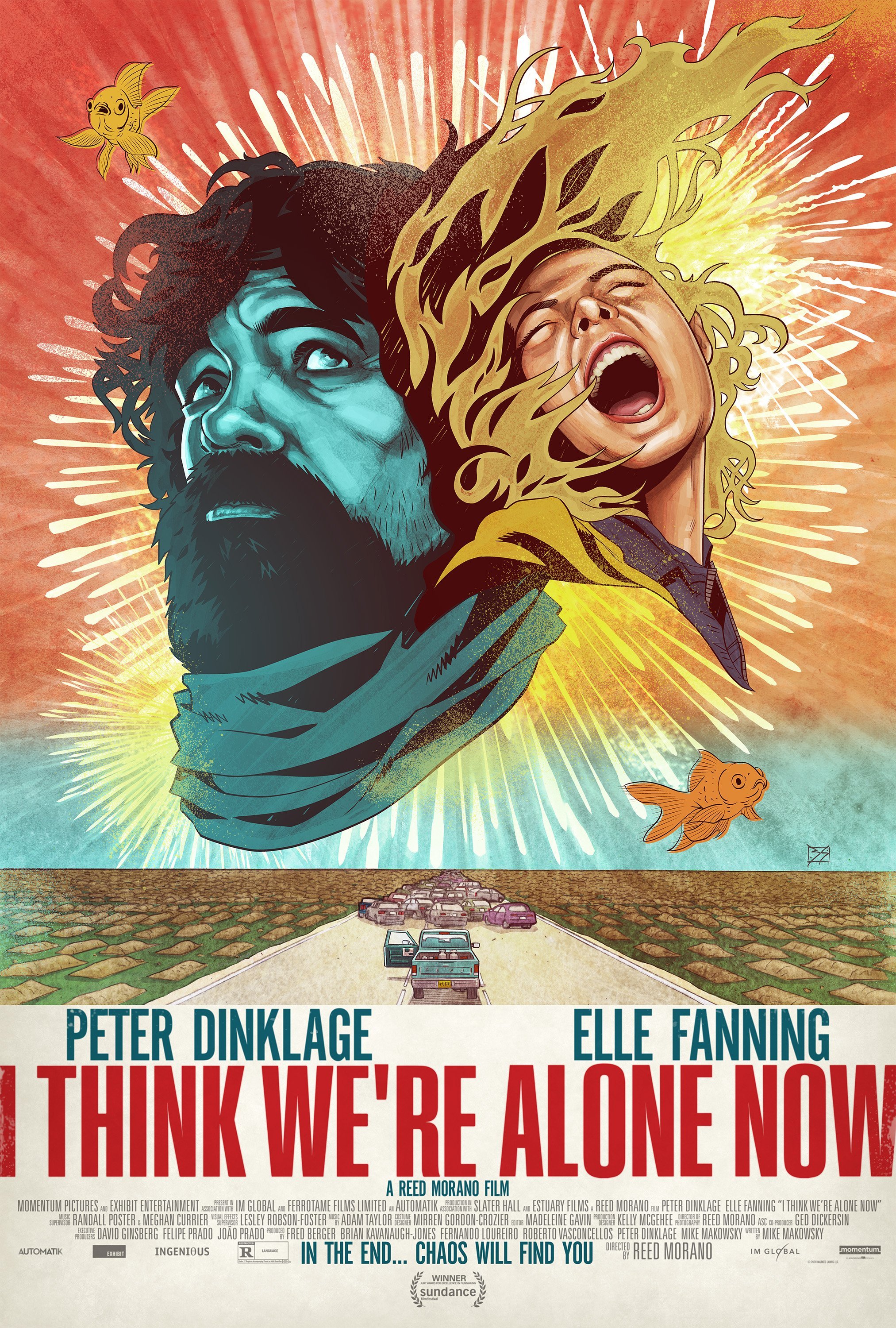
 The last person on earth trope – one of the most adored subjects in the history of literature, television and film. Over the past few centuries, we have seen speculative fiction written on the subject of the apocalypse, where some situation results in the death of the entire human population, with the exception of one very lucky individual, who has to grapple with the crushing loneliness of being the last person on the planet. We’ve seen it in countless works across the decades, in a variety of genres and forms. One of the more recent films that take on this story is also definitely one of the weaker I have seen, I Think We’re Alone Now, the sophomore directorial effort by Reed Morano, a cinematographer also known for directing episodes of the similarly-bleak The Handmaid’s Tale. If we were to cut to the chase, it should be admitted that I Think We’re Alone Now is not an entirely bad film – it has some redeeming qualities such as the underlying story having considerable potential, as well as being beautifully-made, but for the most part, this is a dull, lifeless film that doesn’t say something we haven’t already seen, and as we progress further, we start to discover that this film doesn’t have much direction, and starts to derail even before it forms a coherent story. There is a reason I Think We’re Alone Now has remained a relatively underseen film, because not only does it appear predictable and trite on the surface, once you watch it, those very suspicions are confirmed, and then some.
Del (Peter Dinklage) is a mild-mannered, lonely man who has somehow survived a catastrophic event that wiped out the human population. He lives in a small town, and after the apocalypse takes it upon himself to look after the town and its deceased inhabitants, cleaning their houses and burying their decomposing bodies. It is not ideal, but he makes the most of his situation, and even reaches a place of tranquillity and peaceful solitude (aided in no minor fact that he was always an introvert, and thus living alone in a library is ideal for him). This delicate balance is thrown off with the arrival of Grace (Elle Fanning), a young woman who brings a new energy to Del’s life, initially to his extreme chagrin, but later resulting in a solid friendship as she helps him with the cleaning of houses, as well as becoming a suitable companion. They do everything a pair can do during the post-apocalyptic stages of existence – wander the empty streets, try and survive and even raise a dog for the grand total of about a day. Yet, it becomes clear that Grace is hiding something – and Del soon realizes that they may be less alone than they originally thought, and Grace may certainly know more than she makes it seem.
I Think We’re Alone Now is a film with quite a substantial amount going for it – it is a genre that has shown itself to be extremely popular, and it has two great leads, both of which are excellent. Peter Dinklage is an exceptional actor, and he has shown himself to be capable of performances that go well beyond the limits of his celebrated performance on Game of Thrones. His performance in the criminally-underrated The Station Agent is truly something to behold, and his memorable supporting roles in films such as Find Me Guilty, Death at a Funeral and Three Billboards Outside Ebbing, Missouri, demonstrate Dinklage as someone who can be both a reliable supporting presence as well as being able to lead a film convincingly. Elle Fanning has already developed into one of the finest young actresses working today, being able to balance mainstream films with more independent, arthouse fare, and being perfectly adept at both. To its credit, I Think We’re Alone Now is worthwhile only for the chance to see these two performers working together, and while the film around them may be dreadfully mediocre, their performances are effective and prove to be some of the most fascinating work of their respective careers. Neither character is particularly complex, nor are they particularly likeable, but Dinklage and Fanning manage to elevate the material they are given to play characters that are far better than the film they appear in. Many times, a pair of great performances can make a dull film worth watching – unfortunately, this is not the case for I Think We’re Alone Now.
There are a number of issues with I Think We’re Alone Now that is not only troubling, but they are also inescapable. The first is one that has already been alluded to – this film is not particularly original, and the formula of the “last person on earth” sub-genre is so predictable, it needs a very unique concept to make it worthwhile. I Think We’re Alone Now follows the patterns without ever deviating, and ends up being exactly what we’d expect – a lonely man finds himself being the last person on earth until he finds another survivor – and together, they go in search of new survivors while trying to survive themselves. I Think We’re Alone Now is just not interesting, it is not endearing and it is not particularly good either. Its a standard, run-of-the-mill post-apocalyptic drama that tries to be a moody speculative drama that meditates on the notions of humanity and how one deals with loneliness without actually committing to being original in any way. I feel like I’ve seen this exact same story replicated several times, and there is just nothing particularly compelling about I Think We’re Alone Now, which just serves to be a painfully mediocre affair.
I Think We’re Alone Now tries so hard to be profound – there is a lack of an explanation for what precisely brought an end to human civilization, which would be fittingly ambigious had it been in another film, but in the context of this film, it is rather dismissed as an afterthought, with the audience being forced to come to their own conclusions – had the film actually been intent on explaining what happened, it may have been a bit more interesting – and given I Think We’re Alone Now the chance to comment on some issue, which would’ve given the film appropriate gravitas and some basis. This film tries so desperately to look at the nature of survival, but at the expense of constructing a coherent story – the lesson learned here is that some beautiful cinematography, composed of astonishingly gorgeous shots and intricate lighting, do not make a compelling film (someone let Terrence Malick know, please), and the eerie nature of the film is lost by the resoundingly awful lack of coherency or meaningful commentary – the writing is absolutely awful, and taking its cue from the worst of the pseudo-intellectual mumblecore conventions, it just strikes the viewer as being insincere and almost pretentious – this is a post-apocalyptic film that is about the human side of catastrophic events, and it contains commentary on psychological issues – therefore, it must be adored and respected. The worst part about I Think We’re Alone Now is not that it lacks some semblance of a logical story – it misleads the audience into believing that this is profound and meaningful when in fact it is a disjointed, pretentious and utterly contrived chore of a film. This isn’t even mentioning the final act, which derails the film with a certain arrogant elitist approach to psychological issues and the nature of loneliness that would’ve been hilarious had it not been so utterly pathetic. The fact that this film adds two esteemed actors to the film in this final act made me feel shame on their behalf for being associated with something so relentlessly misguided.
I don’t think I enjoyed a single moment in I Think We’re Alone Now, other than three small aspects that made it somewhat bearable, but not good in the least: the two lead performances were good and deserved to be in a much better film. The filmmaking was beautiful, and even if the story it told was subpar, it looked gorgeous. Finally, the general concept was one that is familiar but did have the potential to grow into something very special. Unfortunately, none of these is able to fully-redeem the film. I’d even go so far as to call I Think We’re Alone Now one of the most miserable films of the year – there is not a single shred of hope throughout the film, nor any attempt at endearing humour (the film does try the familiar trick of introducing a dog, which leaves after a few minutes. I wish I had done the same). I don’t know what troubles me more – the fact that I Think We’re Alone Now failed to be compelling or interesting through its lack of a worthwhile story, or the fact that this film believes itself to be so extraordinarily profound and meaningful. It is almost mean-spirited in how it approaches the subjects, and as much as I wanted to enjoy this film, I couldn’t bring myself to seeing it as being a good film in any way. Perhaps the kindest thing I can say about this film is that it is forgettable, and that at least it shows Dinklage and Fanning doing solid work, much better than the film itself, and indicates that Morano certainly has it in her to make a stunning film – here’s just hoping her next project will be more worth her time. In conclusion, I Think We’re Alone Now is a film that is best left alone.
 The Postmodern Pelican