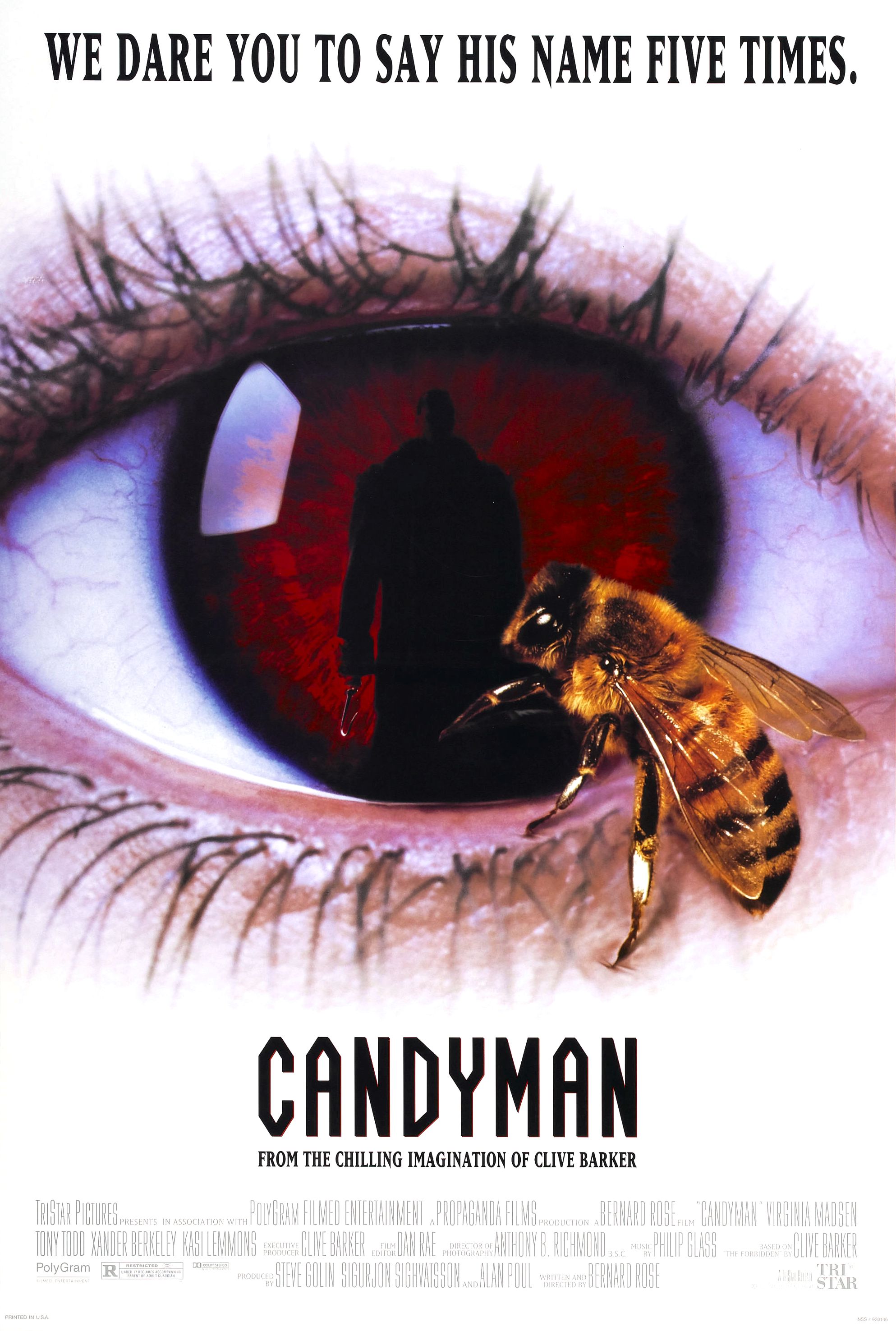
 Imagine this scene – a suburban living room about a decade ago, an ordinary Saturday evening. I was hardly a teenager at that point, and I was surrounded by a few of my equally-juvenile friends. One of us stares ominously into a mirror and recites “Bloody Mary”, a few times. The thrill and fearful panic at that moment as we waited in frightful anticipation to see if the urban legend we had heard from older children was actually true. Luckily, we weren’t viciously slaughtered by some ghostly being summoned by our ritual – but it was enough for us to be suitably shaken by the experience of just flirting with death and the very notion of the ethereally unknown. This concept is the central theme of Candyman, the deliriously great horror film, based on a story by horror maestro Clive Barker. Candyman has always remained an area of fascination for me, especially in my younger days of being fascinated by horror films – but I just could not bring myself to watch it. Something about it seemed so much more sinister than the monsters of my younger years – Freddy Krueger, Jason Vorhees and Pennywise the Dancing Clown seemed to pale in comparison to Candyman, or so I had been led to believe. Now, a decade later (and over two and a half decades since the film’s release), I took the plunge into the twisted world of Bernard Rose and Candyman, and I’ll tell you: its terrific.
Helen Lyle (Virginia Madsen) is a young academic who, along with her colleague Bernadette (Kasi Lemmons) is writing a thesis on urban legends and their relationship to oral folklore traditions. One particular legend catches their attention – that of Candyman, who has apparently been terrorizing the inhabitants of a rural housing project, Cabrini-Green, for over a century. The academic explanation is that these individuals are falling victim to ordinary crime, but assert their belief in the Candyman into the public consciousness, using this mythical figure to account for the rampant death rate, as well as a way through their trauma – it is far easier to blame the death of a loved one or neighbour on some ghostly being than a palpable person. However, their curiosity takes the better of them, and they venture too deeply into the legend of the Candyman and experience the conventional consequences that occur when someone’s inquisitive nature impinges upon the boundaries between the real world and the phantom realm – and very soon, Helen finds herself being haunted by the titular villain (Tony Todd), who finds Helen’s intention to expose the Candyman legend as nothing but psychological panic rather unsuitable, and vows his revenge on her for leading his “congregation” astray.
In many ways, waiting to watch Candyman was a wise decision – not only is this a harrowing horror film that spares no expense or life, but it is also a far more intelligent slasher film than we’d come to expect. In my younger days, I would not have appreciated the subtle nuances imbued throughout this film – and I’d probably consider it a relatively mediocre horror film, because it may be terror-filled, but it is relatively tame compared to what we are normally exposed to. Rather, this is an intricate, character-driven horror film that concerns itself entirely with the psychological aspect of these kinds of horror films (which if often disregarded in favour of an abundance of cheap scares), as well as being a profoundly fascinating deconstruction, not only of the genre, but of the “scary story” tradition that I am sure everyone experienced at some point in their youth. Candyman is an inventive and exhilaratingly scary horror film, but one with a profound sense of intelligence and a unique approach to the genre.
Candyman is quite an original film, because not only does it take the form of a profoundly terrifying film, it attempts to investigate what it is that scares us precisely. The film is less concerned with the actual terror as it is about the psychology behind it – and considering our main antagonist only appears properly in the second act, it is clear that Candyman is not striving to be anything close to a conventional slasher film – this is far from the structure of the serial killer who slowly destroys the lives of a group of people who are unlucky enough to find themselves in his or her path of destruction. It is a game of wits between our pretentious academic protagonist and the ghostly figure who enters into her life and takes her prisoner – perhaps not physically, but definitely emotionally and mentally. Candyman starts to haunt Helen, and she finds herself morbidly fascinated by the existence of a figure that seemed so implausible. There isn’t any “final girl” situation in Candyman – Barker and Rose seem to relish in the construction of Helen not as some heroic figure, but rather an individual who finds her curiosity getting the better of her, leading her into a path of psychological warfare between the living and the dead (and if the ending has any truth to it, Helen may be far less innocent than we’d initially believe). It all starts with the spark of curiosity, which develops into an all-consuming pyre of sinister destruction and hateful malice, all because of the simple concept of belief.
The most fascinating aspect of Candyman is not only does it focus on the psychology of horror films, but it also relates it to a concept that I’d expect to be eerily familiar to all of us. As mentioned in the introduction, at some point, all of us were privy to the occasional scary story, especially in our younger years, and these stories – normally short but impactful, would be almost addictive. We’d find the chilling frightfulness of these stories to be intoxicating, mainly because they were so absurd yet so eerily familiar. The approach taken with this is how Candyman points out the obvious, something that I had never associated these stories with: the oral folklore traditions, perhaps the oldest form of entertainment known to culture. Barker and Rose draw parallels between the archaic oral storytelling traditions, and the more familiar experiences of sitting around a campfire, or in a darkened room, and listening to these harrowing stories that are positioned as being true, and even though we know this is nothing but heightened fiction, the seed of doubt is always present, and can develop over time. The realization that the story we were told wasn’t actually taken from the morning edition of the newspaper, but having been passed down from storyteller to storyteller, it garners a new significance and proves that oral storytelling is anything but archaic – it has just metamorphosized into something else, which is the central concept in Candyman, and the area on which it thrives the most.
“One is not born but becomes a monster” – this bastardization of Simone de Beauvoir’s classic remark in The Second Sex has appeared in countless works written on the subject of monster theory, a field of research that never fails to amaze me with its fascinating insights and incredible approach to the concept of monstrosity. We have recently seen characters like Jigsaw, Freddie Krueger and Jason Vorhees receive unnecessary origin stories, where we are given access to their pasts and how they developed into the psychopathic creatures that terrorize ordinary people – but Candyman was one of the first slasher films that humanizes its villain before we have even encountered him. The characterization of Candyman is impressively deft – the film shows that the titular villain is far more than just a demonic force that wreaks havoc on unsuspecting victims, but also never allows him to become sympathetic, which is surprising considering the attention paid to indicating that he was originally the son of a slave who was lynched for an affair with a white woman. This fits well with the aforementioned themes of the psychology of horror cinema and the relationship between scary stories and oral folklore, because not only does it provide a terrific considerable depth to the film, it adds to the deconstruction of the horror genre. Instead of being terrified by Candyman, we are intrigued – he is far more nuanced and fascinating than his contemporary slasher antagonists, and he makes for a truly compelling villain. We are made to feel some curiosity towards him, and while I am not someone who finds horror sequels to be particularly worthwhile, Candyman is intriguing enough for me to watch the derided sequels, for the sole reason of venturing further into the complexities of this character.
Undeniably, Candyman is a masterful horror film and a poignant addition to the slasher horror canon that has only grown in popularity throughout the years (even though more contemporary ones aren’t nearly as deliriously fun as earlier ones such as this). Tony Todd is extraordinary as the titular villain, playing the role with devious charm and sinister authenticity, and it stands as one of the finest portrayals of a villain in a horror film, entirely because of the restraint Todd brings to the character. Virginia Madsen is remarkable as the protagonist who slowly descends into psychological peril as the Candyman inches closer to her, based entirely on her disbelief in the other realm. Candyman is a tremendous film, absolutely terrifying, without a shortage of jump scares or shocking surprises – the difference is that it compensates for the use of horror conventions with a well-written, compelling story that goes far deeper than the limits of what is normally represented. A masterful achievement, and a film that genuinely scares the audience in a way that is thrilling and unapologetic.
 The Postmodern Pelican