
Things have a way of escalating out here in the West
~ Buster Scruggs
Joel and Ethan Coen have had such varied careers, venturing across genres and cinematic conventions to bring us several wildly different stories throughout the course of their filmmaking endeavours, each of them being unique and wonderful in their own way. One of the genres that the Coen Brothers have managed to salvage into something quite noteworthy is the western, namely through their two previous westerns, the highly-acclaimed No Country for Old Men, and the exceptional adaptation of the classic True Grit, both of which are distinctive films that both pay tribute to and subvert the conventions of the western genre. This year, the Brothers have returned with another excellent take on the western, entitled The Ballad of Buster Scruggs. What was apparently originally intended as a six-part television series has been condensed into a single film, a sweeping western anthology that shows the filmmakers making yet another great genre picture, an epic that looks at life in the Old West and how, like our friend Buster Scruggs says above, things tended to escalate out there during the time of cowboys and natives, frontierspeople and prospectors and everyone and everything in between. Admittedly, it may not hit the extraordinary heights of the Coen Brothers previous work, but The Ballad of Buster Scruggs is an entertaining and enthralling film that subverts the traditional conventions of the western and concocts something quite riveting and entirely enjoyable, as has been their style for the past few decades, and has proven the filmmakers are still most certainly at the very top of their game.
Ballad of Buster Scruggs is presented as six different vignettes, shown to be short stories in a collection by the title of Ballad of Buster Scruggs and Other Tales of the American Frontier. The viewer takes the form of the book’s reader, and he ventures off into the antique days of America in the post-Civil War era. Each story is self-contained and only connected very loosely by the general temporal setting and the traditional sardonic tone that bears quite a resonance to some of the Coen Brothers’ finest work, as well as one thematic concept that only becomes clear at the very end of the film. These are all six independent vignettes, and its quite possible that they were borne out of general ideas that could certainly not be extended into feature films, nor be assimilated very effectively into a broader film in general – therefore, it makes sense that the filmmakers opted to turn these stories into something that takes the form of a fully-realized but episodic representation of the Old West, looking at different kinds of people in a way that is highly original and benefitting from the Coen Brothers and their unique visionary style and trademark sense of acidic humour. Considering this film consists of six different stories that are not related, it is best for us to look at each one individually, and how it speaks to the wider themes that are presented throughout the film. It was certainly quite an audacious decision to condense these stories into a single feature film, because not only does it end up being the longest film they have ever made (clocking in at just under two and a half hours), it is also one of their most narratively fascinating – there isn’t any grand narrative outside of the conventions of the Old West, which allows for some fascinating stories to arise. Essentially, Ballad of Buster Scruggs may not be the Coen Brothers’ finest film, but it is one of their most daring productions, and the result is quite a thrilling genre film, the kind we rarely get nowadays, and one that keeps the audience absolutely captivated throughout the duration of this visually-stunning and narratively-exhilarating, genre-bending western anthology.
The first story is the titular “The Ballad of Buster Scruggs”, which follows the happiest outlaw in the country, Buster Scruggs (Tim Blake Nelson), and he runs from the law (or rather, gleefully meanders with his guitar in hand, telling tales about life as an outlaw in the frontier) and enters into a strange new town, where his brand of well-meaning violence is contrastive to the qualities of the townsfolk, who don’t take kindly to someone who has an inappropriately pleasant disposition for an outlaw, and will readily provide you with a rousing song just as fast as he will a bullet through your head, both of which he gives with ecstatic joy. Tim Blake Nelson has been an unheralded character actor for years, and even in his previous collaboration with the Coen Brothers, O Brother, Where Art Thou?, he demonstrated a certain genial pleasantness that is often missing from actors of his ilk – effortlessly likeable, he was a perfect fit for the role of Buster Scruggs, who is the most dangerous outlaw in the West, but you wouldn’t think it when presented with his mousy frame and warm demeanour. There are few filmmakers who provide unique platforms for characters actors as much as the Coen Brothers, and they tend to bring out the very best in absolutely any actor that they work with. “The Ballad of Buster Scruggs” was a great segment to start the film, because it sets the quirky tone as well as demonstrating how the film will subvert expectations of the traditional western – we are presented with someone who is apparently a misanthropic outlaw, yet he is a grinning, lovable gunslinger more than anything else, and someone who is impossible not to adore, especially when the entire segment is constructed as Buster narrating his own story, directly to the audience, treating us like welcome friends and trusted confidantes to his rambling adventures throughout the Old West. Certainly the most upbeat of the segments (and probably the most violent), it establishes that The Ballad of Buster Scruggs is going to be quite different from what we’d expect, while still retaining the offbeat humour the filmmakers have established through their careers, blending different conventions together to create a rousing start to a wonderful film.
The second segment is entitled “Near Algodones”, and is the shortest of the segments, and is more of a transitional episode rather than being a fully-formed story. A nameless cowboy (James Franco) robs a bank and is subsequently caught and sentenced to hang, despite the fact that he didn’t even successfully execute his plan (he is shown to be a bit of a novice). He is saved at the last moment by some very sympathetic (but no less violent) Native Americans and is on his way to freedom before accidentally being caught for another crime, and once again sentenced to death – but this time, there may not be a saviour on the horizon. “Near Algodones” is a swift story – even the speech of the characters in this segment is faster than normal – and even in its short length, it comments on the nature of outlaws, serving as a companion piece to the preceding segment, with our nameless protagonist here standing in stark contrast to the very upbeat Buster Scruggs. Our dashing hero tries to rob a bank in the middle of nowhere, run by a senile and rambling old proprietor who proves to be a formidable opponent (the sight of Stephen Root in his makeshift armour of pots and pans, running gleefully towards our protagonist, reminds me of what a gem he is, and affirms what I said earlier about the Coen Brothers being profoundly generous when it comes to utilizing character actors), only to be spared by a group of violent Comanches, saved by a well-meaning herder who turns out to be a wanted cattle rustler and sentenced to death again – it goes against the idea of the bold anti-hero who can do anything and be spared the consequences because even though he is a rascal and a rogue, someone so charismatic could not possibly be caught and that there is always a contingency plan in their mind to get them out of any particularly sticky situations. “Near Algodones” is a great critique of the lawless nature of the Old West, where rogues could get away with anything as long as they were quick on the trigger and could charm their way out of any situation – except, it doesn’t work out for our nameless protagonist, who isn’t able to evade death once more.
The third story is “Meal Ticket”, and centres on a travelling duo. An older man (Liam Neeson) travels in a carriage that carries a younger man (Harry Melling), who is disabled insofar as he lacks arms and legs (and was apparently found “homeless, penniless and motherless” on the streets of London) – but he compensates for his physical shortcomings with powerful oratory skills, delighting audiences with his beautiful retellings of classical works, entertaining communities with poetry, biblical epics and political speeches. However, the audiences grow thinner as time moves on, and it is not a particularly profitable enterprise – and our young protagonist starts to appear as more of a liability to his companion, who finds himself growing disillusioned with the care he needs to put on the boy (there is some subtle indication that they may be father and son, which would make the conclusion to this segment even bleaker). This is a simple concept with extraordinary depth – it comments on the nature of minstrels and travelling entertainers, who depended on the curiosity of different communities to make a living – but at what cost does failure come? What happens when a novelty wears off, and one is just left with a burden? Unlike the preceding stories, “Meal Ticket” isn’t particularly humorous, and it devolves into something quite tragic. This was the moment in The Ballad of Buster Scruggs when the tides turned slightly, and the off-beat humour of the previous two segments was carefully put aside in favour of more serious, but not dour, thematic content. “Meal Ticket” is short and does make a vast emotional impact, and it is one of the segments that lingers on well after the film has ended, because it is both the most hauntingly tragic, and along with the final segment (which we will get to in a moment), it is one that thrives on ambiguity – unlike the verbose Buster Scruggs, or the nameless cowboy, these two individuals here are of entirely mysterious origin, and the conclusion to the story, if it is what the audience is lead to believe, is possibly the most harrowing part of this film as a whole.
“All Gold Canyon”, the fourth segment, is the segment I enjoyed the most, because not only does it function well in the context of the film, it is a terrific short film all on its own. We are introduced to a prospector (Tom Waits), who arrives in a valley near a river, without a single other human in sight, being kept company by his horse and an owl who seems to preside over the landscape with sinister silence. He is in search of “Mr Pocket”, a gold deposit. For days, he digs and inspects, intent on finding the gold that can perhaps allow him to live out his final days with ease – and as he and Mr Pocket start to approach each other, the absence of other beings starts to become less clear, and there is a looming danger that comes to be clear. Tom Waits has always been an iconoclast of the music industry but has also been a great ally to cinema, often lending his unconventional talents to some extremely odd characters that always tend to appear to be perfectly-aligned with Waits’ unique breed of eccentric charm. “All Gold Canyon” is the most difficult of the segments for an actor, as there is essentially only a single character, and so much of the performance relies on physicality and movement, with the actor needing the express the personality of this grizzled old prospector through mostly non-verbal means, which has always been something that Waits has been remarkable at conveying. It is self-contained and simple, and it stands on its own with ferocious independence – and it is uplifting because this is the only story with a truly likeable protagonist, as well as one that does manage to have a positive resolution to his narrative. There are certainly some aspects of this segment that do overlap with the others – namely one enormous theme which will be discussed momentarily – but even on its own, “All Gold Canyon” is a compelling short film, and what I found to be the personal highlight of a film that often struggled slightly to find a coherent tone, but the joyful existential mayhem of this segment was most certainly the most effective and Waits probably gives the best performance in the film, and considering the vast ensemble that appears throughout the course of The Ballad of Buster Scruggs, such an achievement is remarkably impressive.
The penultimate segment is “The Gal Who Got Rattled”, which is longer than the first three segments combined, and the one that would have been most possible to stretch into a feature film on its own. It concerns Alice (Zoe Kazan), a fragile young woman who is on her way to Oregon to make a better life with her brother, Gilbert (Jefferson Mays), a businessman whose ambitions and successes do not seem to overlap in any way. They are travelling in a wagon train, with the journey to Oregon being long and arduous, made only more difficult when Gilbert dies from cholera. Alice is on her own now and finds herself in a precarious position when her hired hand demands she is faithful to the agreement of payment apparently made between him and her brother. With the assistance of the posse’s young leader, Billy Knapp (Bill Heck), Alice starts to grow more independent – resulting in yet another violent encounter between the frontiersman and the Comanche, who once again relish in bringing an end to the lives of those who they feel are fraudulently on their land. Without much palpable humour (except the presence of the adorable President Pierce, an adorable terrier who terrorizes the posse consistently, and is the subject of perhaps the most heartbreaking part of the film as a whole), “The Gal Who Got Rattled” is the most serious of the segments, and while it isn’t as fascinating as the others (I would have much preferred more time spent on any of the other stories), it has a certain charm about it, taking the form of a sweeping epic in its own right, no less on behalf of the visually astonishing scenery as we see the posse travail across the arid plains on their way to better lives. The previous stories look at western archetypes – the wandering cowboy, the outlaw, the travelling minstrel and the prospector – but none of them looked at the role of women in the Old West, which is something many westerns neglect, and considering they were certainly more than just faithful wives and mothers, there’s been a shortage of well-formed female representation. The Ballad of Buster Scruggs tries to remedy it with this segment, which may not present us with the most compelling female character, but it places her at the centre, and demonstrates an extraordinary circumstance – what does a woman in the Old West do when the men who govern her life are gone – does she relish in her newfound independence, or does she sacrifice herself to the male gaze and just found another man to be her guiding light? There is something about how her story is resolved that is logical but unsatisfying, and unlike the other stories, “The Gal Who Got Rattled” did have the potential to be something longer (not that it should’ve been), and its ending felt like a convenient way to end this segment and tie it into the broader themes. However, the soaring wonder of this segment, a small-scale odyssey, is impressive and its underlying themes make it a great constituent of a film that aimed to create a nuanced portrait of the Old West.
Finally, we get to the last segment, “The Mortal Remains” – the most ambigious and chilling of this entire film. Five passengers are in a stagecoach. They are strangers, with the exception of the Englishman and the Irishman, who seem to know each other, but to an unknown extent. The passengers start to converse and get onto some particularly difficult subjects, most notably the most dreaded of all: death. Interestingly, “The Mortal Remains” is an independent segment, but it is one that draws everything together and indicates the underlying theme of all the five previous segments. The Ballad of Buster Scruggs consists of six different stories, but they all feature the concept of death quite prominently – in four of the five preceding segments, the main character perishes in some way, and in this segment, the two ominous figures in that stagecoach are implied to be the Grim Reaper, individuals who are taking the souls of the other passengers to their final destination – it is said to be Fort Morgan, but it becomes clear that there is something far more metaphysical pulsating throughout the film, and it is evident that they are being taken to a hotel that may quite possibly contain the stairway to heaven. This is the most effective of all the segments, because it ties everything together, as well as being the most fascinating, looking at issues far larger than those presented in the previous stories, while still remaining an interesting self-contained story in its own right. “The Mortal Remains” was an extraordinary way to end this film, especially as it comments on the very idea of telling stories, which is essentially what The Ballad of Buster Scruggs was a whole – a set of individual stories with an underlying theme that goes beyond the merely entertaining and hints at something a lot more profound.
Understandably, this review has been somewhat rambling and extremely segmented – which is all to do with the fact that Joel and Ethan Coen took a few ideas and moulded them into a masterful film, an anthology that pays tribute to the western genre in a way that is subversive but affectionate. The film starts as a pleasant, bumbling western comedy, and then becomes darker and bleaker, as well as earning a certain profundity that takes it further than one would expect at the outset. The cinematography is beautiful (and the Coen Brothers manage to effectively utilize digital photography, making it look far warmer than how it normally tends to appear), and the stories may not be suitable for much more than segments in this kind of anthology, but they are all compelling and create a fully-realized and effective portrayal of the Old West and all the eccentric characters that have existed throughout the history of the period. The performances are great (the standouts being Tim Blake Nelson, Tom Waits and Zoe Kazan), and the film as a whole is a memorable affair. It may not be top-tier filmmaking from the Coen Brothers, but it is amongst some of their most audacious work, and if for nothing else, it momentarily resurrects two archaic cinematic genres – the western and the anthology – and it does swift work of making them extraordinary. The Ballad of Buster Scruggs is a remarkable film, a simple but effective set of vignettes that work towards a deeper narrative (although, once we realize what these films all have in common, it is too late for it to explore them in enough detail). The Ballad of Buster Scruggs is exactly what we’d expect from Joel and Ethan Coen – well-written, beautifully-directed cinematic mastery, and an exhilaratingly good time.
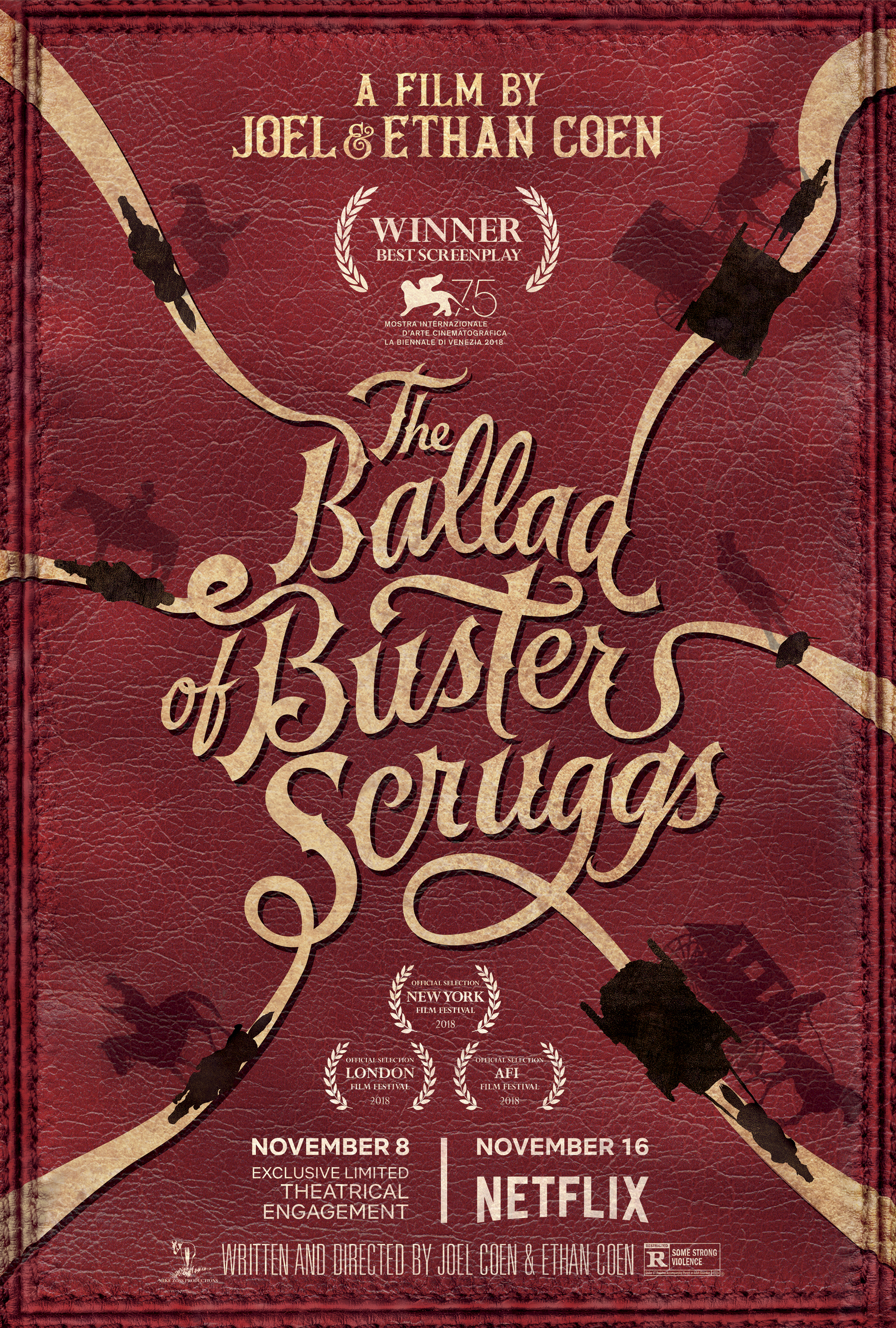
 The Postmodern Pelican
At an earlier point of my life, I relished Westerns for the intensity of excitement they provided. The more action packed the adventure, the higher I held the film in esteem. I still like a thrilling movie, but now my first priority for a Western is the quality of the cinematography. The Ballad of Buster Scruggs is a fine Western.
Working for the Coen Brothers on an original screenplay, cinematographer Bruno Delbonnel provides vista shots of the American West that are awe inspiring. Shooting digital permitted a vibrancy to colors that is captivating. I imagine if you never toured the American West that this film would prompt a visit.
Within the film there are six stories. Each begins with a shot of a cloth bound collection of short stories. For each, the first page is a lovely illustration that reminds the viewer of the artistry of Remington and other masters who painted the events of the migration of white settlers into a land held solely by nations of indigenous people. Each illustration is burnished with care and cues the eye to the use of light and image in the coming tale. So rich are these images that even the pages of the book are beautiful. The thick leaves are the color of an oily vellum that Delbonnel films with reverence. This is a film that celebrates the written word.
I enjoyed the brevity of each story. The Coen Brothers explore death from a variety of perspectives that amuse, enchant, sadden, surprise and unnerve. I particularly admired the performances of Harry Melling as a loquacious sideshow entertainer and Bill Heck as a rugged, but sweet wagon train leader.
Ultimately I feel this film will likely become fodder for high school English classrooms where teachers can show a segment within a standard 50 minute period and have remaining time to discuss the elements of a short story. That’s not a bad destination for a film.