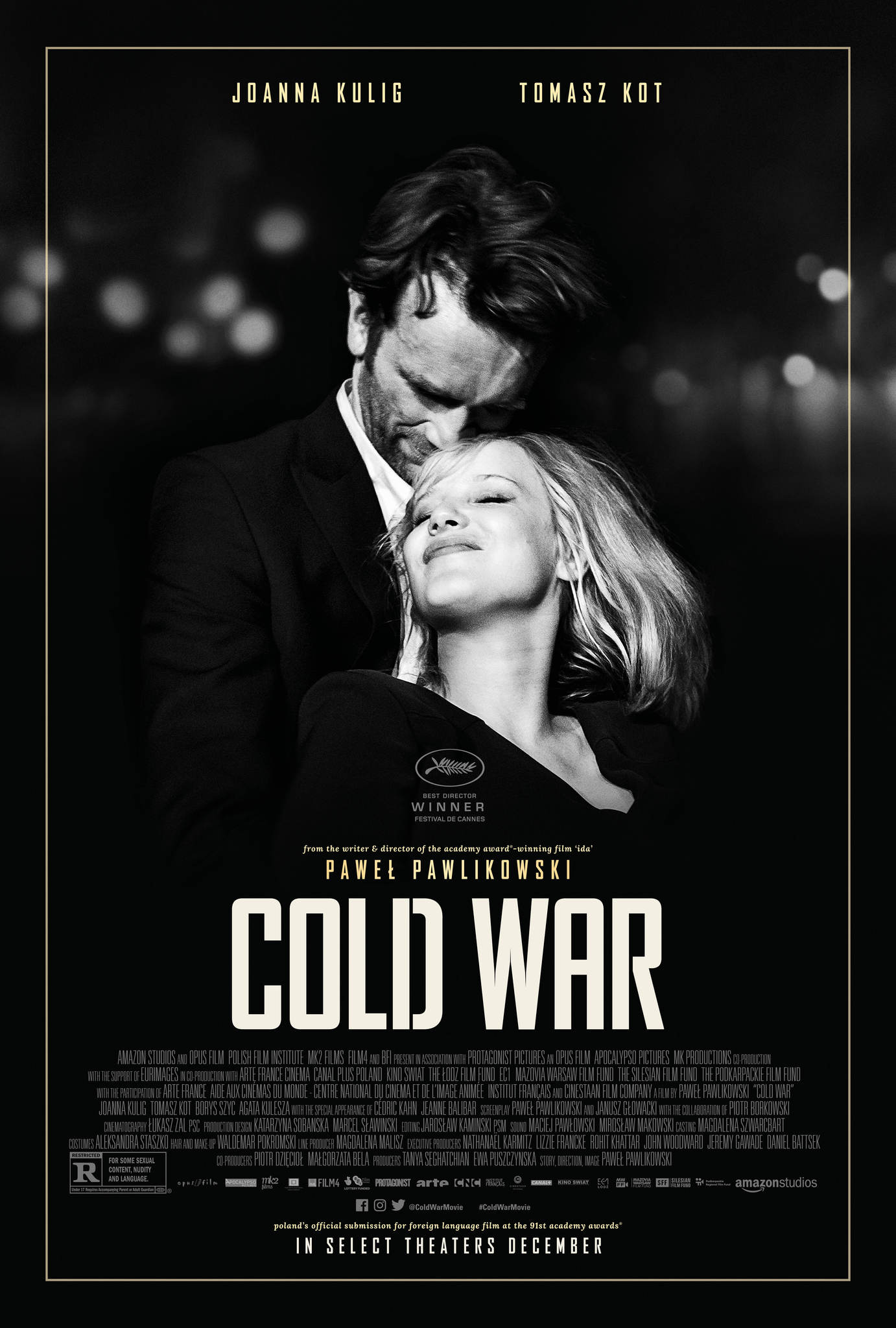
 Falling in love is easy, staying in love is a lot more difficult, and sometimes it proves to be an extraordinarily challenging endeavour – this is the central theme present in Polish maestro Paweł Pawlikowski’s latest masterwork, the brilliant Cold War (Polish: Zimna wojna), a film that takes the viewer on a decade-long journey throughout Europe as we see the love story of two characters who met by chance and reunited by sheer luck set to the backdrop of the Cold War era, based on the director’s own parents and their turbulent relationship in Europe in the years after the Second World War, when the continent was still recovering from the wounds of war, but having to overcome the challenges of an entirely new socio-political climate. I was arguably not a great admirer of Pawlikowski’s previous film, the equally-acclaimed (but far less riveting) Ida, but I found the strengths of that film were carried over into this one, which did not neglect many of the imperative concepts that the previous film did, compensating for the narrative weaknesses of the previous film. Cold War is truly captivating viewing – beautifully moody, atmospheric to a fault, visually gorgeous and incredible well-performed by the cast, in particular the two leads, who are beyond astonishing in this film that is intimate in narrative, and enormous in socio-political and cultural scope, which makes for absolutely enthralling viewing, and confirms Cold War as one of the year’s most audacious achievements, and solidifies Pawlikowski as a vital voice in contemporary world cinema.
Wiktor (Tomasz Kot) is a pianist and conductor who is working on a revue based around the celebration Polish folk music. He and his colleagues establish their base at a huge countryside estate, where they invite ordinary men and women, specifically those with some proficiency in music and performance, to be a part of their show, which soon proves to be an enormously successful endeavour, finding its home all around Europe, delighting audiences, especially when (to the chagrin of the show’s creators), their songs reflect the politics of the era, with these singers being forced into performing songs in favour of the Communist regime. One of the performers is Zula (Joanna Kulig), an enigmatic young woman who is as alluring as she talented, rising to the status as one of the show’s brightest stars, despite her past being quite controversial (there is a suggestion that she had previously been in prison for the murder of her father). Wiktor finds himself slowly falling in love with her, but his self-imposed exile from Poland (as part of a planned elopement with Zula in Berlin, to which she ultimately does not honour her end of the bargain) tears them apart. Making his living in Paris as a penniless pianist to a superior jazz band, Wiktor finds his paths crossing with Zula once more, demonstrating that while their lives are considerably different now, the spark of romance that existed before is most certainly still present – but when Zula’s status begins to rise, while Wiktor’s falls, their relationship starts to decline, and the resilience of their relationship is tested, all in the face of the relentless difficulties that afflicted countless ordinary individuals in post-war Europe.
Cold War has garnered acclaim for a number of reasons, and all of them are very deserving. First of all are the two central performances, which are certainly amongst the very best of the year, with both Tomasz Kot and Joanna Kulig giving truly remarkable depictions of these two individuals who face socio-political adversity for the sake of their love, being torn apart and then brought together by something akin to divine intervention. Their performances are excellent on two levels – firstly, they work brilliantly on their own, finding the quiet intensity in their respective performances, showing their individual growth and eventual decline. The character of Wiktor goes from being a respected musician, the de facto leader of a highly-successful revue that could fill some of the country’s most prestigious venues, to an obscure pianist working in deteriorating jazz clubs in a foreign country, as a part of his exile from his homeland. The inverse can be said about Zulu, who goes from being a country girl, someone who comes from nothing to one of Europe’s most beloved songstresses, a torch-singer who makes her mark on European culture in a time of great social uncertainty. Both Kot and Kulig thrive in their individual performances, but it is also their remarkable chemistry that allows Cold War to soar – their performances are not entirely individual, and they are almost symbiotic, with their roles depending entirely on the strength of the other. Without their incredible collaborative abilities, their collegial brilliance, Cold War would not have been nearly as compelling. One could not exist without the other, and while this film was my introduction to both performers (with the exception of Kulig’s small performance as a nameless singer in Ida), I found myself entirely enthralled by their performances, thoroughly obliged into awed astonishment by their extraordinary portrayals of these characters. There is very little doubt that Cold War unequivocally belongs to Kot and Kulig, who turn in two of the year’s finest performances, and linger on long after the fact.
Another aspect of Cold War that has garnered significant acclaim, and deservedly so, has been the visual aesthetic. Much like Ida, Pawlikowski made Cold War in gorgeous black and white and 4:3 aspect ratio, with the cinematography in this film being arguably the finest of the year – from the first moment of the film (a close-up shot of a pair of folk musicians singing directly to the camera), to the heartbreaking final shot, where our protagonists sit on a park bench and fade away into this film’s ambigious ending, Cold War captivates us visually through the incredible detail put into how this film appears. I have no doubt that while the story here is effective, Cold War would not have been nearly as masterful had it not been for the way it was made – a large portion of this film relies on the way it appears, and the monochrome and unconventional aspect ration makes it appear to be the product of neither this era or any before – it is a timeless piece, and considering the story it tells is relatively universal and without any semblance of specific temporal moment (love, after all, is an ageless concept), it isn’t absurd to assert that Cold War is destined to become a future classic, an enduring masterpiece that demonstrates the willful strength of dedicated filmmaking. Pawlikowski has certainly found his niche with these kinds of films, and I can even admit that for what Ida lacked in captivating narrative, it more than compensated for in its visual beauty – Cold War goes a step further and manages to craft a story that is worthy of its pulchritudinous filmmaking.
Perhaps the most admirable part of Cold War, one that is set apart from its powerful leading performances and the stunning beauty of the filmmaking, is that Pawlikowksi did something both admirably traditional and overtly original – he dared to make a film about the Cold War that doesn’t centralize the issues of the warring governments, or the political and economic strife that persisted throughout the world during the era, but rather carefully utilizes the socio-political climate as a backdrop to the central love story. Cold War is not, despite what one would initially think, about the historical events suggested in the title, but rather a more personal kind of cold war – one of hostility, adversity and challenges, just as the more human level, looking at two contrasting individuals who face innumerable difficulties in their journey towards the desires of their heart, and their own individuality, all the pride and heartbreak that comes with a metaphysical journey towards self-realization. How do we reconcile the desires of the heart with the affairs of the ego? Taking place over approximately fifteen years, between the 1940s and 1950s, Cold War is a powerful film, and it takes the viewer on a tour throughout Europe, situating us in a variety of locations – the countryside of Poland, the smoky cafes of Paris, the wide urban areas of Yugoslavia – and when you consider the bilateral intention of Cold War, it becomes a truly enriching experience. Pawlikowski does not only intend to show the state of post-war Europe from the more overtly human perspective, he does so through a traditional but nonetheless meaningful love story that is heartbreaking and utterly beautiful.
Cold War is an astonishing achievement and running at just 88 minutes, it is economical and very direct in what it intends to say throughout, and considering the events depicted here transpire over the course of fifteen years, it only speaks to the undeniable talents of the filmmaker responsible for this masterpiece. The performances of the two leads are incredible, and both prove themselves to be amongst the finest performers in modern world cinema, and if there is any justice, they will be offered continual platforms on which to demonstrate their studies to a global audience, because their depictions of these tortured souls who are hopelessly in love in the face of adversity was incredible. The powerful story at the center of Cold War was able to soar through the towering visuals, with the shimmering, gorgeous black-and-white photography creating a truly remarkable atmosphere that detached Cold War from its temporal moment and allowed it to exist as a grand manifesto of love and heartbreak, a nostalgic expression of the cyclical nature of love and heartbreak. I found Cold War to be an utterly extraordinary film, and amongst the year’s finest works of art. It is a delicate, nuanced and melancholy romance that uses its cultural background, and some extraordinary music, to tell a story that would be predictable had it not been for the spirited dedication that went into making it. A truly unforgettable experience, and a true masterpiece of contemporary European filmmaking.
 The Postmodern Pelican