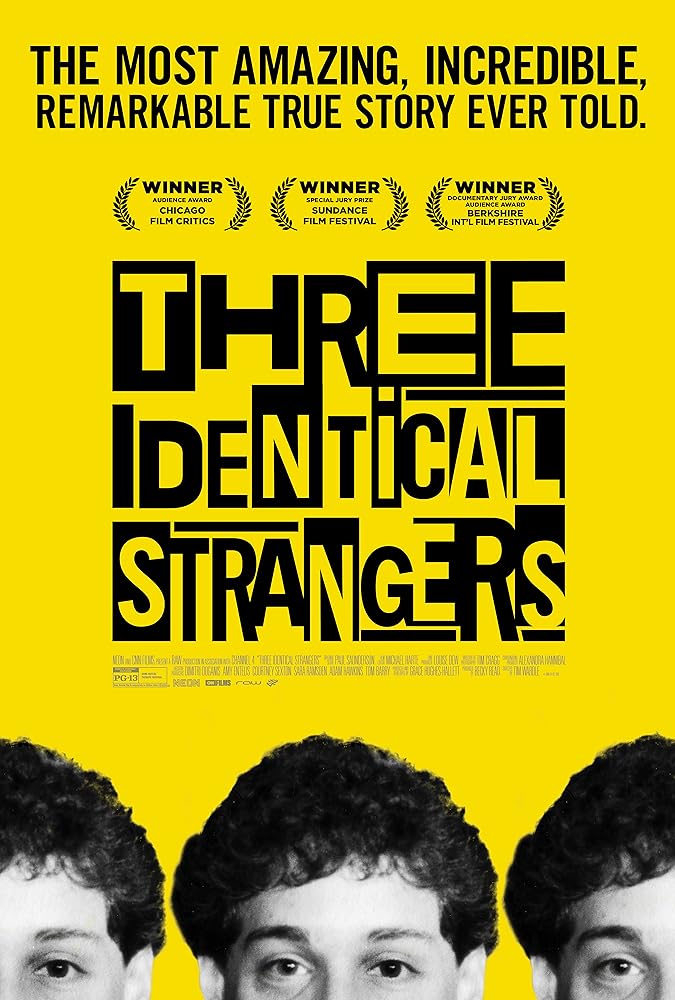
 Many of us have often fantasized about the possibility of turning the corner and being confronted with ourselves. It is a common belief that somewhere in the world, we have a doppelganger, and the likelihood of us meeting this person who is identical to us is astronomically small, but it is nonetheless an enduring and endearing fantastical concept. This is the central concept of Three Identical Strangers, a powerful documentary that looks at three individuals who encounter each other entirely through chance. David Kellman, Bobby Shafran and Eddy Galland had three very different lives, and through something accredited only to sheer luck, they discover that they are identical triplets that were separated at birth. The joyful reunion of the long-lost brothers is the basis of this feel-good documentary – until the reasons why they were separated in the first place come to the fore, which forces Three Identical Strangers down a path of dark, twisted deception, where the reasons as to why Bobby, Eddy and David were split up at only six months are made horrifyingly clear. Three Identical Strangers is an astonishing piece of work, a shocking and exhilarating journey into an absolutely extraordinary film, and one that approaches its subject with such provocative sensitivity and a great amount of nuanced restraint. Never exploitative, but also intent on proving that reality is often much stranger than fiction, the plot of Three Identical Strangers is one that not even the most talented of storytellers could have conjured up and it makes for utterly captivating.
Three Identical Strangers starts as a feel-good documentary about a family reunion (can it actually be a reunion if they did not know of the existence of the others?) – a chance encounter launches two people into the headlines, followed subsequently by the revelation of a third individual making up the trio (if my research is correct, there were actually four identical siblings, with the fourth dying in infancy). They have so many similarities, and seem to not only be identical physically but also emotionally and mentally, as evident by the fact that as the film delves deeper into their lives, we see the tragedy underlying it – mental illness and psychiatric care is shown to be something experienced by all three of the brothers, which further contributes to the central theme of the film, and something I am eternally fascinated by, the nature versus nurture debate, which forms the groundwork for the motivation to separate these brothers at infancy. At the outset, the audience is lead to believe that they are getting a motivational, inspiring tale of sheer luck and a testimony to the fact that life is filled with wonderful surprises. Yet, it goes far deeper, and it starts to provoke the story to a point where we are plunged into the realms of bleak despair as we explore the shocking background to the lives of these brothers, and many others who have experienced the same shocking revelation, as well as those who are involved in it, but are completely unaware that they are. Its difficult to talk about Three Identical Strangers without mentioning the reasons for the separation of the brothers, so read forward at your own peril, because while it isn’t necessarily difficult to conceptualize, the reasons behind their separation left me more shocked than any film in the past year, and based on the film’s acclaim, it seems to have touched a great many people as well.
There is something lingering in Three Identical Strangers that is profoundly unsettling, and a large part of that is based on the situation of the brothers, and how their story relates to something much larger than a novelty piece about triplets being reunited nearly two decades after their separation, and a depiction of their newly-found relationship as they navigate the world as a headline-making trio who warmed hearts and left a memorable imprint on 1980s culture, however small. In Three Identical Strangers, we see the worlds of reality coming into harsh contact with the academic world, and we soon learn of the existence of Dr Peter Neubauer, one of the year’s most rivetting villains, despite having died over a decade ago. A child psychologist, Peter Neubauer did something that not only crossed the limits of academic power, but it also challenged common ethics and human decency. Constructing a study that would separate children in infancy and placing them in different socio-economic and cultural situations, he hoped to once and for all put an end to the aforementioned nature versus nurture debate, made so popular by psychologists and thinkers such as B.F. Skinner, Jean Piaget and Noam Chomsky, all of which made considerable strides on both sides of the contentious issue without resorting to blatant exploitation and immoral activities.
Neubauer’s study is demonstrated as being not only unethical, but wholly indecent, and the film never attempts to humanize his actions or justify them – even two of his closest associates in the study not only attempt to atone for their involvement, but acknowledge the immorality of the actions, and even openly distance themselves from Neubauer and his horrendous study. Three Identical Strangers is a film that will hit home for many people, especially those with experiences in academia, because if this film exposes one thing, it is the arrogance of the academic world – the fact that Neubauer not only designed the study but also defended it by hiding behind the defence that it is for the sake of science, only makes it that much worse. Three Identical Strangers is an explicit indictment on this very world, and by positioning Neubauer as not a man with considerable achievements who was qualified to conduct such a study, it portrays him and his failed experiment as not only being monumental wastes of time but also profoundly hurtful and damaging to the lives of a number of people, the extent to which we are not privy to.
Even putting aside the moralistic and philosophical quandaries of the film, Three Identical Strangers is a powerful and brilliant documentary that executes it story with such precision, being extremely economical about the way it portrays the story. This is undeniably an extraordinary event that was only possible through a set of near-impossible circumstances that somehow came together to allow these men to enter into each other’s lives by nothing short of chance – what if Bobby Shafran had opted to go to another college, or even just was assigned another dormitory room? What if David Kellman’s friend hadn’t read the newspaper that morning when the reunion between Eddy and Bobby had been reported? This is a film composed out of two very intangible but vital concepts – questions without answers, and the improbability of luck – and both work in tandem in constructing this riveting documentary that extends far beyond the realm of being a novelty piece about three brothers, or something worthy of the morning news, rather becoming something far more meaningful, and often very alarming and discomforting. To call Three Identical Strangers anything short of a towering masterwork is impossible.
There is something about Three Identical Strangers that is indescribably special, and even if we don’t focus on the extraordinary story at the core or the horrifying situations that served to be the catalyst for the story, this is a film that demands the audience halt for a brief moment and just considers several metaphysical concepts – it asks us to question the fundamental quality of what makes us human, as well as critically considering the connections we make with those around us. It tries to be a reflection on the way society is structured, showing the different levels of socio-economic and cultural status, and juxtaposes this with the broader concept of childhood and the environment we are raised in and the role our surroundings influence us. In many ways, while I would never condone the study, and the ramifications it had on the individuals involved in it are utterly heartbreaking, but the underlying intention speaks to the inherent curiosity we all have, regardless of whether or not we are aware of it. Three Identical Strangers takes aims at the meta-narratives of society, dismantling the notions of what is considered ordinary, and showing that there are certain occurrences, as rare as they may be, that call into question the natural order of existence.
You can view Three Identical Strangers in one of two ways – as a clear example of the evils that exist in the world and the power certain people have to influence the lives of others, or as a sad but uplifting story about three brothers who found each other years after being cruelly separated, and working through their shared traumas in an endeavour to live their lives together. In fact, you can view Three Identical Strangers in both ways, because this is a layered, complex film that may leave far too many questions unanswered, but in a way that doesn’t cause frustration, but rather stirs thought and incites discussion. That is precisely why Three Identical Strangers is such a special film. It is an astonishing piece, a film that leaves you shaken to the core, shocked at the events that transpired and utterly in awe of the incredible story portrayed on screen – and the realization that is is all true is extremely unsettling, and makes Three Identical Strangers far more terrifying than any horror film made this year. The story about Bobby, Eddy and David is incredible and powerful, but it is one that is shown to be three lives filled with despair, sadness and eventual tragedy. Three Identical Strangers is a brutally honest film that makes an extraordinarily forceful emotional impact that is as disconcerting as it is resonant and moving. This is a film that deserves to be witnessed, if not for the magnificent execution and the pure emotion, for the incredible true story it tells. Three Identical Strangers has a singular vision, and the story of these triplets is one that needs to be seen, for both the riveting and improbable nature of their encounter, and the discussions a film like this will doubtlessly inspire. One of the finest documentaries of recent years, and an unforgettable experience that is almost too good to be true – and the fact that this is fact and not wild fiction is absolutely extraordinary.
 The Postmodern Pelican