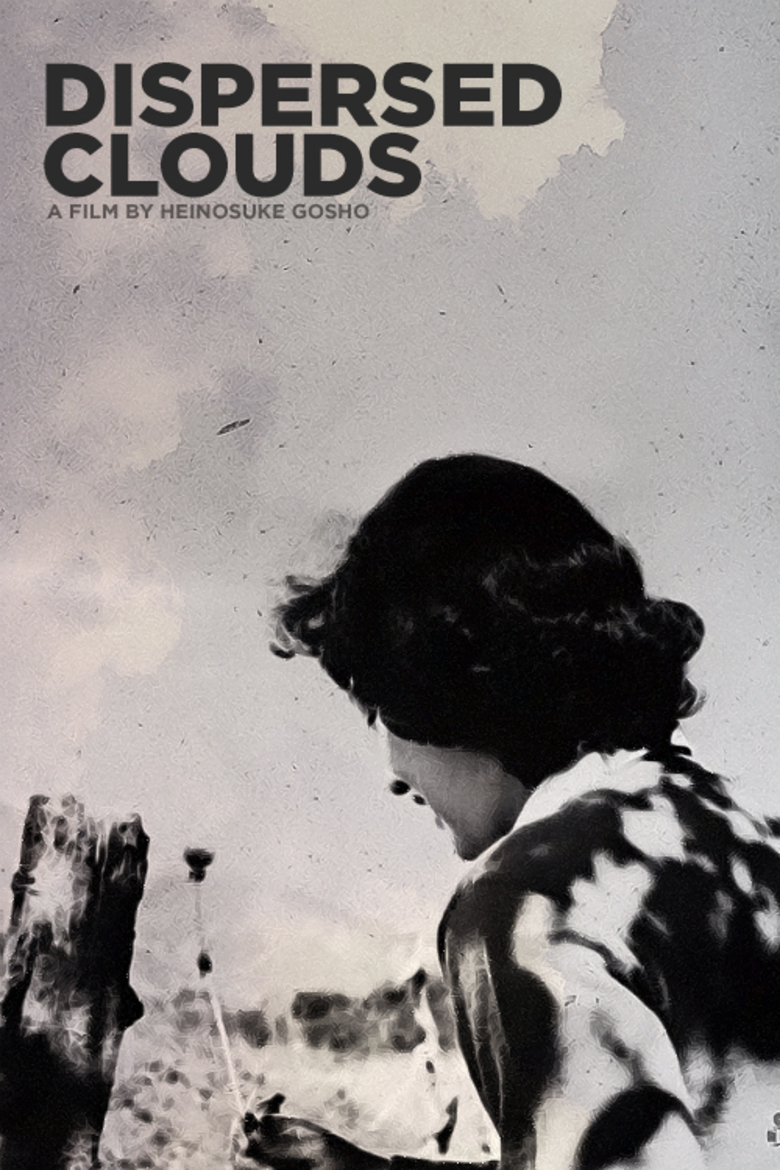
 Dispersed Clouds is the kind of film that makes me truly appreciate cinema – a small and intimate social drama that has an explosively powerful message at its core and an execution that understands the human condition with incredible profundity, a film that always does more than it says and ends up being a magnificent odyssey into Japan in the post-Second World War era. Heinosuke Gosho made Dispersed Clouds (Japanese: Wakare-gumo or ‘わかれ雲) in a way that pays tribute to Japanese society without ever being heavy-handed or unnecessarily convoluted. A slice-of-life drama that has a great deal of heart and soul, and enough endearing humour to make it one of the most charming social realist dramas of the period. A film that has somehow failed to acquire much of a following, Dispersed Clouds is not a film that demands acclaim, but rather one that earns it through lovable, earnest storytelling and delicate filmmaking that always treats its characters with respect, and its audience with complete adoration.
The film is set in a small village in rural Japan, where a group of students from Tokyo are on a walking tour of the mountain region, only to have one of them, Masako, fall from an unnamed ailment. They soon discover that she is extremely ill, and while she is not at risk of dying, she needs to rest. Thus, the girls have to remain in the village, and soon discover that there is far more to the quaint little countryside hamlet than initially meets the eye, and Masako encounters the town’s physician, the young and dashing Dr. Minami who has a passion for helping others, as well as a mysterious older woman who speaks of days when she too resided in Tokyo. There is a distinctive culture shock, with both groups having to adjust to the presence of the others – the schoolgirls need to adapt to the more easy-going country life, far from their cosmopolitan comforts back in their big city, whereas the village folk have to deal with the sometimes unpredictable demands of a group of people who are used to luxury, with hard work being as foreign a concept to them as their surroundings – one can recall a moment towards the beginning of the film, where one of the girls remarks at the strength of a farmer woman, taking pictures of her as if she was a completely abstract object. The two cultures, however, do find common ground in their search for meaning, and there is even the underlying touch of romance between Masako and the charming Dr. Minami that creates an unusually delicate atmosphere throughout the film.
Even at its most broad and mindless, Japanese cinema has an uncanny ability to have such profound meaning, and Dispersed Clouds is not an exception. Perhaps the film doesn’t have the grand scope of the films of Kurosawa, Ozu or Mizoguchi, but it certainly has the same relentless desire to understand the human condition, and to find the meaning within our lives that is not immediately clear, but that we realize is a shared trait of humanity – we are looking for some understanding of the world around us, to have the persistent idiosyncracies of the world shown to have some depth and not be just random occurrences. This is the central theme of Dispersed Clouds, a film that perhaps doesn’t lend itself to a great deal of discussion, as it is a relatively straightforward social drama, but to deny its incredible heart, towering spirit and incredibly energizing story is misguided. Heinosuke Gosho is one of the more underrated of the Japanese realists, and through this film, he displayed his remarkable ability to portray humanity in all of it’s inconsequential, almost insignificant beauty. Dispersed Clouds is not a major work, and it doesn’t feature much in regards to being an outlying masterpiece of realistic cinema, but it has an unquestionably-strong charm captivates the audience and leaves us astonished at the fact that this very small film has such magnificent scope.
Dispersed Clouds is a film that prides itself in saying quite a bit without saying anything at all, and while it doesn’t strive to be some towering masterpiece of social cinema, a strong statement on the state of society and all of its flaws, it is capable of some exceptionally fascinating commentary, most distinctively in the contrast between the city and the village, with the proverbial “city mice” finding themselves stranded in the middle of a place where they are very happy to spend a few hours marvelling at the state of the rural areas, but cannot comprehend the idea of spending any substantial time as members of this community. However, they soon come to understand (in particular the protagonist, Masako), that one cannot find themselves stuck in a village and not be assimilated into the society through the caring hospitality of the townspeople who are far more agreeable and welcoming than the people they find elsewhere. This is a film that examines the endearing remedy of the countryside, and how rural life may not be glamorous, but it is honest and earnest, and can even turn a spoiled person like Masako into a half-decent individual. The contrasts between the two worlds are often very funny, especially with the landlady, who sees herself as the most progressive, stylish person in the village, only to discover that even through all of her efforts, she is still a country girl at heart, and that she pales in comparison to the self-obsessed visitors. Dispersed Clouds is a great portrayal of conflicting worlds, and how common ground can be found even when there isn’t anything to go by initially.
Melodramatic without being void of charm or personality, Dispersed Clouds is a deeply meaningful film, and throughout it, we are presented with a few characters all on the deeply personal journey of self-realization. Masako is searching for some meaning, and realizing that he is just a spoiled girl, rather than this magnificent, glamorous iconoclast, she undergoes some introspection, which leads her to form a friendship with Dr. Minami, who is far more than just a country doctor – he is a man who wants to help as many people as he can, even filling his small clinic to capacity with people who are seeking help, travelling far and wide to help anything who needs assistance. The bitter, misanthropic Masako and the generous, caring Dr. Minami would logically be in conflict, yet they agree on one fundamental point: they care about the world and are in awe of its many complexities. They are in desperate search of answers, some explanation for why things are the way they are – and whether or not they find the solutions to their problems is not the concern of the film – Dispersed Clouds is more about their journey, rather than the destination.
Dispersed Clouds is an excellent film – a formal and elegant social drama that has an abundance of understated charm and a great heartfulness that portrays the joys and sorrows of existence in ways that are so simple, yet so utterly gorgeous. It may lack the powerful visual flair of similar contemporary films, but there is a certain unbelievable beauty present in the visual aesthetic of this film – it is very evident that Gosho’s career has its roots within the silent era, which is portrayed through the unique visual style and framing choices. As a whole, Dispersed Clouds is a powerful film, one with a magnificent emotional impact and a palpable soul that pervades throughout the film. An absolutely astonishing film, and one that may not stand as one of the hallmarks of Japanese cinema, but absolutely should. It has an underrated master behind the lens, a wonderful story, extraordinary performances and most importantly, a resonant and endearing story borne out of its profound admiration for humanity. In short, Dispersed Clouds is an astonishing achievement in both form and content, and a towering example of the power of social cinema.
 The Postmodern Pelican