
“I saw the best minds of my generation destroyed by madness, starving hysterical naked,
dragging themselves through the negro streets at dawn looking for an angry fix,
angelheaded hipsters burning for the ancient heavenly connection to the starry dynamo in the machinery of night”
~ Allen Ginsberg, “Howl”
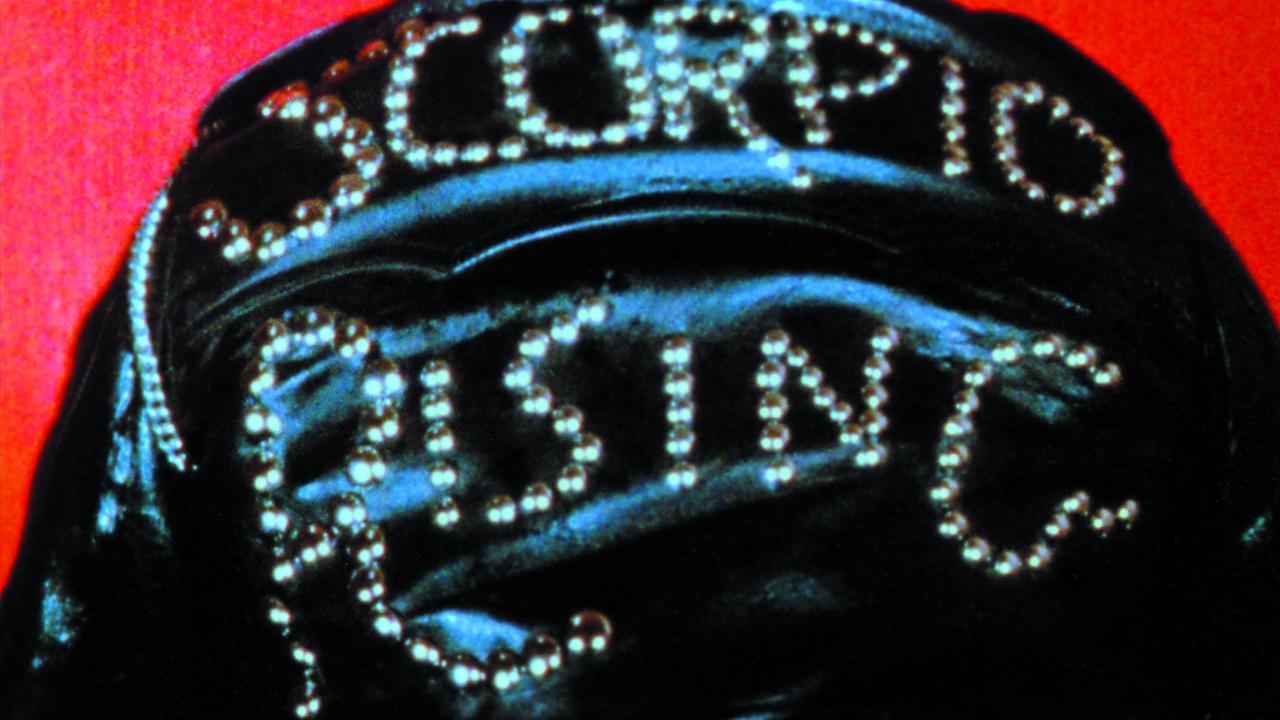
In the history of experimental cinema, very few films stand out quite as starkly as Scorpio Rising, the counterculture manifesto crafted by Kenneth Anger, who is equal parts genius as deranged. A short film that lacks nearly everything that makes a film watchable, he somehow creates something quite extraordinary, a hypnotic journey into the depths of American culture, a film that so beautifully represents the era in which it was made. A film without any structure or notion of logic, Scorpio Rising is a fascinating experiment – an attempt to tell a story without any story to tell, a series of moments that are, on initial viewing, detached and nonsensical, but come together perfectly in a truly unsettling work of boundary-pushing filmmaking, proving that while Kenneth Anger may be a polarizing figure, and someone whose personal endeavours have made him the subject of considerable criticism and perhaps a bit of fear, he was capable of putting something together that not only challenges the limits of what can be represented on film, it contends with the idea that cinema needs to always make sense, and that sometimes, we can find clarity and profundity in the most illogical of places, including in Scorpio Rising, one of the most idiosyncratic experimental films ever made, a bohemian horror film that doubtlessly leaves an indelible impression.
I’m not ashamed to say that I am not entirely sure what to make of this film, but its clear that this a common response, and I sincerely doubt that Anger made Scorpio Rising with the intention of making something easily understood. There isn’t really much of a story, with the film taking the form of a documentary-style biker film, focused on a group of bikers who may or may not be homosexual Nazis with a penchant for the occult, led by the central protagonist, who we assume is named Scorpio, and we watch as he and his friends engage in sordid activities, from deadly bike races to initiation ceremonies that are a far cry from the morally-decent expectations of the society they reside in. Moreover, with a running time of just under thirty minutes, there isn’t much time for Scorpio Rising to develop much of a coherent story – not that there seems to be any intention to.
For a film that lacks both length and a coherent story, Scorpio Rising is an exceptionally difficult film to write about, and it seems like multiple viewings are necessary to understand what Anger was trying to convey with this film – the filmmaking is meticulous and rich, and there doesn’t seem to be a wasted moment throughout the film. Every moment has some deeper meaning, and everything is so carefully chosen in order to convey the multitudes of themes that Anger seemed to be intent on portraying. The most accurate description of Scorpio Rising is that it is a deeply meaningful portrayal of the era in which it occurs. Anger made a poignant representation of the counter-culture era, and imbues it with a multitude of traditional images that defined the period in which it was made – conventionally-attractive men that seem to be the product of Tom of Finland and his brand of homoerotic art, colorful comic strips that are about as meaningful as they are realistic, a wide array of popular songs and the eternal interplay between chrome and leather, all of which are undeniably iconic symbols of the 1960s. Scorpio Rising is a manifesto of the 1960s generation, the youthful abandon of the baby boomers finally coming to age, exploring their newfound freedom in an era of Civil Rights and protests against inequality, an era where youthful sexuality and reckless abandon was not only accepted but actively encouraged by this generation.
Scorpio Rising is a visual depiction of Americana in its most pure, unadulterated form, and it often takes the form of being a film driven by the fetishes of the director, who somehow manages to transform his unhinged obsessions with homoeroticism, the occult and Nazism into an unsettling and powerful portrayal of the corrupted nature of American society. There is a contrast between things that are typically American – mainstream pop music with digestible lyrics, the All-American boys, the neat suburban bedroom filled with posters and comic books – and darker concepts such as those mentioned previously. Anger’s interests in both sides of society are evident here, and he made a film that represents a different side to a familiar world, a terrifyingly uncanny depiction of a society seemingly built on the foundation of decency, morality and honesty. Scorpio Rising is very much a film that embodies the epigraph to this review, which are the ominous first lines of Allen Ginsberg’s “Howl”, a text comparable to Scorpio Rising in its representation of an entire generation lost to their own carnal desires through being victims of a deteriorating society. Much like the work of Ginsberg and his contemporaries, Anger portrays society as something encompassed by margins, taboos and perversions, which demonstrates the
Looking beyond the intention, we need to consider that Scorpio Rising is more than just being a film that looks at the darker desires of society’s most upstanding citizens and that the way Anger represents this story is far more notable. Scorpio Rising is an inherently postmodern film, with a complete lack of structure, and Anger partakes in a process of dismantling any concept of narrative by presenting us with an episodic set of moments, scenes intercut with imagery taken from elsewhere. The film is constructed out of fragmented moments that work towards a greater whole, which creates an atmosphere rather than telling a story. Scorpio Rising is very much a film that prioritizes artistic expression rather than narrative cohesion, and in many ways, this film is a beautiful testament to Anger’s own desires, focusing on his obsessions and interests, which he projects into this fiendishly complex social quasi-documentary, which results in a postmodern stream-of-consciousness masterwork. Scorpio Rising dismisses logical and opts for a series of mesmerizing, non-linear moments that tell a story through visual implication rather than through any palpable narrative – and one can either adore or despise it, but no one can deny that Scorpio Rising is incredibly creative.
Importantly, we need to mention the music. Scorpio Rising has come to be infamous for its gratuitous use of popular music, which Anger liberally used without any permission. The result is a short film with over a dozen songs by some of the era’s most popular artists. Had he been given permission to use these songs, I doubt Anger would’ve actually used them – the defiance of illegally using these songs lends Scorpio Rising its distinctive rebellious tone. Moreover, the soundtrack is not just auditory accompaniment to the film, but rather helps craft it. The music is just as important to the film as the images that occur around it, and it often shapes the fragments of the story, giving them necessary impact. There is something so effective about these pleasant, agreeable and entertaining pop songs such as those by Elvis Presley, Ray Charles and Ricky Nelson, representing normality, being contrasted with the brutal and shocking imagery of Nazism, occult and gang violence. The use of the music, as stark and contradictory as it is, is never ironic or parodic, and it creates something far more shockingly earnest than one would initially think when presented with the content of this film.
Scorpio Rising is a bewildering film, but to call it anything short of a notable achievement is misguided. Kenneth Anger made an experimental masterpiece here, crafting a film that is not necessarily narrative-driven, but rather a snapshot of a generation, one that sacrifices coherency and the intention to be resonant in favour of a complex portrait of a generation. There is a sense of alienation in this film, and the despair for the modern world underlies Scorpio Rising as we see Anger combine the current state of the world with the seedier side of humanity in this avant-garde testament to the counterculture era. Anger finds something poetic in the ordinary, and something beautiful in the hideous, and Scorpio Rising is defined but having a certain grotesque glamour, a subversive and queer approach to a very layered set of concepts. The influence of this film is unquestionable, and it left an impact on filmmaking. It was a music video before music videos were being made, a non-narrative exploration of society long before Godfrey Reggio made his career out of it. It set the groundwork for modern independent cinema and doubtlessly inspired some of the greatest cinematic artists of their generation to tell stories in their own ways, breaking free of conventions and defying the concept of logic in favour of artistic expression. Scorpio Rising is not the most comfortable film to watch, and it is often quite unsettling, but it has a willful spirit and a dedicate rebelliousness that makes it quite extraordinary, and something most certainly worth seeking out.
 The Postmodern Pelican