
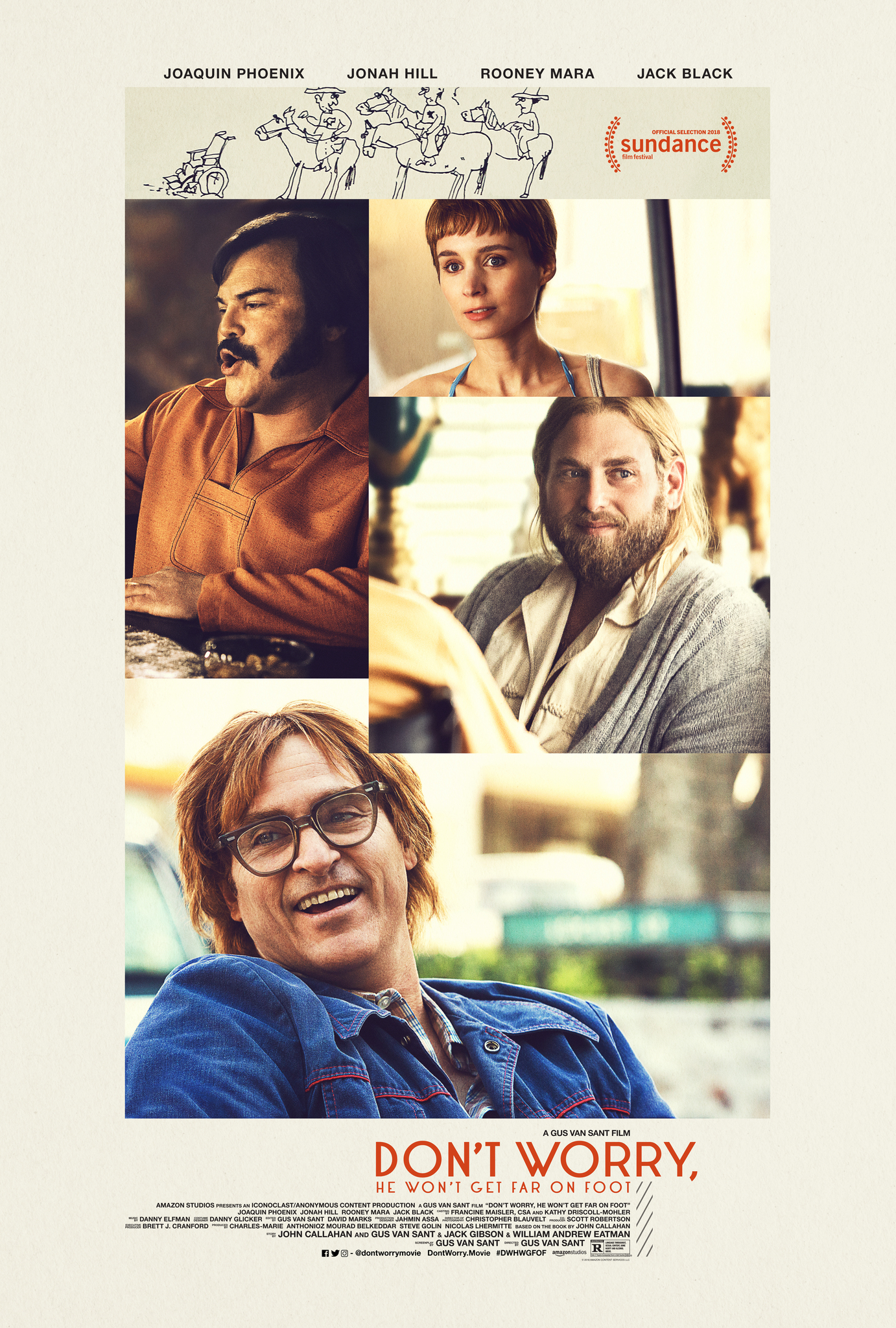
Don’t Worry, He Won’t Get Far on Foot is based on the biography of John Callahan (Joaquin Phoenix), an aspiring songwriter who just weaves through existence, living his life in between bottles of alcohol. A particularly raucous evening results in a car accident that leaves him paralysed from the chest downwards, and he is forced to consider his life – confronted with his alcoholism, and broken (both physically and mentally) by his accident, he undergoes a voyage of self-improvement, helped by his harsh but caring Alcoholics Anonymous sponsor, Donnie Green (Jonah Hill) and Annu (Rooney Mara), the Swedish therapist who soon forms a meaningful friendship with John that later evolves into a loving relationship. Eventually, John manages to find solace and comfort in the most unconventional way – he begins to draw cartoons with a darkly comical edge, which allows him to work through a number of his personal quandaries – his life-altering disability, his attempts to become sober and the anger he feels towards his mother, who abandoned him when he was a baby. John channels his anger, regrets and bitterness into humour, and while his work does cause occasional outrage, it becomes clear that John was not drawing for others, he was drawing for himself.
In all honesty, Don’t Worry, He Won’t Get Far on Foot is as cliched and hackneyed as it sounds – but it didn’t have to be. The story of John Callahan is a truly inspiring one, and it had the potential for something exceptionally special. It is one that had the ability to be both a hilarious and outrageous look at a man who relished in making others laugh through his unconventional artistic process, as well as a bittersweet drama about addiction, disability and mental health. It is hardly surprising that Callahan’s book was first optioned by the late Robin Williams, and I have no doubt that there is a great film lurking within this story. Yet, it wasn’t given the treatment it deserved, and instead of becoming the soaring manifesto of persistence it could’ve been, it was a bland, ordinary biopic by a director who is just not as exciting as he was before. There are a lot of moving parts in Don’t Worry, He Won’t Get Far on Foot, and Van Sant just seems to be on the verge of derailing this film throughout. There are certainly merits in this film, but they are few and far between and appear so sporadically, its difficult to look at this film for much more than its flaws. Luckily, the merits balance out with the flaws effectively enough to make Don’t Worry, He Won’t Get Far on Foot at least somewhat decent, and while it isn’t particularly memorable, it could have been worse.
If there is one aspect of Van Sant’s directorial career that deserves praise, it is his effortless ability to bring out new sides to his actors, and Don’t Worry, He Won’t Get Far on Foot is not an exception. Joaquin Phoenix takes on the lead role, and even if this film doesn’t come anywhere close to the monumental performances that have populated his diverse career, he brings the same intense passion to this performance that he normally does. He embodies the nuances of the character with such grace and tact, and he never plays Callahan as a stereotype – it is a layered, meaningful performance and Phoenix is clearly still very much committed to giving nuanced depictions of complex individuals fighting a panoply of personal demons on their way to self-realization and conscious improvement. Jonah Hill also has a significant role, and he was perhaps even better than Phoenix, insofar as his performance seemed to be coming from an even more genuine place. Hill abandons much of what has made him such a popular actor, playing the stern but loving AA facilitator with respectful humour and quiet devotion. Unfortunately, only Hill and Phoenix are giving anything substantial to do, with Jack Black being massively underused (appearing only in the first act and briefly in the third), and Rooney Mara once again playing the role of the inconsequential love interest who exists for no other reason than just to be the embodiment of our protagonist’s fantasies and a representation of his self-improvement. Yet, despite the diminished capacity of their roles, Black and Mara do leave some impact, but this is more indicative of their talents as performers, as opposed to any generosity on behalf of the filmmakers, who seem to think their presence alone can compensate for the weakness of their character development. The cast of Don’t Worry, He Won’t Get Far on Foot did manage to salvage the film and elevate it far beyond where it could have been, and if there is a reason to see this film, its purely because the performances are great.
However, not everything about Don’t Worry, He Won’t Get Far on Foot is bad – like I’ve mentioned, it is far from being an awful film, and it rather comfortably settles into the realm of being a pleasant but forgettable experience. There are some elements of this film that do work, and some aspects of the execution were handled surprisingly well. For example, despite being a film that focuses on three very serious themes – addiction, disability and familial trauma – it finds a lot of warmth and humour in its situation. There was very little doubt that Callahan would have despised an overly-saccharine approach to his life, and Don’t Worry, He Won’t Get Far on Foot comes a lot closer to the sardonic humour of his work than you’d expect. There are many moments when this film deftly avoids becoming overly-sentimental, and Callahan is not reconsidered as some tragic hero – he is portrayed in all of his flaws, and his shortcomings are also very evident. However, the film also never makes light of his situation in a way that is inappropriate or mean-spirited. If anything, Don’t Worry, He Won’t Get Far on Foot thrives on being an affectionate and meaningful approach to its difficult subject matter, and it is one that utilizes Van Sant’s considerable delicacy as a filmmaker to its benefit. Not to mention that there are several moments of fleeting glory, such as a montage of John’s recovery, which is juxtaposed with his early days as an infant in the care of nuns – suddenly, he has been returned to the helpless state he was as a baby, at the mercy of those around him to care for him. Don’t Worry, He Won’t Get Far on Foot is a film with some great moments, the problem is that they just don’t add up to anything particularly profound.
The most glaring flaw in Don’t Worry, He Won’t Get Far on Foot is that it seems to be awkwardly positioned between comedy and drama, and while this isn’t necessarily a shortcoming, the film’s inability to find a tone impinges upon the central story, because while we would expect something that balances the humour and the gravitas effectively, it becomes muddled and tirelessly episodic. Moreover, this is a film that tries to tell a decades-long story, but seems to lack the very notion of time – the audience is thrown into a film where we are presented with three alternative storylines – John before his accident, John recovering from his accident, and the later years of John’s life where he becomes a public figure of sorts. Very little effort is put in to help distinguish between them, with the viewer having to deduce which period we are in by the size of Phoenix’s glasses and the length of his red wig that makes him look like a deranged version of Carrot Top. The flashback sequences aren’t handled well, and there is an over-use of montages that are edited so poorly, Don’t Worry, He Won’t Get Far on Foot begins to look like a badly-made television documentary rather than a feature film with some considerable talent in front of and behind the camera. The underlying story of Don’t Worry, He Won’t Get Far on Foot, as is the intention – but when it comes to the surface representation, it just falls apart, and while it isn’t a complete disaster, there is very little that can salvage this film from being painfully mediocre.
Don’t Worry, He Won’t Get Far on Foot is not awful by any means – but it isn’t particularly good either, and the fact that there was no excuse for this film to be so lacking in so many areas doesn’t give me any reluctance to call this a lesser work for everyone involved. It has its merits – Gus Van Sant moves away from the unbearably saccharine sentimentality of his recent films for something a little more nuanced and realistic, and the cast, led admirably by the consistently-excellent Joaquin Phoenix and Jonah Hill in a surprisingly restrained performance, turns this film into something that does have some remnants of being watchable. In all honesty, Don’t Worry, He Won’t Get Far on Foot isn’t as monumental as it could’ve been – it does tackle a range of difficult topics with dignity and respect but at the expense of some cohesion that could’ve pulled it together and made it into a soaring masterpiece of social commentary. I wouldn’t dissuade anyone from watching this film, but it is not one that feels urgent in any way, and as meaningful as the message contained within it is, Don’t Worry, He Won’t Get Far on Foot is just forgettable. Of course, this film could’ve been much worse, but there was the possibility of it being much better. In all honesty, the best representation of John Callahan’s life, his personal struggles and his formidable beliefs will always be his towering work, and if Don’t Worry, He Won’t Get Far on Foot provides one thing, it is wider distribution of this fascinating man and his work, which says more about these themes and concepts than this film ever does.
 The Postmodern Pelican