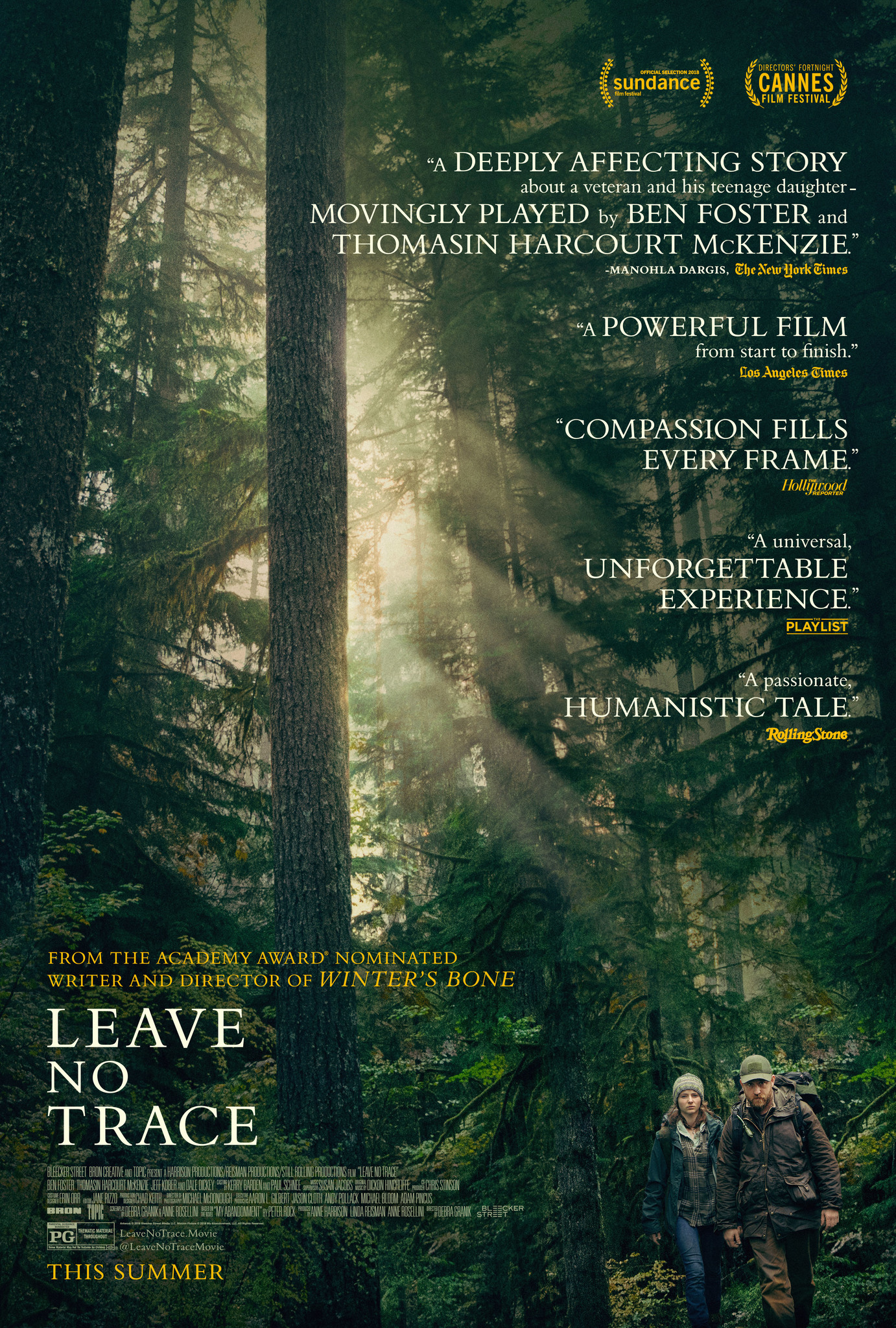
 Debra Granik is a great filmmaker. While not necessarily the most prolific film director, having only directed three feature films (and working on several fiction and non-fiction films in some capacity), she has shown herself to be a remarkably talented artist. This review is concerned with her most recent work of art, the astonishing Leave No Trace, which is an extraordinary drama that proves to be far more than just the total sum of its parts – what could have been just another rural drama with overtures of daring adventure became something beautiful and intricate, and overtly powerful in the story it conveys. Much like Granik’s two previous feature films, Down to the Bone and Winter’s Bone, this film is a slow-burning, but incredibly resonant experience that compensates for its simple story with masterful execution and authentic emotion conveyed so perfectly through the narrative mastery Granik has shown herself to be capable of. In addition, much like the previous two films, Leave No Trace is a very surprising film – it is not a film that one expects to be this moving from the outset, but it manages to wrangle its way to your heart, and by the time the final powerful moments have transpired, you are left a profoundly emotional wreck. In no uncertain terms, Leave No Trace is a brilliant film.
Will (Ben Foster) is a veteran who suffers from Post-Traumatic Stress Disorder, which he manages to keep under control, with the help of some medication (which he has come to sell to other veterans as a means of making money) and his lifestyle, which is minimalistic to say the least. He and his daughter, Tom (Thomasin McKenzie) live in a park on the outskirts of Portland, Oregon. They illegally occupy a small piece of the land, existing on the bare minimum and entering society only when it is entirely necessary. They live in relative seclusion, which may seem somewhat utopian for the more misanthropic of us, but as we see, Tom is restless, and pines for the opportunity to just lead a normal life, which her father is vehemently against. However, when they are soon found, their lives take a substantial turn, which results in them being forced into society, subsequently trying to escape from it, only to find themselves delving deeper within, either by accident or by sheer irresponsibility. We soon come to understand that Tom is growing fond of the idea of leading a normal life, with friends to see and experiences to have, with her father and his inability to adapt to the modern world constantly holding the young woman back. The pair starts to become emotionally separated by the differing ideas of paradise while remaining physically bound through the powerful bonds of family, and the fact that as unstable Will is, he is still a good father at heart, even if his actions don’t reflect that.
Ben Foster is an actor who I am still divided on. I have seen him in several works, and my perception of his abilities do wane from time to time. However, Leave No Trace is amongst his best performances, where he gives a very simple but nuanced portrayal of a loving father who just wants the best for his daughter. Foster is very good, and he keeps everything extremely internal, conveying the deepest emotions through his expressions and non-verbal gestures that communicate more than mere words. Yet, it isn’t Foster that is the heart of this film, but Thomasin McKenzie, who plays his daughter. This film may seem to be built around Foster’s character and his daughter, but as the film progresses, we soon see that McKenzie’s character is the real focus, with her adaptation from the isolated to the ordinary being the central theme on which Granik tells this moving story. I was extremely impressed by McKenzie – not only was the young performer able to hold her own against her established co-star in every scene they had together, she often surpassed him, showing the strife and uncertainty that comes with youth, which is only amplified when we consider how she has the added experience of living in the wilderness as a hermit. McKenzie gives undeniably one of the best performances of the year, with Leave No Trace being a remarkable breakthrough for a young actress who most certainly has a very bright career ahead of her if this film is any indication.
Leave No Trace is a complex film, and much like Captain Fantastic, it shows a father and widower dealing with his own personal demons through the enticing lure of the wilderness. In the real world, there are problems and annoyances, but in the wild, one can just exist – this is obviously why the idea of camping vacations s so seductive to many of us. Yet, Will takes it too far and raises his daughter in the wild, taking away the best years of her life, which any ordinary child should be using to socialize, become educated (scholastically and in life’s many lessons), as well as finding out who she is, developing her own voice and her own path. Leave No Trace takes on an odd portrayal of the traditional parent/child relationship, and while it may look at a story that may be viewed as exploitative and abusive (a father raising his daughter in the wild), or oddly enticing (by those who yearn for the tranquillity of the wild), it is above everything else, a film about a father and a daughter and their attempts to survive – and to them, survival isn’t safety and routine – it is uncertainty, danger and spontaneity. They take on journeys without ever knowing where they’re going, other than the fact that they are going away from society. It can best be described in the words of Tom, who replies to a question about where her home is with the powerful statement: “with my dad” – all the hackneyed terms about home being where the heart is do ring somewhat true here, showing that home is where those we love go. However, sometimes we need to forge our own path, which may go in the complete opposite direction. Leave No Trace is a deeply moving film, and at its core, the story about an unbreakable bond between a parent and child is extremely resonant and powerful.
Eight years after her incredible breakout film, Winter’s Bone, Granik returns to the wilderness to make Leave No Trace, and it is indescribably gorgeous. Much of this film takes place in forests and parks, showing our two protagonists travailing between spaces to find their home, moving away from civilization into their own tranquil existences. Granik seems to have an eye for these small, intimate wilderness dramas, both in terms of the narratives, but also through her effortless visual abilities. The director’s background in cinematography is made very clear throughout Leave No Trace, with the screen perpetually being filled with gorgeously-lush green vegetation and strikingly bold visual choices. In many ways, Leave No Trace is a film that relies heavily on the way it is visually-composed, because it is dependent on the audience feeling the same animalistic desire to return to the wild as these two characters – the cold, arid and lonely landscapes of the woods need to be presented as inviting rather than terrifying, and there needs to be a sense of empathy for these characters on behalf of the audience. Granik most certainly creates a bold film that manages to astonish not only with its story but also its distinctive technical prowess, which displays the rugged grandiosity of the wilderness in a way that is honest but not sensationalized. It may be a very simple and unfurnished film, but Leave No Trace is as gorgeous to look at as it is heartwrenching to watch, and that’s a difficult feat to pull off so effectively, yet Granik seems to have done just that.
Leave No Trace is definitely one of the year’s best surprises – it is an unassuming, humble drama about two individuals doing their best to stay together in the face of adversity. It is a film that thrives on its ability to be unequivocally simple – it tells a coherent story and doesn’t take too many unnecessary diversions. Granik is an economic filmmaker, and every moment, big or small, is significant to the grander narrative of this film. Leave No Trace is a visually-stunning achievement, a film that portrays the simple beauty of life when the distractions of the modern world are removed. However, where this film really soars is in its story, with Granik’s dedication to depicting a range of complex themes through nuanced, effortless simplicity. The film is extraordinarily moving, and the performances from the two leads are excellent, which all come together in a beautiful achievement of a film, a towering drama that leaves the audience both heartbroken and exhilarated, as well as optimistic, because despite the poignant ending, there is a glimmer of hope for all of us who want to break free of some situation, whether mental, physical and emotional, and shows that we are often presented with a series of paths, and while some may take us to places we don’t necessarily want to go, as long as we keep moving, we’ll find the road one. It may be the road not taken, but if we look hard enough and persist through all the obstacles and hindrances, we’ll find it, and won’t look back. Leave No Trace is a truly beautiful, poetic film, and one I will remember for a long time.
 The Postmodern Pelican
I have seen this story before. The Mosquito Coast and Captain Fantastic come immediately to mind. Each film addresses adolescent development in regards to addressing life with a parent who suffers from a varying degree of mental illness.
Both actors here in this basically two hander are fine. Ben Foster avoids the histrionics that another actor might embrace. Foster pulls everything inward. We study his eyes for insight into his choices. Newcomer Thomasin McKenzie is good in her role as the daughter who slowly awakens to her burgeoning feelings of independence.
I suspect one’s affection for this film depends on whether you identify with the trauma of establishing yourself as an individual or the trauma of seeing your child take control of her own life. The script quickly informs us that this young woman’s education is advanced (aren’t the kids in all these wilderness schooled scenarios more advanced than their peers). She is obviously healthy and maturing normally. The drama quickly boils down to the parent’s ability to maintain his instability and the child’s coming decision to leave.
In this film, I just found myself annoyed that this father would have subjected his child to such a life for more than a decade. Really, his behavior is inexcusable. If you are mentally ill and have a child to raise, get some help. Allowing your demons to put a young girl in a darkened, unsecured, heavily graffitied railroad car to sleep or walking in freezing temperatures with exposure to frostbite is the height of self-indulgence. When the inevitable break came, I was just happy for her that this childhood nightmare was over.
I can see that some may want to romanticize this unique upbringing, however, my unapologetic opinion defines the experience as child abuse.