 Despite having made only three films over the span of nearly two decades, Kenneth Lonergan is most certainly one of the most important voices in contemporary independent cinema. Margaret was a misunderstood labour of love, and Manchester by the Sea was a towering achievement that remains one of the finest representations of grief ever committed to film. I recently watched his debut directorial effort, You Can Count On Me and I was in awe throughout the entire duration. Lonergan is a filmmaker who has astonished me through every encounter I have had with his work, and while You Can Count On Me is not a sweeping social epic in the same way Margaret was, nor an emotional masterwork like Manchester by the Sea, it was nonetheless an astonishingly complex work, a beautiful poem of a film and an artistic piece that touches on some gravely serious themes without losing its heart, managing to be a serious meditation on existence, as well as an exuberant celebration of life.
Lonergan’s body of work, especially that of a director, is composed of three very different and distinct films that stand on their own as masterful achievements. However, there is a common theme that runs throughout all of them, and one that is not necessarily foreign to cinema, but hardly as impressive as presented here: being alive. You Can Count On Me, like Lonergan’s other work, is an atmospheric, poignant expression of existence, one that takes a deep look into the lives of a few individuals and how they react to the traumas they may have to endure, and how they depend on others in various ways, while often finding themselves becoming disappointed and disillusioned with life, but nonetheless retaining some semblance of hope. Lonergan is clearly a playwright at heart, with his films not having any grand metanarrative – these films don’t set out to tell some powerful, eventful story with any specific relevant content, nor do they attempt to be timely pieces that focus on a specific concept. Lonergan’s films are understandably quite inaccessible at first, with their paced, meticulous execution being somewhat impenetrable – but I’d argue that they are not difficult films, but rather heavily resonant ones.
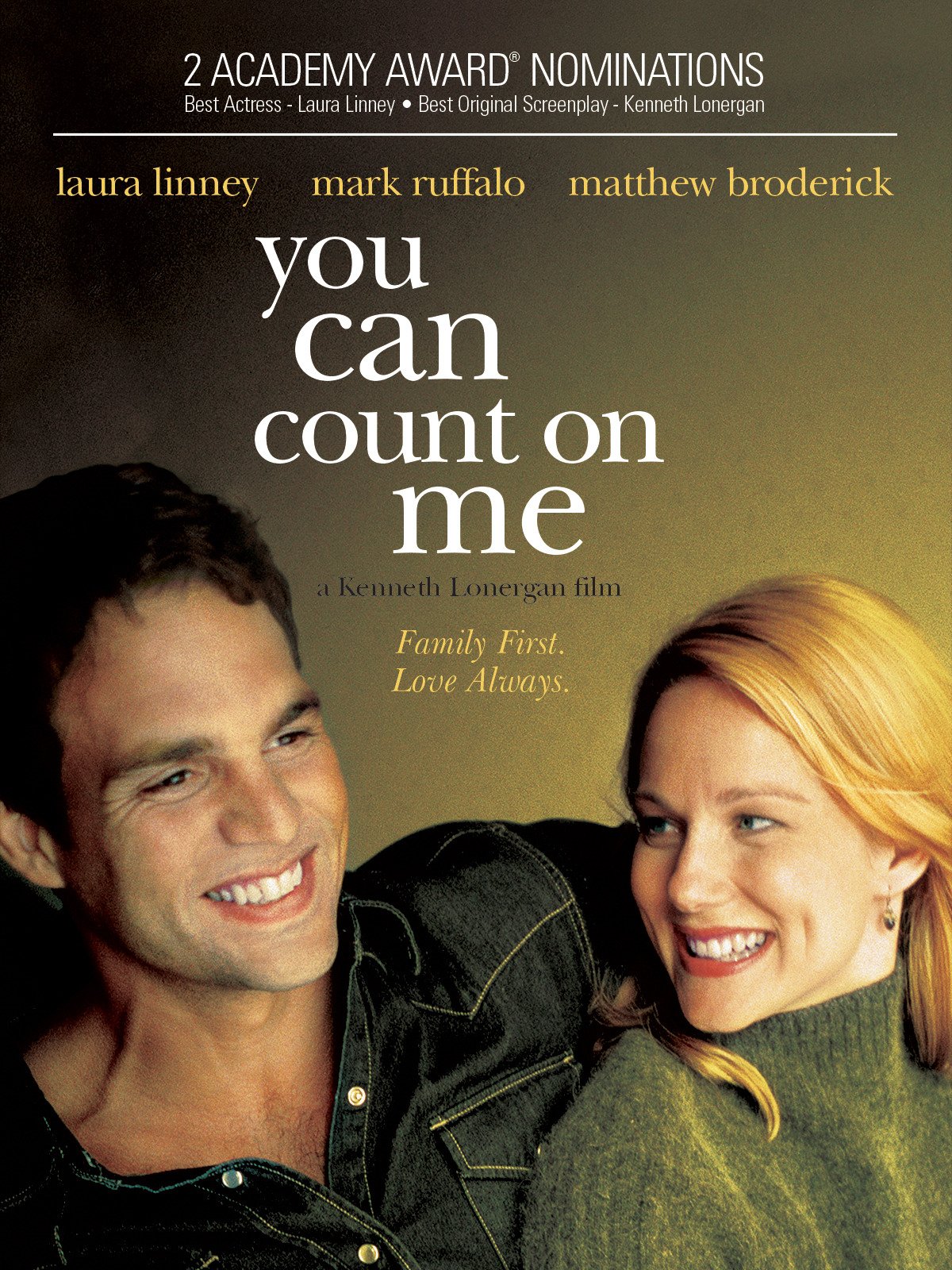
It is in the simplicity of the story that You Can Count On Me soars, and in presenting it as a straightforward family drama, Lonergan is able to explore the deepest recesses of our human insecurities and the uncertainty of existence. The film is relatively undemanding – Sammy (Laura Linney) is a single mother who works at a local bank in the small Upstate New York town that she and her son Rudy (Rory Culkin) have spent all their lives in. Without much notice, her younger brother, Terry (Mark Ruffalo) reappears in her life – but she soon discovers that his visit was less to do with reconnection and more with looking for financial help after his recent release from prison and his struggles in becoming entirely reformed. However, it soon becomes clear that Terry needs a lot more than money – he needs guidance and help, and what he soon discovers is that he needs his family, and his family needs him, and that through even the most trying situations, we all find our way back to those who we can truly count on.
It is easy to understand why You Can Count On Me is such a resonant film – it is almost nondescript in specific details, being set in a somewhat anonymous small town, featuring very little that alienates it from the rest of the suburban world, as well as characters that are not particularly significant or remarkable, but rather realistic and honest. Lonergan’s story thrives on the fact that many people, regardless of background, can relate to this kind of story. The narrative is not overly melodramatic, and it retains some wonderful humour, but it never veers off into the territory of being implausible. This is a story rooted deeply in humanity, and its earnest honesty is quite simply incredible, with the gritty realism of this story often being uncomfortably heartbreaking, but otherwise deeply beautiful and will certainly strike a chord with anyone who has experienced disappointment, heartbreak and uncertainty as to where the future is headed. You Can Count On Me is a film about questioning life, grappling with the confusion of existence, but Lonergan never dares to try and answer these enigmatic problems – to attempt to would be almost inauthentic because what You Can Count On Me lacks in comfort, it makes up for in powerful practicality. This film is a tremendously poignant social drama, but one that is pragmatic with its ability to represent life as it is, and there is nothing quite as moving as an honest encounter with reality.
More than this, You Can Count On Me is a film that doesn’t present us with particularly admirable characters – each person in this film is flawed, imperfect and partially damaged by past experiences, as well as doing their best to improve their lives, which is only made more difficult by the fact that every step forward they take, life pushes them two steps back. These characters are not perfect, but they are real, and they become deeply endearing through the performances of the cast, who are fully committed to portraying these characters with steadfast sincerity. Laura Linney is quite simply one of the greatest actresses working today, and I cannot recall many actresses who are as capable of the same fiery intensity that is very much kept internal but manifests through the powerful fragility of her performances. You Can Count On Me is amongst her best work, a delicate but moving portrayal of a woman who is doing everything she can, and while she may falter at many times, and fall into moral uncertainty, she is doing her very best. Linney’s performance was absolutely stunning, and the final moments of this film left me almost speechless.
Linney was only matched in brilliance by Mark Ruffalo, who has yet to be better than he was here – beautifully heartbreaking as the ex-convict who is trying to find his place in the world, a drifter on a metaphysical journey to find himself. Ruffalo is someone whose subtleties don’t always translate particularly well, but here they work brilliantly. The interactions between Linney and Ruffalo are incredible, and I challenge anyone to watch You Can Count On Me and not be moved to an emotional wreck at their final scene. Finally, Rory Culkin needs to be mentioned for his terrific performance as they young Rudy, who is just a child trying to make sense of the world. His youthful innocence contrasts wonderfully with the moral quandaries felt by his mother and uncle, and despite his age, he is only trying to navigate the world in much the same was Terry and Samanta. Lonergan’s films are complex character studies, and it takes exceptional actors to bring out the inherent brilliance of his stories, and I can attest to the fact that You Can Count On Me is another Lonergan film with remarkable performances from its talented cast.
I found You Can Count On Me to be an extraordinary achievement – a quiet, emotionally-resonant and thematically powerful film that may not be particularly joyful, but is nonetheless a beautiful celebration of life, looking at the simple lives of ordinary people, exploring our individual battles with those around us and ourselves, navigating a hostile world, one that is confusing and filled with innumerable challenges – but being driven by our relentless belief that there is some hope, somewhere. Lonergan is a true humanist filmmaking, representing life as it is, without thematic embellishment or overly excessive execution. You Can Count On Me is not a particularly easy film to watch, but it is a worthwhile one, and as heartbreaking as it is, the themes it touches on are universal and are highly relatable. I cannot implore everyone to watch Lonergan’s work, as he is an incredible storyteller and a brilliant filmmaker. You Can Count On Me may be a small film, but there are few films that will leave as much of an impression as this one.
 The Postmodern Pelican