 With the exception of Charles Dickens’ seminal words “it was the best of times, it was the worst of times”, or Vladimir Nabokov’s “Lolita, light of my life, fire of my loins”, I would argue that there has not been a more iconic and noteworthy set of words to open any work of literature than the following:
“Gregor Samsa awoke to find himself transformed into a gigantic insect”
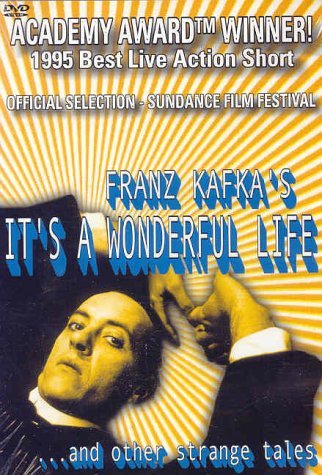
These words obviously are the introductory remarks to Franz Kafka’s iconoclastic masterpiece, The Metamorphosis, and while the specific words do tend to vary from translation to translation, the general spirit of the sentiment remains and continues to make a stark impact on literature over a century later. I am a great admirer of Kafka, and consider his work to be some of the greatest literature ever produced. He continues to pervade the artistic sphere, with his style becoming an adjective (“Kafka-esque”) to describe subsequent works inspired by his bleak, paranoid sensibilities, traces of which still exist today. Film, of course, has been a great benefactor of Kafka’s style, and the great Czech writer has seen his fair share of cinematic representation over the year, across genres and eras, with everyone from film students to world-renowned auteurs emulating his unique perspective. One of the more effective and interesting works inspired by Kafka is Franz Kafka’s It’s a Wonderful Life, directed by Peter Capaldi, the result of an off-hand verbal mistake that stirred up ideas in the actor and ended with him winning awards for this subversive and delightful work. Perhaps reviewing a film that runs at only twenty-two minutes seems a tad redundant, but as you will see, Capaldi made something I am doubtless Kafka would be proud of (if he could drag himself out of his paranoid stupor, that is), and the length of this work isn’t important, as there is a certain quality to this film that makes it exceptionally special. If anything, Franz Kafka’s It’s a Wonderful Life proves that, on occasion, a short film can be just as compelling and effective as a feature-length film, and duration is inconsequential when there is a strong story and a singular vision guiding the work.
Franz Kafka’s It’s a Wonderful Life is centrally concerned with the quoted line above, that of the opening to Kafka’s famous novella The Metamorphosis. Capaldi crafted this film around the writing of these first few words, with the film focusing on Kafka (Richard E. Grant) isolated in his arid Prague apartment, trying to write, but failing to come to a satisfactory opening to this story. Gregor Samsa undergoes various transformations in the first few drafts – a banana and a kangaroo for example – until Kafka has a stroke of genius brought on by a very unexpected (and initially unwanted) visitor, a grisly cockroach which incites both fearful paranoia and overt inspiration in the misanthropic author. Meanwhile, Kafka has to endure various distractions and impingements from neighbours, delivery people and a particularly persistent fellow who seems intent on terrorizing the meek Kafka. How can Kafka possibly finish this work with all these distractions disturbing him all the time? Moreover, to fit with the title, Franz Kafka’s It’s a Wonderful Life is set at Christmas, and thus Kafka has to face the dreary concept of festive cheer, which somehow makes his role as a cynical milquetoast slightly more difficult. Inspiration is all around him, Kafka just needs to find it, which proves to be more complex than he initially thought.
I could pretend I wanted to see this film for a number of reasons, all of which would be logical, coherent, intelligent and utterly dishonest. I wanted to see Franz Kafka’s It’s a Wonderful Life because it combines two people I really adore – Franz Kafka, a writer I absolutely love, and Richard E. Grant, an actor I will defend as one of the suavest, effortlessly-talented performers of his generation. I could not possibly pass up the opportunity to see the two figures overlap, and the fact that I waited this long is quite bewildering. Needless to say, Grant is terrific, and he captures the unhinged paranoia of Kafka with such precision and sensitivity. Unlike the various actors who have played Kafka or Kafka-surrogates, Grant doesn’t emphasize the fearfulness of the character, but rather the cranky, pseudo-intellectual side of the writer, someone who chooses a dour outlook in the pursuit of the creative life, the proverbial “starving artist” who puts himself through tough physical, mental and emotional labour all for the sake of his art. verging on rampant misanthropy. Twenty-two minutes is not a long time to develop a character fully, but Franz Kafka’s It’s a Wonderful Life gives us one of the more fascinating portrayals of the writer, and Grant is excellent – but then again, he always is, so it would be more noteworthy if he wasn’t brilliant. Character performers like Ken Stott and Phyllis Logan are excellent in small roles and capture the rigid perfection of Capaldi’s Kafka-esque vision.
What else is there to say about Franz Kafka’s It’s a Wonderful Life? Perhaps we can consider the genius in making this story as a short film. There could have been several factors that motivated the short duration of this film – perhaps it is the fact that Capaldi was a young actor who was making his directorial debut, and thus the best place to start would be in short-format filmmaking. Or it could be the fact that this story doesn’t demand a longer running time. Kafka may be known for novellas like The Metamorphosis and his longer works like The Trial and Amerika, but anyone who has considered his prolific output will tell you that he often relied on exceptionally short stories, with many of them often occupying little more than a single page. Yet, despite their brevity, each and every one of them left an indelible impression, both on the specific reader and the literary industry as a whole. Kafka’s stories were philosophically-complex but narratively and creatively very straightforward. He was an economical, logical writer who chose quality over quantity, and the same can possibly be extended towards Franz Kafka’s It’s a Wonderful Life. This film would not have made as much of an impact had it been padded out with unnecessary details and events that detract from the central intention. Capaldi has a central idea, and he remains dedicated to it, which results in a film that may be short, but leaves a lasting impression, especially because of the unique approach. We’ve seen countless filmmakers interpret Kafka, either directly or through inspiration by proxy, and while some are exceptionally successful (Orson Welles’ The Trial), others are dull and lifeless (Steven Soderbergh’s Kafka). Franz Kafka’s It’s a Wonderful Life stands at the crossroads between the two, and what it lacks in length it makes up for in depth and profundity.
Moreover, we need to consider that beyond the narrative, there is something about Franz Kafka’s It’s a Wonderful Life that makes it even more compelling. Perhaps it is the production design, which is eerily reminiscent of a Kafka story – gloomy, bleak and filled with hopeless despair. Kafka’s visual style has often been the subject of many subsequent works, and in this regard, Franz Kafka’s It’s a Wonderful Life isn’t entirely innovative, as it seems to just be replicating the familiar trends that governed the artistic style. Yet, for a debut film, Franz Kafka’s It’s a Wonderful Life is gorgeously detailed, and constructed beautifully. The costumes are wonderful, and on a purely creative and technical level, this film may be simple and conventional based on what has been done before, but it finds genuine heart in this simplicity. Franz Kafka’s It’s a Wonderful Life is wonderfully made, and it fits in very well with previous works inspired by Kafka both visually and narratively.
I am surprised Capaldi didn’t ascend to a more ambitious career in filmmaking. He is undeniably a great actor, with his iconic performances as the 12th Doctor in Doctor Who and the legendarily foul-mouthed Malcolm Tucker in The Thick of It being enough to give any actor the recognition they deserve. However, Franz Kafka’s It’s a Wonderful Life proves that he has a visual and narrative flair often missing from people behind the camera. He can assemble a very simple story and execute it with great flair and finesse without losing any of the rugged charms that were behind the film initially. Capaldi has done some minor directorial work, such as making one feature-length film, and two seasons of the brilliant Getting On, but he has stayed relatively distant from directing as a consistent career, which is a shame because he had a promising career (although, if I won an Academy Award for my debut film, I probably wouldn’t be too concerned with impressing people subsequently). Franz Kafka’s It’s a Wonderful Life is a tremendous film, a short and entertaining little ode to one of the great writers of all time, providing an absurd but lovable tale about his most famous work, a delightful little fable with a great central performance and genuine heart. Perhaps not a major work, it is freely available, and thus I highly suggest others seeking it out. It is a pleasant, diverting and dynamic short film, and a solid constituent of an ever-growing canon of artistic works inspired by the great Franz Kafka.
 The Postmodern Pelican