 There’s nothing better than a good genre film, especially a genre that has somewhat fallen out of favour. Except for a film that subverts the genre and re-imagines it as something entirely different, unique and wonderful. Nathan and David Zellner made Damsel, which could quite possibly be the most outrageously hilarious Western since Blazing Saddles decades ago, and not only do they breathe new life into a long-deceased genre (albeit one that is extremely popular as a platform for experimentation in recent years), they create one of the year’s most deliriously delightful comedies, a rollicking adventure that takes the audience on an entertaining and unexpected journey into the heart of the Wild West, giving us some nasty surprises and proving to be a truly unpredictable, original and subversive work that manages the rare task of not only commenting on traditional tropes and conventions, but also fits well within the very genre that it satirizes. A quaint gem of a film, Damsel is good-natured, innovative fun, and a seriously terrific film.
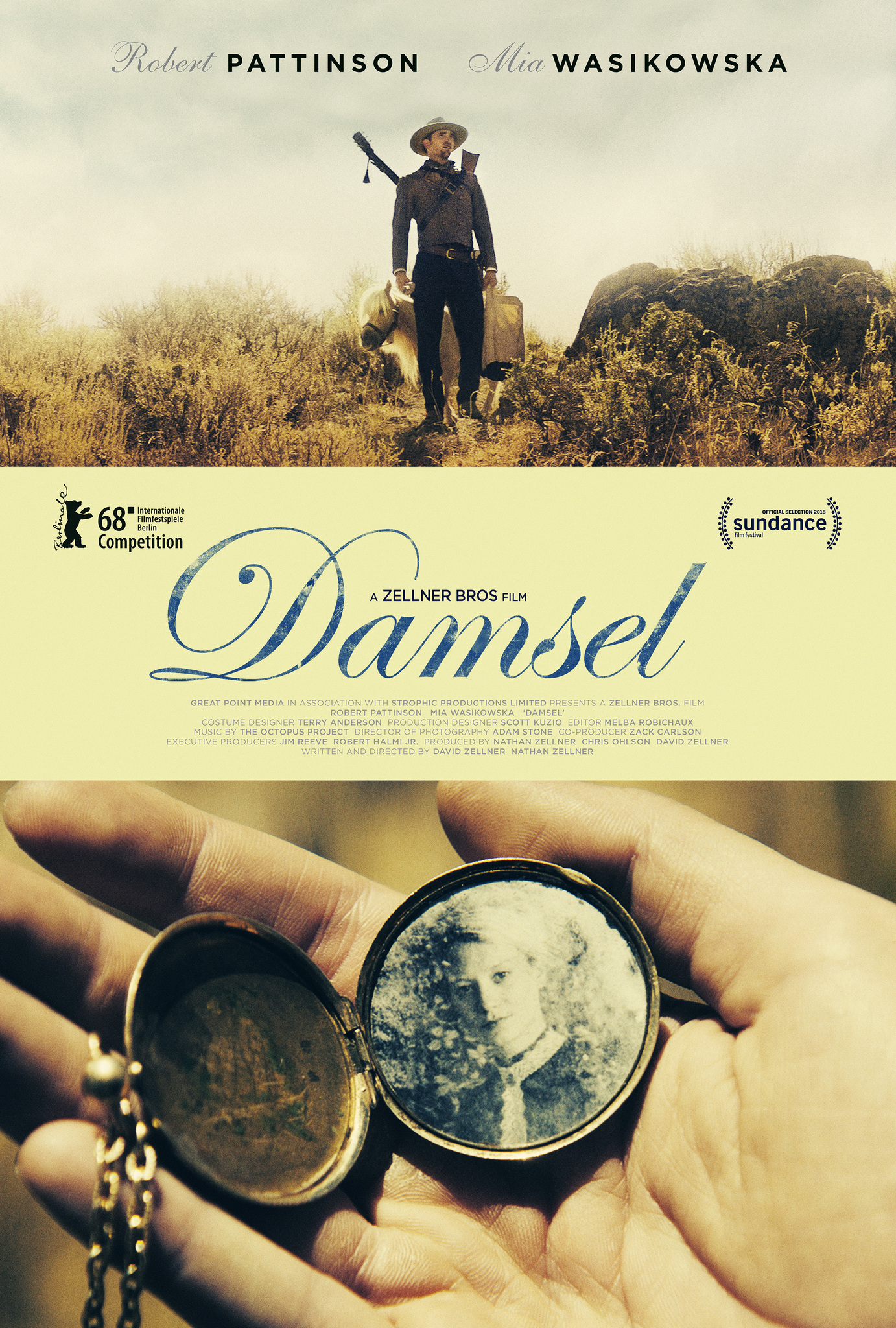
Samuel Alabaster (Robert Pattinson) arrives in a small town in the Old West, armed with a guitar and a miniature horse named Butterscotch. He is in search of Parson Henry (David Zellner, who also co-directed the film), a drunken pastor who has agreed to assist Samuel in a very unconventional task. Samuel is setting off into the wilderness to find his beloved, Penelope (Mia Wasikowska), who was intended to be his wife but was kidnapped by the malicious Cornell Brothers, who are holding her captive in the rural prairies. Samuel enlists the parson to be his companion and “hired gun” to help him on this rescue mission, and then eventually officiate the long-overdue wedding between the two lovers. It is a classic adventure film – it consists of the traditional retrieve-and-rescue mission, with a dashing hero, lovable sidekick who shows unexpected bravery, a set of villains with are the embodiment of cruel malice and of course, the archetypal damsel-in-distress who is at the mercy of the men around her, a victim to her captors anxiously awaiting the literal chivalrous hero to rush through on his mighty steed to save her. Until we realize, Damsel isn’t about this at all, and about something far more unique and subversive.
I have been a fan of Robert Pattinson for a long time, and considering he has undergone a substantial career re-assessment with his forays into meaningful, profoundly unique work from a set of internationally-renowned auteurs, it is not surprising that he has redeemed himself after the brutally uncomfortable Twilight Saga (even if they did have their charms, as scarce as they may be). Damsel is just another in his continual streak of impressive performances, and considering this role is far more complex than it would appear on the surface, Pattinson has the arduous task of playing a character who gradually devolves into something entirely different, without making any garish changes to his performance. The character of Samuel starts off as a dashing, endlessly-brave hero who embodies courage and chivalry, and ends as a delusional, obsessed fool who would have been far less likeable had we known that he was this unstable from the outset. Pattinson really did exceptionally well in this film, but considering he’s given some much stronger performances, such as his career-defining performance in Good Time last year, Damsel is not a career-changing performance, but it is a consistently good one, and one that allows the actor to exercise his comedic abilities, and I’ll be damned if I didn’t admit that Pattinson once again proved himself to have exceptional prowess over this kind of lighthearted performance. Tremendous work from an actor who never fails to surprise me.
Here’s someone I will openly admit I have not been much of a fan of in the past – Mia Wasikowska. While far from being a bad actress, Wasikowska has never truly impressed me, and while she often chooses interesting performances, she didn’t display anything particularly special. Damsel allows her the opportunity to play a very different kind of character, and she actually excels as the feisty, defiant Penelope. This may be the first time I found her to give an inspiring performance, interpreting the character as far more than what we are presented with. Wasikowska still has a long way to go as an actress, and rather than being untalented, she’s just not someone who I was entirely enthusiastic about. Damsel is a great showcase for her abilities, and she is really excellent in the film. Far more resilient and interesting than the majority of her popular roles have allowed her to be, Wasikowska flourishes in this odd story, being able to capture the essence of her character beautifully, and creating something extremely special. Although she only enters properly at the halfway mark, we soon learn that she is far more important than we expected her to be, with the remainder of Damsel belonging almost entirely to her. A great performance from an actress who has been around for a while, but gives one of her most refined, impressive portrayals to date.
Perhaps the most impressive performance in the film came from David Zellner, the director of the film who has the central role as Parson Henry. What initially began as the comedic sidekick to the main protagonist became something entirely different, and by the end of the film, this character undergoes such a substantial evolution, it makes the preceding two hours seem almost inconsequential, where we start to question who the actual hero of the film was. Perhaps slightly ecocentric, Zellner casting himself in the role (with his brother and co-director Nathan Zellner having a small role in the film as well) was quite inspiring, because it was almost unexpected – a filmmaker with paltry, insignificant acting credits in his own films and those of others ends up with the most important role in the film. The cast of Damsel is small but effective, and do exceptionally well in interpreting this strange little story. Damsel is almost worth watching for character actor Robert Forster’s memorable cameo right at the beginning of the film as a manic old preacher, which makes quite a delightful impact and sets the tone for the rest of the film.
Damsel is a very odd, but highly-original film, but in order to explain why, I need to talk about some elements of this film that are quite significant, but also give away parts that would be better experienced without any prior knowledge – so if you have not seen Damsel and intend to watch it (you should), just skip this part of the review. Essentially, what makes Damsel so effective is that it sets itself up to be a traditional Western film – a film about a hero going on a quest to save his intended, a damsel who is in great peril. It turns out that his quest is not for heroic purposes, as he is not setting out to save an innocent, helpless maiden’s life – he is venturing out to win back the heart of a strong, independent woman who left him years before to start her own life. There is no heroism here – in fact, the character of Samuel Alabaster is, to put it frankly, an enormous idiot. He positions himself as some great hero, but never actually shows anything resembling true heroism – rather, he is just obsessive and deluded into thinking himself to be the bravest soul in the entirety of the Wild West – and the fact that he was made out to be our hero, but very unceremoniously dies right in the middle of the film and does not return, proves how unconventional this film was, and perhaps the reason why I found Damsel to be such a great film – I really did enjoy the first two actors, which is just a goofy, lighthearted comedic genre film, but as soon as the true intention of the film is made clear, it is elevated into something excellent.
Much like last year’s breakout hit Swiss Army Man demonstrated, taking traditional tropes and conventions and subverting them can be quite effective if done well, and the Zellner brothers did exactly that here and crafted something extremely original. I have seen Damsel be reductively referred to as “a feminist western”, and in some way, as simplistic as this assertion it, it manages to be true. The title bears stark resonance when you consider what this film is actually about – it is not about a hero’s journey to save a damsel, it is about a willful woman who is positioned as a damsel, an object of desire that can be used and manipulated as a prize, or a goal, rather than being a fully-formed individual. The entire first act is used just as a prelude to the actual story, and looking at the underlying story, it is an exercise in genius futility. When we break it down, Damsel is about a woman being annoyed by the continuous presence of men who see her as incapable, an achievement. There are no less than three men who propose marriage to Penelope throughout this film, and not only are they rejected, one of them commits suicide, the other gets shot in the back by an arrow and the third gets a boulder thrown at him. Even the arrival of a chivalrous Native American is misleading. The central message of this film is simple – not every woman is a damsel in distress, and there isn’t always a need for a hyper-masculine saviour to be her salvation from the clutches of the villains who apparently terrorize her. Damsel takes a great concept and becomes increasingly playful with it, developing something quite original, and entirely memorable.
Moreover, the Zellner brothers don’t limit themselves to narrative prowess and refuse to settle for just telling an original story that subverts tropes of the genre – the needed to make it look the part as well. In that regard, Damsel is equally as good, with the directors capturing the spirit of the Old West in a way that was traditional but still somewhat rebellious. The detail that went into the visual aesthetic of this film – the gorgeous production design, the historically-accurate costumes and the profoundly beautiful cinematography give Damsel the appearance of a Western from cinematic days of yore, the energetic, grandiose Wild West epics that were so undeniably popular in previous decades, but have fallen out of favour. The attention to presenting this film as genuinely as possible works alongside the more disruptive elements of the film, with the modernity of the story being starkly juxtaposed with the general atmosphere. The score by The Octopus Project is terrific as well, and the film as a whole is composed of several memorable elements that all come together beautifully in this visually-stunning and revolutionary take on an archaic genre.
Understandably, Damsel is not merely a modern film packaged as a Western, nor is it a parody of the films of the past. It is a highly-inventive postmodern, somewhat revisionist portrayal of a certain era that casts a wholly original gaze on a familiar set of conventions, presenting a truly extraordinary film, one that is as visually stunning as it is a profoundly original tale that is brimming with unconventional surprises and unpredictable events that not even the most insightful of us could have possibly seen coming. The cast works exceptionally well, in particular the core trio of Robert Pattinson, Mia Wasikowska and David Zellner, who bring life to characters who are intended to be caricatures of the past, but ones that are still well-developed and fully-formed individuals who the audience can feel some emotional connection to, regardless of whether it is loving adoration or utter contempt. Bitingly satirical, furiously sardonic and hilarious to a fault, Damsel is one of the year’s biggest surprises, a meaningful ode to the Westerns of the past, as well as a sarcastic critique of the taut conventions that governed those films, turning them on their head and presenting us with an unexpectedly brilliant, charming comedy that never takes itself seriously, even when serving as one of the most cutting-edge literary satires of the past few years. A delightful little gem of a film.
 The Postmodern Pelican