 When someone asks me why I admire Spike Lee, I normally point to any of his tremendous films such as Jungle Fever, 25th Hour, She’s Gotta Have It or Do the Right Thing, a film I consider to be the greatest film ever made by an American director. This year, he may have just proven himself far from being out of the game with BlacKkKlansman, a film that is nothing short of a towering achievement, a testament to society that exceeds expectations and defies conventions, and one that is most certainly in the top tier of his magnificent career. It is a film that looks at social and political issues in a way that is astonishingly profound and relentlessly unsettling, and a work of exquisite artistic expression, proving that Spike Lee is far more than just a ham-fisted, socially-conscious filmmaker who casts a keen eye on society, always ready to pounce on its injustices – he is a cinematic artist, a master of his craft who took a story that is undoubtedly amongst his most daring, and constructed an audacious, complex and brilliant social satire that was as hilarious as it was terrifying. I am going to take a dare and proclaim BlacKkKlansman as the year’s best film – and while this fact is certainly not sacrosanct and can be easily changed in a moment, my belief is that nothing this year and possibly be more effective, nuanced and haunting as Lee’s masterful period drama that stands amongst his finest works to date. From a position as someone who absolutely idolizes Spike Lee, as well as admiring cinematic audacity, BlacKkKlansman exemplifies masterful filmmaking in a way that is almost unprecedented, even for the great auteur himself. Can you tell that I absolutely adored BlacKkKlansman? If not, you certainly will in due course.
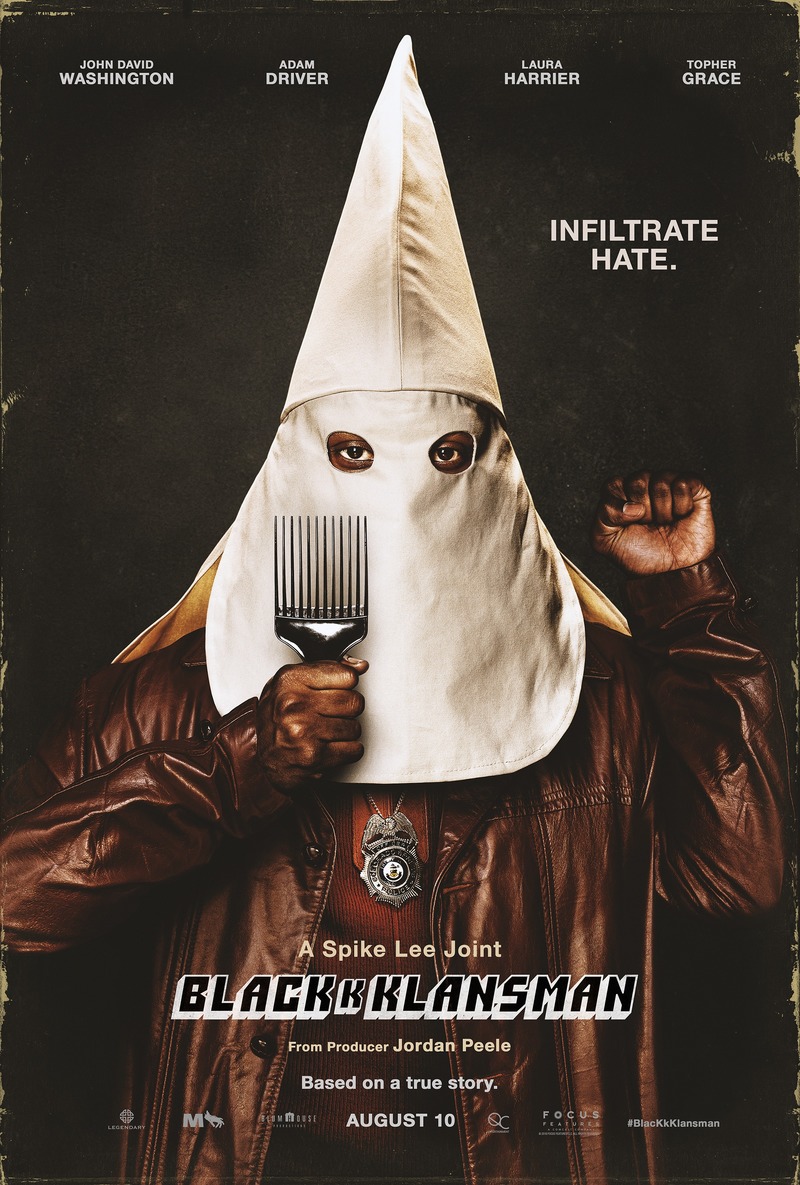
BlacKkKlansman is based on the true story (or as the opening credits state “some fo real, fo real shit”) of Ron Stallworth (John David Washington), the first black police officer in Colorado Springs, in the year 1979. A dignified, honest man, he hopes to channel his earnest respect for society into serving his community and helping bridge the gap between social groups through his risky but bold choice of entering a workplace that is hostile and often excessively belligerent to our protagonist based only on his race. Based only on a whim after seeing an advertisement for a particular organization, Stallworth sets in motion a ludicrous, nearly-impossible assignment. This organization is obviously the Ku Klux Klan, and Stallworth’s intention is monitor this group of white supremacists through slowly infiltrating the local chapter, hoping to expose plans of violence against minorities. He gets the help of Flip Zimmerman (Adam Driver), a fellow detective who is a Jew, and thus has some skin in the game, as Stallworth mentions, thus motivating him to quite literally playing a part in exposing the malicious organization. Stallworth manages to pass for white over the phone, but as he intends to physically manoeuvre into the ranks of the Klan, he uses Flip to be the physical embodiment of the racist white supremacist, who quite strangely also goes by the name of Ron Stallworth. Suddenly, there are two Ron Stallworths, and through careful and intricate plotting, he manages to rise up into the ranks of the Ku Klux Klan and soon learns of their sordid, malicious plans for “cleansing” America and returning it to its apparent former glory, being that of white dominance. Meanwhile, Ron falls for Patrice (Laura Harrier), the president of the local college’s Black Power union, which hopes to spread change in the Colorado Springs community. Stallworth grapples with both his professional and personal quandaries in this biting exploration of race relations in Civil Rights-era America, showing the disunity in the Union, and exposing the underlying tensions that defined the era, as well as unfortunately trickling through up to this very moment, resulting in a starkly relevant representation of contemporary issues.
In BlacKkKlansman, Lee is at his peak, constructing a hilarious film that is narratively-brilliant and technically a marvel. It is important to first consider the more superficial elements of the film, because BlacKkKlansman goes much deeper than what we see on the surface, but to ignore the more cinematic aspects of the film, the artistic mastery that went on behind the scenes, would be unfortunate. The film is photographed by relative newcomer Chayse Irvin, who is far from a rookie (having shot such substantial works as Beyonce’s Lemonade and a handful of other projects that prove his exceptional talents), and his camera works alongside the fabulous production design and costumes to create a flawless throwback to the 1970s, a film that reminded me of so many different era-specific genres – smooth, cool-headed blaxploitation films, gritty crime thrillers and powerful social dramas, and Lee (along with his artistic collaborators) capture the era in perfect clarity. Perhaps the best technical and creative element of this film isn’t visual at all, but rather entirely auditory. One of Lee’s most important collaborators is Terence Blanchard, who has scored most of his films and helped define the memorable soundscapes of Lee’s cinematic career. With BlacKkKlansman, Blanchard composes perhaps his finest work to date, nothing short of musical mastery. The score to this film was astounding – grandiose, powerful and almost overwhelmingly overt. This is a score that doesn’t only support what is being shown on the screen – its triumphant nuances suggest that what we are seeing is not to be taken lightly – and while often gently mocking the overly-serious scores of other socially-resonant dramas, it becomes quite powerful in its own right. In addition to Blanchard’s score, Lee’s use of pre-existing music is once again excellent, and Lee proves that music is not peripheral to the film, but rather pivotal in setting a specific tone and implying certain notions. On a creative level, BlacKkKlansman is extraordinary, but considering the grand scope of this film and what it has to say, how it says it is rendered almost inconsequential.
With the exception of Do the Right Thing, I would consider Lee’s most incendiary, powerful social work was Malcolm X, and he helped cement Denzel Washington as one of this generation’s finest leading men with this film, which was groundbreaking for a number of reasons (as well as bearing many similarities with BlacKkKlansman, particularly in the scenes focusing on Stokely Carmichael). Now, decades later, Lee gives the same opportunity to Washington’s offspring, offering the lead role of Ron Stallworth to his son, John David Washington. To say I was impressed by Washington in this film is tragically inappropriate – he gives a performance many professionals who have been in the industry for decades are incapable of giving, and he demonstrates a rare talent that is rarely seen. Much like his father, Washington commands the screen and forces the audience to pay attention to his every movement, utterance and expression. It is a difficult performance, but Washington rises up to the challenge, and one can only hope BlacKkKlansman launches the talented young actor to even more notable projects. Washington’s screen partner for much of BlacKkKlansman is Adam Driver, who I still consider his generation’s finest actor, simply through his consistent work with a wide range of auteurs, defying conventions and being both an indie darling and a mainstream regular. BlacKkKlansman sees Driver turning in another powerful performance, and while much of the film is focused on Washington, Driver has his own distinctive moments that makes this just another of his excellent performances. The chemistry between the two leads is terrific, and they guide this film with good humour and dedicated charm.
BlacKkKlansman is populated by a terrific cast of supporting players who are far more than just parts of the story but actively contributing to the general success of this film. Laura Harrier, who has been in some noteworthy projects already, is excellent as the love interest who is far more than just a one-dimensional supporting character. I can easily see Harrier becoming a cinematic mainstay, and as BlacKkKlansman shows, she is capable of a beguiling brilliance that is rarely seen from someone as new to the industry as her. Topher Grace, who is rapidly becoming a darling of auteurs himself, has the plum supporting role as David Duke. I cackled with laughter when I read an article about how the real-life Duke was terrified that this film would make him look like an idiot – and while it certainly did, neither the story nor Grace’s performance contributed very much to that, honestly. He wasn’t stating something we didn’t actually know, and as evident in this film, the straight-laced delusions of this man would be laughably ludicrous if they weren’t so hopelessly terrifying. To his credit, Grace is great in the role, and while much of it relies on the fact that the leader of the Ku Klux Klan is made out to be a klutzy milquetoast, the actor is dedicated to representing the sleazy villainy of Duke. Interestingly, BlacKkKlansman doesn’t show Duke as this malicious figure – it isn’t necessarily kind to him, but they reduce him from an ominous, sinister antagonist to someone who is quite simply pathetic, a waif of an individual whose bigotry is ridiculed and mocked with unhinged anger by this film. It would have been far more simple to show Duke as an overly-malicious, cruel and despicable individual – but the choice to position him as, quite frankly, an utter idiot shows Lee’s sardonic humour as well as his palpable anger to people who not only accept, but actively promote racialized violence and social division. BlacKkKlansman has great one-scene performances from Corey Hawkins and the legendary Harry Belafonte that are shatteringly profound and heartbreakingly powerful. What their performances lack in screentime they more than compensate for in raw, existential strength, and they only further elevate this film and show the tremendous resonance this film is capable of conveying.
Let’s not delude ourselves into think Lee made a placid film or one that can be reduced to just superficial, distant and cold statements about how entertaining it was as a film, with great performances and a satisfying attention to genre conventions in its endeavour to be a throwback to the past. As true as this may be, there is something far deeper in BlacKkKlansman that strikes the audience like very few films are able to. The best way to describe Lee’s work, especially with this film, is through the words of the good friend I watched it with lat night, when he called Lee “beautifully perceptive”, and the simplicity of this statement is quite remarkable, because it encompasses absolutely everything about this film and what makes BlacKkKlansman such an astonishing film. Lee has been outspoken about social, political and philosophical issues since his explosive debut as an exciting voice in cinema in the 1980s, with his ability to observe and subsequently represent every facet of society being the foundation upon which his iconic career has been based. His films always speak to some grander social issue, and BlacKkKlansman may just be the pinnacle of Lee’s resonant works, and while many consider the filmmaker usually too on-the-nose with some of his films, I have always admired his ability to tell these stories with such strong, steadfast conviction and unwavering dedication. Each of Lee’s films, regardless of how detached they are from factuality, are so personal and meaningful and serve to be intimate explorations into the psyche of a filmmaker who never fails to put a piece of himself into everything he makes. Watching a Spike Lee film is a transcendent experience, because even at his lowest moments, he is capable of such intricate sagacity and fierce determination, and as brilliant a film as BlacKkKlansman, it will develop into more of a powerful statement, a historically-resonant document of defiant filmmaking and audacious depth.
Lee is not the first, nor is he the last, filmmaker to focus his attention on the great social injustices of the past, and considering the fluctuating nature of our world, these kinds of stories will continuously be made. The difference between this film and others that look at similar issues is that it is far more than just a dark comedy about a black man infiltrating an organization build out of deriding people just like him through false science and excessive violence. It is a film that features unquenchable anger, and I would be so bold as to call this the most rage-filled film Lee has ever made. There is a pulsating, mighty strength that almost overwhelms the film flowing throughout, creating an uneasy tone that threatens to alienate the audience through its sheer, furious robustness. BlacKkKlansman may be a very funny film, but I would not dare reduce this to the status of simply being a comedy, and the humour present throughout this film is not there to entertain us, but rather to make us even more uncomfortable. Humour is a powerful narrative tool, and Lee understands this (as evident by other films that use it as a way to progress the story) – and throughout BlacKkKlansman, the audience is dared, even openly encouraged – to laugh and be generally jovial, because there are some exceptionally lighthearted moments, the same kind we have come to expect from a comedy by Spike Lee. It is in the moments of stark, arid despair when we realize why we were provoked into laughter before – to make us realize the bleak scope of social injustice, how terrifyingly desolate of hope the past is. Lee makes us laugh to terrify us – a complex contradiction, but Lee’s films, especially BlacKkKlansman, tend to be perversely intent on evoking certain reactions, and I definitely don’t think BlacKkKlansman would have been nearly as effective had it been played as a conventional historical drama. The comedic flair works in conjunction with other elements of the film to allow the one emotion Lee intends the audience to feel when watching this film: unexpected despair.
It is not enough to make a comedy about a very serious issue – Lee is far too passionately angry about the state of the world to make something effective but relatively conventional, and those who have seen BlacKkKlansman or know Lee’s approach are well-aware of the coda of this film that can be only described as horrifying. In the final moments of the film, the story switches from the semi-fictionalized reenactment of Stallworth’s misadventures in the world of the Ku Klux Klan to something far more terrifying than any film: reality. Lee inserts footage from recent history, namely the Neo-Nazi demonstration in Charlottesville, Virginia and the subsequent protests that drew worldwide attention to the fact that racism was not only far from being eradicated, it was stronger than ever, resulting in injury, destruction and tragic death. This footage is beyond shocking within reality, but to see it transposed onto a film like BlacKkKlansman makes it unbelievably harrowing. Throughout the film, Lee blends the past and the present in ways that are subversive and clever, but hopelessly harsh. Throughout the film, there are quite overt hints to contemporary social issues – such as the idea that someone who is openly pro-supremacy and against immigration and civil rights could never be elected to the office of President of the United States, or a certain character’s loud proclamation that they should “make America great again!” – that really make an indelible impact. However, its one thing to make subliminal references to contemporary issues, but the decision to include real footage, including that of the most powerful man in the world not only failing to condemn the hateful rhetoric of white supremacists but making their behaviour seem acceptable, that strikes the rawest nerve.
BlacKkKlansman is very much a direct attempt on the part of Lee to correlate history with reality through very obvious parallels between the periods, and while some may consider it tacky and unnecessary, personally I feel like this is precisely where the subversive brilliance of BlacKkKlansman lays – it completely disregards well-established, pre-ordained standards, and borders on being vulgar in its overt references to recent occurrences. In the hands of other filmmakers, I doubt BlacKkKlansman would have been so direct in its message – but Spike Lee is clearly furious, and his hopeless fatigue manifests in this fiery social masterwork, and as unsettling as it is, to deny its brilliance is singularly misguided. Spike Lee is tired, and we should be too. This is the message BlacKkKlansman spouts, and accept it or not, this problem exists. We can ignore, we can rewrite history to help us forget that these things ever happen, but social injustice cauterizes the world, leaving scars that cannot be removed, marks that cannot and should not ever be erased. History is filled with despair, desolation and undyingly bleak moments, and BlacKkKlansman demonstrates this perfectly. It places the future of society in the hands of the populace, which is a daunting but necessary task for us who actually want to see change occur.
I don’t remember the last time a film left me as shaken as BlacKkKlansman. I found myself in constant oscillation between gleeful enjoyment and hopeless despair, and the final moments of the film left me utterly speechless. This isn’t simply an excellent film – it is an essential one, an outrageously funny but direly serious dose of reality. Spike Lee may represent the old guard of socially-conscious filmmakers, and while he has certainly helped forge paths for other diverse voices in the industry, as BlacKkKlansman demonstrates, he very much still has the same youthful passion that made him into the cinematic icon he is today. I truly admire Spike Lee, as an artist and as an individual, and BlacKkKlansman only helps me realize what an essential voice he is in the arts today. This film is a harrowing, unforgettable experience, a film that has a certain intention and very explicitly makes it clear what it is trying to say. Subtletly has thankfully never been in Lee’s repertoire, and while this film will doubtlessly stir controversy (having already caused certain provocation), it is the kind of artistic work on which revolutions are built. If someone doesn’t become senselessly angry after watching this film, if they don’t feel some iota of rage and anguish, then their morality must have failed in some way. Much like the filmmaker behind it, BlacKkKlansman is a film that one either loves or despises, but regardless of how one feels about it, the importance of its existence is unquestionable. BlacKkKlansman is a crucial film, a vitally uncomfortable civil penetration that challenges the audience and dares us into considering how the sins of the past manifest in the actions of the present, which subsequently morph the future. BlacKkKlansman is a film that I won’t soon be forgetting. Spike Lee, you are an utter genius, and amongst the greatest to ever live.
 The Postmodern Pelican
Political theater has a long and powerful history. Artists use their creativity to influence audiences on a variety of social issues.
Spike Lee has built a career in political theater. His legacy is a bod of work that addresses racial inequality. He certainly has big aspirations with his latest effort, BlacKkKlansman.
In an interview with CNN, Lee, never hesitant to speak, stated, “I hope that (viewers would) be motivated to register to vote. The midterms are coming up, then this guy in the White House is going to run again, and what we’re going through is demonstrated, I think, is full evidence (of) what happens when you don’t vote, when you don’t take part in the process. I know a lot of people who say, ‘Fuck politics, they’re all crooks, whatever.’ But to me, that says, ‘defeatist attitude,’ and we just have to be smarter on who we vote.”
As he had aged, I think Lee has become more subtle in his efforts to engage audiences. Much of the loud, angry disputes are missing. BlacKkKlansman is quite intentionally funny and romantic.
The story is a bio pic about a Colorado undercover detective and his Jewish partner who join the KKK. Amidst this rather intense masquerade of identity, the black officer Ron Stallworth begins actively wooing a college student who is the outspoken president of the local college’s Black Student Union. The fact that any romance is missing from the autobiography Stallworth wrote shows that Lee invented the romance to build a more mainstream audience friendly story.
The film’s funniest scene is also invented. Stallworth never confronted David Duke about his deception as is presented in one of the film’s highlights. The camera is tight on Stallworth and his fellow detectives as Duke is ridiculed. We and the white actors roar with laughter at the phone confrontation. It is very funny.
I think these inventions are quite telling about Lee’s development as an artist. A title card at the opening of the film tells us that the story is “based on some fo’ real, fo’ real shit” and then proceeds to spend much of the film’s 135 minute running time on artificially created plot points that make the film accessible to a large audience.
And certainly we can agree that Lee’s manipulations are effective. When the film finishes its mostly humorous exposé on the KKK and tells an invented bomb scare story, we have been thoroughly entertained and given some nuggets of truth about race relations from 40 years ago to consider.
Here Lee doesn’t pull his punches. He brings the reality home in visceral, painful newsfeeds from recent events to remind us that the ugly reality of racial inequality is still prevalent in our society today. The audience watches the barrage of images in silence. No one is laughing at racist buffoons now. Our eyes are opened to a disturbing and undeniable truth.
This film is different from the confrontational films of Lee’s youth (Do The Right Thing, Malcolm X, Jungle Fever). BlacKkKlansman is film designed to seduce its audience and then sucker punches us with brutal truths.