 A decade ago, a film called Speed Racer was released. I was still a cinematic neophyte, and thus I took the thoughts of the critics as being the gospel truth and considering this film received an almost overwhelmingly negative response, I opted to skip it and go for something a bit more acclaimed. Now, having substantially grown as a film-lover, I am able to see that sometimes, the critics get it wrong, and sometimes they are too hasty to dismiss a film without considering its glowing merits. Speed Racer isn’t only a terrific film, it is a groundbreaking piece of cinema that was way ahead of its time, and it has aged exceptionally well over the past decade, proving itself to be an innovative, unique work that can best be described through something one of the characters in Speed Racer boldly states: “beautiful and inspiring and everything art should be”. This is a film for the ages, a marvellously entertaining, gleefully ludicrous example of perfect escapism, and something truly special that deserves far more credit than it originally got. Speed Racer has undergone a substantial reassessment since its release, with many people coming around to its charms, and I am so glad that I can be a part of the wave of people who find this film extraordinarily special. Without any sense of sardonic irony or sarcasm, I really loved Speed Racer and consider it one of the most wonderful cinematic surprises I’ve had in recent years, and I was truly blown away by it.
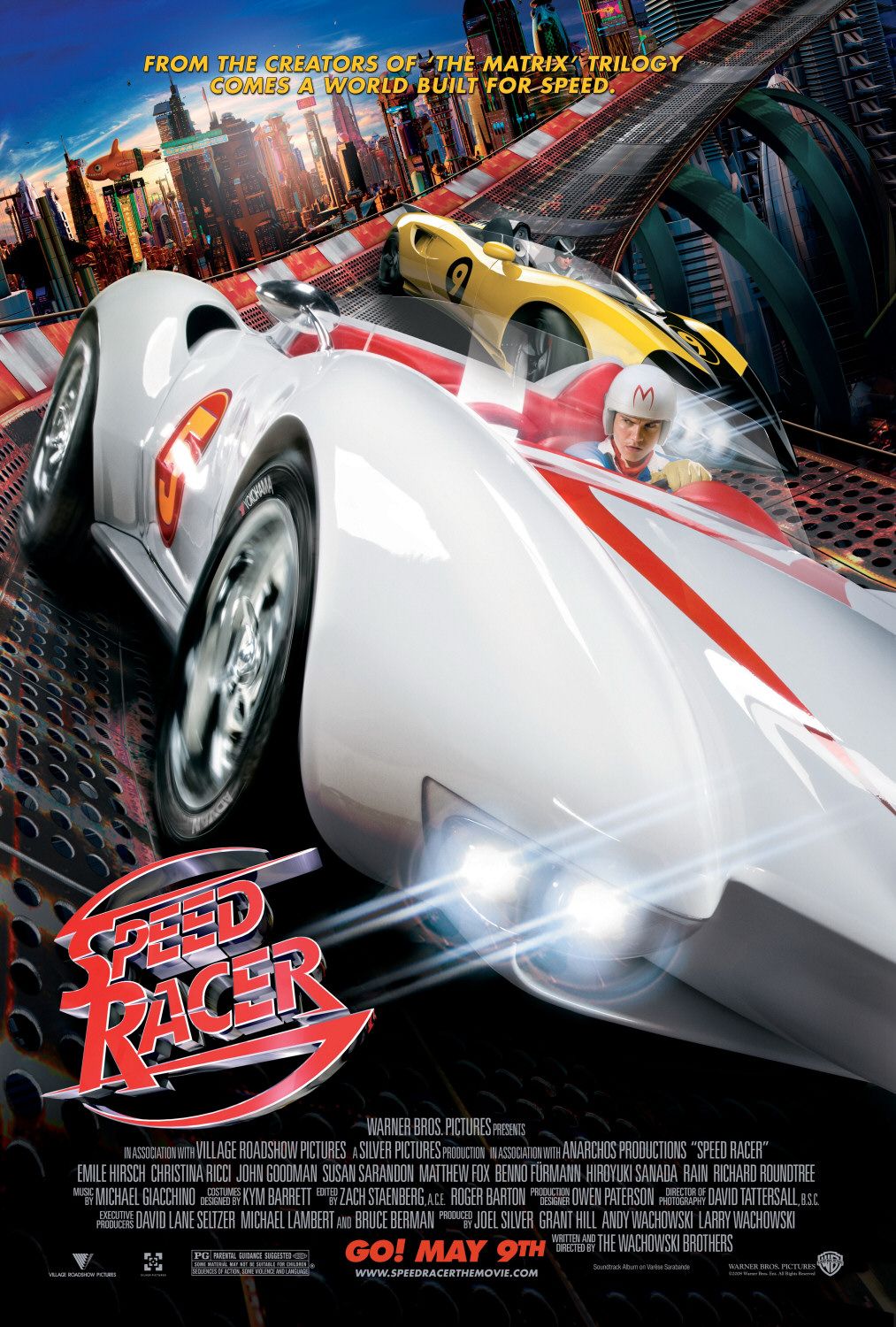
The film is centred on Speed Racer (Emile Hirsch), who, very appropriately, is enamoured with racing. His older brother Rex was a world-famous racer who unfortunately perished in a sleazy cross-country rally, which motivates him to do his brother proud, but also makes his family paranoid over his wellbeing, not wanting him to end up with the same tragic fate as his similarly speed-loving brother. His father, Pops (John Goodman) designs racing cars, independently from any of the huge corporations that tend to make champions of their drivers, but when the mysterious and sinister Arnold Royalton (Roger Allam), who owns and operates the biggest conglomerate in the region, arrives at their home with an offer to sponsor Speed, the family needs to consider whether they intend to “sell-out” or retain their strong independence. However, the lustful lure of the track proves that Speed is able to make it on his own, without any assistance from soulless corporations, which only makes him a target for wealthy megalomaniacs who see racing less as a sport and more as a business opportunity, and will do anything to destroy the free-spirited Speed and his chances at living up to his brother’s legacy. How will Speed overcome the malicious intentions of these cruel men, as well as his own personal insecurities and anxieties? On the race-track, where he proves himself to be worthy of his name, and then some!
I could try and find value in this film and look at it as a scathing social critique of capitalism, a representation of the importance of family and a unique perspective on the world of the future. But in all seriousness, while these are very true for this film, Speed Racer isn’t great because of them. Speed Racer is a great film because when I was watching it, I was suddenly transported back to my childhood, watching a colourful, joyfully anarchic and delightfully chaotic assault on my senses, and I adored every moment of it. Speed Racer is a strangely nostalgic experience, because it is the precise kind of film that I would have absolutely devoured as a child, and a part of me is disappointed that I didn’t have this film when I was much younger because it is the kind of film that childhood memories are built on. Everything about this film is childish and ridiculous, but it absolutely embraces every artificial moment, every ludicrous concept and implausible action that results in a film that can be considered nothing more than joyful, delirious fun.
Speed Racer has some tremendous merits, which is precisely what makes this film so effective. The problem was that many people couldn’t look past the superficial artifice that governs this film to find the true brilliance within it. One of the film’s most remarkable elements is the cast. Emile Hirsch is a great lead, and his portrayal of the angst-filled, ambitious Speed Racer is excellent. Yet, as good as he was, it was just another standard protagonist performance, and he didn’t do anything we haven’t seen before. The true gems in this cast lie in the supporting ensemble, some of which give really terrific performances. Everyone’s favourite character actor John Goodman has one of his most touching roles to date as Pops Racer, Speed’s dedicated but cynical father. Goodman is honestly the heart of the film, and while it is nothing innovative, it is a sweet, heartwarming performance from one of the most reliable actors working today. Susan Sarandon is as beguiling as always as Mom Racer, the loving mother who is the backbone of her family, giving support to the overly-ambitious and often extremely reckless men in her life. Christina Ricci is lovely, and while she doesn’t get much to do other than being the love interest of our hero, she does very well with what she has. Finally, Roger Allam turns in a brilliant performance as Donald Trump Arnold Royalton, the malicious, money-obsessed capitalist who wants complete dominance and power. Arguably, the performances in Speed Racer are not high-calibre, and they are only endearing because of how charmingly goofy they are. However, Allam gives a genuinely great performance, a dedicated portrayal of an antagonist who is delightfully over-the-top and excessive precisely where it matters, creating one of the more fascinating screen villains in recent years. Even those that despise this film can’t deny Allam’s tremendous performance. As a whole, however, the cast of Speed Racer is filled with fantastic performances that drive this film forward (pun intended).
Since watching Speed Racer, I have been trying to figure out precisely why it was received so poorly initially, because as much as I wanted to see where these cynical critics were coming from, I just found they were focusing on elements of this film that quite simply didn’t even matter when looking at the bigger picture. It is overly pedantic to pick at the small plot-holes that occur throughout because while Speed Racer does have moments of complete absurdity (many of which made me guffaw with great intensity), to point them out as flaws rather than endearing merits seems misguided. Speed Racer was never supposed to be a serious, logical film. The Wachowskis have not built their careers on coherent storytelling where everything makes sense. Speed Racer is a highly-artificial, technical film that embraces its shortcomings, with the small logical fallacies being exactly what makes this film so unbelievably charming. Speed Racer is an exceptionally silly film, no one in their right mind would ever deny that. But it has something so many other similar films don’t – its got heart. It is a genuine, earnest and scrappy underdog of a film, a big-budget action film that dares to be exuberant and vivacious in a cinematic landscape where so many of these films try to be overly serious. Whereas other films of this ilk are constructed as gritty, grave affairs, Speed Racer takes a different approach, opting for a more joyful and mindlessly frivolous execution that may have lacked gravitas, but certainly made up for it in unhinged resonance. It is such a fun, entertaining film, and its growth from being initially dismissed to its status as a cult film is quite heartening, because if any film deserves another look for its hidden merits and powerful message, its Speed Racer.
Not only is Speed Racer a misunderstood masterpiece, it is also a film that was way ahead of its time, and I dare to call it one of the most influential action films of the past decade. I truly believe that Speed Racer, without even realizing it, set a precedent for action-packed blockbusters. Recall that in 2008, the genres of superheroes, action and science fiction were governed by dour, gritty filmmaking, with an attempt to move these far-fetched stories into the “real world”, where important social issues could be explored through the lens of abstract, implausible situations. This is still evident in films today, such as in the DC Extended Universe, whose films (with the exception of Wonder Woman) are seen as disposable, forgettable and overly-serious bores. They are regularly beaten, both in critical acclaim and box office numbers, by the Marvel Cinematic Universe, that utilizes artifice, humour and good-natured entertainment to dominate the cinematic landscape year after year. Is it a coincidence that Marvel started to make these effective, entertaining films in 2008, the same year that Speed Racer was released? It probably is, but I’d still argue that Speed Racer showed that an action film didn’t need to be serious. It could be mind-numbingly silly, surreal and as absurd as it wants to be, as long as it acknowledges its inherent flaws and looks past them in creating something not intended to do anything other than entertain audiences. Back in 2008, Speed Racer captured something that seems to elude a lot of filmmakers who are trying to make these crowd-pleasing, enjoyable films – it doesn’t take itself too seriously, being playful, amusing affairs. Quite ironically, this is the exact same quality that critics initially used as their primary tool of dismissal for Speed Racer years ago, but fawn over the latest Guardians of the Galaxy film for having. I have very little doubt that if Speed Racer was made recently, it would be far better received. It is a film made in a time that just did not understand its brilliance, and looking at it from a more recent perspective allowed me to appreciate how wonderful this film actually is.
This isn’t even to mention the visual aesthetic of this film. People usually praise the Wachowskis for their innovative use of special effects, many people citing The Matrix as their finest moment (personally, I’m not much of a fan, but I understand its appeal), with Cloud Atlas and the utterly dreadful Jupiter Ascending both showing the directors utilizing technology to its highest potential. Speed Racer is probably their most groundbreaking work, a visually-stunning masterwork that may look gaudy and inauthentic at first glance, but subsequently grows on the viewer. It could be seen as jarring, but the explosive use of colour and the very artificial special effects work wonders in creating the sense that this film is caught partway between the worlds of animation and live-action, blurring the boundaries between different styles. There is a certain unconventional warmth present in how this film is visually composed, and it has the childish rebelliousness that many of us remember from the cartoons we watched in our youth. Implausible? Certainly, but it has such an overt confidence in its own far-fetched beauty, it becomes stunning on its own merits. While technology may have improved over the past decade, Speed Racer still stands as one of the most exquisite uses of special effects, using it to the support the narrative rather than to distract from it.
Speed Racer is something truly wonderful. The Wachowskis may not be filmmakers I’m particularly enamoured with, but their work in Speed Racer was extraordinary. It is a quaint and entertaining little film that captures the mindless joie de vivre of childhood that doesn’t merely incite strong feelings of nostalgia, but transports us momentarily back to that period of time, when we had very few cares in the world and little to worry about other than missing our favourite Saturday morning cartoon, or rushing home from school in time to catch a particularly resonant TV show. Speed Racer is a tragically underrated film, one that fell victim to the cynicism of a group of people who just did not see the overt brilliance, as well as failing to acknowledge the risk the filmmakers took in making this film. To their credit, the true influence of Speed Racer was only felt in subsequent years, as various blockbusters came and went without much fanfare, and Speed Racer remaining steadfast in its position as nothing more than a good, earnest dose of heightened escapism, which set the baseline for future films of its kind.
Dizzying, hypnotic and mesmerizing to a fault, Speed Racer is a postmodern masterpiece, one that deconstructs the genre in which it was made, and lays a foundation of unadulterated, endearing amusement. I can’t remember a film that kept me as captivated as Speed Racer, and I can only hope that this terrific but misunderstood film earns a wider audience, both from new viewers as well as those who previously dismissed it but give it a chance based on the fact that it is far better than it is given credit for. Perhaps my adoration for this film is a bit hyperbolic, but I truly adored it and found it to be an overwhelming surprise, and I hope that more people will experience this exceptional film in much the same way. Outlandish, silly and absurd, but lovably pleasurable, and something you won’t soon be forgetting.
 The Postmodern Pelican