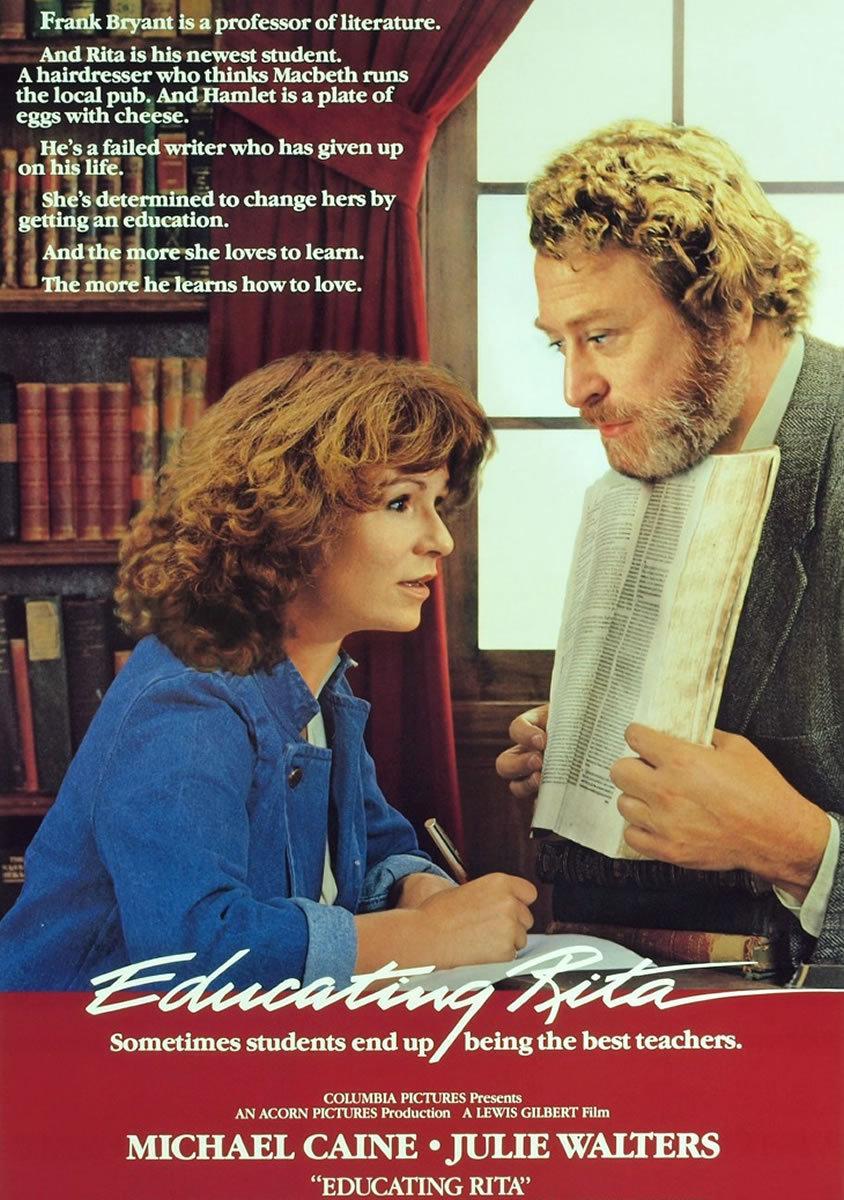
 I remember seeing a film on television when I was much younger. It was early on in my days a film lover, and thus I had a very rudimentary knowledge. Yet, there were two names I did recognize – yet I didn’t recognize the actors in the film. The film was Educating Rita, and those actors were Julie Walters and Michael Caine, who I was familiar with – the former for her role in the Harry Potter franchise, and the latter for his position as one of the more reliable older British actors. There was something about this film that lingered in the back of my mind, and while I would not say I particularly enjoyed it then (probably as much as someone who had yet to even reach his adolescent years would), I always intended to eventually revisit it, because something about it seemed so oddly alluring. That day came recently when I finally took a journey into this beautiful, hilarious and quaint little character comedy, and while the years have allowed me to understand this film more, finding resonance in its very simple story, it remains as mesmerizing as that afternoon years ago when I first encountered it. Without any sense of hyperbole, Educating Rita is one of the most delightful comedies of the 1980s, a masterful achievement of British comedic formalism and a touching, eccentric tale of friendship and self-realization. It is a gem in every sense of the word.
Dr Frank Bryant (Michael Caine) is a well-known university lecturer in the English Literature department. Despite being renowned and respected, by colleagues and students alike, there is something missing in his life. In order to feel something, he relies too heavily on alcohol, which is the cause for both his dumb avoidance of life’s problems, as well as tensions between him and others, such as his longtime girlfriend and the faculty of the university, who find his liberal use of alcohol quite unsettling. His life is soon destined to change with the arrival of a young woman named Susan White (Julie Walters), who goes by the name “Rita”, named after the now-beloved lesbian author Rita Mae Brown, whose book Rubyfruit Jungle is the root of our heroine’s presence in Dr Bryan’s office. She comes in search of a course in Literature and is assigned to be under Frank’s tutelage, much to his chagrin. A working-class hairdresser by day, Rita is growing weary of her banal, mundane existence and hopes to escape the drudgery of her dull routine by seeking out an education. Over a period of time, the vaguely-misanthropic Frank and the perky, enthusiastic Rita form an unconventional friendship, with Frank offering his vague assistance in “educating Rita”, only to have her take his words with relish, forming into the epitome of an educated woman, and someone whose future seems a lot brighter than before she undertook this journey of self-realization.
Dame Julie Walters is one of the most unheralded actresses of her generation – while many of her contemporaries sit on the mantle of icons, she is more under-praised, despite being one of the most significant elder-stateswomen of British cinema. Her career has found her in a range of fascinating roles in a number of genres across the world, but it was Educating Rita that started it all. The most surprising part of her performance here was that it was her debut feature film performance, yet she seems so undeniably natural in the role. Reprising the role of Rita from the original stage production, she delivers an exceptional, lived-in performance that stands as one of the finest debuts from an actress ever committed to film. Her auspicious performance here is quite astonishing, and the core of the character requires the performer to convey the change that has been made throughout, and under many performers, the growing intellect and radical shift in personality would have been jarring and artificial, but in the capable hands of Walters, it seems so entirely natural and flawless. I absolutely adored her here, and she embodies the working-class angst exceptionally well. Walters would give larger, more significant performances in subsequent years, but what she did here in Educating Rita is amongst her finest work, and shows an actress who had great promise right from the outset.
Obviously, Educating Rita is about the titular character, but that doesn’t imply that it is solely her film. The character of Frank Bryant is equally as important, and so much of the story revolves around his own growth as a character. The contrast in this film between characters is not superficially significant, but rather deeply meaningful, because while the character of Rita required someone young, energetic and inexperienced, the character of Frank is built out of exhausted despair and midlife contempt – thus, it required a veteran who would be able to handle both aspects of the character. Sir Michael Caine, whose earlier career I am far more fond of than his more recent one, gives a complex and nuanced portrayal of the professor, showing his deft ability to navigate a character who is supposed to be a layered representation of midlife uncertainty. Caine is terrific, and while the character is supposed to be likeable despite the circumstances, Caine never frames him as anything close to the archetypal tragic hero. He has his flaws, and they are embraced but not forgotten. It does help that Caine and Walters have exceptional chemistry, each supporting the other, adding strength to their respective performances and developing memorable characters that are fully-formed and believable. The theatrical roots of this story are clear, but it does not limit the film, nor these performances, from flourishing on their own merits. Educating Rita is a high point in the career of both performers and amongst their finest work.
I found Educating Rita to be a refreshing film – very few films are made on the topic of academia that still manages to be entertaining, rather than dire and dull. By no means is this film flawless, but much like its two protagonists, it embraces its imperfections and rises above criticism to become something exceptionally special. The resonance that many audience members feel towards Educating Rita, myself included, is through its theme of pursuing a better life for oneself, through any means necessary. At the beginning, both Rita and Frank are exceptionally unhappy people – their lives are mundane and without any spark. They both set off on a metaphysical journey of self-discovery, where the presence of the other incites a certain joie de vivre in them, with each finding the joy that they had been seeking. The parable of “singing a better song” is extremely powerful and makes Educating Rita an unquestionably touching film. It is a story for anyone who feels trapped in a life without any hope of possible escape, showing how sometimes, if we want to improve our lives, we need to improve ourselves. It reminds me of a song by the great British troubadour Frank Turner who powerful asserts “the big things stay the same, ’til we make little changes”, and that sentiment has never been truer than it has been here.
More than this, Educating Rita is just a delight. It feels like a classic formal British comedy (it obviously has severe overtures of Shaw’s Pygmalion and the seminal adaptation of that work, My Fair Lady), yet it still subverts many tropes without being too jarringly experimental. The film is focused on two characters, both of which experience heart-wrenching endings of relationships, yet there isn’t any real palpable sense that this film was implying that they will eventually fall in love – there are certainly undercurrents of romance, and it seems like the film playfully suggests that they could eventually fall in love, but it is never gaudy enough to betray the story with such a cliched and taut storyline. It is a film built upon an odd couple friendship, with two completely different worlds colliding and influencing each other in ways that they each become better people. There is a multitude of works that take similar approaches to show the unlikely friendship between seemingly-polar opposites, but very few are as soulful and resonant as Educating Rita. Its status as a classic of British cinema is extremely deserving, and it leaves an indelible impression.
Not particularly groundbreaking, Educating Rita is a good-natured and very endearing comedy that understands the limitations of the genre and manages to seize the moment and make something truly special. It was a nostalgic experience to revisit this film because while I didn’t remember too much from my first viewing all those years ago, there was always a strangely hypnotic quality about it that has remained in my mind, and I am so glad to find it still persists throughout this wonderful little film. It may be overly formal at times, and its theatre roots may prevent some truly inspired moments from reaching their full potential, but the film has tangible heart and is genuine and honest with what it is trying to achieve. It may not redefine comedy, but it certainly fits in with some of the very best of its ilk. Educating Rita has aged extremely well, and it is as resonant and timeless as it was in 1983. If you have not seen this tremendous film, then I suggest you seek it out, because it really is quite wonderful.
 The Postmodern Pelican